


Equitymaster's 2026 Grand Festive Offer
Two Research Reports, Six Stocks
3 Small Cap, 3 Large Cap
**Important: We hate spam as much as you do. Check out our Privacy Policy and Terms Of Use.
Is this Radhakishan Damani's Favourite Stock? (Hint: It's Not DMart)
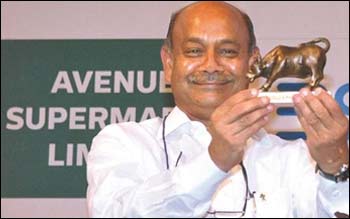 Image source: Business Standard
Radhakishan Damani's name is synonymous with inspiration and perseverance, representing one of India's most respected businessmen and investors.
Beginning his stock market career at the age of 32, Damani rose to prominence during the 1992 bull-bear market battle against Harshad Mehta. At 70, his journey reflects decades of relentless effort, visionary thinking, and remarkable achievements.
His transition from a stock market stalwart to a pioneer in retail underscores the power of hard work, determination, and strategic foresight, inspiring countless individuals on their paths to success. Over the years, Damani's net worth has witnessed extraordinary growth, placing him among India's wealthiest and most influential entrepreneurs.
As of 7 January 2025, his estimated portfolio net worth stands at approximately Rs 1,796.4 billion (bn), comprising 13 stocks. This article explores one of his longest-held investments, VST Industries.
About VST Industries
VST Industries Limited is an India-based company, which is engaged in the manufacturing and trading of cigarettes containing tobacco and unmanufactured tobacco products.
The company operates through the Tobacco and related products segment. It's brands include Total, Editions, Charms, Special, Moments, Total Active Mint, and Total Royal Twist.
It has manufacturing facilities in Hyderabad and Toopran, Telangana.
Radhakishan Damani's Holding in VST industries
Radhakishan Damani, through his investment firm Bright Star Investments, first bought shares in VST Industries at Rs 85 in the year 2000.
In February 2001, he made a hostile bid for the company, acquiring almost 15% of VST at an average price of Rs 88 per share. Damani then offered Rs 112 per share for an additional 20%, which was a 26% premium over the market price at the time.
The initial 15% stake cost about Rs 200 million (m), and the next 5% was bought for approximately Rs 110 m.
Between 2003 and 2005, Bright Star acquired another 4% for around Rs 200 m. Finally, between 2007 and 2009, it purchased the remaining 2% for about Rs 100-120 m.
In total, Bright Star's 25.95% stake in VST is estimated to have cost no more than Rs 630 m. He kept this stake constant till September 2019.
However, his holding has varied since then. Here's how his holding in VST Industries has varied.
| Quarter Ending | Stake (%) |
|---|---|
| Mar-16 to Sep-19 | 25.95 |
| Dec-19 | 29.21 |
| Mar-20 | 30.92 |
| Jun-20 | 30.92 |
| Sep-20 | 30.92 |
| Dec-20 | 31.03 |
| Mar-21 | 30.16 |
| Jun-21 | 30.16 |
| Sep-21 | 32.26 |
| Dec-21 | 32.26 |
| Mar-22 | 32.34 |
| Jun-22 | 32.34 |
| Sep-22 | 32.34 |
| Dec-22 | 30.71 |
| Mar-23 | 30.71 |
| Jun-23 | 30.71 |
| Sep-23 | 30.71 |
| Dec-23 | 30.71 |
| Mar-24 | 32.66 |
| Jun-24 | 34.66 |
| Sep-24 | 29.1 |
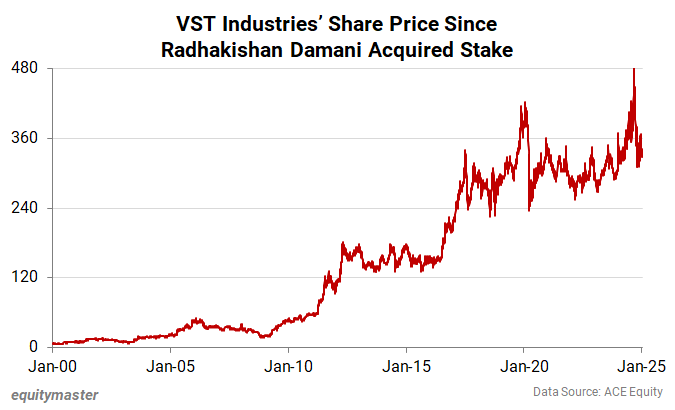
Since his first purchase of Rs 88 in 2000, the stock as of 7 January 2025 is trading at Rs 329, up over 270%.
The Story Behind RK Damani's VST Stake
Radhakishan Damani's investment in VST Industries came at a time when the company was already under the control of British American Tobacco (BAT) and faced significant competitive and regulatory challenges.
February 2001, through his investment arm Bright Star, accumulated nearly 15% stake at an average price of Rs 88 per share over the preceding year. He even offered Rs 112 per share for an additional 20% stake, representing a 26% premium to the market price.
This move led to a high-stakes bidding war, with ITC stepping in to thwart Damani's ambitions. Despite increasing his offer to Rs 151 per share for 30% of the company, Damani failed to secure a controlling stake, as regulatory delays and political considerations favoured ITC's counteroffer. However, Bright Star ultimately increased its stake to 25.95%.
This raises a question: What could have driven Damani to bid so aggressively for VST Industries, knowing BAT's influence and ITC's clout in the Indian market?
Potential Rationale
Radhakishan Damani's decision to acquire a stake in VST Industries can be attributed to several strategic factors.
First, VST Industries operates in a segment with high entry barriers, particularly due to regulatory challenges, capital intensity, and competition. As a result, the company has successfully carved out a niche for itself in the lower-priced segment, where it holds an 8% market share, according to the CRISIL Ratings report of May 2024.
Further, it is the third-largest player in the Indian cigarette industry.
With a significant presence in key states like West Bengal, Andhra Pradesh, Telangana, Bihar, and Uttar Pradesh, VST has established a firm foothold in a highly competitive market.
Additionally, VST has a robust history of over 80 years of operations, making it an established player in the Indian cigarette industry. Its flagship brands like Charminar, Charms Virginia, and Moments have built strong brand recognition over the years, which contributes to its market dominance.
Moreover, VST Industries has been diversifying its portfolio, especially by introducing higher-range cigarettes, which not only helps improve its profitability but also boosts revenue realisation. This strategy of moving into higher-margin segments would likely have been appealing to Damani.
Further, it also offers a strong dividend payout ratio, providing steady returns to investors. The company has been paying dividends since 1997.
VST Industries Dividend History (1997-2024)
| Year | Dividend per share (in Rs) |
|---|---|
| FY24 | 150 |
| FY23 | 150 |
| FY22 | 140 |
| FY21 | 114 |
| FY20 | 103 |
| FY19 | 95 |
| FY18 | 77.5 |
| FY17 | 75 |
| FY16 | 70 |
| FY15 | 70 |
| FY14 | 70 |
| FY13 | 62.5 |
| FY12 | 65 |
| FY11 | 45 |
| FY10 | 30 |
| FY09 | 30 |
| FY08 | 20 |
| FY07 | 20 |
| FY06 | 12.5 |
| FY05 | 12.5 |
| FY04 | 6 |
| FY03 | 5.5 |
| FY02 | 4.5 |
| FY01 | 2.5 |
| FY00 | 1 |
| FY98 | 1 |
| FY97 | 1 |
VST's debt-free status since 2003 and its healthy capital structure strengthen its financial risk profile, making it a relatively safe investment in a capital-intensive industry.
A Close Look at Financials
For the September 2024 quarter, VST Industries reported an 1.9% YoY rise in revenue to Rs 4,610.4 m, up from Rs 4,522.5 m a year back.
Meanwhile, the net profit decreased from Rs 760 m to Rs 476 m, down 37%.
For FY24, the company showed a 10% growth in revenue to Rs 10,034 m, up from Rs 9,124 m a year back. The net profit also grew to Rs 3,016 m, down 7.7% from Rs 3,270 m.
VST Industries' Financial Snapshot (FY20-24)
| (Rs m, Consolidated) | FY20 | FY21 | FY22 | FY23 | FY24 |
|---|---|---|---|---|---|
| Revenue | 11,083 | 7,491 | 7,957 | 9,124 | 10,034 |
| Revenue Growth (%) | 9.3 | (-32.4) | 6.2 | 14.7 | 10 |
| Net Profit | 3,041 | 3,108 | 3,202 | 3,270 | 3,016 |
| Net Profit Margin (%) | 27.4 | 41.5 | 40.2 | 35.8 | 30.1 |
| Return on Equity | 38.6 | 33 | 29.8 | 27.8 | 24.1 |
| Return on Capital Employed | 53.4 | 44.4 | 39.9 | 36.4 | 31.6 |
Over the past five years, VST Industries' revenue and net profit has not recovered the post covid.
The company has maintained good operating and net profit margins, averaging 30.7% and 41.1%, respectively, during this period.
Recent Development
# Chairman Appointment Dispute
Radhakishan Damani is believed to have opposed the reappointment of Naresh Kumar Sethi, a nominee of British American Tobacco (BAT), as Executive Chairman of VST Industries Ltd. for a five-year term.
VST Industries, known for its Charminar brand of cigarettes, had sought shareholder approval to elevate Sethi from his current position as non-executive director and chairman to executive chairman.
However, during the voting period, which ended on 15 December 52.6 m public non-institutional votes were cast against Sethi's reappointment.
BAT, the promoter of VST Industries, holds a 32.16% stake in the company through affiliates such as The Raleigh Investment Co., Tobacco Manufacturers India Ltd., and Rothmans International Enterprises Ltd.
Damani, the second-largest shareholder, holds nearly 31% of the company's shares. When the final voting results were announced, the proposal for Sethi's appointment received only 56% of the votes, falling short of the 75% threshold required to pass a special resolution.
# Sale of Immovable Property
In November 2024, the company announced the sale of its immovable property in Hyderabad for a consideration of Rs 1 bn.
VST Industries sold an immovable property on 22nd November 2024. The property, spanning approximately 2.7 acres of land, along with structures, is located in Plot Nos. 7 & 15, Plot No. 8, Plot No. 9, and Plot No. 10 at Panjagutta, Banjara Hills, Hyderabad, Telangana.
The sale was completed through the execution and registration of sale deeds to M/s. ViNS Bioproducts Ltd and others.
What Next?
VST Industries has outlined ambitious sustainability and growth objectives as part of its "Roadmap 2030." The company plans to incorporate 50% renewable energy into its overall energy mix by FY30.
Additionally, it aims to transition its entire fleet, comprising both owned and third-party vehicles, to electric vehicles by 2030.
In line with its environmental commitment, VST targets having 100% of its packaging be reusable, recyclable, or biodegradable by 2030.
The company is also focused on achieving plastic neutrality by offsetting all plastic packaging through post-consumer plastic waste collection and processing under Extended Producer Responsibility (EPR).
On the growth front, VST Industries continues to expand its brand portfolio, concentrating on innovative product launches in both the mainstream premium and emerging segments.
Consumer-relevant innovation remains a core priority, and the company is committed to growing its volume and market share by leveraging multiple strategic initiatives to drive sustained growth.
Conclusion
In addition to his significant stake in VST Industries, Radhakishan Damani has maintained substantial holdings that include major players like Avenue Supermarts, Aptech, 3M India, Bluedart Express, Trent, and Advani Hotels. These investments have been a cornerstone of his strategy over the years.
When an investor like Damani backs a stock, it often ignites considerable buzz on Dalal Street, showcasing the influence of such seasoned investors.
However, while it might seem attractive to mirror the moves of these financial titans, it's important to be mindful of the risks involved.
The allure of these stocks could cause one to purchase them at prices far higher than the ones Damani paid, often when they were undervalued at an earlier stage. This reinforces the need for thorough research and careful consideration of the right time to enter the market.
Investing purely based on the choices of successful investors, without factoring in market timing and valuation, can lead to less-than-ideal returns.
The key takeaway here is that while following the lead of renowned investors can be insightful, it should be done with a discerning eye, keeping market conditions and stock fundamentals in focus.
Before making any investment, investors should evaluate the company's fundamentals, corporate governance, and the stock's valuation as key factors when conducting due diligence.
--- Advertisement ---
Investment in securities market are subject to market risks. Read all the related documents carefully before investing
Which businesses are most likely to emerge stronger over the next 3 to 5 years?
After screening thousands of listed companies, comparing industries, and examining balance sheets...
Our research team discovered some of the strongest opportunities in what we call... Essential Stocks.
Opportunities like this do not remain hidden forever.
Disclaimer: This article is for information purposes only. It is not a stock recommendation and should not be treated as such. Learn more about our recommendation services here...
ABOUT EQUITYMASTER
Since 1996, Equitymaster has been the source for honest and credible opinions on investing in India. With solid research and in-depth analysis Equitymaster is dedicated towards making its readers- smarter, more confident and richer every day. Here's why hundreds of thousands of readers spread across more than 70 countries Trust Equitymaster.
PREMIUM PRODUCTS
- Hidden Treasure
- Forever Stocks
- Super Sector Stocks
- Equitymaster Venture
- Microcap Millionaires
- Momentum Profits
- Double Income
- Midcap Value Alert
- Exponential Profits
- Annual Breakout Alert
- Lazy Millionaire
- Phase One Alert
- Smallcap AlphaQuest
- InsiderPro Stocks
- StockSelect
- Private Briefing
- Active Wealth Multiplier 2030
- FundSelect
- Fund Advantage
QUICK LINKS
POPULAR TOPICS
- Multibagger Penny Stocks
- Basics of Value Investing
- Benjamin Graham
- How to Invest in Gold
- How to Invest in Silver
- Best Stocks to Buy Today
- Best Small-cap Stocks to Buy
- Best Bluechip Stocks to Buy
- Guide to Penny Stocks
- How to Invest in the Share Market
- Warren Buffett - The Value Investor
- Pick the Best Multibagger Stocks
TRENDING TOPICS
- Best Defence Stocks in India
- Upcoming Dividend Stocks
- Best Semiconductor Stocks in India
- Data Center Stocks in India
- Best Railway Stocks in India
- Best Solar Stocks in India
- Fastest Growing Stocks in India
- List of BSE Sensex 30 Stocks
- Adani Group Shares
- Stocks Recently Bought by FIIs in India
- Top Value Stocks in India


LEGAL DISCLAIMER:
Investment in securities market are subject to market risks. Read all the related documents carefully before investing.
Registration granted by SEBI, enlistment with BSE as IA and RA, and certification from NISM in no way guarantee performance of the intermediary or provide any assurance of returns to investors.
All rights reserved. Any act of copying, reproducing or distributing any content from this website whether wholly or in part, for any purpose without the permission of Quantum Information Services Private Limited is strictly prohibited and shall be deemed to be copyright infringement.
Quantum Information Services Private Limited (QIS) is a SEBI registered Research Analyst (bearing registration no INH000021128) and Investment Adviser(Reg. No: INA000000680). Consequent upon the merger of Equitymaster Research Private Limited into QIS, effective October 30, 2025 QIS owns and operates brand 'Equitymaster' and website www.equitymaster.com. This does not constitute or is not intended to constitute an offer to buy or sell, or a solicitation to an offer to buy or sell financial products, units or securities and QIS including its employees, personnel, directors, associates will not be liable for any losses (direct or indirect) incurred or investment(s) made or decisions taken/or not taken based on the information provided herein. All content and information is provided on an 'As Is' basis by QIS. Information herein is believed to be reliable but QIS does not warrant its completeness or accuracy and expressly disclaims all warranties and conditions of any kind, whether express or implied. The services rendered by QIS are on a best effort basis. QIS does not assure or guarantee the user any minimum or fixed returns. The securities quoted, if any are for illustration only and are not recommendatory. Use of this information is at the user's own risk. The user must make his own investment decisions based on his specific investment objective and financial position and using such independent advisors as he believes necessary. This is not directed for access or use by anyone in a country, especially, USA, Canada or the European Union countries, where such use or access is unlawful or which may subject QIS or its affiliates to any registration or licensing requirement.
The performance data quoted represents past performance and does not guarantee future results. As a condition to accessing QIS's content and website, you agree to our Terms and Conditions of Use, available here
Equitymaster requests your view! Post a comment on "Is this Radhakishan Damani's Favourite Stock? (Hint: It's Not DMart)". Click here!
Comments are moderated by Equitymaster, in accordance with the Terms of Use, and may not appear
on this article until they have been reviewed and deemed appropriate for posting.
In the meantime, you may want to share this article with your friends!