


Equitymaster's 2026 Grand Festive Offer
Two Research Reports, Six Stocks
3 Small Cap, 3 Large Cap
**Important: We hate spam as much as you do. Check out our Privacy Policy and Terms Of Use.
Top 5 Fastest Growing Nuclear Power Stocks to Watch Out for in 2025
 Image source: chatGPT
India, the world's third-largest electricity producer, has recently seen a surge in power demand, driven by urbanisation, the rise of data centres, industrial development, and a growing population.
The shift towards electric vehicles (EV) and more energy-hungry technologies has further increased the need for a robust power infrastructure.
So, what's India doing about it?
The country is ramping up electricity generation. At the same time, it aims to reduce carbon emissions to achieve its ambitious net zero emission target by 2070.
With that in mind, the country is gradually diversifying its energy mix by experimenting with solar, wind, and nuclear energy.
Nuclear energy stands out due to its reliable and continuous energy supply. It emits minimal carbon emissions and generates a high energy from little fuel. It also enhances energy security by reducing dependence on fossil fuel imports.
The benefits have encouraged countries worldwide to produce more electricity using nuclear power.
Nuclear power is vital for India's energy landscape and is growing at an impressive rate-it's actually doubling the pace of global growth.
According to the Energy Institute in the UK, in 2023, nuclear power generation in India surged 4.4%, compared to just 2.2% worldwide. It has 24 nuclear power reactors, which generated 47,971 million units last year.
In the past decade, India's nuclear power capacity has skyrocketed over 70%, from 4,780 megawatts (MW) in 2013-14 to 8,180 MW. This is expected to grow rapidly in the coming year as the country's power requirements and the demand for net-zero emissions grow.
Consequently, the government intends to triple the capacity to 22,480 MW by 2031-32 and aims for 100,000 MW by 2047.
This ambitious goal requires a close look at nuclear power stocks. So, here are the top 5 fastest-growing nuclear power stocks you should watch in 2025.
These companies are filtered using Equitymaster's powerful stock screener.
#1 AMIC Forging
First on the list is AMIC Forging.
AMIC Forging specialises in manufacturing open forgings and precision-machined components for various industries, including nuclear power.
It supplies products such as shafts, flanges, and gear couplings to the nuclear power industry, supporting India's efforts to expand its nuclear energy capacity.
The company has an installed capacity of 12,600 metric tonnes and a capacity utilisation rate of 85%. It plans to install a new foundry for casting quality forged ingots induction furnace to increase its capacity further. This will help it cut costs while maintaining the quality of its products.
It has an established design center with the latest 3D software and highly trained technicians. It is known for its time-bound delivery and premium quality products. It delivers its products to reputed clients like Larsen & Toubro, Jindal Steel and Power, and Tata Steel.
Coming to its financials, AMIC Forging has performed exceptionally well over the years. Its sales have grown at a compounded annual growth rate (CAGR) of 68.4% in the last 3 years to Rs 1.26 bn in FY24. At the same time, profits have grown at a CAGR of 190.9% to Rs 1380 m.
It also has an impressive return on equity (ROE) of 21.4%, demonstrating its ability to efficiently generate profits from shareholders' equity.
Overall, AMIC Forging's specialised manufacturing capabilities and strategic positioning make it a key player in supporting and advancing India's nuclear power initiatives.
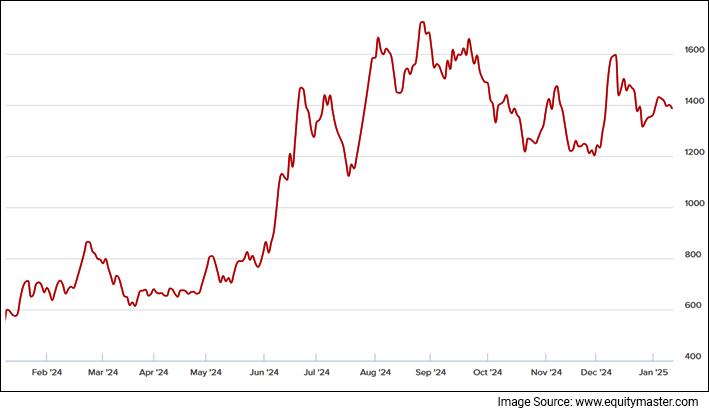
Here is how its stock has performed over the last 1-year.
AMIC Forging Share Price
To know more, check out AMIC Forging's financial factsheet.
#2 Venus Pipes and Tubes
Next on the list is Venus Pipes and Tubes.
Venus Pipes is a leading Indian producer of stainless steel pipes and tubes. Its products are divided into seamless and welded pipes, which account for 57% and 33% of revenue.
To cater to the needs of nuclear power, it also manufactures value-added premium products like hygienic SS and titanium-grade tubes.
The company generates 88% of its revenue from the domestic market, with the remainder coming from exports.
Venus Pipes serves various sectors, including oil and gas, dairy, defence, aerospace, and nuclear power. Its clientele comprises over 58 Fortune 500 companies, including the Adani Group, Larsen & Toubro, Amul, and ITC.
Over the years, its production capacity has increased multifold. The seamless pipe capacity rose from 3,600 metric tonnes per annum (MTPA) in FY23 to 9,600 MTPA in FY24, while the welded pipe capacity grew from 8,400 to 24,000 MTPA.
It recently inaugurated a capacity of 14,400 MTPA for mother hollow pipes.
The company has also outlined plans to further increase seamless and welded pipe capacity by 2025, targeting the growing needs of sectors like nuclear power generation. The company is gearing up for the next growth phase through this planned expansion.
In nuclear facilities, high-quality stainless steel pipes and tubes are essential for critical applications such as heat exchangers, coolant systems, and structural components, where durability and resistance to corrosion are paramount.
Coming to its financials, over the past five years, Venus Pipes has achieved impressive financial results. The company's sales have increased at a CAGR of 46.5% to Rs 8 bn in FY24. Meanwhile, profits have risen at an 87% CAGR to Rs 860 m.
As power consumption rises and the push for zero emissions intensifies, the demand for steel pipes will increase, creating opportunities for companies like Venus.
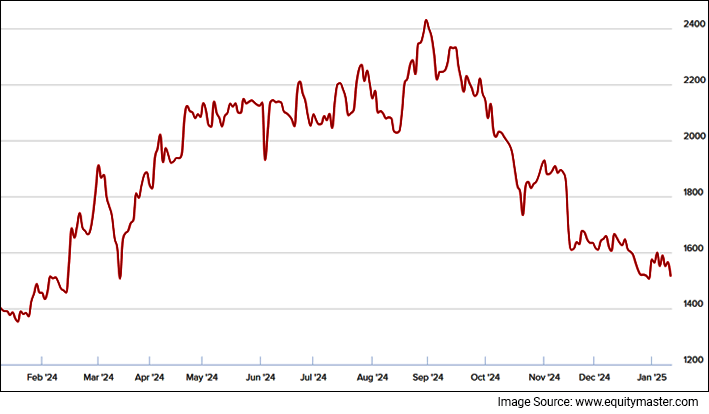
Here is how its stock has performed over the last 1-year.
Venus Pipes Share Price
To know more, check out Venus Tubes and Pipes' financial factsheet.
#3 Kilburn Engineering
Third on the list is Kilburn Engineering.
Kilburn specialises in designing, manufacturing, and commissioning customised process equipment, including dryers, coolers, fabricated equipment, and heat transfer systems.
The company products services various industries, including chemicals, steel, petrochemicals, food processing and nuclear power. Its clientele includes Reliance, BHEL, ONGC, GAIL, Lupin, Cipla, ITC, Tata Chemicals, and Larsen and Toubro.
85% of its revenue comes from the domestic market, with the remainder coming from exports to countries such as Germany, the US, Thailand, and Brazil.
Kilburn offers equipment such as air cooling units for nuclear reactors in the nuclear sector. It helps manage and regulate air temperatures, ensuring optimal operating conditions and safety standards.
It also supplies heavy water vapor recovery systems for nuclear power plants, which help recover and recycle heavy water.
Coming to its financials, over the past five years, its sales have surged at a CAGR of 18%, reaching Rs 3.3 bn in FY24. Meanwhile, profits have increased at 53.6% CAGR to Rs 505 m.
Additionally, the return on equity has risen impressively from just 2.2 in FY23 to 21.9 in FY24, indicating strong returns for shareholders.
Several factors suggest growth opportunities for this company going forward.
First, it is expanding through inorganic means. In 2024, it acquired one factory unit, which it expects will generate about Rs 1 bn in revenue. It also bought M.E Energy, which specialises in tailored energy-saving, heating, and cooling solutions.
It is also reducing its leverage, successfully reducing its net debt from Rs 1.15 bn in FY20 to Rs 470 m in FY24. It aims to be net debt-free by the end of FY25. This reduction is anticipated to lower interest expenses, positively impacting on its bottom line.
To fund the acquisition and reduce the net debt, Kilburn Engineering raised Rs 3 bn through preferential allotment of shares at Rs 425 per share.
As of the September quarter, the company reported a consolidated order book of Rs 3.54 bn. It anticipates this figure will increase to Rs 5 bn by the close of FY25, resulting in an order book-to-sales ratio of approximately 1.51.
Kilburn's revenue is projected to rise in the medium term, thanks to a diverse product portfolio, a broad client base, a robust order book, and ongoing expansion efforts.
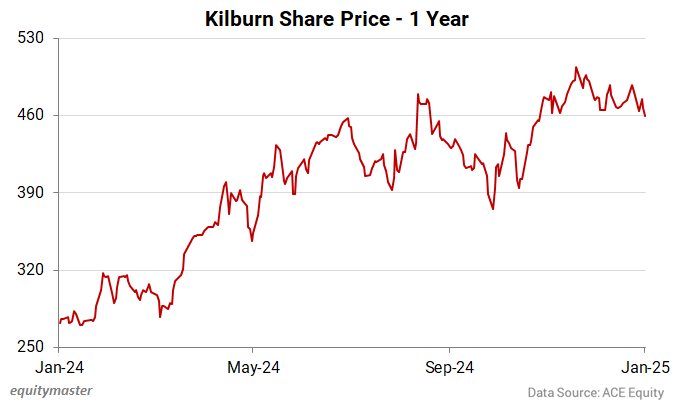
Here is how its stock has performed over the last 1-year.
To know more, check out Kilburn Engineering's financial factsheet.
#4 MTAR Technologies
Fourth on the list is MTAR Technologies.
MTAR is an Indian precision engineering company with a market presence of more than 50 years. It specialises in manufacturing critical components and assemblies for sectors such as clean energy, including civilian nuclear power, space, defence, and aerospace.
The company has over 40 years of experience serving customers in the civilian nuclear power sector. This segment contributes 6% to its revenue, while 71% comes from space, defence, and clean energy segments. The domestic market generates 74% of its revenue, with the remainder coming from exports.
MTAR supplies fuel machining heads for civilian nuclear reactors. It also manufactures bridge and column structures, including sealing plugs, shielding plugs, liner tubes, end fittings, nuclear headers, and vessels.
It has also developed special hollow ball screws for nuclear power plants, with an in-house facility to design, manufacture, and test them.
It has a long list of reputed clients, including the Indian Space Research Organisation, the Defence Research and Development Organisation, and the National Power Corporation of India (NPCIL), with which it has had a strong relationship for over 16 years.
Coming to its financial performance, over the past five years, its sales have grown at a CAGR of 25.9% to Rs 5.8 bn in FY24. However, profit growth has not been remarkable, reaching Rs 561 m with a CAGR of only 7.4%.
As of the September 2024 quarter, it had a well-diversified order book of Rs 9,423 m, of which 14.7% came from the civil nuclear power segment.
The order book is expected to grow to Rs 1.4-1.5 bn by FY25, with the nuclear segment contributing Rs 6.5bn. In December 2024, MTAR received an order worth Rs 2.26 bn in the clean energy and aerospace segment, executable by April 2026.
The company is well positioned due to its strong presence in emerging sectors such as clean energy, including space and nuclear energy. This, along with a strong order book, is expected to keep its revenue growth firm in the future.
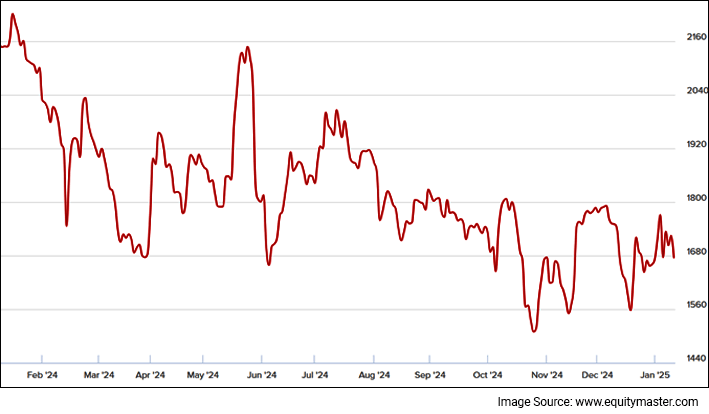
Here is how its stock has performed over the last 1-year.
MTAR Technologies Share price
To know more, check out MTAR Technologies' financial factsheet.
#5 Power Mech Projects Limited
Fifth on the list is Power Mech Projects.
Power Mech deals with industrial construction, infrastructure development, and power generation. It is a leading infrastructure company in the country and has recently emerged as a strong contender in the nuclear power sector.
In May 2024, it marked its foray into the nuclear power sector by securing its first major contract, worth Rs 5.63 bn, from Bharat Heavy Electricals Ltd (BHEL).
It will conduct civil works at the Kaiga Atomic Power Project in Karnataka for the Nuclear Power Corporation of India Ltd (NPCIL). This includes constructing turbine buildings, auxiliary structures, and associated facilities essential for nuclear power plant operation.
The contract will be completed over 32 months, with a 12-month service guarantee. The project includes civil, structural, and architectural works for two 700 MWe Pressurized Heavy-Water Reactors (PHWR). This will boost the Kaiga plant capacity from 880 MW to 2,280 MW.
Over the past seven years, Power Mech's revenue has increased at a CAGR of 17.8%. At the same time, profits have risen even faster, at a CAGR of 21.4%, demonstrating a strong capacity to convert revenue into profit.
Its average return on equity and return on capital employed stood at 12.4% and 22.5%, respectively.
As India expands its nuclear energy initiatives, the number of upcoming contracts is increasing. There is growing speculation that the company may secure additional contracts in the nuclear energy sector besides the one with BHEL.
Moreover, as India and Russia seek to strengthen their nuclear partnership, Power Mech, given its extensive experience in the infrastructure sector, is poised to gain advantages.
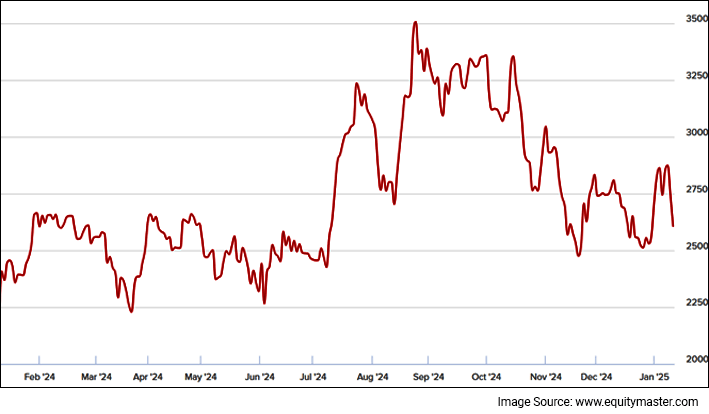
Here is how its stock has performed over the last 1-year.
Power Mech Share price
To know more, see the Power Mech Projects company fact sheet.
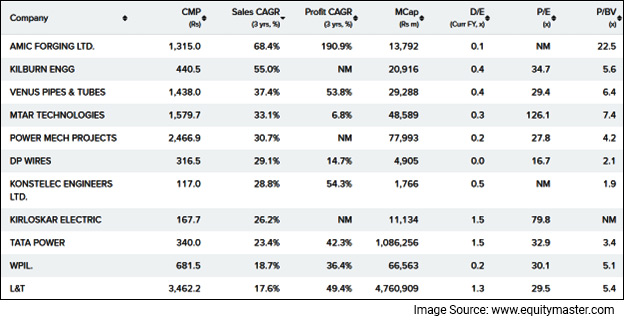
Snapshot of Fastest Growing Nuclear Power Stocks
Here's a table showing the above companies on various important parameters -
Should You Invest in Nuclear Power Stocks?
The demand for clean energy sources to combat climate change is increasing. Nuclear power stands out as the cleanest energy source globally. But its contribution remains limited, accounting for just 3% of India's electricity generation.
However, this will likely evolve as India works to lessen its reliance on fossil fuels. This shift presents significant growth opportunities for companies directly and indirectly associated with this sector.
However, each investment opportunity carries its own risks. Therefore, it is essential to conduct due diligence and select only fundamentally strong companies for your portfolio.
Investors should evaluate these companies fundamentals, corporate governance, and valuations of the stocks as key factors when conducting due diligence before making investment decisions.
By the way, you can also check out the video version of this editorial on Equitymaster's YouTube channel.
Happy Investing.
--- Advertisement ---
Investment in securities market are subject to market risks. Read all the related documents carefully before investing
Which businesses are most likely to emerge stronger over the next 3 to 5 years?
After screening thousands of listed companies, comparing industries, and examining balance sheets...
Our research team discovered some of the strongest opportunities in what we call... Essential Stocks.
Opportunities like this do not remain hidden forever.
Disclaimer: This article is for information purposes only. It is not a stock recommendation and should not be treated as such. Learn more about our recommendation services here...
ABOUT EQUITYMASTER
Since 1996, Equitymaster has been the source for honest and credible opinions on investing in India. With solid research and in-depth analysis Equitymaster is dedicated towards making its readers- smarter, more confident and richer every day. Here's why hundreds of thousands of readers spread across more than 70 countries Trust Equitymaster.
PREMIUM PRODUCTS
- Hidden Treasure
- Forever Stocks
- Super Sector Stocks
- Equitymaster Venture
- Microcap Millionaires
- Momentum Profits
- Double Income
- Midcap Value Alert
- Exponential Profits
- Annual Breakout Alert
- Lazy Millionaire
- Phase One Alert
- Smallcap AlphaQuest
- InsiderPro Stocks
- StockSelect
- Private Briefing
- Active Wealth Multiplier 2030
- FundSelect
- Fund Advantage
QUICK LINKS
POPULAR TOPICS
- Multibagger Penny Stocks
- Basics of Value Investing
- Benjamin Graham
- How to Invest in Gold
- How to Invest in Silver
- Best Stocks to Buy Today
- Best Small-cap Stocks to Buy
- Best Bluechip Stocks to Buy
- Guide to Penny Stocks
- How to Invest in the Share Market
- Warren Buffett - The Value Investor
- Pick the Best Multibagger Stocks
TRENDING TOPICS
- Best Defence Stocks in India
- Upcoming Dividend Stocks
- Best Semiconductor Stocks in India
- Data Center Stocks in India
- Best Railway Stocks in India
- Best Solar Stocks in India
- Fastest Growing Stocks in India
- List of BSE Sensex 30 Stocks
- Adani Group Shares
- Stocks Recently Bought by FIIs in India
- Top Value Stocks in India


LEGAL DISCLAIMER:
Investment in securities market are subject to market risks. Read all the related documents carefully before investing.
Registration granted by SEBI, enlistment with BSE as IA and RA, and certification from NISM in no way guarantee performance of the intermediary or provide any assurance of returns to investors.
All rights reserved. Any act of copying, reproducing or distributing any content from this website whether wholly or in part, for any purpose without the permission of Quantum Information Services Private Limited is strictly prohibited and shall be deemed to be copyright infringement.
Quantum Information Services Private Limited (QIS) is a SEBI registered Research Analyst (bearing registration no INH000021128) and Investment Adviser(Reg. No: INA000000680). Consequent upon the merger of Equitymaster Research Private Limited into QIS, effective October 30, 2025 QIS owns and operates brand 'Equitymaster' and website www.equitymaster.com. This does not constitute or is not intended to constitute an offer to buy or sell, or a solicitation to an offer to buy or sell financial products, units or securities and QIS including its employees, personnel, directors, associates will not be liable for any losses (direct or indirect) incurred or investment(s) made or decisions taken/or not taken based on the information provided herein. All content and information is provided on an 'As Is' basis by QIS. Information herein is believed to be reliable but QIS does not warrant its completeness or accuracy and expressly disclaims all warranties and conditions of any kind, whether express or implied. The services rendered by QIS are on a best effort basis. QIS does not assure or guarantee the user any minimum or fixed returns. The securities quoted, if any are for illustration only and are not recommendatory. Use of this information is at the user's own risk. The user must make his own investment decisions based on his specific investment objective and financial position and using such independent advisors as he believes necessary. This is not directed for access or use by anyone in a country, especially, USA, Canada or the European Union countries, where such use or access is unlawful or which may subject QIS or its affiliates to any registration or licensing requirement.
The performance data quoted represents past performance and does not guarantee future results. As a condition to accessing QIS's content and website, you agree to our Terms and Conditions of Use, available here
Equitymaster requests your view! Post a comment on "Top 5 Fastest Growing Nuclear Power Stocks to Watch Out for in 2025". Click here!
Comments are moderated by Equitymaster, in accordance with the Terms of Use, and may not appear
on this article until they have been reviewed and deemed appropriate for posting.
In the meantime, you may want to share this article with your friends!