

Investment in securities market are subject to market risks. Read all the related documents carefully before investing
Two Years of Market Correction
Is This Your Buying Window?
See Where the Opportunities are Emerging for the Next 3-5 Years
**Important: We hate spam as much as you do. Check out our Privacy Policy and Terms Of Use.
5 Things Tata Motors Shareholders Should Know When TML Commercial Vehicles Gets Demerger Approval
 Tata Motors Logo source: https://www.tatamotors.com
Editor's Note: Shares of Tata Motors opened 1.5% higher on Wednesday, 7 May 2025, and quickly emerged as the top gainer on the Nifty 50 index.
The stock has since extended its rally to nearly 40%, driven by investor optimism following shareholder approval for the company's demerger into two separate listed entities.
The vote took place during the shareholders' meeting held on Tuesday, 6 May.
We had earlier, on 16 January 2025, published a detailed editorial outlining detail of the Tata Motors demerger.
Continue reading...
5 Things Tata Motors Shareholders Should Know When TML Commercial Vehicles Gets Demerger Approval
With a legacy spanning over 78 years in the Indian automobile industry, Tata Motors has been a symbol of innovation, quality, and dedication to societal progress.
As part of the Tata Group, one of India's oldest and largest conglomerates established in 1868 by Jamsetji Tata, Tata Motors began its journey in 1945 as Tata Engineering and Locomotive Co. Ltd., marking the group's entry into the automotive sector.
Today, Tata Motors is a market leader in commercial vehicles and holds a strong position among the top three in the passenger vehicle segment.
A pivotal moment in its global expansion came with the acquisition of Jaguar Land Rover, making its entry into the premium automobile market. From shaping traditional markets to embracing cutting-edge advancements, Tata Motors has consistently set benchmarks.
As India's largest electric vehicle manufacturer, accounting for nearly 80% of the market, Tata Motors leads the country's EV revolution.
With its sights set on redefining its legacy, Tata Motors unveiled its transformative demerger plan in 2024, to add a bold new chapter in its storied history.
Tata Motors Demerger
In a significant development, Tata Motors first announced its demerger plan in March 2024.
This strategic decision is set to redefine the company's structure and future growth trajectory. Here are the key details of the demerger plan.
#1 Demerger Approval
Following Tata Motors' announcement in March 2024, the company's board approved the demerger plan on 1 August 2024.
The plan outlines the separation of Tata Motors' operations into two distinct entities: Tata Motors Commercial Vehicles Ltd (TMLCV) and Tata Motors Passenger Vehicles Ltd (TMPV).
The board's approval of a composite scheme of arrangement, involving Tata Motors, Tata Motors Commercial Vehicles, Tata Motors Passenger Vehicles, and their respective shareholders, is in accordance with sections 230-232 and other relevant provisions of the Companies Act, 2013.
#2 Demerger Plan
Under the approved scheme, Tata Motors will transfer all assets, liabilities, and employees associated with its Commercial Vehicle (CV) business to the newly established Tata Motors Commercial Vehicles Ltd (TMLCV).
This restructuring is designed to provide the CV business with greater agility and focus, enabling it to pursue its distinct strategic objectives and enhance shareholder value.
Meanwhile, Tata Motors Passenger Vehicles (TMPV), encompassing the Passenger Vehicle (PV) and Electric Vehicle (EV) segments, along with Jaguar Land Rover (JLR), will merge into the existing listed entity, Tata Motors Ltd (TML).
This reorganisation aims to streamline operations by consolidating PV, EV, and JLR under one umbrella, allowing for a sharper focus on these segments, while TMLCV exclusively handles the CV business.
To ensure a robust and transparent process, the restructuring has been supported by PwC Business Consulting Services LLP, which provided the share entitlement report.
SBI Capital Markets has offered its fair opinion, while legal and tax advisory services are being handled by AZB & Partners and Deloitte Touche Tohmatsu India LLP, respectively.
#3 Demerger Ratio
Under the Tata Motors demerger scheme, shareholders will maintain identical ownership in both the resulting entities.
The share entitlement ratio has been set at 1:1, meaning that for every fully paid-up share of Rs 2 held in Tata Motors Limited (TML), shareholders will receive one fully paid-up share of Rs 2 in Tata Motors Commercial Vehicles Limited (TMLCV) of the same class.
For shareholders, this is a value-creating move. This arrangement ensures that investors retain equal stakes in both the passenger and commercial vehicle businesses following the demerger, aligning with the company's objective of equitable value distribution among its shareholders.
#4 Rationale
Tata Motors' decision to pursue a demerger aligns with its strategic evolution over recent years. The move follows the 2022 subsidiarisation of its passenger vehicle and electric mobility businesses, which have been operating independently under distinct leadership since 2021.
These businesses have demonstrated strong performance by implementing strategies tailored to their respective markets and priorities.
The demerger aims to further empower Tata Motors' Commercial Vehicles (CV), Passenger Vehicles (PV+EV), and Jaguar Land Rover (JLR) divisions to focus on their unique growth paths.
By granting greater operational autonomy, the company seeks to enhance agility, accountability, and strategic execution across these segments.
Although synergies between the CV and PV businesses are minimal, significant opportunities exist within the PV, EV, and JLR divisions.
The demerger is expected to unlock these synergies, particularly in areas such as electric vehicles, autonomous technology, and advanced vehicle software, enabling Tata Motors to strengthen its market presence and drive innovation across its portfolio.
#5 Demerger Timeline
Tata Motors' demerger into two separate listed entities is projected to be completed within the next 12 to 15 months, as outlined in a regulatory filing made in August 2024. The company's board approved the demerger scheme, marking a pivotal step in its restructuring process.
To identify the shareholders eligible to receive shares in the demerged entity, Tata Motors will declare a record date.
Following the completion of the demerger, the shares of the newly created entity will be listed on both the NSE and BSE. The specific listing date will be announced by Tata Motors in due course.
A Close Look at the Financials
Revenue for Tata Motors stood at Rs 1,014.5 billion (bn) at the end of the second quarter, a drop from last year's topline figure of Rs 1,051.3 bn.
Its net profit fell 11% to Rs 33.4 bn, driven by weak performance at its Jaguar Land Rover (JLR) unit and in its commercial vehicles segment.
For the FY24 the company reported revenue at Rs 4,379,278 million (m), up 26.6% YoY. Meanwhile it reported its highest ever net profit at Rs 318,068 m.
Tata Motor's Financial Snapshot (FY22-24)
| (Rs m, Consolidated) | FY20 | FY21 | FY22 | FY23 | FY24 |
|---|---|---|---|---|---|
| Revenue | 2,610,680 | 2,497,948 | 2,784,536 | 3,459,670 | 4,379,278 |
| Revenue Growth (%) | (-13.5) | (-4.3) | 11.5 | 24.2 | 26.6 |
| Net Profit | (-109,752) | (-130,161) | (-112,347) | 26,899 | 318,068 |
| Net Profit Margin (%) | (-4.2) | (-5.2) | (-4) | 0.8 | 7.3 |
| Return on Equity (%) | (-17.6) | (-23.6) | (-25.2) | 5.9 | 37.5 |
| Return on Capital Employed (%) | (-2.3) | (-1.6) | 1.6 | 10.2 | 25.8 |
Over the years, Tata Motors has witnessed a significant financial turnaround. Its revenue surged from Rs 2,610,680 in FY20 to Rs 4,379,278 m in FY24, reflecting a steady CAGR of 7.7%.
After grappling with losses in previous years, the company returned to profitability in FY23, driven by strong demand, improved cost management, and a more focused portfolio.
This recovery was largely attributed to the remarkable turnaround in its Jaguar Land Rover (JLR) segment, which played a pivotal role in revitalising the company's overall performance.
Recent Developments
#1 AI Integration
Tata Motors has emphasised its commitment to integrating artificial intelligence (AI) and advanced technologies to enhance vehicle safety for both occupants and vulnerable road users.
The company has adopted a holistic approach that addresses safety at every stage-before, during, and after an accident.
This approach goes beyond traditional safety measures by focusing on pre-accident prevention, crash-event management, and post-accident support.
While safety ratings like the Global New Car Assessment Program (GNCAP) have historically focused on crash-event performance and injury assessment, Tata Motors is taking it a step further by incorporating cutting-edge accident prevention technologies into its vehicles.
#2 Auto Financing Partnership
On 10 January 2025 TMPV and TPEM, signed a Memorandum of Understanding (MoU) with Saraswat Bank, one of the largest cooperative banks in India.
This partnership aims to provide tailored auto retail financing solutions to customers looking to purchase both internal combustion engine (ICE) vehicles and electric vehicles (EVs) from Tata Motors.
The collaboration is intended to enhance the accessibility of Tata Motors' popular passenger vehicle offerings (both ICE and EV models) by offering competitive interest rates.
By doing so, it will improve the overall purchasing experience, making Tata Motors' vehicles more affordable and convenient for customers.
Tata Motors Recent Share Price Performance
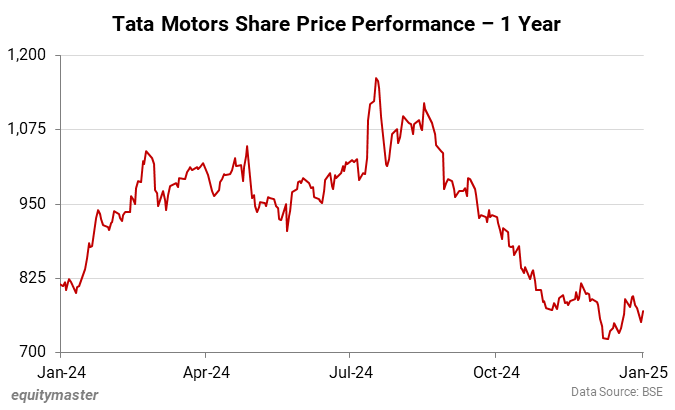
Tata Motors has lately seen a significant drop, mirroring the larger issues in the automotive sector.
Tata Motors is currently trading at Rs 763 down significantly from its 52-week high of Rs 1,179.05. This is a drop of around 35%.
Tata Motors' stock is down 18% in the last three months and 6% in past year. This can be attributed to a challenging industry structure in the domestic market.
What Next?
Tata Motors is set to make significant strides in its electric vehicle (EV) division, with plans to invest between Rs 160 bn and Rs 180 bn by FY30.
Currently offering four electric car models, the company aims to expand its portfolio by launching six additional models by March 2026.
The company has set an ambitious target of capturing a 20% share of the passenger vehicle (PV) market by FY30.
As of FY24, Tata Motors held a 13.81% share in the Indian PV market, according to data from the Society of Indian Automobile Manufacturers.
To drive the "mainstreaming" of EVs in India, Tata Motors has outlined a comprehensive strategy. This includes diversifying its EV product portfolio to offer vehicles with better range and achieving price parity with internal combustion engine (ICE) cars.
The company also plans to expand its e-car dealership network to 50 cities within the next two years.
In addition, Tata Motors is collaborating with private charge points operators, such as ChargeZone, Glida, and Statiq, to significantly enhance the EV charging infrastructure.
The company aims to increase the number of public charge points tenfold, targeting approximately 100,000 by FY30.
Tata Motors is also promoting renewable energy adoption among its customers.
Currently, only 10-15% of its e-car customers use rooftop solar for vehicle charging, but the company aims to increase this share to 50% by FY30.
Looking ahead, Tata Motors expects EV penetration in the Indian car market to grow from around 2% in FY23 to 20% by FY30.
Within its own portfolio, the company is targeting a robust EV penetration of approximately 30% by FY30, cementing its position as a leader in India's transition to sustainable mobility.
Conclusion
Tata Motors' demerger plan represents a strategic move aimed at safeguarding shareholder interests while unlocking new growth opportunities and ensuring long-term stability for the company.
By enabling its commercial vehicle (CV) and passenger vehicle (PV) segments to operate independently, the company has positioned itself to address distinct market demands with greater focus and agility.
The passenger vehicle segment, which includes cars, utility vehicles, and vans, achieved a 4.2% growth in the 2024 calendar year, reaching 4.3 m units-its highest ever-driven largely by robust SUV sales.
This segment is poised for further growth, fuelled by increasing consumer demand and advancements in technology.
The Indian EV market is on a transformative trajectory, expected to expand from US$ 2 bn in 2023 to US$ 7.1 bn by 2025.
By 2030, the market is projected to reach 10 m annual sales, underscoring the nation's shift towards clean and sustainable transportation.
On a global scale, the EV market is anticipated to grow to US$ 2.1 tn by 2033, with a remarkable CAGR of 23.42% from 2024 to 2033.
These developments present Tata Motors with substantial opportunities to solidify its leadership in the EV segment, both domestically and globally.
With growing auto demand, the commercial vehicle segment is also set to experience growth, benefiting from increased infrastructure development and transportation needs across the country.
Investors should evaluate the company's fundamentals, corporate governance, and valuations of the stock as key factors when conducting due diligence before making investment decisions.
--- Advertisement ---
Investment in securities market are subject to market risks. Read all the related documents carefully before investing
Which businesses are most likely to emerge stronger over the next 3 to 5 years?
After screening thousands of listed companies, comparing industries, and examining balance sheets...
Our research team discovered some of the strongest opportunities in what we call... Essential Stocks.
Opportunities like this do not remain hidden forever.
Disclaimer: This article is for information purposes only. It is not a stock recommendation and should not be treated as such. Learn more about our recommendation services here...
ABOUT EQUITYMASTER
Since 1996, Equitymaster has been the source for honest and credible opinions on investing in India. With solid research and in-depth analysis Equitymaster is dedicated towards making its readers- smarter, more confident and richer every day. Here's why hundreds of thousands of readers spread across more than 70 countries Trust Equitymaster.
PREMIUM PRODUCTS
- Hidden Treasure
- Forever Stocks
- Big Wave Profits
- Equitymaster Venture
- Microcap Millionaires
- Momentum Profits
- Double Income
- Midcap Value Alert
- Exponential Profits
- Annual Breakout Alert
- Lazy Millionaire
- Phase One Alert
- Smallcap AlphaQuest
- InsiderPro Stocks
- StockSelect
- Private Briefing
- Active Wealth Multiplier 2030
- FundSelect
- Fund Advantage
QUICK LINKS
POPULAR TOPICS
- Multibagger Penny Stocks
- Basics of Value Investing
- Benjamin Graham
- How to Invest in Gold
- How to Invest in Silver
- Best Stocks to Buy Today
- Best Small-cap Stocks to Buy
- Best Bluechip Stocks to Buy
- Guide to Penny Stocks
- How to Invest in the Share Market
- Warren Buffett - The Value Investor
- Pick the Best Multibagger Stocks
TRENDING TOPICS
- Best Defence Stocks in India
- Upcoming Dividend Stocks
- Best Semiconductor Stocks in India
- Data Center Stocks in India
- Best Railway Stocks in India
- Best Solar Stocks in India
- Fastest Growing Stocks in India
- List of BSE Sensex 30 Stocks
- Adani Group Shares
- Stocks Recently Bought by FIIs in India
- Top Value Stocks in India


LEGAL DISCLAIMER:
Investment in securities market are subject to market risks. Read all the related documents carefully before investing.
Registration granted by SEBI, enlistment with BSE as IA and RA, and certification from NISM in no way guarantee performance of the intermediary or provide any assurance of returns to investors.
All rights reserved. Any act of copying, reproducing or distributing any content from this website whether wholly or in part, for any purpose without the permission of Quantum Information Services Private Limited is strictly prohibited and shall be deemed to be copyright infringement.
Quantum Information Services Private Limited (QIS) is a SEBI registered Research Analyst (bearing registration no INH000021128) and Investment Adviser(Reg. No: INA000000680). Consequent upon the merger of Equitymaster Research Private Limited into QIS, effective October 30, 2025 QIS owns and operates brand 'Equitymaster' and website www.equitymaster.com. This does not constitute or is not intended to constitute an offer to buy or sell, or a solicitation to an offer to buy or sell financial products, units or securities and QIS including its employees, personnel, directors, associates will not be liable for any losses (direct or indirect) incurred or investment(s) made or decisions taken/or not taken based on the information provided herein. All content and information is provided on an 'As Is' basis by QIS. Information herein is believed to be reliable but QIS does not warrant its completeness or accuracy and expressly disclaims all warranties and conditions of any kind, whether express or implied. The services rendered by QIS are on a best effort basis. QIS does not assure or guarantee the user any minimum or fixed returns. The securities quoted, if any are for illustration only and are not recommendatory. Use of this information is at the user's own risk. The user must make his own investment decisions based on his specific investment objective and financial position and using such independent advisors as he believes necessary. This is not directed for access or use by anyone in a country, especially, USA, Canada or the European Union countries, where such use or access is unlawful or which may subject QIS or its affiliates to any registration or licensing requirement.
The performance data quoted represents past performance and does not guarantee future results. As a condition to accessing QIS's content and website, you agree to our Terms and Conditions of Use, available here
Equitymaster requests your view! Post a comment on "5 Things Tata Motors Shareholders Should Know When TML Commercial Vehicles Gets Demerger Approval". Click here!
Comments are moderated by Equitymaster, in accordance with the Terms of Use, and may not appear
on this article until they have been reviewed and deemed appropriate for posting.
In the meantime, you may want to share this article with your friends!