

Investment in securities market are subject to market risks. Read all the related documents carefully before investing
Two Years of Market Correction
Is This Your Buying Window?
See Where the Opportunities are Emerging for the Next 3-5 Years
**Important: We hate spam as much as you do. Check out our Privacy Policy and Terms Of Use.
4 Undervalued Bluechip Stocks to Add to Your Watchlist
 Image source: Artur/www.istockphoto.com
Stocks markets don't move in straight lines.
Even strong companies go through long phases where the stock underperforms. Earnings disappoint investors and their attention drifts elsewhere. What looked like a safe bet start to feel uncertain.
Over the past year, many bluechip companies have been in this phase. Growth slowed, expectations were reset, and valuations cooled off after years of being priced to perfection.
But this makes them weak businesses. It means they're going through a difficult part of the cycle.
In 2026 some of these companies appear to be finding their footing again. Costs are coming under control and balance sheets remain strong. Demand, while not roaring back, is beginning to improve as well. The numbers are not dramatic but the direction has started to change.
For investors who value stability and are patient, these businesses are worth watching. The excitement may be missing but the foundations for a comeback are being laid.
#1 Dr Reddy's Laboratories
First on our list is Dr Reddy's Laboratories.
Dr Reddy's Laboratories is a global pharmaceutical company with a strong presence in generics, biosimilars, and proprietary products.
The company caters to the US, India, Europe, and emerging markets. It operates a diversified business, with the US generics business accounting for a large share of revenue, alongside steadily growing non-US markets.
Dr Reddy's reported a mixed quarter, with revenue broadly in line but margins coming under pressure. The pain point was the US business, where faster-than-expected price erosion, especially in gRevlimid, weighed on profitability.
The growing Europe and emerging markets business helped steady the topline, but not enough to offset the margin impact.
In Q2 FY26, consolidated revenue grew 10% year-on-year (YoY). The EBITDA margin fell sharply to 23.3%. Lower gRevlimid sales in the US, higher SG&A spending, and one-time provisions linked to a discontinued product, dragged margins.
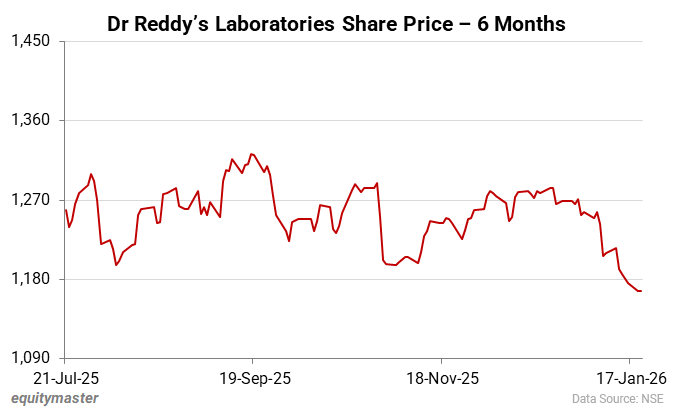
The management expects some near-term pressure in the US but sees single-digit US revenue growth over the next 2-3 years due to new launches.
Outside the US, performance was stronger. Europe grew sharply and emerging markets grew 14%, supported by new launches and favourable currency movements. India revenues rose 13%, better than the industry.
Looking ahead, the management is aiming to soften the blow from gRevlimid. These include launches such as Semaglutide, Abatacept and Denosumab, planned over 2026-27.
While pricing, particularly for Semaglutide, is expected to be competitive, these products should gradually rebuild growth momentum. But the management expects the impact to be gradual, with earnings growth likely to remain muted in the short term.
Presently, the stock trades at a PE of 17, below its historical median.
To know more about the company, check out its financial factsheet and quarterly results.
#2 Infosys
Next on our list is Infosys.
Infosys' stock largely remained range-bound over the past year as demand recovery in IT services was slower than expected.
Enterprise tech spending has been cautious. While deal activity has improved, investors have not priced in a full recovery.
Operationally, the company has done better than the stock price suggests. In H1 FY26, Infosys delivered constant currency revenue growth of 3.3%. The pickup was led by a strong ramp-up of large deals, including the NHS contract, along with steady discretionary spending in the BFSI vertical.
The manufacturing vertical was stable but retail remained cautious. Large deal wins stood at US$ 6.9 bn, with more than 60% coming from new deals, improving visibility beyond FY26.
Margins have held steady despite higher investments AI capabilities and subcontracting. This was due to pricing discipline and efficiency gains under Project Maximus.
The H1 FY26 operating margin was 20.9%.
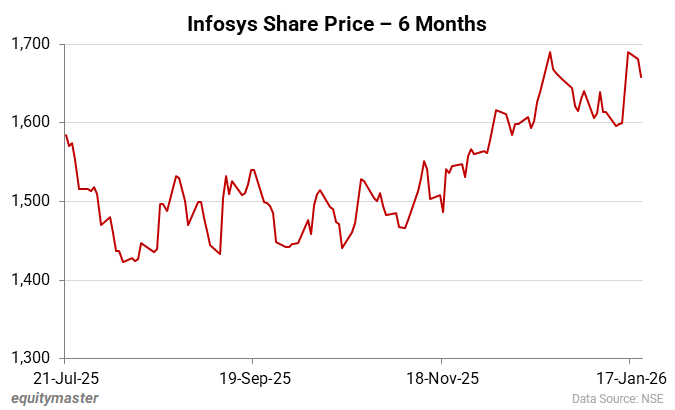
What stood out this quarter was the change in the management's tone. Infosys raised its FY26 constant currency revenue growth guidance to 3-3.5%. The management also pointed to early signs of demand improvement in BFSI and energy and utilities for FY27.
These are still early signals, but they suggest AI-led programs are beginning to move beyond pilots into scaled deployments.
AI-related work is becoming a larger part of the conversation. Infosys is seeing stronger traction in enterprise AI, particularly in modernisation and cost optimisation programs. Several projects are getting executed, which should help with deal conversion and client stickiness.
Infosys's cash generation has been strong. The company announced a Rs 180 bn buyback along with a higher interim dividend.
Presently, Infosys trades at a PE of 24, below its 5-year median of 27.
To know more about the company, check out its financial factsheet and latest quarterly results.
#3 Power Finance Corporation
Third on our list is Power Finance Corporation (PFC).
PFC is India's largest power sector financier. Over the past year, the stock has declined 10-12% as investors turned cautious on PSU financials after a strong multi-year rally.
In H1 FY26, the consolidated loan book grew 10% YoY to Rs 11.43 trillion (tn), in line with management's full-year guidance. On a standalone basis, loan assets rose 14% YoY to Rs 5.61 tn.
Disbursements during were Rs 85,994 bn, the highest ever for a half year. This was supported by power distribution, transmission, and renewable energy projects.
Margins were stable despite a competitive lending environment. Net interest margin was at 3.62%, while interest spread came in at 2.55%. A marginal decline in the cost of funds supported spreads, despite lending rates remaining steady.
Consolidated profit after tax grew 17% YoY to Rs 16,816 bn.
Asset quality improved. Net NPA declined to 0.3% at the consolidated level and 0.37% on a standalone basis, the lowest in nearly a decade. Gross NPA also came in lower. With legacy stress largely addressed, credit costs remain contained.
PFC's renewable energy loan book, at Rs 84,679 bn as of September 2025, expanded further. Renewables now account for around 15% of the standalone loan book. The book is exposed to different sectors, across solar, wind, and large hydro projects, keeping concentration risks low.
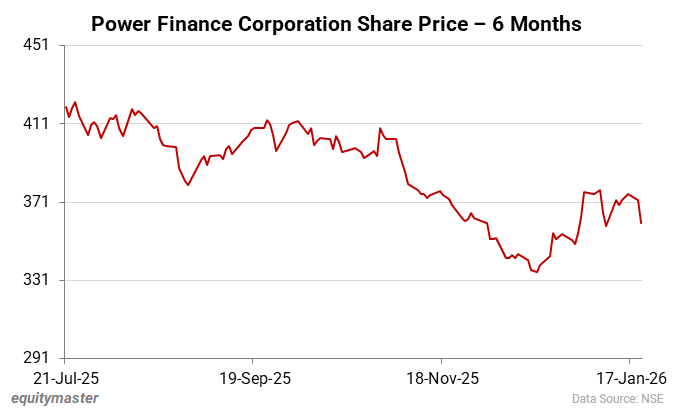
Looking ahead, PFC has reiterated its loan growth guidance of 10-11% for FY26. Disbursements are expected to be steady. This will be driven by power distribution reforms under the RDSS scheme, transmission projects, along with growing opportunities in renewables and energy storage.
Capital adequacy (21.62% CRAR) remains comfortable. Borrowings are well diversified and nearly 95% of foreign currency exposure is hedged. This should contain balance-sheet risks.
Presently, the stock's price to book (PB) of 0.97 is above its historical median.
To know more about the company, check out its financial factsheet and latest quarterly results.
#4 Ashok Leyland
Fourth on the list is Ashok Leyland.
Ashok Leyland is one of India's leading commercial vehicle manufacturers. The company has a strong presence across medium and heavy trucks, buses, and a growing non-CV portfolio.
After a period of muted demand, the company's operating performance is improving and signs of a CV upcycle are emerging.
In Q2 FY26, Ashok Leyland's revenue grew 9.3% YoY. This came on the back of a richer product mix, with aftermarket revenues up 11%, power solutions revenue up 14%, and defence revenues rising 25%. The company's focus on diversifying beyond core CVs is beginning to show in the numbers.
EBITDA margin improved to 12.1%, despite input cost inflation, and the transition to AC cabins. This was led by cost-reduction initiatives, better pricing discipline, and a higher share of non-CV and export revenues.
Exports grew 45% YoY with volumes growing 38% in H1 FY26. The management expressed confidence that export volumes will grow at a 20% CAGR over the next 2-3 years, led by demand from GCC, Africa, and SAARC.
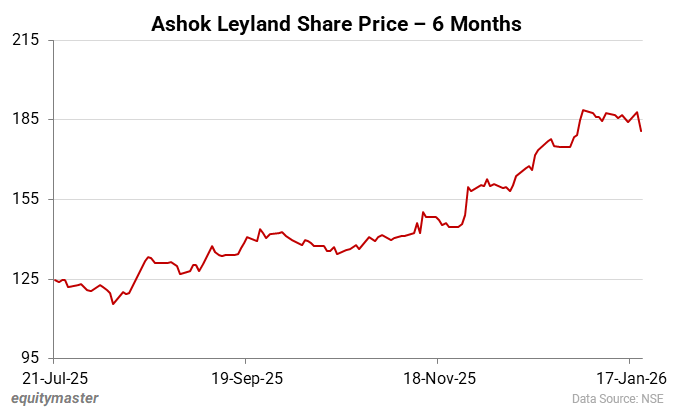
Domestic demand is also turning favourable. Truck utilisation and freight rates have improved. GST rate cuts have reduced vehicle acquisition costs and supported freight demand. The management believes these could be the early signs of a CV upcycle.
Looking ahead, Ashok Leyland is banking on premiumisation and new launches to drive growth and margins. The company plans to introduce higher horsepower and torque trucks in the premium segment, to regain market share and improve realisations.
Presently, the stock's PE is 30, a little above its historical median PE.
To know more about the company, check out its financial factsheet and latest quarterly results.
Conclusion
Even in markets dominated by short-term trades and quick sector rotations, bluechip stocks tend to form the quieter core of most portfolios.
They offer scale, resilience, and the ability to absorb shocks when market cycles turn uncomfortable.
The real work lies in spotting those stocks where the business remains intact, earnings are beginning to stabilise, and valuations no longer assume perfection.
2025 reminded us that size alone does not insulate companies from corrections. But where balance sheets are strong and execution is good, these phases become periods of repair rather than decline.
For patient investors, this is often where the next phase of compounding quietly begins.
Investors should evaluate the company's fundamentals, corporate governance, and valuations of the stock as key factors when conducting due diligence before making investment decisions.
Happy investing.
--- Advertisement ---
Investment in securities market are subject to market risks. Read all the related documents carefully before investing
Which businesses are most likely to emerge stronger over the next 3 to 5 years?
After screening thousands of listed companies, comparing industries, and examining balance sheets...
Our research team discovered some of the strongest opportunities in what we call... Essential Stocks.
Opportunities like this do not remain hidden forever.
Disclaimer: This article is for information purposes only. It is not a stock recommendation and should not be treated as such. Learn more about our recommendation services here...
ABOUT EQUITYMASTER
Since 1996, Equitymaster has been the source for honest and credible opinions on investing in India. With solid research and in-depth analysis Equitymaster is dedicated towards making its readers- smarter, more confident and richer every day. Here's why hundreds of thousands of readers spread across more than 70 countries Trust Equitymaster.
PREMIUM PRODUCTS
- Hidden Treasure
- Forever Stocks
- Big Wave Profits
- Equitymaster Venture
- Microcap Millionaires
- Momentum Profits
- Double Income
- Midcap Value Alert
- Exponential Profits
- Annual Breakout Alert
- Lazy Millionaire
- Phase One Alert
- Smallcap AlphaQuest
- InsiderPro Stocks
- StockSelect
- Private Briefing
- Active Wealth Multiplier 2030
- FundSelect
- Fund Advantage
QUICK LINKS
POPULAR TOPICS
- Multibagger Penny Stocks
- Basics of Value Investing
- Benjamin Graham
- How to Invest in Gold
- How to Invest in Silver
- Best Stocks to Buy Today
- Best Small-cap Stocks to Buy
- Best Bluechip Stocks to Buy
- Guide to Penny Stocks
- How to Invest in the Share Market
- Warren Buffett - The Value Investor
- Pick the Best Multibagger Stocks
TRENDING TOPICS
- Best Defence Stocks in India
- Upcoming Dividend Stocks
- Best Semiconductor Stocks in India
- Data Center Stocks in India
- Best Railway Stocks in India
- Best Solar Stocks in India
- Fastest Growing Stocks in India
- List of BSE Sensex 30 Stocks
- Adani Group Shares
- Stocks Recently Bought by FIIs in India
- Top Value Stocks in India


LEGAL DISCLAIMER:
Investment in securities market are subject to market risks. Read all the related documents carefully before investing.
Registration granted by SEBI, enlistment with BSE as IA and RA, and certification from NISM in no way guarantee performance of the intermediary or provide any assurance of returns to investors.
All rights reserved. Any act of copying, reproducing or distributing any content from this website whether wholly or in part, for any purpose without the permission of Quantum Information Services Private Limited is strictly prohibited and shall be deemed to be copyright infringement.
Quantum Information Services Private Limited (QIS) is a SEBI registered Research Analyst (bearing registration no INH000021128) and Investment Adviser(Reg. No: INA000000680). Consequent upon the merger of Equitymaster Research Private Limited into QIS, effective October 30, 2025 QIS owns and operates brand 'Equitymaster' and website www.equitymaster.com. This does not constitute or is not intended to constitute an offer to buy or sell, or a solicitation to an offer to buy or sell financial products, units or securities and QIS including its employees, personnel, directors, associates will not be liable for any losses (direct or indirect) incurred or investment(s) made or decisions taken/or not taken based on the information provided herein. All content and information is provided on an 'As Is' basis by QIS. Information herein is believed to be reliable but QIS does not warrant its completeness or accuracy and expressly disclaims all warranties and conditions of any kind, whether express or implied. The services rendered by QIS are on a best effort basis. QIS does not assure or guarantee the user any minimum or fixed returns. The securities quoted, if any are for illustration only and are not recommendatory. Use of this information is at the user's own risk. The user must make his own investment decisions based on his specific investment objective and financial position and using such independent advisors as he believes necessary. This is not directed for access or use by anyone in a country, especially, USA, Canada or the European Union countries, where such use or access is unlawful or which may subject QIS or its affiliates to any registration or licensing requirement.
The performance data quoted represents past performance and does not guarantee future results. As a condition to accessing QIS's content and website, you agree to our Terms and Conditions of Use, available here
Equitymaster requests your view! Post a comment on "4 Undervalued Bluechip Stocks to Add to Your Watchlist". Click here!
Comments are moderated by Equitymaster, in accordance with the Terms of Use, and may not appear
on this article until they have been reviewed and deemed appropriate for posting.
In the meantime, you may want to share this article with your friends!