


Equitymaster's 2026 Grand Festive Offer
Two Research Reports, Six Stocks
3 Small Cap, 3 Large Cap
**Important: We hate spam as much as you do. Check out our Privacy Policy and Terms Of Use.
5 Fundamentally Strong FMCG Stocks Down 30% from 52 Week Highs
 Image source: george tsartsianidis/www.istockphoto.com
The Indian fast moving consumer goods (FMCG) industry is seeing continuous expansion in the recent times, with the key drivers of this expansion being the consumer-driven growth and higher product prices, particularly for essential goods.
The sector plays a crucial role in the Indian economy, providing employment to around 3 million (m) people and accounting for approximately 5% of the total factory employment in the country.
The sector's growth is fuelled by a combination of favourable government initiatives and policies, an expanding rural market, a youthful population, the introduction of new branded products, and the rise of e-commerce platforms.
To sustain this growth and create long-term value for consumers, resilience must be a key focus across manufacturing processes, daily operations, retail and logistic channels, consumer insights, and communication strategies.
As we continue this path of resilience, the sector has experienced significant growth recently, bolstered by the strength of the leading players in the FMCG industry.
However, there are some companies whose share prices have not reflected this overall growth.
Today, we will discuss these companies, which may be undervalued by the market and have seen their share prices decline by nearly 30% from their peak values.
Let's have a look...
#1 Nestle
First on the list is Nestle India.
Nestle India is a subsidiary of Nestle which is a Swiss multi-national corporation. The company operates in the food segment.
The company is among the top two players in most of its product categories, including milk products and nutrition, beverages, prepared dishes and cooking aids, and chocolate and confectionery.
Nestle owns brands such as Nescafe, Maggi, Milkybar, Kitkat, Bar-One, Milkmaid, Nestea, etc. The company's distribution consists of 10,000+ distributors and more than 5.2 m outlets.
Nestle derives 96% of its revenues from the domestic market and balance 4% from exports.
Coming to the financials, Nestle witnessed a muted growth in net sales for the quarter ended September 2024 at 1.3% YoY to Rs 51 bn.
Operating profit for the quarter stood at Rs 11.7 bn, while the operating profit margin stood at 23% YoY versus 24%, in Q2 FY24.
The net profit grew to Rs 9.8 bn, versus Rs 9.1 bn, in Q2 FY24. The net profit margin stood at 19.3%, versus 18%, in Q2 FY24.
Below is the chart showing annual share price performance of the company.
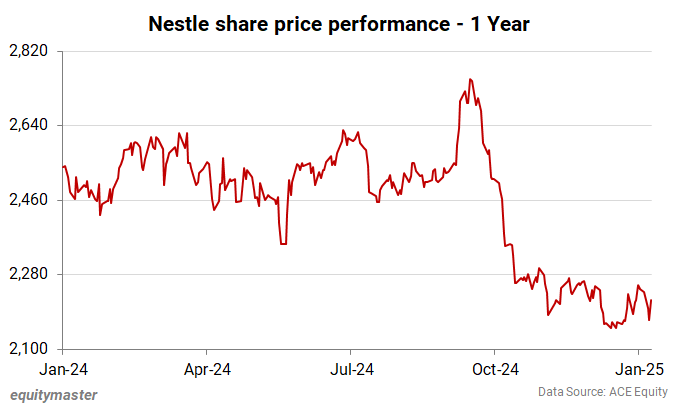
In the past year, the company reached its highest share price of Rs 2,778 on 26 September 2024. Currently, the share price is Rs 2,214, representing a 20% discount from its highest price over the past year.
Going ahead, management believes that sustained rural growth, premiumisation and focus on innovation and cost efficiency will allow the company to portray better results in FY25.
The company has accelerated its focus on innovating and renovating, launching many new products. Currently, it has 30 new projects in the pipeline.
It is working on developing a diverse range of food products across multiple brands that highlight millet as a more eco-friendly and sustainable food option.
Additionally, the company has doubled its spending on sustainability in sectors such as dairy, plastics, and sustainable sourcing.
For more details about the company, you can have a look at Nestle India's factsheet and Nestle India's latest quarterly results on our website.
#2 Procter & Gamble Hygiene and Health Care
The second stock on our list is P&G Hygiene and Health Care.
The company is the Indian subsidiary of the American MNC, Procter & Gamble. It's engaged in the manufacturing and selling of branded packaged consumer goods in the feminine hygiene and healthcare business.
Its portfolio includes popular brands such as Whisper, Vicks, and Old Spice.
Coming to its financial performance, the revenue of the company saw a slight decline of 0.3% YoY to Rs 11.3 bn.
The operating profit stood at Rs 2.9 bn versus Rs 2.8 bn, in Q2 FY24. The operating profit margin for the quarter stood at 26%, versus 25%, in Q2 FY24.
The net profit remained flat at Rs 2.1 bn. The net margin grew marginally to 18.7% versus 18.5%, in Q2 FY24.
Below is the chart showing annual share price performance of the company.
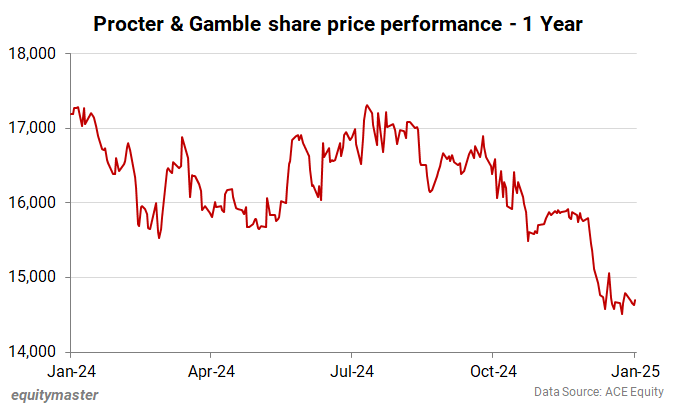
Procter and Gamble's share price reached a 52-week high of Rs 17,745 on 24 July 2024. Currently, the share price stands at Rs 14,825, reflecting a 16% discount compared to its highest price over the past year.
Going ahead, the management expresses confidence in the company's ability to delight consumers and drive sustained growth despite external challenges.
It expects rapid growth in the quick commerce segment, with a 22% rise in active users on leading platforms.
Additionally, the management acknowledges ongoing macroeconomic volatility but remains optimistic about the integrated growth strategy's ability to navigate challenges.
It anticipates continued double-digit growth in the feminine care category over the next three years, while focusing on balancing top-line growth with bottom-line margins through productivity and innovation.
For more details, see the Procter & Gamble Health fact sheet and quarterly results.
#3 Dabur India
Next on the list is Dabur India.
Dabur India, an FMCG giant with a well-established household name for over 139 years, is one of the most prolific names in the Indian market.
The company is involved in the production of Ayurvedic medicines and natural products, and now they are a multinational brand that is present in more than 120 countries around the world.
From tasty 'hajmola' to bitter yet effective 'sudarshan ghanvati' medicine to trusted 'chyawanprash', Dabur has a lot of products where it has left a strong impression.
Coming to its financials, in the September quarter FY25, the topline of the company saw a decline of 5.5% YoY to Rs 30.3 bn.
The operating profit also declined by 16% YoY to Rs 5.5 bn. The operating profit margin also declined to 18% versus 21%, in Q2 FY24.
The bottom-line saw a dip of 18% YoY to Rs 4.2 bn. The net margin also saw a degrowth to 13.8% versus 15.8%, YoY.
Below is the chart showing annual share price performance of the company.
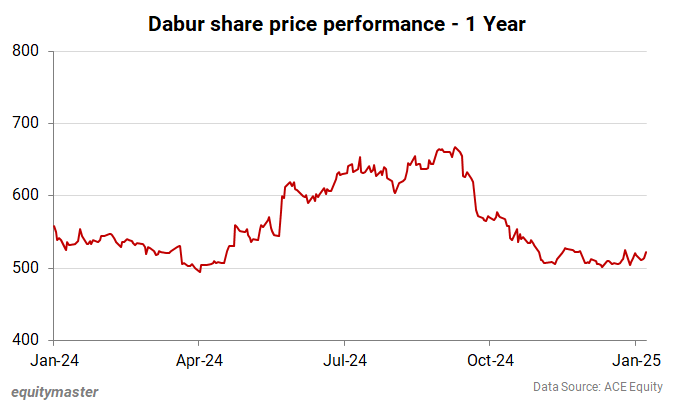
Dabur India's share price hit a 52-week high of Rs 672 on 20 September 2024. Currently, it is trading at Rs 520, which represents a 23% discount to the 52-week high.
Going ahead, the management is optimistic about recovering urban demand, citing base effects and ongoing growth in e-commerce and quick commerce channels.
It also remains committed to investing behind its brands and enhancing distribution capabilities to ensure long-term growth and value creation.
Though the company is facing challenges in the beverages business and a decline in the juices and nectar category due to aggressive pricing from competitors like Campa Cola.
It is implementing a multipronged strategy to ramp up its drinks portfolio and improve affordability through pack price architecture.
Despite of this, the management exhibits confidence in overcoming these challenges, with strategic initiatives in place to enhance profitability, expand market share, and capitalize on the recovery of urban demand.
To know more about Dabur, check out its factsheet and quarterly results.
#4 Tata Consumer Products
Next In the list is Tata Consumer Products.
Tata Consumer Products is a focused consumer products company uniting the principal food and beverage interests of the Tata Group under one umbrella.
The company's portfolio of products includes tea, coffee, water, salt, pulses, spices, ready-to-cook offerings, breakfast cereals, snacks, and mini meals.
In India, Tata Consumer Products has a reach of over 200 m households, giving it an unparalleled ability to leverage the Tata brand in consumer products.
Coming to its financials, revenue for Q1 FY25 increased by 13% YoY to Rs 42.1 bn, supported by contributions from recent acquisitions, including Organic India and Capital Foods.
Its operating profit stood at Rs 6.3 bn, with the operating margins shrinking by 0.3% YoY to 14.9%.
The company's quarterly net profit for Q2 FY25 rose 1% YoY to Rs 3.7 bn. However, this growth was accompanied by margin pressure, decreasing to 8.7%, versus 9.7% YoY.
Below is the chart showing annual share price performance of the company.
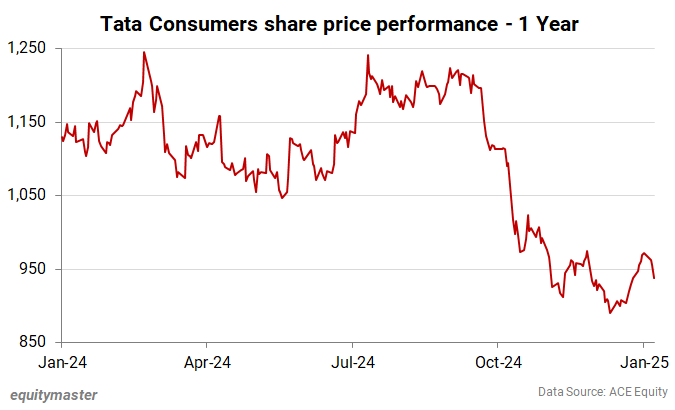
Tata Consumer's 52-week high was observed on 23 July at Rs 1,235.7. The current share price stands at Rs 972, representing a 25% discount from its 52-week high.
Going ahead, Tata Consumer Products is focused on becoming a full-fledged FMCG company. It plans to enter new product categories to reduce reliance on its core beverage and food segments.
The company is also conducting pilot programs in food services, pharmacies, and other channels to explore future growth opportunities.
The company has doubled its capex to Rs 7.9 bn for FY25, with significant investments in a new plant in Vietnam. Tata Consumer will continue looking for acquisitions that align with its focus on health-oriented and food products.
While specific acquisitions are not disclosed, it remains open to growth opportunities if they offer financial and strategic value.
To know more about the company, check out Tata Consumer Products company fact sheet and quarterly results.
#5 Colgate-Palmolive India
Next in the list is Colgate-Palmolive.
Colgate-Palmolive India Ltd is engaged in manufacturing/trading of toothpaste, tooth powder, toothbrush, mouthwash and personal care products.
The company's product portfolio includes various SKUs of toothpaste, tooth powder, toothbrush, mouthwash, and personal care products.
Colgate's flagship brand is one of the most recognised brands in India having a penetration of 88% in the domestic market.
The company has 51% market share in the toothpaste segment, 48% in toothpowder, and 30% market share in the toothbrush segment.
Coming to its financials, the revenue for the September FY25 quarter saw an increase of 10.1% YoY to Rs 16.2 bn.
The operating profit stood at 4.9 bn. While the operating profit margin declined to 31% versus 33%, in Q2 FY24.
The net profit for the quarter stood at Rs 3.9 bn, up from Rs 3.4 bn YoY. The net profit margin for the quarter grew to 24.4% versus 23.1%, in Q2 FY24.
Below is the chart showing annual share price performance of the company.
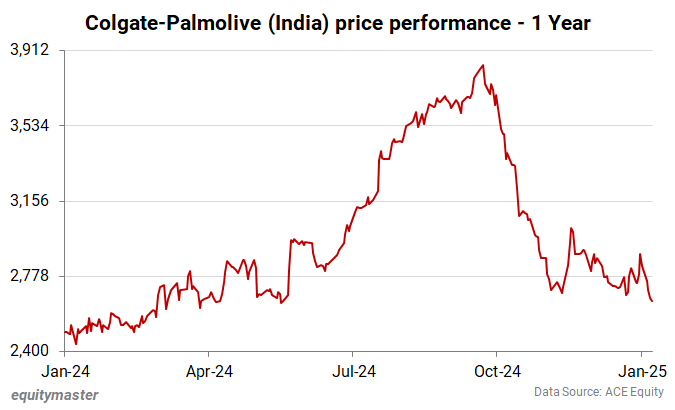
Over the past one year, the share price has seen its highest point on 3 October 2024, of Rs 3,890. Currently the share price is trading at Rs 2,740, which is 30% discount to its 52-week high share price.
During the quarter, the company continued investment in advertising and brand building, particularly for the oral health movement and product innovations.
Despite of observing competitive intensity in the toothpaste segment, particularly in urban areas, the management remains optimistic about driving consistent growth despite macroeconomic challenges.
Looking forward, the management has placed emphasis on revenue growth management to optimize pricing and product mix for sustained profitability.
For more information, you can check out the financial factsheet and quarterly results.
Conclusion
The Indian FMCG sector continues to experience impressive growth, fuelled by favourable economic and demographic trends, it is clear that not all players in the market have been able to capitalize on these opportunities equally.
Despite the overall resilience of the industry, some companies have faced significant challenges, with their stock prices plunging nearly 30% from their highs.
This drop in value raises concerns about the underlying operational issues, strategic missteps, or market misalignment that could be impacting their performance.
The disparity between the sector's growth trajectory and the poor stock performance of certain firms underscores the importance of a more cautious and discerning approach to investment.
While the FMCG industry remains crucial to the Indian economy, investors must be mindful that not all companies are equally positioned to navigate this growth.
Therefore, it is essential to stay conscious and evaluate any investment opportunity on its merit, ensuring that thorough research and a clear understanding of potential risks are prioritised before making financial commitments.
Investors should also consider corporate governance as one of the criteria for due diligence before considering an investment.
Happy Investing.
--- Advertisement ---
Investment in securities market are subject to market risks. Read all the related documents carefully before investing
Which businesses are most likely to emerge stronger over the next 3 to 5 years?
After screening thousands of listed companies, comparing industries, and examining balance sheets...
Our research team discovered some of the strongest opportunities in what we call... Essential Stocks.
Opportunities like this do not remain hidden forever.
Disclaimer: This article is for information purposes only. It is not a stock recommendation and should not be treated as such. Learn more about our recommendation services here...
ABOUT EQUITYMASTER
Since 1996, Equitymaster has been the source for honest and credible opinions on investing in India. With solid research and in-depth analysis Equitymaster is dedicated towards making its readers- smarter, more confident and richer every day. Here's why hundreds of thousands of readers spread across more than 70 countries Trust Equitymaster.
PREMIUM PRODUCTS
- Hidden Treasure
- Forever Stocks
- Super Sector Stocks
- Equitymaster Venture
- Microcap Millionaires
- Momentum Profits
- Double Income
- Midcap Value Alert
- Exponential Profits
- Annual Breakout Alert
- Lazy Millionaire
- Phase One Alert
- Smallcap AlphaQuest
- InsiderPro Stocks
- StockSelect
- Private Briefing
- Active Wealth Multiplier 2030
- FundSelect
- Fund Advantage
QUICK LINKS
POPULAR TOPICS
- Multibagger Penny Stocks
- Basics of Value Investing
- Benjamin Graham
- How to Invest in Gold
- How to Invest in Silver
- Best Stocks to Buy Today
- Best Small-cap Stocks to Buy
- Best Bluechip Stocks to Buy
- Guide to Penny Stocks
- How to Invest in the Share Market
- Warren Buffett - The Value Investor
- Pick the Best Multibagger Stocks
TRENDING TOPICS
- Best Defence Stocks in India
- Upcoming Dividend Stocks
- Best Semiconductor Stocks in India
- Data Center Stocks in India
- Best Railway Stocks in India
- Best Solar Stocks in India
- Fastest Growing Stocks in India
- List of BSE Sensex 30 Stocks
- Adani Group Shares
- Stocks Recently Bought by FIIs in India
- Top Value Stocks in India


LEGAL DISCLAIMER:
Investment in securities market are subject to market risks. Read all the related documents carefully before investing.
Registration granted by SEBI, enlistment with BSE as IA and RA, and certification from NISM in no way guarantee performance of the intermediary or provide any assurance of returns to investors.
All rights reserved. Any act of copying, reproducing or distributing any content from this website whether wholly or in part, for any purpose without the permission of Quantum Information Services Private Limited is strictly prohibited and shall be deemed to be copyright infringement.
Quantum Information Services Private Limited (QIS) is a SEBI registered Research Analyst (bearing registration no INH000021128) and Investment Adviser(Reg. No: INA000000680). Consequent upon the merger of Equitymaster Research Private Limited into QIS, effective October 30, 2025 QIS owns and operates brand 'Equitymaster' and website www.equitymaster.com. This does not constitute or is not intended to constitute an offer to buy or sell, or a solicitation to an offer to buy or sell financial products, units or securities and QIS including its employees, personnel, directors, associates will not be liable for any losses (direct or indirect) incurred or investment(s) made or decisions taken/or not taken based on the information provided herein. All content and information is provided on an 'As Is' basis by QIS. Information herein is believed to be reliable but QIS does not warrant its completeness or accuracy and expressly disclaims all warranties and conditions of any kind, whether express or implied. The services rendered by QIS are on a best effort basis. QIS does not assure or guarantee the user any minimum or fixed returns. The securities quoted, if any are for illustration only and are not recommendatory. Use of this information is at the user's own risk. The user must make his own investment decisions based on his specific investment objective and financial position and using such independent advisors as he believes necessary. This is not directed for access or use by anyone in a country, especially, USA, Canada or the European Union countries, where such use or access is unlawful or which may subject QIS or its affiliates to any registration or licensing requirement.
The performance data quoted represents past performance and does not guarantee future results. As a condition to accessing QIS's content and website, you agree to our Terms and Conditions of Use, available here
Equitymaster requests your view! Post a comment on "5 Fundamentally Strong FMCG Stocks Down 30% from 52 Week Highs". Click here!
Comments are moderated by Equitymaster, in accordance with the Terms of Use, and may not appear
on this article until they have been reviewed and deemed appropriate for posting.
In the meantime, you may want to share this article with your friends!