

Investment in securities market are subject to market risks. Read all the related documents carefully before investing
Two Years of Market Correction
Is This Your Buying Window?
See Where the Opportunities are Emerging for the Next 3-5 Years
**Important: We hate spam as much as you do. Check out our Privacy Policy and Terms Of Use.
Top 5 Smallcap Cash-Rich Companies to Watch Out for in 2025
 Image source: ChatGPT
Cash combined with courage in a crisis is priceless.' - Warren Buffett
In the world of investing, small-cap companies often fly under the radar, but those with robust cash reserves stand out as promising opportunities for future growth.
These cash-rich small-cap firms are in a strong financial position to weather economic volatility, invest in innovation, and seize new market opportunities.
Their liquidity allows them to make strategic moves, from expanding operations to acquiring competitors, without relying heavily on external funding.
Hence, let's examine the top 5 small-cap cash-rich companies selected from Equitymaster's screener for Cash-Rich Stocks.
To the screener mentioned above, we have applied a filter to consider small-cap companies with market capitalization of more than Rs 5 billion (bn).
These are not stock recommendations. Investors should do their own research and due diligence before considering any investment in the stock market. Also, investors should pay close attention to corporate governance while performing their due diligence.
So, let's examine the top 5 smallcap cash-rich companies and what the future holds in store...
#1 SMC Global (SMC)
First on this list is SMC Global.
SMC is a well-diversified financial service company in India and abroad. It has been offering one-stop investment solutions in trading and investments, since 1990.
It offers advanced broking services across equity, derivative, currency, and commodity asset classes, financial analytics, mortgage advisory, investment banking, and executions in cash & future equities.
While the company's market capitalization was Rs 13.1 bn on 3 February 2025, it had a cash and bank balance amounting to Rs 23.3 bn as of 30 September 2024.
Thus, the cash and bank balance as a percentage of market capitalization amounted to 178%.
Thus, the company has a significant amount of liquid assets on hand compared to its value in the stock market.
With such a high cash balance, the company can weather downturns or periods of market volatility without needing to take on debt or issue new equity. This provides operational flexibility and stability.
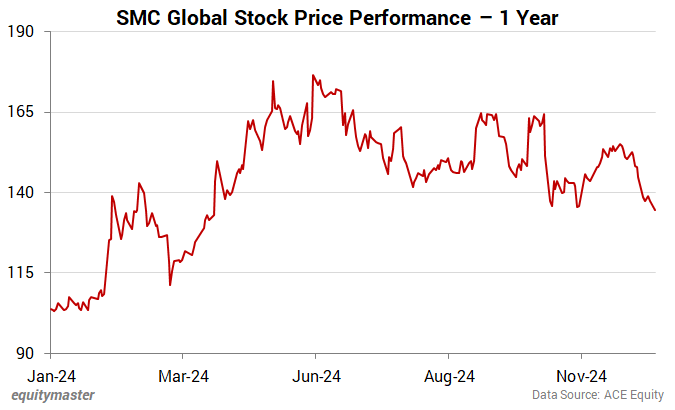
Coming to the financials, the company's revenue has grown at a compounded annual growth rate (CAGR) of 16.8% in the last five years while its net profit has grown at a CAGR of 20.2%.
This has resulted in healthy return ratios. The company's five-year average return on equity (RoE) and return on capital employed (RoCE) were 14.5% and 16%, respectively.
Its debt-to-equity ratio was 1.3 on 31 March 2024.
In the nine months (9M) FY25, SMC Global achieved revenue of Rs 13 bn, up 20% year-on-year (YoY). The earnings before interest, tax, depreciation, and amortization (EBITDA) was Rs 3.6 bn, up 24.3% YoY and profit after tax (PAT) was Rs 1.4 bn, up 17% YoY.
The company's management acknowledged the impact of regulatory changes on short-term revenue but remained optimistic about long-term growth.
SMC Global plans to enhance digital marketing efforts and streamline account opening processes to increase client acquisition.
Additionally, the company is targeting both retail and high net worth individuals (HNI) clients through a comprehensive suite of financial services, including mutual funds, insurance, and fixed-income products.
To know more, check out SMC Global's financial factsheet and latest quarterly results.
#2 5Paisa Capital
Second on this list is 5Paisa Capital.
5 paisa capital was started in 2007. It is a fintech company having a presence mainly in online discounted stock broking, depository services, research, distribution of financial products, and peer-to-peer lending.
Its promoter is Nirmal Jain who is also the promoter of IIFL Group.
The company's product suite includes stock broking, mutual and direct funds, robo advisory, algo trading, insurance, and research-based products like swing trader, smart investor, small case, etc.
While the company's market capitalization was Rs 12.4 bn on 3 February 2025, it had a cash and bank balance of Rs 16 bn as of 30 September 2024.
Thus, the cash and bank balance as a percentage of market capitalization amounted to 129%.
Thus, by holding high liquidity, the company reduces its dependence on external financing and better manages its risks.
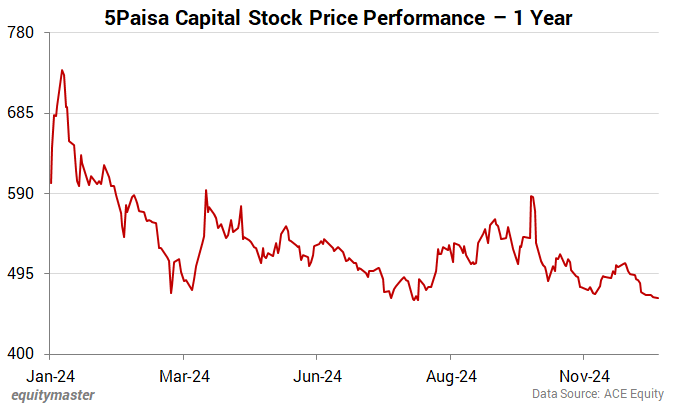
Coming to 5Paisa Capital's financials, the company's revenue has grown at a CAGR of 45.4% in the last five years while its net profit has grown at a CAGR of 36.5%.
The company's five-year average RoE and RoCE were 8.3% and 9.5%, respectively.
Its debt-to-equity ratio was as low as 0.6 on 31 March 2024.
5paisa Capital acquired 1.1 lakh new customers in Q3 FY25, bringing the total customer base to 47.4 lakh.
The average daily turnover (ADT) declined 20% on a quarter-on-quarter (QoQ) basis, to Rs 3,030 bn due to regulatory changes.
5Paisa Capital has been focusing on broadening its portfolio by offering a variety of investment options, such as mutual funds, SIPs (Systematic Investment Plans), and insurance products.
Their goal is to become a one-stop solution for retail investors by enabling them to access a wide range of financial products through a single platform.
Additionally, the company has emphasized investing in technology to enhance its platform. It's improving the user experience for both new and seasoned traders by integrating advanced features like AI-driven recommendations, better analytics, and faster transaction speeds.
The company's management believes regulatory changes will have a temporary effect but are ultimately positive for long-term market growth.
To know more, check out 5Paisa Capital's financial factsheet and latest quarterly results.
#3 Master Trust
Next on this list is Master Trust.
Master Trust was incorporated in 1985. It is in the business of lending, sales /purchase of securities and land.
The services offered by the company include equity trading depository, currency trading insurance, derivatives trading, wealth management, commodity trading, portfolio management services, research and advisory, algo trading systems, merchant banking, and non-banking financial corporation (NBFC).
While the company's market capitalization was Rs 14.5 bn on 3 February 2025, it had a cash and bank balance amounting to Rs 15.4 bn as of 30 September 2024.
Thus, the cash and bank balance as a percentage of market capitalization amounted to 106%.
A portion of the excess cash can be distributed as a special dividend to reward shareholders. This could improve investor sentiment and increase demand for the stock.
Similarly, the excess cash and bank balance can be invested in new product lines, geographical expansion or even strengthening technology.
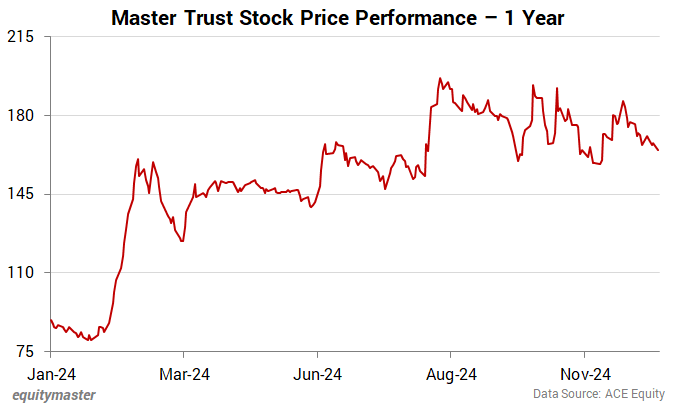
Coming to the financials, the company's revenue has grown at a CAGR of 30.1% in the last five years while its net profit has grown at a CAGR of 45.4%.
This has resulted in healthy return ratios. The company's five-year average RoE and RoCE were 18.5% and 23.2%, respectively.
Its debt-to-equity ratio was as low as 0.4 on 31 March 2024.
Master Trust delivered a profitable performance in FY24 despite market headwinds.
The company plans to broaden its range of financial products and solutions to meet the diverse needs of both individual and institutional clients.
Emphasizing digital transformation, it's investing in innovative technologies to improve operational efficiency and client engagement.
The company is also exploring opportunities to enter new regions with high growth potential.
On 30 September 2024, it announced a stock split as part of a strategic growth initiative. Each existing equity share with a face value of Rs 5 was subdivided into five shares, each with a face value of Re 1. The record date for this stock split was 30 October 2024.
To know more, check out Master Trust's financial factsheet and latest quarterly results.
#4 Fusion Finance
Fourth is Fusion Finance.
Fusion Finance is a systemically important non-deposit non-banking financial corporation (NBFC).
It provides small credit to women entrepreneurs from low-income segments lacking access to formal financial services and caters to the 'missing middle' of the MSME sector, offering loans for growth-oriented purposes such as working capital and solar rooftop installations.
While the company's market capitalization was Rs 17.5 bn on 3 February 2025, it had a cash and bank balance amounting to Rs 18.5 bn as of 30 September 2024.
Thus, the cash and bank balance as a percentage of market capitalization amounted to 106%.
In the microfinance sector, where access to capital is crucial for lending and expansion, the company can leverage the significant liquidity advantage.
Additionally, the company can expand into new geographical regions, especially rural and semi-urban areas.
Fusion Finance can also strengthen its credit risk framework, reducing non-performing assets (NPAs) to ensure sustainable growth.
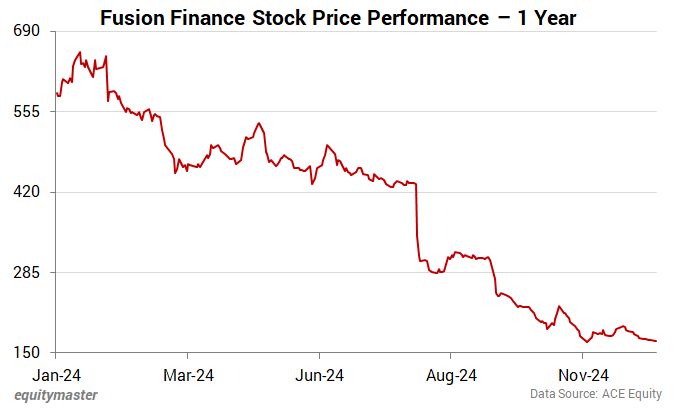
Coming to the financials, the company's revenue has grown at a CAGR of 36.2% in the last five years while its net profit has grown at a CAGR of 58.4%.
This has resulted in healthy return ratios. The company's five-year average RoE and RoCE were 13.1% and 11.3%, respectively.
Its debt-to-equity ratio was as high as 3 as of 31 March 2024.
In Q2 FY25, the company's credit cost amounted to Rs 6.9 bn, reflecting proactive provisioning due to rapid deterioration in collections.
The write-offs in H1 FY25 totaled Rs 2.5 bn, with Rs 2 bn in Q2 FY25 alone.
Overall, the microfinance sector is facing significant headwinds, particularly in certain states, experiencing elevated levels of asset quality stress.
The company continues to focus on the MSME vertical, with AUM growing to Rs 6.2 bn and a significant portion of the portfolio being secured.
Fusion Finance's management is in discussions with lenders regarding covenant breaches and expects to receive necessary waivers.
Additionally, the management highlighted that the overall credit profile of customers has weakened due to over-leverage, which is being addressed through stringent underwriting practices.
Going forward, Fusion Finance's management remains cautiously optimistic about recovery, citing early signs of stabilization in collection performance.
The company anticipates improved rural economic activity in the H2 FY25, which could aid recovery efforts.
To know more, check out Fusion Finance's financial factsheet and latest quarterly results.
#5 Emkay Global Financial Services (EGFSL)
Next on this list is Emkay Global Financial.
EGFSL is a 360-degree financial services provider of institutional broking, asset management, wealth/ portfolio management, succession planning, currency, depository participant, equity and commodity broking, distribution of financial products, and investment banking operations.
While the company's market capitalization was Rs 5.8 bn on 3 February 2025, it had a cash and bank balance amounting to Rs 5.8 bn as of 30 September 2024.
Thus, the cash and bank balance as a percentage of market capitalization amounted to 100%.
EGFSL can invest in expanding its existing services, such as wealth management, research, and investment banking.
The company can also invest in AI-driven research platforms, algorithmic trading solutions, and digital client services to improve efficiency and competitiveness.
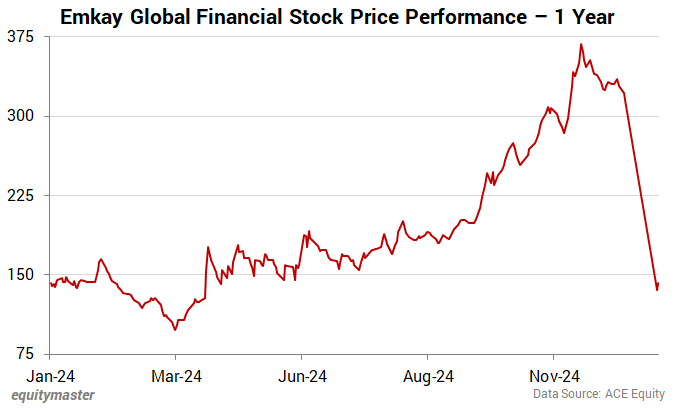
Coming to Emkay Global Financials' financials, the company's revenue has grown at a CAGR of 16.5% in the last five years while its net profit has grown at a CAGR of 31.6%.
This has resulted in average return ratios. The company's five-year average RoE and RoCE were 8.2% and 10.6%, respectively. Its debt-to-equity ratio was as low as 0.1 as of 31 March 2024.
EGFSL continues to strengthen its research franchise by expanding company coverage, with 23 new companies added during Q3 FY25.
The company's efforts to enhance its sales franchise in Asia have yielded strong traction, particularly in Singapore, Hong Kong, and Taiwan.
The company is making significant investments to expand its presence in the US market.
EGFSL is focusing on sectors with strong historical and projected growth, aiming to capitalize on areas where the RoCE exceeds the weighted average cost of capital.
This strategy includes targeting companies with earnings growth surpassing GDP growth rates, particularly in large and mid-cap segments.
These initiatives reflect EGFSL's commitment to leveraging research-driven insights and strategic investments to foster sustainable growth and deliver value to its clients.
To know more, check out Emkay Global Financials' financial factsheet and latest quarterly results.
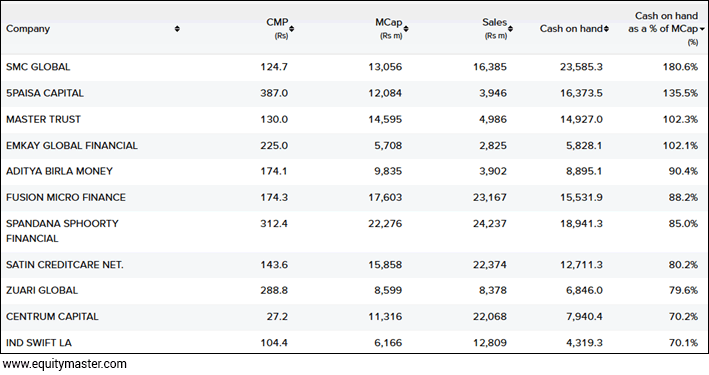
Snapshot of Smallcap Cash-rich Stocks on Equitymaster's Stock Screener
Here's a table that shows the smallcap cash-rich stocks across various parameters.
Conclusion
Small-cap companies with strong cash reserves are positioned to navigate market challenges and seize growth opportunities in a way that many of their peers cannot.
These cash-rich firms offer a unique combination of financial stability and growth potential, making them an attractive choice for investors seeking value beyond the large-cap stocks.
These companies have the flexibility to invest in expansion, innovate, and weather economic downturns, all while creating long-term value for their shareholders.
Keeping an eye on these smallcaps could be a smart strategy for anyone looking to diversify their investment portfolio.
However, conducting due diligence on these companies and including corporate governance as a key criterion in your selection process is essential.
At the same time, assess your financial goals, risk tolerance, and investment horizon before making investment decisions.
Happy Investing.
--- Advertisement ---
Investment in securities market are subject to market risks. Read all the related documents carefully before investing
Which businesses are most likely to emerge stronger over the next 3 to 5 years?
After screening thousands of listed companies, comparing industries, and examining balance sheets...
Our research team discovered some of the strongest opportunities in what we call... Essential Stocks.
Opportunities like this do not remain hidden forever.
Disclaimer: This article is for educational purposes only. It is not a recommendation and should not be treated as such. Learn more about our recommendation services here...
ABOUT EQUITYMASTER
Since 1996, Equitymaster has been the source for honest and credible opinions on investing in India. With solid research and in-depth analysis Equitymaster is dedicated towards making its readers- smarter, more confident and richer every day. Here's why hundreds of thousands of readers spread across more than 70 countries Trust Equitymaster.
PREMIUM PRODUCTS
- Hidden Treasure
- Forever Stocks
- Big Wave Profits
- Equitymaster Venture
- Microcap Millionaires
- Momentum Profits
- Double Income
- Midcap Value Alert
- Exponential Profits
- Annual Breakout Alert
- Lazy Millionaire
- Phase One Alert
- Smallcap AlphaQuest
- InsiderPro Stocks
- StockSelect
- Private Briefing
- Active Wealth Multiplier 2030
- FundSelect
- Fund Advantage
QUICK LINKS
POPULAR TOPICS
- Multibagger Penny Stocks
- Basics of Value Investing
- Benjamin Graham
- How to Invest in Gold
- How to Invest in Silver
- Best Stocks to Buy Today
- Best Small-cap Stocks to Buy
- Best Bluechip Stocks to Buy
- Guide to Penny Stocks
- How to Invest in the Share Market
- Warren Buffett - The Value Investor
- Pick the Best Multibagger Stocks
TRENDING TOPICS
- Best Defence Stocks in India
- Upcoming Dividend Stocks
- Best Semiconductor Stocks in India
- Data Center Stocks in India
- Best Railway Stocks in India
- Best Solar Stocks in India
- Fastest Growing Stocks in India
- List of BSE Sensex 30 Stocks
- Adani Group Shares
- Stocks Recently Bought by FIIs in India
- Top Value Stocks in India


LEGAL DISCLAIMER:
Investment in securities market are subject to market risks. Read all the related documents carefully before investing.
Registration granted by SEBI, enlistment with BSE as IA and RA, and certification from NISM in no way guarantee performance of the intermediary or provide any assurance of returns to investors.
All rights reserved. Any act of copying, reproducing or distributing any content from this website whether wholly or in part, for any purpose without the permission of Quantum Information Services Private Limited is strictly prohibited and shall be deemed to be copyright infringement.
Quantum Information Services Private Limited (QIS) is a SEBI registered Research Analyst (bearing registration no INH000021128) and Investment Adviser(Reg. No: INA000000680). Consequent upon the merger of Equitymaster Research Private Limited into QIS, effective October 30, 2025 QIS owns and operates brand 'Equitymaster' and website www.equitymaster.com. This does not constitute or is not intended to constitute an offer to buy or sell, or a solicitation to an offer to buy or sell financial products, units or securities and QIS including its employees, personnel, directors, associates will not be liable for any losses (direct or indirect) incurred or investment(s) made or decisions taken/or not taken based on the information provided herein. All content and information is provided on an 'As Is' basis by QIS. Information herein is believed to be reliable but QIS does not warrant its completeness or accuracy and expressly disclaims all warranties and conditions of any kind, whether express or implied. The services rendered by QIS are on a best effort basis. QIS does not assure or guarantee the user any minimum or fixed returns. The securities quoted, if any are for illustration only and are not recommendatory. Use of this information is at the user's own risk. The user must make his own investment decisions based on his specific investment objective and financial position and using such independent advisors as he believes necessary. This is not directed for access or use by anyone in a country, especially, USA, Canada or the European Union countries, where such use or access is unlawful or which may subject QIS or its affiliates to any registration or licensing requirement.
The performance data quoted represents past performance and does not guarantee future results. As a condition to accessing QIS's content and website, you agree to our Terms and Conditions of Use, available here
Equitymaster requests your view! Post a comment on "Top 5 Smallcap Cash-Rich Companies to Watch Out for in 2025". Click here!
Comments are moderated by Equitymaster, in accordance with the Terms of Use, and may not appear
on this article until they have been reviewed and deemed appropriate for posting.
In the meantime, you may want to share this article with your friends!