

Investment in securities market are subject to market risks. Read all the related documents carefully before investing
Two Years of Market Correction
Is This Your Buying Window?
See Where the Opportunities are Emerging for the Next 3-5 Years
**Important: We hate spam as much as you do. Check out our Privacy Policy and Terms Of Use.
5 Fundamentally Good Stocks with Zero Returns in the Last 3 Years
 Image source: z_wei/www.istockphoto.com
Bull markets create their own consensus. Prices rise, confidence builds and investors begin to believe that growth alone justifies valuation. Indian equities have seen a similar phase in recent years, supported by steady earnings, policy predictability and strong domestic flows.
Yet markets rarely move in unison. Even in a rising market, some stocks simply stop moving. Not because the business is broken, but because expectations ran ahead earlier or the narrative shifted elsewhere.
Good businesses do not always reward shareholders immediately. They often pass through phases of market indifference while continuing to strengthen operations and generate cash flows. Over time, however, stock prices tend to follow earnings.
The companies in this list share that characteristic. Their businesses remain reasonably solid and growth drivers are visible, yet their stocks have delivered little over the past three years. Such gaps between business performance and market returns are often where patient investors begin to pay attention.
#1 Container Corporation of India
First on our list is Container Corporation of India.
Container Corporation of India sits quietly in the background of the economy, moving containers rather than grabbing headlines. When trade rises, it participates. When consumption improves, it participates again. Over time, businesses like these tend to compound steadily, even if the stock price occasionally forgets to follow along.
Operations have held up reasonably well, capacity is expanding and growth visibility exists. Yet investor excitement has been hard to come by.
Q3FY26 sales grew about 5% year-on-year while EBITDA margin stood at 22%. The improvement was aided by operating leverage, though pricing pressure and weaker originating volumes capped the upside.
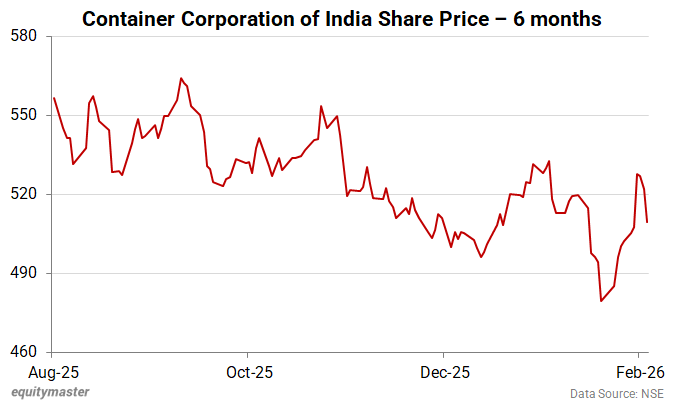
The company has increased FY26 capex by 23% to Rs 10 billion (bn), largely toward containers and rolling stock as it prepares for higher freight movement. Management has retained volume guidance of 10% growth in EXIM and 20% in domestic, indicating confidence in demand recovery.
Looking ahead, the Dedicated Freight Corridor should bring longer lead traffic, which may translate into better realizations. EXIM is projected to grow more than 15% annually over three years, supported by new terminals, double-stack routes, shipping partnerships and cross-border cargo opportunities. Domestic volumes should expand over 20% annually, with bulk cement and tank containers acting as key drivers.
The stock trades at a P/E of about 30, a discount to its long-term median.
To know more about the company, check out its financial factsheet and latest quarterly results.
#2 Tata Chemicals
Next on the list is Tata Chemicals.
Tata Chemicals operates in a business where cycles matter more than headlines. When prices are strong, profitability expands quietly. The company remains a large global soda ash player with a diversified chemicals portfolio, but the past year has been a reminder that commodity chemistry rarely moves in a straight line.
That explains why the stock finds a place among fundamentally sound companies that have delivered little in terms of returns recently. The balance sheet remains comfortable, capacity is being added and long-term demand drivers such as solar and EV applications remain intact. Yet the near-term narrative is dominated by weak realizations.
Q3FY26 sales declined about 1% year-on-year as lower realizations offset higher volumes. EBITDA margin slipped to about 9.7%, largely due to subdued pricing across geographies and a sharp fall in US profitability. Oversupply and muted demand kept global soda ash prices under pressure, with exports to Southeast Asia occurring at lower prices.
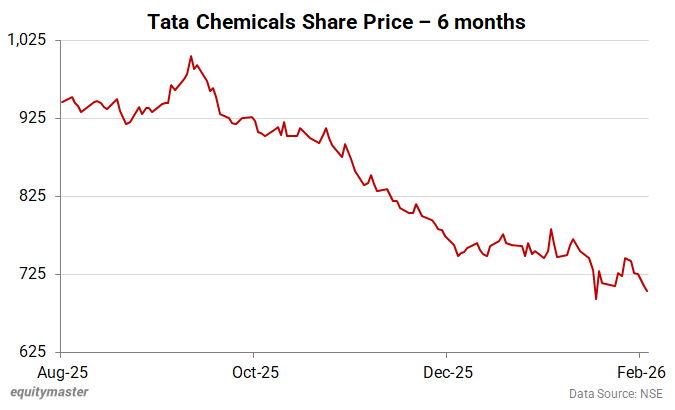
The demand environment remains tepid in the near term and new global capacity is expected to keep pricing tight, limiting any quick margin recovery. Over the medium term, however, demand is expected to grow modestly, supported by solar glass and other emerging applications.
Looking ahead, the company continues to invest through the downcycle, but with visible restraint. The board has approved Rs 5,150 m for a 210 KTPA iodized salt facility, Rs 7,750 m for a precipitated silica plant and Rs 1,350 m for dense soda ash capacity, with expected returns above 16% and closer to 18%.
Importantly, the soda ash expansion involves reconfiguring an existing unit, keeping capital intensity in check. The Singapore acquisition should double bicarbonate capacity from 60 KTPA to 120 KTPA, adding a higher-value lever to the portfolio.
Management has also held back expansion in weaker markets, signalling a preference for disciplined growth over aggressive capacity addition.
For now, the market is choosing caution over optimism. The stock trades at about 65.7 times FY26E earnings, well above its long-term median.
To know more about the company, check out its financial factsheet and latest quarterly results.
#3 Devyani International
Third on our list is Devyani International.
Devyani International operates in a business where growth is visible almost everywhere except, occasionally, in the same store. New outlets open, brands expand and the network gets denser. Yet the consumer decides the pace and lately that pace has been uneven.
That explains why the stock sits comfortably in the bucket of fundamentally sound companies that have delivered limited returns. Expansion continues, but consumption has not quite kept up.
Q3FY26 revenue grew 11% year-on-year, led by 12% growth in the India business and strong traction in owned brands. EBITDA margin contracted about 40 basis points to 15.8% as higher employee and other expenses offset gross margin gains. Store additions drove growth even as same-store sales and average daily sales for core brands remained negative, though January saw positive SSSG across all brands except Pizza Hut. Management cautioned that one month is too early to call a trend.
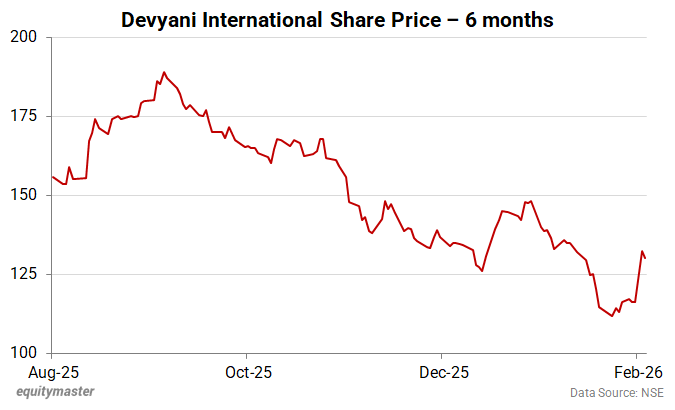
The near-term priority is repair rather than expansion in parts of the portfolio. Management has initiated a clean-up of loss-making Pizza Hut stores and plans to keep store count broadly net-neutral, with the turnaround expected to play out over several years. Encouragingly, the Skygate portfolio has already reached brand EBITDA breakeven ahead of guidance, allowing the focus to shift from turnaround to measured scaling.
The proposed merger with Sapphire Foods remains on track, with estimated annual synergies of Rs 2.1-2.25 bn, although the strategic roadmap will likely evolve after approvals.
To know more about the company, check out its financial factsheet and latest quarterly results.
#4 Aditya Birla Fashion and Retail
Fourth on our list is Aditya Birla Fashion and Retail.
Aditya Birla Fashion and Retail is attempting something few apparel companies manage successfully. It is building a house of brands across price points while simultaneously investing in newer engines of growth.
The business is expanding, newer portfolios are gaining traction, yet demand has shown signs of hesitation. In retail, growth is never just about opening stores. It is about getting consumers to walk in.
Q3FY26 revenue grew about 8% year-on-year, while EBITDA margin improved 70 basis points to 13%. The expansion was supported by strong traction in ethnic wear, luxury and digital-first businesses. Overall growth, however, moderated as the mass segment remained soft and the festive calendar shift pushed some sales into adjacent quarters.
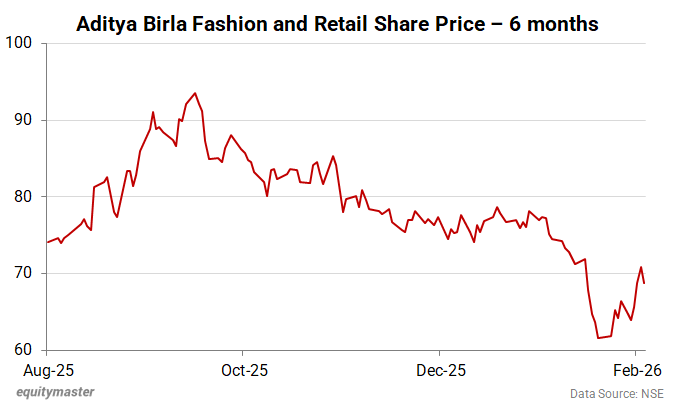
The contrast within the portfolio is worth noting. Ethnic businesses grew around 20%, helped by occasion-led demand and operating leverage. The TMRW platform expanded 29% as technology-led capabilities and category additions supported scale. Luxury retail delivered double-digit growth driven by store additions and higher basket values. Pantaloons revenue slipped about 2%, a reminder that discretionary spending tends to wobble before it recovers.
The company added roughly 50 stores during the quarter, taking its retail footprint beyond 7.7 million sq. ft. Even so, management points to calibrated investments, sharper operating efficiency and profitability improvement rather than unrestrained expansion.
Retail cycles often reward patience more than speed. For now, the company seems to be preparing for the next demand upcycle rather than reacting to the current one.
To know more about the company, check out its financial factsheet and latest quarterly results.
#5 Westlife Foodworld
Last on our list is Westlife Foodworld.
Westlife Foodworld runs a business where affordability and footfalls often matter more than menu innovation. The model is to get consumers through the door, keep pricing accessible and volumes tend to follow. The challenge, however, is that eating out is among the first expenses households postpone when sentiment weakens.
Q3FY26 revenue grew a mere 2.6% year-on-year, while EBITDA margin expanded about 106 basis points to 14.6% on the back of cost optimization even as gross margins contracted. Same-store sales declined 3.2%, reflecting lower eating-out frequency. December and January, however, showed early signs of recovery with positive momentum in guest counts.
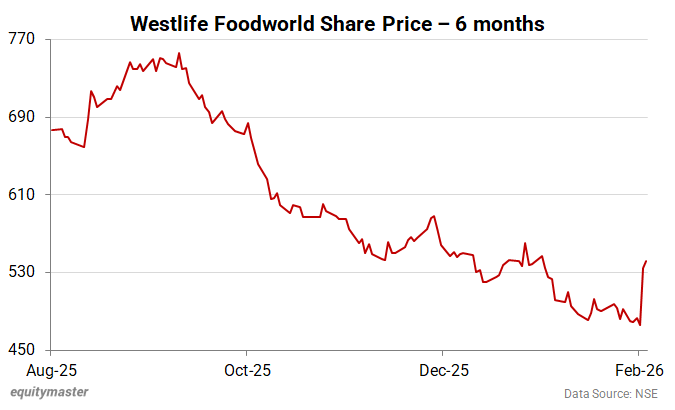
Management has responded by leaning into value. The Rs 99 meal launched in December is attracting store footfalls, while hyperlocal marketing, digital engagement and app-driven ordering supported a 6% growth in the on-premise business. Delivery declined marginally due to volatility in third-party aggregators, partly offset by the company's own app.
Expansion continues despite the uneven demand environment. The company operates 458 restaurants across 73 cities and remains on track to reach 580-630 outlets by 2027, signalling confidence in long-term consumption even as the near term demands patience.
To know more about the company, check out its financial factsheet and latest quarterly results.
Conclusion
Even in a market that looks expensive, fundamentally sound businesses provide a quiet anchor. Stock prices can stay indifferent for long periods, but companies that generate steady cash flows and maintain balance sheet discipline tend to endure.
Investing is largely about separating price from value. Markets often get distracted in the short run, while business strength reveals itself gradually. The two may diverge for a while, but rarely forever.
For investors, patience becomes a strategy. Focusing on financial strength, governance and valuation discipline, while insisting on a margin of safety, often proves more rewarding than chasing momentum. Markets eventually recognise consistency. The challenge is staying invested until they do.
--- Advertisement ---
Investment in securities market are subject to market risks. Read all the related documents carefully before investing
Which businesses are most likely to emerge stronger over the next 3 to 5 years?
After screening thousands of listed companies, comparing industries, and examining balance sheets...
Our research team discovered some of the strongest opportunities in what we call... Essential Stocks.
Opportunities like this do not remain hidden forever.
Disclaimer: This article is for information purposes only. It is not a stock recommendation and should not be treated as such. Learn more about our recommendation services here...
ABOUT EQUITYMASTER
Since 1996, Equitymaster has been the source for honest and credible opinions on investing in India. With solid research and in-depth analysis Equitymaster is dedicated towards making its readers- smarter, more confident and richer every day. Here's why hundreds of thousands of readers spread across more than 70 countries Trust Equitymaster.
PREMIUM PRODUCTS
- Hidden Treasure
- Forever Stocks
- Big Wave Profits
- Equitymaster Venture
- Microcap Millionaires
- Momentum Profits
- Double Income
- Midcap Value Alert
- Exponential Profits
- Annual Breakout Alert
- Lazy Millionaire
- Phase One Alert
- Smallcap AlphaQuest
- InsiderPro Stocks
- StockSelect
- Private Briefing
- Active Wealth Multiplier 2030
- FundSelect
- Fund Advantage
QUICK LINKS
POPULAR TOPICS
- Multibagger Penny Stocks
- Basics of Value Investing
- Benjamin Graham
- How to Invest in Gold
- How to Invest in Silver
- Best Stocks to Buy Today
- Best Small-cap Stocks to Buy
- Best Bluechip Stocks to Buy
- Guide to Penny Stocks
- How to Invest in the Share Market
- Warren Buffett - The Value Investor
- Pick the Best Multibagger Stocks
TRENDING TOPICS
- Best Defence Stocks in India
- Upcoming Dividend Stocks
- Best Semiconductor Stocks in India
- Data Center Stocks in India
- Best Railway Stocks in India
- Best Solar Stocks in India
- Fastest Growing Stocks in India
- List of BSE Sensex 30 Stocks
- Adani Group Shares
- Stocks Recently Bought by FIIs in India
- Top Value Stocks in India


LEGAL DISCLAIMER:
Investment in securities market are subject to market risks. Read all the related documents carefully before investing.
Registration granted by SEBI, enlistment with BSE as IA and RA, and certification from NISM in no way guarantee performance of the intermediary or provide any assurance of returns to investors.
All rights reserved. Any act of copying, reproducing or distributing any content from this website whether wholly or in part, for any purpose without the permission of Quantum Information Services Private Limited is strictly prohibited and shall be deemed to be copyright infringement.
Quantum Information Services Private Limited (QIS) is a SEBI registered Research Analyst (bearing registration no INH000021128) and Investment Adviser(Reg. No: INA000000680). Consequent upon the merger of Equitymaster Research Private Limited into QIS, effective October 30, 2025 QIS owns and operates brand 'Equitymaster' and website www.equitymaster.com. This does not constitute or is not intended to constitute an offer to buy or sell, or a solicitation to an offer to buy or sell financial products, units or securities and QIS including its employees, personnel, directors, associates will not be liable for any losses (direct or indirect) incurred or investment(s) made or decisions taken/or not taken based on the information provided herein. All content and information is provided on an 'As Is' basis by QIS. Information herein is believed to be reliable but QIS does not warrant its completeness or accuracy and expressly disclaims all warranties and conditions of any kind, whether express or implied. The services rendered by QIS are on a best effort basis. QIS does not assure or guarantee the user any minimum or fixed returns. The securities quoted, if any are for illustration only and are not recommendatory. Use of this information is at the user's own risk. The user must make his own investment decisions based on his specific investment objective and financial position and using such independent advisors as he believes necessary. This is not directed for access or use by anyone in a country, especially, USA, Canada or the European Union countries, where such use or access is unlawful or which may subject QIS or its affiliates to any registration or licensing requirement.
The performance data quoted represents past performance and does not guarantee future results. As a condition to accessing QIS's content and website, you agree to our Terms and Conditions of Use, available here
Equitymaster requests your view! Post a comment on "5 Fundamentally Good Stocks with Zero Returns in the Last 3 Years". Click here!
Comments are moderated by Equitymaster, in accordance with the Terms of Use, and may not appear
on this article until they have been reviewed and deemed appropriate for posting.
In the meantime, you may want to share this article with your friends!