

Investment in securities market are subject to market risks. Read all the related documents carefully before investing
Equitymaster's 2026 Grand Festive Offer:
Get Rs 20,000 Worth of Research
For Rs 2,950 + GST.
**Important: We hate spam as much as you do. Check out our Privacy Policy and Terms Of Use.
Will Trump's New Sweeping Tariffs Cause a Stock Market Crash?
 Image source: Maxger/www.istockphoto.com
Our world is an interconnected place. In a globalised world, a decision that hurts one country will have a ripple effect on another.
Trump's threat to impose tariffs on a small country of Columbia was enough to spook global markets.
But that was just the beginning. Trump then imposed 10% tariffs on imports from China. In response, China has imposed 15% tariffs on imports from the US.
A major universal tariff of 25% has also been imposed on aluminium and steel. This will be applicable on all countries exporting these goods to the US.
Mexico and Canada have temporarily avoided tariffs but these nations, along with many others, are in the crosshairs of the Trump administration. There have also been reports that Trump is considering tariffs on European countries.
Then came the bombshell announcement. Trump announced a policy of reciprocal tariffs. This is yet to take effect but when it does, there will be major implications on global trade. The second and third order effects of these tariff policies will only be known later.
Financial markets don't like uncertainty regarding trade. Uncertainty has caused fear among traders and investors about the impact of tariff policies on profits of companies.
Thus, some investors have begun to take defensive positions in the markets. This has involved selling stocks and moving to the relative safety of bonds and gold.
But could these tariff policies cause more damage? The big worry in the minds of Indian investors is the possibility of a market crash.
The One Thing Dalal Street Fears
Since the Indian market peaked back in September 2025, the midcap and smallcap indices have fallen about 20%.
But the benchmark Nifty is holding up quite well. It's down 12-13% from the all-time high.
Nifty 6 Month Chart
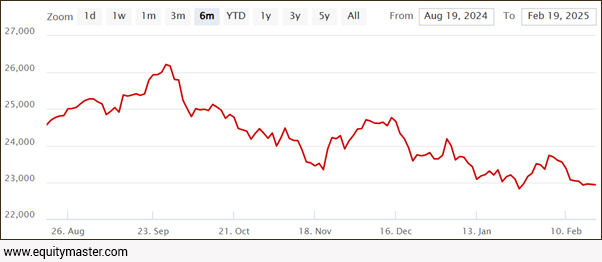
Thus, despite the massive declines we have seen in midcaps and smallcaps, the Indian stock market has not crashed... at least not yet.
And this is the big fear on Dalal Street.
If trade wars were to heat up, India will feel the heat. Most Indian companies might not feel the effects too much but the companies in the impacted sectors will take a hit on the stock market.
Sectors, like software, jewellery, textile, commodities, and finance are more integrated with the global economy than others. Many investors wouldn't want to take the risk of holding on to such stocks.
So, in a worst-case scenario, the Nifty could fall into a bear market i.e. a correction more than 20%.
For more on this, you can read our overview of Trump's tariff policy on Indian stocks.
Traders might remember the days when Trump was the US President last time. His tweets and unscripted comments could make the markets move sharply, resulting in either profits or losses depending on the direction of the trade.
Every Indian trader and investor is looking out for clues about the next move in the Nifty and how Trump's policies will drive individual stock prices.
It's safe to say that a serious correction in the Nifty is the top concern right now in the Indian market.
Is a Crash Coming?
Well, to be honest, no one on Dalal Street has the answer to this question.
In fact, we believe that anyone claiming to know the answer with certainty is either wrong or lying.
But we cannot rule out the possibility.
After all, the ongoing correction in the broader market of midcaps and smallcaps, has badly impacted sentiment among retail investors.
Foreign investors have sold about US$ 25 billion in the Indian stock market since September 2024. Retail investors were holding up the market in the face of the relentless FII selling.
If the negative sentiment in the broader market were to creep into bluechips too, then the risk of a crash or bear market will become real.
So far, the Indian market has avoided that. But it's something every investor should keep an eye on.
The magic number on the Nifty is 21,000. A fall below that would confirm a bear market. A fall below 20,000 would likely result in extreme pessimism.
This scenario would provide an excellent opportunity for long term investors to buy meaningful amounts of shares in high-quality stocks. Such investments could provide life changing profits.
Should You Buy, Hold or Sell?
Tariffs are demonstrating their effectiveness, positioning the US for a notable economic upswing.
Recent media reports suggest that some companies have begun relocating their operations to the United States to sidestep tariffs.
Meanwhile, India is cautiously aligning its approach, maintaining strong and positive relations with the US as exemplified during PM Modi's recent visit to the US.
In these uncertain times, Indian investors must remain cautious and vigilant about the changing trade landscape and the risks associated with potential tariffs on Indian goods.
Always do your due diligence, and consider factors such as valuation, industry trends, corporate governance, and market risks before making investment decisions.
And if you are worried about the stocks in your portfolio, ask the following questions...
- Are the company's fundamentals weak?
- Has there been any recent negative changes in the company's fundamentals?
- Did the PE ratio shoot up without an improvement in the company's earnings?
- Did you make a mistake in your original analysis at the time of buying?
These are all good reasons to sell or at least reduce your holdings. But as is the case with any stock, you must allocate sufficient time to do the necessary due diligence.
If the answers to the questions above is a clear 'NO', then you can consider holding on, especially if the valuations are not too expensive.
And what about buying stocks now?
To find good buying opportunities in the market today, look for fundamentally strong stocks where fear is at its highest.
Stocks with the highest fear factor satisfy the following two criteria.
- They should have fallen at least 20% in this correction.
- They should be trading at a low price to earnings (PE) and/or a low price to book (PB).
These are the best stocks to invest in right now as long as the fundamentals are strong.
Conclusion
An interesting four years lie ahead for financial markets. Navigating Trump's policies as well as his occasional eccentricities will become par for the course.
But such developments should not distract investors from their main job of identifying fundamentally strong stocks trading at reasonable valuations so as to buy them for the long term.
We believe in leaving the politics to the politicians and the news media. Investors should focus on finding fundamentally strong stocks for the long term that are trading at reasonable valuations.
In this market correction, evaluate company fundamentals, corporate governance, and valuations of the stocks as key factors when conducting due diligence before making investment decisions.
Happy investing.
Disclaimer: This article is for information purposes only. It is not a stock recommendation and should not be treated as such. Learn more about our recommendation services here...
ABOUT EQUITYMASTER
Since 1996, Equitymaster has been the source for honest and credible opinions on investing in India. With solid research and in-depth analysis Equitymaster is dedicated towards making its readers- smarter, more confident and richer every day. Here's why hundreds of thousands of readers spread across more than 70 countries Trust Equitymaster.
PREMIUM PRODUCTS
- Hidden Treasure
- Forever Stocks
- Big Wave Profits
- Equitymaster Venture
- Microcap Millionaires
- Momentum Profits
- Double Income
- Midcap Value Alert
- Exponential Profits
- Annual Breakout Alert
- Lazy Millionaire
- Phase One Alert
- Smallcap AlphaQuest
- InsiderPro Stocks
- StockSelect
- Private Briefing
- Active Wealth Multiplier 2030
- FundSelect
- Fund Advantage
QUICK LINKS
POPULAR TOPICS
- Multibagger Penny Stocks
- Basics of Value Investing
- Benjamin Graham
- How to Invest in Gold
- How to Invest in Silver
- Best Stocks to Buy Today
- Best Small-cap Stocks to Buy
- Best Bluechip Stocks to Buy
- Guide to Penny Stocks
- How to Invest in the Share Market
- Warren Buffett - The Value Investor
- Pick the Best Multibagger Stocks
TRENDING TOPICS
- Best Defence Stocks in India
- Upcoming Dividend Stocks
- Best Semiconductor Stocks in India
- Data Center Stocks in India
- Best Railway Stocks in India
- Best Solar Stocks in India
- Fastest Growing Stocks in India
- List of BSE Sensex 30 Stocks
- Adani Group Shares
- Stocks Recently Bought by FIIs in India
- Top Value Stocks in India


LEGAL DISCLAIMER:
Investment in securities market are subject to market risks. Read all the related documents carefully before investing.
Registration granted by SEBI, enlistment with BSE as IA and RA, and certification from NISM in no way guarantee performance of the intermediary or provide any assurance of returns to investors.
All rights reserved. Any act of copying, reproducing or distributing any content from this website whether wholly or in part, for any purpose without the permission of Quantum Information Services Private Limited is strictly prohibited and shall be deemed to be copyright infringement.
Quantum Information Services Private Limited (QIS) is a SEBI registered Research Analyst (bearing registration no INH000021128) and Investment Adviser(Reg. No: INA000000680). Consequent upon the merger of Equitymaster Research Private Limited into QIS, effective October 30, 2025 QIS owns and operates brand 'Equitymaster' and website www.equitymaster.com. This does not constitute or is not intended to constitute an offer to buy or sell, or a solicitation to an offer to buy or sell financial products, units or securities and QIS including its employees, personnel, directors, associates will not be liable for any losses (direct or indirect) incurred or investment(s) made or decisions taken/or not taken based on the information provided herein. All content and information is provided on an 'As Is' basis by QIS. Information herein is believed to be reliable but QIS does not warrant its completeness or accuracy and expressly disclaims all warranties and conditions of any kind, whether express or implied. The services rendered by QIS are on a best effort basis. QIS does not assure or guarantee the user any minimum or fixed returns. The securities quoted, if any are for illustration only and are not recommendatory. Use of this information is at the user's own risk. The user must make his own investment decisions based on his specific investment objective and financial position and using such independent advisors as he believes necessary. This is not directed for access or use by anyone in a country, especially, USA, Canada or the European Union countries, where such use or access is unlawful or which may subject QIS or its affiliates to any registration or licensing requirement.
The performance data quoted represents past performance and does not guarantee future results. As a condition to accessing QIS's content and website, you agree to our Terms and Conditions of Use, available here
Equitymaster requests your view! Post a comment on "Will Trump's New Sweeping Tariffs Cause a Stock Market Crash?". Click here!
Comments are moderated by Equitymaster, in accordance with the Terms of Use, and may not appear
on this article until they have been reviewed and deemed appropriate for posting.
In the meantime, you may want to share this article with your friends!