


Equitymaster's 2026 Grand Festive Offer
Two Research Reports, Six Stocks
3 Small Cap, 3 Large Cap
**Important: We hate spam as much as you do. Check out our Privacy Policy and Terms Of Use.
4 Best Energy Stocks in India and How to Invest in Them
 Image source: Bet_Noire/www.istockphoto.com
Energy stocks span multiple business segments across the value chain.
The main categories are: upstream oil and gas producers; midstream pipeline and gas transport companies; downstream refiners and fuel marketers; integrated energy conglomerates; oilfield services firms; power generating companies, coal mining companies and more.
Energy stocks play a strategic role in portfolio construction because they behave differently from many other sectors. Their earnings are closely tied to commodity prices, global demand, and geopolitical events.
This means they often move independently of other sectors like IT, banking, or FMCG. This helps improve diversification and reduces overdependence on one economic theme.
Here are 4 best energy stocks to track.
These companies have been selected from the BSE Energy index. In choosing the 4 best companies we have chosen only the largest companies in their area of operations, and a proven track record of profitability and dividends.
#1 GAIL (India) Ltd
GAIL (India) is the largest natural gas transmission and marketing company in India. The company owns and operates the largest natural gas pipeline network in India and is a dominant gas marketer in the country. It is also a major player in petrochemicals (polymers) and LNG trading.
GAIL owns and operates an extensive network of approximately 18,001 km of natural gas pipelines, spanning the length and breadth of India.
On the financial front, the company achieved turnover of Rs 340.30 bn as against Rs 349.07 bn in the corresponding period of last year. The net profits fell to Rs 16,030 m as against Rs 38,670 m YoY.
The drop in net profits of GAIL India is mainly because of an exceptional income the company got last year in Q3, on account of arbitration settlement with SMTS.
Moving ahead, the Petroleum and Natural Gas Regulatory Board (PNGRB) has issued an interim revision of natural gas pipeline tariff for GAIL's integrated natural gas pipeline network from Rs 58.61 to Rs 65.69 per MMBTU, effective 2 February, 2026. This represents an increase of approximately 12.1%, leading to a positive impact of approximately Rs 12 bn per annum for the company.
In terms of diversification, GAIL (India) has been offered to set up two fertilizer plants along the MNJPL corridor. The envisaged investment for these two plants is Rs 210 bn. The set proposal is having an in-principle approval of the board, and the proposal is under evaluation stage at the company.
On the renewable energy front, GAIL India sees it as a strategic growth opportunity and is undertaking a significant expansion of existing clean energy portfolio of 145 MW.
Several large projects are currently in various stages of development are under progress, including 170 MW wind project in Maharashtra, solar projects of 100 MW and 600 MW in Uttar Pradesh, and approximately 35 MW captive use solar plants across various GAIL India locations.
Compressed biogas continues to be a strategic pillar of the company's clean energy portfolio. Following the successful commissioning of 5 ton per day CBG plant at Ranchi, the board has approved investment for establishing 6 compressed biogas plants.
GAIL's Retail LNG business continues to progress steadily with a plan to establish 29 LNG stations. Development of LNG stations at 5 locations is presently underway.
Overall, the company has steady long-term prospects driven by pipeline expansion, rising natural gas demand, and regulated transmission revenues. However, earnings remain sensitive to global LNG prices and marketing margins.
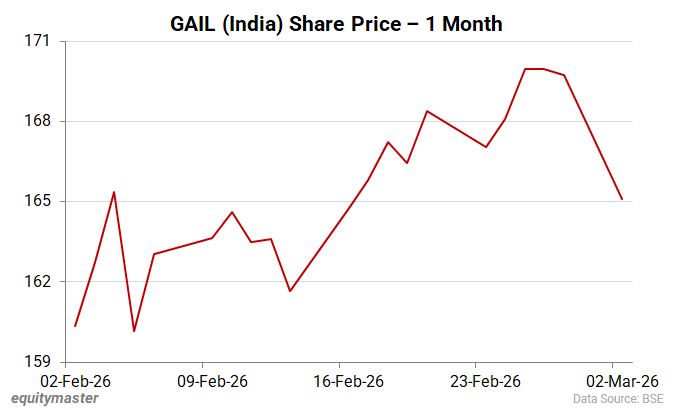
How GAIL (India) Share Price has Performed Recently?
In the last 5-days GAIL (India) shares have moved marginally lower to Rs 165.10 from Rs 167.25.
Over the past year, the shares have been up 7.2%.
The stock touched its 52-week high of Rs 202.65 on 12 June 2025 and its 52-week low of Rs 150.60 on 4 March 2025.
To know more check the GAIL (India) fact sheet and latest quarterly results.
#2 Indian Oil Corporation (IOC)
The company is the biggest government-owned oil producer and energy company in India, leading in refining, pipelines, fuel marketing, and related businesses.
It has one of the largest refining capacities in the country and a vast marketing network of fuel stations and LPG distribution.
On the financial front, the company reported revenues of Rs 2,362,572 m for Q3 FY26 vs Rs 2,195,224 m YoY. Indian Oil Corporation also reported net profits of Rs 130,358 m vs Rs 19,129 m YoY.
The company benefited from higher gross refining margins (GRM) - the difference between crude costs and finished product prices - which expanded significantly in Q3 FY26. This was a key driver of profitability.
Refinery throughput rose, and domestic product sales grew, helping boost earnings.
Moving ahead, Indian Oil Corporation is undertaking some major expansions. Let's take a look at the table.
Capex & Major Projects Update as on 31 Dec, 2025
| Name of the project | Cost (Rs billion) | Physical Progress (%) | Expected date of Commissioning |
|---|---|---|---|
| Panipat Refinery Expansion (15 MMTPA to 25 MMTPA) | 382.31 | 91.6 | Dec 2026 |
| Gujarat Refinery Expansion (13.7 MMTPA to 18 MMTPA) | 189.36 | 85.8 | November 2026 |
| Barauni Refinery Expansion (6 MMTPA to 9 MMTPA) | 181.13 | 89.4 | Aug 2026 |
| PX-PTA Complex at Paradip Refinery | 138.05 | 92.2 | Aug 2026 |
| New Mundra Panipat Crude Oil Pipeline, GJ, HR and RJ | 90.28 | 88.6 | June 26 |
| Poly Butadiene Rubber Plant at Panipat, Haryana | 29.49 | 79.5 | June 2026 |
The company has some massive expansion plans, particularly on the refinery front. Panipat Refinery is expanding capacity to 25 MMTPA with petrochemical integration, and phased commissioning.
The Gujarat Refinery's capacity is being increased to 18 MMTPA with an integration of new petrochemical units like polypropylene and catalytic dewaxing.
Over the next few years, growth is likely to be driven by refinery expansions, petrochemical integration (which improves margins), expanding gas marketing, and investments in green hydrogen, biofuels and EV charging.
However, the company's financial performance is sensitive to volatile crude prices and government policy. Investors should be prepared for volatility, especially in periods of rising global oil prices.
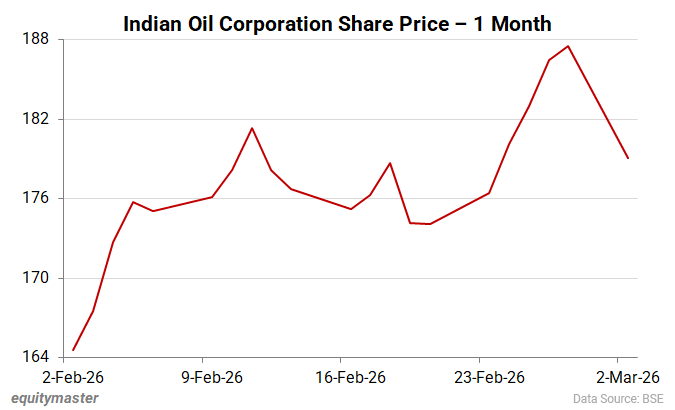
How Indian Oil Corporation Share Price has Performed Recently?
In the last 5-days IOC shares have moved marginally higher to Rs 179.05 from Rs 177.70.
Over the past year, the shares have been up 56%.
The stock touched its 52-week high of Rs 188.90 on 27 February 2026 and its 52-week low of Rs 110.75 on 3 March 2025.
To know more check the Indian Oil Corporation fact sheet and latest quarterly results.
#3 ONGC
Next on our list is the stock of Oil and Natural Gas Corporation Limited (ONGC). The company is India's largest government-owned oil and gas explorer and producer, and one of the most important energy companies in the country.
ONGC contributes around 70-75 % of India's domestic crude oil production and a significant share of natural gas output.
On the financial front, the company's revenues for Q3 FY26 were Rs 1,674,229 m compared to Rs 1,672,126 m YoY. For Q3 FY26, ONGC reported a net profit of Rs 118,492 m compared to Rs 101,112 m YoY.
The company delivered good numbers, bolstered by gas performance. During 9M FY26, revenue from new well gas stood at Rs 50.28 bn, delivering an additional Rs 9,440 m revenue compared to the APM gas price.
New well gas now contributes more than 18% of total gas sales revenue from ONGC portfolio.
ONGC monetized 2 hydrocarbon discoveries during Q3 of FY26, namely, in Gujarat and in Tripura. Under Government of India's sponsored initiative, ONGC is undertaking the drilling of the first stratigraphic well AND-P-1 in ultra-deep-water region of Andaman Basin. The well has been spudded on 27 January 2026.
The company's western offshore Daman upside development project nears gas production start. In fact, ONGC will see as many as four major infrastructure projects nearing completion.
The company's future rests on balancing traditional hydrocarbon growth with energy transition investments. Strong production revival initiatives and diversification put it on a robust long-term track, but commodity price volatility (especially crude) remains a central risk shaping near-to-medium-term profitability.
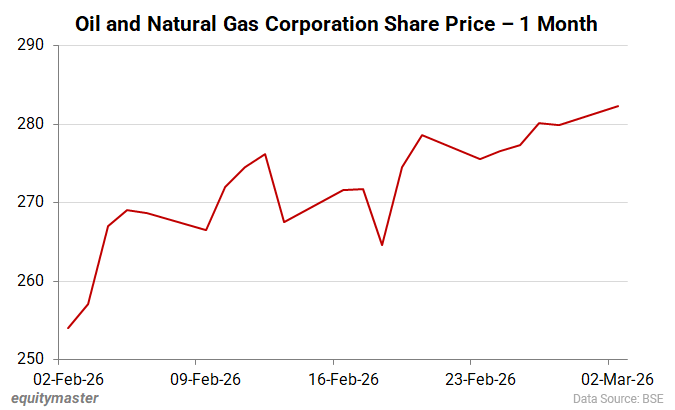
How ONGC Share Price has Performed Recently?
In the last 5-days ONGC shares have moved marginally higher to Rs 282.25 from Rs 277.
Over the past year, the shares have been up 23%.
The stock touched its 52-week high of Rs 293.15 on 2 March 2026 and its 52-week low of Rs 205 on 7 April 2025.
To know more check the Oil and Natural Gas Corporation fact sheet and latest quarterly results.
#4 Coal India
Next on our list is the stock of Coal India.
Coal India is the largest coal mining and production company in India. It commands over 80% of the country's coal production, making it the largest coal producer in the world.
The substantial market share is largely attributed to government ownership and regulatory licensing, providing access to coal blocks. It serves as the primary coal supplier for key industries such as power, steel, cement, and fertilizers.
In Q3 FY26, Coal India reported a drop in consolidated revenue to Rs 349,242 m, compared to Rs 368,586 m in the same period last year. The consolidated net profits were placed at Rs 68,772 m compared to Rs 84,202 m in the same period last year.
The compounded sales growth over the last three years has been 11.2%, while net profit growth was better at 26.7%.
Coal India's roadmap targets 1.23 bn tonnes by FY35, with an 8% annual growth forecast from FY25. The company has secured priority access to railway infrastructure and are expediting project clearances for FMC implementation.
The company is rapidly diversifying with an aim to be a net-zero entity through installation of 3,000 MW of renewable solar capacity by FY 2028.
Till December 2025, Coal India and its subsidiaries have set up renewable energy capacity installation of around 247 MW which is expected to go up to 675 MW by the current fiscal's closure.
The upcoming capacity addition includes two major solar power projects in Gujarat, 100 MW in Patan and 300 MW in Khavda.
Beyond these projects, the company is also actively scouting for 2,000 MW of RE capacity in near term through its subsidiaries and joint ventures. One is, 875 MW plant with Rajasthan Rajya Vidyut Utpadan Nigam Limited and the other is a 500 MW capacity plant through Uttar Pradesh Rajya Vidyut Utpadan Nigam Limited in phased manner.
Further bids have been invited for 20 MW floating solar plant in Gorakhpur. Battery Energy Storage System (BESS) is also on the company's radar.
India's clean energy transition will remain the biggest challenge for Coal India in the next few years. The positive is that the company is gradually diversifying including renewable energy and critical minerals.
The stock is often accumulated by investors for its strong dividend payouts and dividend yields. That is unlikely to change in the immediate future.
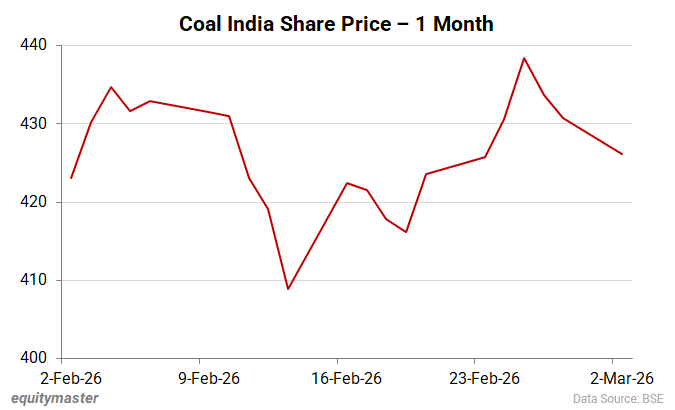
How Coal India Share Price has Performed Recently?
In the last 5-days Coal India shares have moved marginally higher to Rs 426.10 from Rs 423.20.
Over the past year, the shares have been up 16%.
The stock touched its 52-week high of Rs 461.20 on 29 January 2026 and its 52-week low of Rs 350.15 on 7 April 2025.
To know more check the Coal India fact sheet and latest quarterly results.
How to Invest in Energy Stocks in India?
When investing in energy stocks, the segment you choose should match your risk appetite, return expectations, and view on crude prices and policy.
- Choose the Segment
You can invest across different parts of the value chain:
Upstream producers
Refiners/marketers
Integrated players
Renewables/power
Coal mining companies.
You can buy individual stocks, sector mutual funds, or energy-focused ETFs.
- Advantages of investing in energy stocks
Inflation hedge: Energy often benefits when commodity prices rise. This makes stocks from the sector good hedge against inflation.
High dividends: Many PSU energy stocks offer strong yields. This is a good place to invest for those looking at steady dividend income.
Cyclical upside: For upstream oil and gas companies, there could be an earnings jump during crude upcycles.
Energy transition opportunity: Investing in sectors like renewables help you to allocate money to emerging sectors that offer long-term growth.
- Risks of Investing in Energy Stocks
Commodity Price VolatilityEarnings of upstream companies fluctuate sharply with crude oil and gas prices. A sudden fall in prices can significantly reduce profits.
Policy & Regulatory RiskGovernment intervention, price controls, or windfall taxes can impact margins, especially for refiners.
Cyclical NatureThe energy sector moves in boom-and-bust cycles. Strong earnings during high-price phases can reverse quickly in downturns.
High Capital Intensity & DebtEnergy projects require large investments in exploration, refining, or power plants. This can increase debt levels and financial risk.
Geopolitical RiskGlobal conflicts, sanctions, or supply disruptions can create sudden volatility in oil and gas markets.
Energy Transition RiskLong-term global shifts toward renewables may reduce demand for fossil fuels, affecting profitability of some companies.
Overall, assess earnings stability, debt levels, capital expenditure plans, and dividend consistency, as energy businesses are capital intensive and often cyclical.
Investors should evaluate the company's fundamentals, corporate governance, and valuations of the stock as key factors when conducting due diligence before making investment decisions.
--- Advertisement ---
Investment in securities market are subject to market risks. Read all the related documents carefully before investing
Which businesses are most likely to emerge stronger over the next 3 to 5 years?
After screening thousands of listed companies, comparing industries, and examining balance sheets...
Our research team discovered some of the strongest opportunities in what we call... Essential Stocks.
Opportunities like this do not remain hidden forever.
Disclaimer: This article is for information purposes only. It is not a stock recommendation and should not be treated as such. Learn more about our recommendation services here...
ABOUT EQUITYMASTER
Since 1996, Equitymaster has been the source for honest and credible opinions on investing in India. With solid research and in-depth analysis Equitymaster is dedicated towards making its readers- smarter, more confident and richer every day. Here's why hundreds of thousands of readers spread across more than 70 countries Trust Equitymaster.
PREMIUM PRODUCTS
- Hidden Treasure
- Forever Stocks
- Big Wave Profits
- Equitymaster Venture
- Microcap Millionaires
- Momentum Profits
- Double Income
- Midcap Value Alert
- Exponential Profits
- Annual Breakout Alert
- Lazy Millionaire
- Phase One Alert
- Smallcap AlphaQuest
- InsiderPro Stocks
- StockSelect
- Private Briefing
- Active Wealth Multiplier 2030
- FundSelect
- Fund Advantage
QUICK LINKS
POPULAR TOPICS
- Multibagger Penny Stocks
- Basics of Value Investing
- Benjamin Graham
- How to Invest in Gold
- How to Invest in Silver
- Best Stocks to Buy Today
- Best Small-cap Stocks to Buy
- Best Bluechip Stocks to Buy
- Guide to Penny Stocks
- How to Invest in the Share Market
- Warren Buffett - The Value Investor
- Pick the Best Multibagger Stocks
TRENDING TOPICS
- Best Defence Stocks in India
- Upcoming Dividend Stocks
- Best Semiconductor Stocks in India
- Data Center Stocks in India
- Best Railway Stocks in India
- Best Solar Stocks in India
- Fastest Growing Stocks in India
- List of BSE Sensex 30 Stocks
- Adani Group Shares
- Stocks Recently Bought by FIIs in India
- Top Value Stocks in India


LEGAL DISCLAIMER:
Investment in securities market are subject to market risks. Read all the related documents carefully before investing.
Registration granted by SEBI, enlistment with BSE as IA and RA, and certification from NISM in no way guarantee performance of the intermediary or provide any assurance of returns to investors.
All rights reserved. Any act of copying, reproducing or distributing any content from this website whether wholly or in part, for any purpose without the permission of Quantum Information Services Private Limited is strictly prohibited and shall be deemed to be copyright infringement.
Quantum Information Services Private Limited (QIS) is a SEBI registered Research Analyst (bearing registration no INH000021128) and Investment Adviser(Reg. No: INA000000680). Consequent upon the merger of Equitymaster Research Private Limited into QIS, effective October 30, 2025 QIS owns and operates brand 'Equitymaster' and website www.equitymaster.com. This does not constitute or is not intended to constitute an offer to buy or sell, or a solicitation to an offer to buy or sell financial products, units or securities and QIS including its employees, personnel, directors, associates will not be liable for any losses (direct or indirect) incurred or investment(s) made or decisions taken/or not taken based on the information provided herein. All content and information is provided on an 'As Is' basis by QIS. Information herein is believed to be reliable but QIS does not warrant its completeness or accuracy and expressly disclaims all warranties and conditions of any kind, whether express or implied. The services rendered by QIS are on a best effort basis. QIS does not assure or guarantee the user any minimum or fixed returns. The securities quoted, if any are for illustration only and are not recommendatory. Use of this information is at the user's own risk. The user must make his own investment decisions based on his specific investment objective and financial position and using such independent advisors as he believes necessary. This is not directed for access or use by anyone in a country, especially, USA, Canada or the European Union countries, where such use or access is unlawful or which may subject QIS or its affiliates to any registration or licensing requirement.
The performance data quoted represents past performance and does not guarantee future results. As a condition to accessing QIS's content and website, you agree to our Terms and Conditions of Use, available here
Equitymaster requests your view! Post a comment on "4 Best Energy Stocks in India and How to Invest in Them". Click here!
Comments are moderated by Equitymaster, in accordance with the Terms of Use, and may not appear
on this article until they have been reviewed and deemed appropriate for posting.
In the meantime, you may want to share this article with your friends!