

Investment in securities market are subject to market risks. Read all the related documents carefully before investing
Two Years of Market Correction
Is This Your Buying Window?
See Where the Opportunities are Emerging for the Next 3-5 Years
**Important: We hate spam as much as you do. Check out our Privacy Policy and Terms Of Use.
5 Things Shareholders Should Know About Siemens' Energy Business Demerger
 Siemens logo source: https://www.siemens.com/
Companies often start as single entities, laser-focused on one core product or service.
But as it grows, diversification kicks in. First, it will be smaller units within the main structure to keep things simple.
Eventually, expansion, financial gains, and market shifts make it clear: It's time to demerge.
Splitting into independent entities isn't just about structure-it's about unlocking value, optimising growth, and making the most of tax advantages.
In 2025, demergers have taken centre stage across various sectors, with companies rethinking their game plans. A wave of corporate restructuring is sweeping through Indian businesses, with big names carving out separate paths for their operations.
The goal? A sharper focus, better capital access, and greater shareholder returns.
History proves the power of a well-timed demerger. Just look at the Bajaj Group's 2008 split. When Bajaj Auto and Bajaj Finserv broke away from Bajaj Holdings, it wasn't just a restructuring move; it was a wealth-creation masterstroke, giving rise to two thriving businesses.
Now, after the ITC demerger in 2025, Siemens is set to follow suit to demerge its energy business.
About Siemens
Siemens operates across multiple sectors, offering products and integrated solutions for industrial applications, process industries, and infrastructure.
The company specialises in intelligent infrastructure for buildings, efficient power generation from fossil fuels, and oil & gas applications.
It is also engaged in the transmission and distribution of electrical energy and provides solutions for passenger and freight transportation, including rail vehicles, automation, and electrification systems.
What Does Siemens Energy India Do?
Siemens Energy India covers the entire energy value chain, offering products and services for power plants, including gas turbines, steam turbines, and generators.
The company holds a significant position in the High Voltage Direct Current (HVDC) segment.
It manufactures power transformers and constructs substations, thereby enhancing India's energy infrastructure.
#1 Demerger Plan
On 14 May 2024, Siemens Ltd announced its decision to demerge and list its energy business, aligning with a global restructuring initiated by its German parent company three years ago.
The newly entity, Siemens Energy India, will have the same shareholding structure as Siemens, with shareholders receiving one share of Siemens Energy India Ltd for every share held in Siemens.
This ensures that existing investors retain proportional ownership in both entities post-demerger.
#2 Why Is Siemens Demerging Its Energy Business?
According to Sunil Mathur, Managing Director and CEO of Siemens, the energy and industrial businesses operate under fundamentally different market dynamics and capital allocation requirements.
The demerger will enable both companies to focus on their core strengths and optimise financial resources more efficiently.
This move follows a similar approach taken by ABB India Ltd., which demerged its power transmission business before selling its stake to Hitachi.
Siemens has also faced challenges in the past with shareholder pushback. In one instance, investors rejected a proposed Rs 22 billion (bn) sale of its low-voltage and geared motors business due to valuation concerns.
#3 Transparent Demerger Strategy
Siemens' decision to demerge its energy business while maintaining the existing shareholding structure is seen as a more transparent and straightforward approach to restructuring.
Unlike selling the business to its parent company-where valuation concerns and related-party transactions could create complexities-this method ensures greater investor confidence.
Globally, Siemens AG separated its energy business into Siemens Energy AG in 2020, but in India, Siemens Ltd continued to operate its energy vertical.
In November 2023, Siemens AG acquired an 18% stake in Siemens Ltd. from Siemens Energy AG.
This was followed by the incorporation of Siemens Energy India Ltd in December 2023, marking a key step toward the demerger.
Over time, Siemens Energy AG is expected to acquire a majority stake in the newly formed Siemens Energy India Ltd., further aligning with its global strategy.
#4 Demerger Timeline
Siemens Ltd has received a no-objection certificate from Indian stock exchanges for the demerger of its energy business.
The next step involves seeking clearance from the National Company Law Tribunal (NCLT). Once approved, Siemens Energy India Ltd will be listed on stock exchanges within 60 days of the NCLT order. The demerger is expected to be completed in 2025.
#5 Will the Demerger Unlock Shareholder Value?
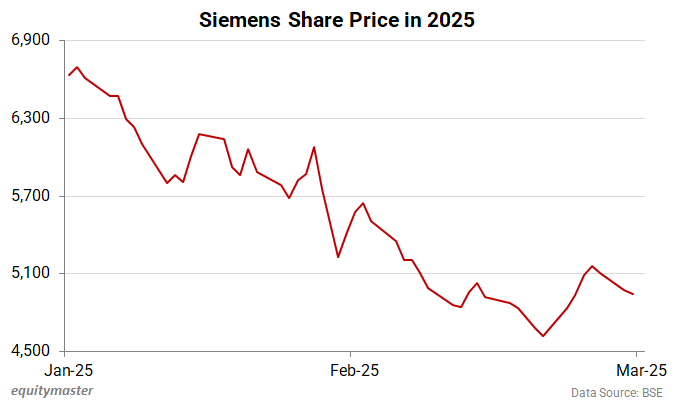
Despite the positive outlook, Siemens Ltd's stock has been under pressure, declining over 26% in 2025 so far.
However, analysts believe that the demerger will ultimately unlock further shareholder value.
The company is expected to benefit from margin expansion as it capitalizes on rising investments in transmission & distribution (T&D), decarbonisation, automation, and digitalisation.
The separation of its energy division is anticipated to enhance Siemens' financial performance and strategic focus.
A Close Look at the Financials
In the December quarter, Siemens Ltd saw a 20% rise in new orders, reaching Rs 42.6 bn. However, revenue declined 3% YoY to Rs 35.9 bn.
On the operational front, EBITDA fell 11.5% YoY to Rs 4 bn, down from Rs 4.5 bn in the same quarter last year, with EBITDA margins contracting to 11.2% from 12.2%. Net profit also declined 10% YoY to Rs 3.7 bn.
Meanwhile, the energy business delivered strong profitable growth, supported by the sustained demand for transmission products and solutions. The segment also benefited from a one-time gain of Rs 980 million (m), boosting profitability.
Revenue from discontinued operations grew 28% YoY to Rs 14.3 bn, while profit after tax surged 158% YoY to Rs 2.4 bn, as per the company's press release.
Siemens Energy India Ltd., a wholly owned subsidiary of Siemens Ltd., reported a more than twofold increase in net profit in Q1 FY25. This marks the first time that Siemens Ltd has disclosed the financials of its soon-to-be independent energy division.
What Next?
On 20 December Siemens' management addressed analysts in a post-earnings call, discussing the company's outlook.
Private capex has yet to gain significant traction, though sectors like semiconductors and batteries remain steady, while traditional industries have been slower in ramping up investments.
The energy business continues to witness strong demand, particularly in the transmission segment, driven by the transition to renewable energy. Management identified the High Voltage Direct Current (HVDC) segment as a key growth area.
While most of Siemens' current projects are based on Line Commutated Converter (LCC) technology, the company is shifting its focus to Voltage Source Converter (VSC) projects, although this segment is still in its early stages.
Siemens India's digital industries segment has been under pressure due to semiconductor shortages and customer destocking.
This has led to margin compression, driven by pricing pressures and an unfavourable product mix. However, management expects a gradual recovery in the coming quarters as destocking efforts subside.
Conclusion
Government spending on infrastructure was relatively subdued in H1 FY25 but is expected to pick up in the second half of the year.
The manufacturing PMI indicator rebounded in October from a nine-month low, signalling an increase in new orders and international sales. This recovery is expected to benefit the manufacturing sector, which has been experiencing a slowdown.
India's energy demand is projected to increase significantly due to rapid urbanization, industrialization, and a growing population.
The country's energy consumption has more than doubled since 2000, and this trend is expected to continue, creating strong tailwinds for companies operating in the sector.
With the demerger in its final stages, Siemens Ltd is positioning itself for a more streamlined future. By separating its energy business, the company aims to enhance operational efficiency, improve capital allocation, and create greater value for shareholders.
Investors should evaluate the company's fundamentals, corporate governance, and valuations of the stock as key factors when conducting due diligence before making investment decisions.
--- Advertisement ---
Investment in securities market are subject to market risks. Read all the related documents carefully before investing
Which businesses are most likely to emerge stronger over the next 3 to 5 years?
After screening thousands of listed companies, comparing industries, and examining balance sheets...
Our research team discovered some of the strongest opportunities in what we call... Essential Stocks.
Opportunities like this do not remain hidden forever.
Disclaimer: This article is for information purposes only. It is not a stock recommendation and should not be treated as such. Learn more about our recommendation services here...
ABOUT EQUITYMASTER
Since 1996, Equitymaster has been the source for honest and credible opinions on investing in India. With solid research and in-depth analysis Equitymaster is dedicated towards making its readers- smarter, more confident and richer every day. Here's why hundreds of thousands of readers spread across more than 70 countries Trust Equitymaster.
PREMIUM PRODUCTS
- Hidden Treasure
- Forever Stocks
- Big Wave Profits
- Equitymaster Venture
- Microcap Millionaires
- Momentum Profits
- Double Income
- Midcap Value Alert
- Exponential Profits
- Annual Breakout Alert
- Lazy Millionaire
- Phase One Alert
- Smallcap AlphaQuest
- InsiderPro Stocks
- StockSelect
- Private Briefing
- Active Wealth Multiplier 2030
- FundSelect
- Fund Advantage
QUICK LINKS
POPULAR TOPICS
- Multibagger Penny Stocks
- Basics of Value Investing
- Benjamin Graham
- How to Invest in Gold
- How to Invest in Silver
- Best Stocks to Buy Today
- Best Small-cap Stocks to Buy
- Best Bluechip Stocks to Buy
- Guide to Penny Stocks
- How to Invest in the Share Market
- Warren Buffett - The Value Investor
- Pick the Best Multibagger Stocks
TRENDING TOPICS
- Best Defence Stocks in India
- Upcoming Dividend Stocks
- Best Semiconductor Stocks in India
- Data Center Stocks in India
- Best Railway Stocks in India
- Best Solar Stocks in India
- Fastest Growing Stocks in India
- List of BSE Sensex 30 Stocks
- Adani Group Shares
- Stocks Recently Bought by FIIs in India
- Top Value Stocks in India


LEGAL DISCLAIMER:
Investment in securities market are subject to market risks. Read all the related documents carefully before investing.
Registration granted by SEBI, enlistment with BSE as IA and RA, and certification from NISM in no way guarantee performance of the intermediary or provide any assurance of returns to investors.
All rights reserved. Any act of copying, reproducing or distributing any content from this website whether wholly or in part, for any purpose without the permission of Quantum Information Services Private Limited is strictly prohibited and shall be deemed to be copyright infringement.
Quantum Information Services Private Limited (QIS) is a SEBI registered Research Analyst (bearing registration no INH000021128) and Investment Adviser(Reg. No: INA000000680). Consequent upon the merger of Equitymaster Research Private Limited into QIS, effective October 30, 2025 QIS owns and operates brand 'Equitymaster' and website www.equitymaster.com. This does not constitute or is not intended to constitute an offer to buy or sell, or a solicitation to an offer to buy or sell financial products, units or securities and QIS including its employees, personnel, directors, associates will not be liable for any losses (direct or indirect) incurred or investment(s) made or decisions taken/or not taken based on the information provided herein. All content and information is provided on an 'As Is' basis by QIS. Information herein is believed to be reliable but QIS does not warrant its completeness or accuracy and expressly disclaims all warranties and conditions of any kind, whether express or implied. The services rendered by QIS are on a best effort basis. QIS does not assure or guarantee the user any minimum or fixed returns. The securities quoted, if any are for illustration only and are not recommendatory. Use of this information is at the user's own risk. The user must make his own investment decisions based on his specific investment objective and financial position and using such independent advisors as he believes necessary. This is not directed for access or use by anyone in a country, especially, USA, Canada or the European Union countries, where such use or access is unlawful or which may subject QIS or its affiliates to any registration or licensing requirement.
The performance data quoted represents past performance and does not guarantee future results. As a condition to accessing QIS's content and website, you agree to our Terms and Conditions of Use, available here
Equitymaster requests your view! Post a comment on "5 Things Shareholders Should Know About Siemens' Energy Business Demerger". Click here!
Comments are moderated by Equitymaster, in accordance with the Terms of Use, and may not appear
on this article until they have been reviewed and deemed appropriate for posting.
In the meantime, you may want to share this article with your friends!