

Investment in securities market are subject to market risks. Read all the related documents carefully before investing
Two Years of Market Correction
Is This Your Buying Window?
See Where the Opportunities are Emerging for the Next 3-5 Years
**Important: We hate spam as much as you do. Check out our Privacy Policy and Terms Of Use.
Top 5 Value Investing Stocks to Watch Out for in 2025
 Image source: marchmeena29/www.istockphoto.com
The market correction in late 2024 to early 2025, was driven by weak economic data, corporate earnings misses, and a shift in FII focus on China and the US.
This has left room for selective buying opportunities for value focused investors in the Indian market.
In this editorial, we look at the top five value stocks in India that stand out not just for their attractive valuations but also for their ability to weather the economic storm ahead.
These stocks are filtered using Equitymaster's powerful stock screener.
#1 Bajaj Finance
First on our list Bajaj Finance.
Bajaj Finance is one of India's largest non-banking financial companies (NBFCs) with 76 million (m) customers.
It has a broad lending portfolio across retail, SME, rural, and commercial lending while also accepting public and corporate deposits.
Through its subsidiaries, Bajaj Housing Finance and Bajaj Financial Securities, it offers home loans and brokerage services.
The company operates across eight key segments, including consumer lending, personal loans, SME and commercial lending, and rural financing.
Geographical expansion, a strong customer base, and digital adoption are key growth drivers.
Bajaj Finance Financial Snapshot (2020-24)
| 2019-2020 | 2020-2021 | 2021-2022 | 2022-2023 | 2023-2024 | |
|---|---|---|---|---|---|
| Revenue Growth (%) | 187.30% | -28.20% | 128.70% | 42.40% | 33.50% |
| Net NPA(%) | 0.79% | 0.91% | 0.85% | 0.43% | 0.46% |
| Net Profit Margin (%) | 20.00% | 16.60% | 22.20% | 27.80% | 26.30% |
| Return on Capital Employed(%) | 11.90% | 9.40% | 10.30% | 11.80% | 11.90% |
| Return on Equity (%) | 20.40% | 12.90% | 17.60% | 23.70% | 22.30% |
After being rangebound for a few years, Bajaj Finance's net non-performing assets (NPA) ratio dropped by half in FY23, a sign that it hasn't taken undue risks to expand.
Its NPA levels are now comparable to HDFC Bank, which has the lowest NPAs in the banking sector. The five-year average RoE stands at 19.4%.
The management has maintained its assets under management (AUM) growth guidance of 27-28%, with existing businesses driving 24-25% of the growth and newer businesses contributing around 3%.
Also, as per the management, credit costs are expected to peak at current levels before improving. Net interest margins (NIMs) should remain stable.
Bajaj Finance aims to expand its customer base to 100 m, leveraging its vast distribution network and product portfolio.
It has introduced new car and medical equipment financing while strengthening its rural presence through digital and physical channels.
A focus on cross-selling and AI-driven underwriting is driving loan growth and improving efficiency.
With disciplined asset quality management and an aggressive expansion strategy, Bajaj Finance is well-positioned for continued growth in the NBFC space.
To know more about the company, check out its financial factsheet and latest financial results.
#2 SJVN
Next on our list is SJVN.
SJVN is in the business of power generation and engineering consultancy. It is jointly held by the government of India and the government of Himachal Pradesh.
The company is primarily into hydropower production, pumped-storage power plants, and wind & solar power. It has built a sizable presence with its six installed plants across Arunachal Pradesh, Uttarakhand, Himachal Pradesh, and Nepal.
It has a generation capacity of 2,091 MW, with 1,912 MW (or 91.4%) being hydroelectric power and PSP.
Solar and wind power are smaller segments, with 81.9 MW (3.9%) and 97.6 MW (4.7%), respectively. SJVN also operates an 86 km-long power transmission line.
Last year, SJVN established a subsidiary known as SJVN Green Energy to expand its presence in solar and wind energy.
SJVN Financial Snapshot (2020-2024)
| 2019-2020 | 2020-2021 | 2021-2022 | 2022-2023 | 2023-2024 | |
|---|---|---|---|---|---|
| Revenue Growth (%) | 5.57% | 7.68% | -25.77% | 24.58% | -12.35% |
| Operating Profit Margin (%) | 99.90% | 117.00% | 83.10% | 88.80% | 82.90% |
| Net Profit Margin (%) | 58.00% | 66.20% | 41.00% | 46.30% | 35.30% |
| Return on Capital Employed (%) | 16.70% | 15.20% | 8.80% | 9.10% | 5.30% |
| Return on Equity (%) | 13.50% | 13.20% | 7.60% | 10.10% | 6.50% |
Between 2020-2024, the sales and net profit have fallen at a CAGR of -1.5% and -8.1%, respectively. The returns have been rangebound, with the RoE and RoCE averaging at 11.1% and 10.1%.
Going forward, the company is aspiring to diversify its business operations and establish a prominent presence in the clean energy sector.
As part of its efforts to diversify into clean energy, SJVN has outlined an plan to ramp up its capacity to 30,000 MW by FY33 and 40,000 MW by FY40.
To know more about the company, check out its financial factsheet and latest financial results.
#3 Power Finance Corporation
Third on our list is Power Finance Corporation (PFC).
PFC is the backbone of India's power sector financing.
As the country pushes for energy security and renewable expansion, PFC remains the key lender for power generation, transmission, and distribution projects.
It has also been growing its presence in renewable energy and infrastructure financing.
PFC Financial Snapshot (2020-24)
| 2019-2020 | 2020-2021 | 2021-2022 | 2022-2023 | 2023-2024 | |
|---|---|---|---|---|---|
| Net Interest Income Growth (%) | 9.60% | 26.40% | 17.00% | -3.20% | 8.40% |
| Net Interest Margin (%) | 34.30% | 37.60% | 41.40% | 39.40% | 36.30% |
| Net Profit Growth (%) | -25.02% | 65.83% | 19.42% | 12.84% | 24.94% |
| Return on Assets (%) | 1.00% | 1.50% | 1.80% | 1.80% | 1.90% |
| Return on Equity (%) | 14.40% | 19.30% | 19.60% | 18.90% | 19.50% |
PFC has done well between 2020-2024. Its interest income and net profit have grown at a CAGR of about 12% and 14.9%.
PFC's gross NPAs declined to 2.7% as of December 2024. Following the resolution of the KSK Mahanadi case, gross NPAs are expected to drop further to 1.9%.
Looking ahead, PFC has signed an agreement to provide Rs 268 bn in financial assistance to Madhya Pradesh power utilities.
The funds will support power generation, transmission, and distribution projects to improve efficiency and reliability in the state. This investment aims to strengthen infrastructure, reduce transmission losses, and ensure a more sustainable electricity supply.
To know more about the company, check out its financial factsheet and latest quarterly results.
#4 Oracle Financial Services
Fourth on our list is Oracle Financial Services.
It's a subsidiary of Oracle Global. The company has strong R&D, offering products to banks in more than 150 countries.
The company serves customers across a variety of industries, including banking and financial services, healthcare, manufacturing, telecommunications etc.
Oracle mainly assists companies in implementing artificial intelligence in their IT processes, to minimise human errors and gain business insights.
90% of its revenue comes from products and the balance 10% comes from services.
Oracle Financial Services Financial Snapshot (2020-24)
| 2019-2020 | 2020-2021 | 2021-2022 | 2022-2023 | 2023-2024 | |
|---|---|---|---|---|---|
| Revenue Growth (%) | -2.70% | 2.20% | 3.70% | 10.10% | 13.90% |
| Operating Margin (%) | 49.50% | 52.20% | 50.40% | 46.70% | 49.00% |
| Net Profit Margin (%) | 30.10% | 35.40% | 36.20% | 31.70% | 34.80% |
| Return on Capital Employed(%) | 40.00% | 37.20% | 36.40% | 35.50% | 39.80% |
| Return on Equity (%) | 26.20% | 26.90% | 27.70% | 25.40% | 29.50% |
The business has been growing well over the past 5 years. While sales have grown at a 5-year CAGR of 5.2%, net profit has grown at 9.8%. The returns have been strong with RoCE and RoE averaging 37% and 27%, respectively.
Oracle is strengthening its AI-driven financial solutions, recently integrating AI tools into NetSuite to streamline price quote generation and enhance customer interactions.
Over the past year, it has focused on strategic collaborations, including a September 2024 partnership with AWS to launch Oracle Database@AWS, allowing access to Oracle Autonomous Database and Exadata Database Service within AWS.
Around the same time, J.P. Morgan Payments expanded its partnership with Oracle, introducing new product integrations across Oracle's ecosystem.
Looking ahead, AI integration remains central to growth, with a focus on cloud-based financial solutions and strategic alliances.
To know more about the company, check out its financial factsheet and latest financial results.
#5 ONGC
Last on our list is Oil and Natural Gas Corporation (ONGC).
ONGC is India's largest oil and gas explorer, playing a critical role in the country's energy security.
It's a key player in India's hydrocarbon sector, with vast reserves and ongoing investments in offshore and onshore projects.
The company is also expanding into renewable energy and petrochemicals, aiming for a diversified energy portfolio.
Despite its strong fundamentals, ONGC's stock has corrected, mirroring the broader market weakness. Concerns over crude price volatility, declining legacy production, and regulatory risks have weighed on investor sentiment.
In Q3FY25, ONGC's standalone EBITDA grew 13% YoY, but net profit fell 17% due to higher recouped costs?. Lower crude realisations also impacted earnings, with oil prices slipping from US$ 80 to US$ 72 per barrel.
ONGC Financial Snapshot (2020-24)
| 2019-2020 | 2020-2021 | 2021-2022 | 2022-2023 | 2023-2024 | |
|---|---|---|---|---|---|
| Revenue Growth (%) | -6.11% | -22.43% | 57.56% | 28.44% | -5.42% |
| Operating Profit Margin (%) | 14.45% | 16.52% | 16.58% | 12.65% | 18.04% |
| Net Profit Margin (%) | 2.68% | 5.89% | 9.22% | 4.95% | 8.83% |
| Return on Capital Employed(%) | 8.37% | 10.98% | 17.27% | 13.96% | 20.41% |
| Return on Equity (%) | 5.43% | 10.03% | 20.52% | 12.56% | 18.42% |
Between 2020 and 2024, ONGC has performed consistently, with sales and net profit growing at a CAGR of 6.9% and 11%, respectively. The company's RoCE and RoE have been stable, averaging 14.2% and 13.4%, respectively, supported by higher crude oil prices and growing production.
ONGC's KG Basin oil output was projected to hit 45 kbpd by March 2025, with gas ramp-up in three months. Production has been forecast at 42.4/44.5/45.6 mmtoe for FY25/26/27, growing at 3.4% CAGR.
The big projects in play - Daman Upside, DSF II, MHN Redevelopment, CBM Bokaro, KG 98/2 - should add 35 mmtoe by FY28.
The Daman-Tapti & DSF II should add 9-10 mmscmd in 1.5-2 years, with total gas addition hitting 15 mmscmd by 2026-end.
To know more about the company, check out its financial factsheet and latest financial results.
Conclusion
As India's economic outlook improves, value stocks present a promising opportunity for investors looking for stability and growth.
While large-cap stocks are nearing fair valuations, midcaps and smallcaps may still face volatility.
Thus, investors should carefully assess each stock's potential while considering their own risk appetite.
It's essential to align investment choices with personal risk profiles, investment horizons, and tolerance for market volatility.
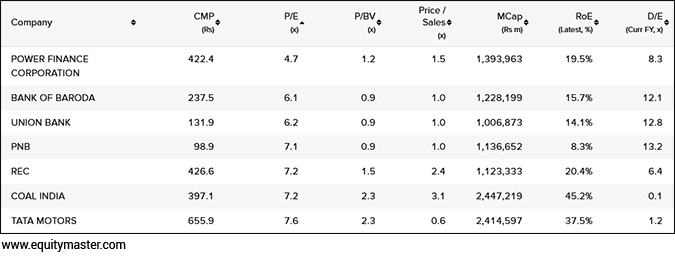
Snapshot of Value Stocks in India
--- Advertisement ---
Investment in securities market are subject to market risks. Read all the related documents carefully before investing
Which businesses are most likely to emerge stronger over the next 3 to 5 years?
After screening thousands of listed companies, comparing industries, and examining balance sheets...
Our research team discovered some of the strongest opportunities in what we call... Essential Stocks.
Opportunities like this do not remain hidden forever.
Disclaimer: This article is for information purposes only. It is not a stock recommendation and should not be treated as such. Learn more about our recommendation services here...
ABOUT EQUITYMASTER
Since 1996, Equitymaster has been the source for honest and credible opinions on investing in India. With solid research and in-depth analysis Equitymaster is dedicated towards making its readers- smarter, more confident and richer every day. Here's why hundreds of thousands of readers spread across more than 70 countries Trust Equitymaster.
PREMIUM PRODUCTS
- Hidden Treasure
- Forever Stocks
- Big Wave Profits
- Equitymaster Venture
- Microcap Millionaires
- Momentum Profits
- Double Income
- Midcap Value Alert
- Exponential Profits
- Annual Breakout Alert
- Lazy Millionaire
- Phase One Alert
- Smallcap AlphaQuest
- InsiderPro Stocks
- StockSelect
- Private Briefing
- Active Wealth Multiplier 2030
- FundSelect
- Fund Advantage
QUICK LINKS
POPULAR TOPICS
- Multibagger Penny Stocks
- Basics of Value Investing
- Benjamin Graham
- How to Invest in Gold
- How to Invest in Silver
- Best Stocks to Buy Today
- Best Small-cap Stocks to Buy
- Best Bluechip Stocks to Buy
- Guide to Penny Stocks
- How to Invest in the Share Market
- Warren Buffett - The Value Investor
- Pick the Best Multibagger Stocks
TRENDING TOPICS
- Best Defence Stocks in India
- Upcoming Dividend Stocks
- Best Semiconductor Stocks in India
- Data Center Stocks in India
- Best Railway Stocks in India
- Best Solar Stocks in India
- Fastest Growing Stocks in India
- List of BSE Sensex 30 Stocks
- Adani Group Shares
- Stocks Recently Bought by FIIs in India
- Top Value Stocks in India


LEGAL DISCLAIMER:
Investment in securities market are subject to market risks. Read all the related documents carefully before investing.
Registration granted by SEBI, enlistment with BSE as IA and RA, and certification from NISM in no way guarantee performance of the intermediary or provide any assurance of returns to investors.
All rights reserved. Any act of copying, reproducing or distributing any content from this website whether wholly or in part, for any purpose without the permission of Quantum Information Services Private Limited is strictly prohibited and shall be deemed to be copyright infringement.
Quantum Information Services Private Limited (QIS) is a SEBI registered Research Analyst (bearing registration no INH000021128) and Investment Adviser(Reg. No: INA000000680). Consequent upon the merger of Equitymaster Research Private Limited into QIS, effective October 30, 2025 QIS owns and operates brand 'Equitymaster' and website www.equitymaster.com. This does not constitute or is not intended to constitute an offer to buy or sell, or a solicitation to an offer to buy or sell financial products, units or securities and QIS including its employees, personnel, directors, associates will not be liable for any losses (direct or indirect) incurred or investment(s) made or decisions taken/or not taken based on the information provided herein. All content and information is provided on an 'As Is' basis by QIS. Information herein is believed to be reliable but QIS does not warrant its completeness or accuracy and expressly disclaims all warranties and conditions of any kind, whether express or implied. The services rendered by QIS are on a best effort basis. QIS does not assure or guarantee the user any minimum or fixed returns. The securities quoted, if any are for illustration only and are not recommendatory. Use of this information is at the user's own risk. The user must make his own investment decisions based on his specific investment objective and financial position and using such independent advisors as he believes necessary. This is not directed for access or use by anyone in a country, especially, USA, Canada or the European Union countries, where such use or access is unlawful or which may subject QIS or its affiliates to any registration or licensing requirement.
The performance data quoted represents past performance and does not guarantee future results. As a condition to accessing QIS's content and website, you agree to our Terms and Conditions of Use, available here
Equitymaster requests your view! Post a comment on "Top 5 Value Investing Stocks to Watch Out for in 2025". Click here!
Comments are moderated by Equitymaster, in accordance with the Terms of Use, and may not appear
on this article until they have been reviewed and deemed appropriate for posting.
In the meantime, you may want to share this article with your friends!