


Equitymaster's 2026 Grand Festive Offer
Two Research Reports, Six Stocks
3 Small Cap, 3 Large Cap
**Important: We hate spam as much as you do. Check out our Privacy Policy and Terms Of Use.
How to Look for Healthy Option in QSR Stocks 
What differentiates Quick Service Restaurants (QSRs) is the set up. Setting up a Full-Service Restaurant is time-consuming and resource-heavy, QSRs boast an asset-light business model compared to its full-fledged counterpart.
It is also beneficial for the QSRs that most are either self-servicing or take-aways, reducing the necessity for wait staff and allowing them to function well on a skeletal team just to run the kitchen.
Are you familiar with the acronym QSR? Well, if you aren't maybe you should.
Food and Indians have a unique relationship. The food market in India has grown steadily, and in 2018 it was valued at Rs 3.7 trillion, with about 10 per cent annual growth. Casual dining restaurants and QSR (Quick Service Restaurants) account for more than 74 per cent of the market and are growing exponentially. The term QSR or Quick Service Restaurants literally denotes the future of Indian restaurants.

Quick Service Restaurants are the chain models. Most of the restaurants are established where the footfall are high, which is why you will find these places near the movie theatre or shopping malls. To reduce cooking time, most of the food items are prepared in central kitchens.
The QSR segment is experiencing growth as a result of technological innovations as well, like improved Point of Sale(POS) systems, varied payment options, and improved geolocation to aid the delivery segment.
The take-away segment is expected to grow at ~18.0%, and the home delivery segment is expected to grow at around 17.4% between FY 2022 and 2025.

- QSR brands have been most commonly seen in mega and mini-metros, as far as the number of outlets goes, with around 50% of their total branches being centered around these areas. For the sake of growth, however, attempts have been made to make headway into tier-1 cities over the last decade, with presence in smaller cities being seen only in the more recent years.
- With increasing digitisation and penetration of smartphones QSRs might have an easier time getting established in these new domains they set foot in.
- Rapid urbanisation and employment opportunities resulting from it have generated higher disposable incoms. As a result, people have become more open to spending on eating out rather than eating at home.
Most importantly...what differentiates QSRs is the set up. Setting up a Full-Service Restaurant is time-consuming and resource-heavy, QSRs boast an asset-light business model compared to its full-fledged counterpart.
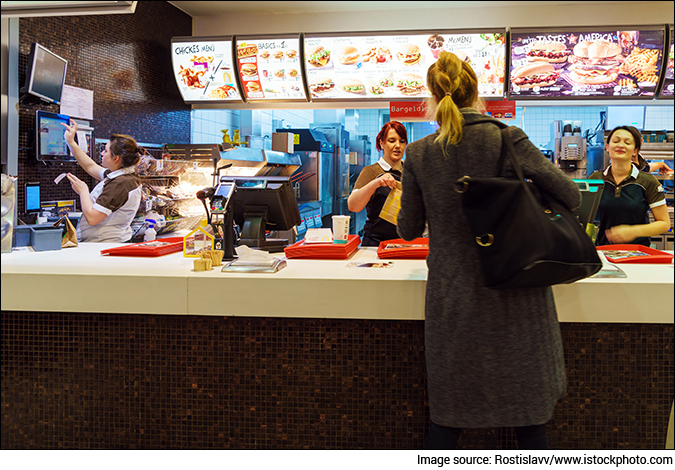
It is also beneficial for the QSRs that most are either self-servicing or take-aways, reducing the necessity for wait staff and allowing them to function well on a skeletal team just to run the kitchen.
Now, over the years there are several QSR stocks that have got listed and each has its unique positioning.
You can see the basic financials of some of the top QSR stocks here.
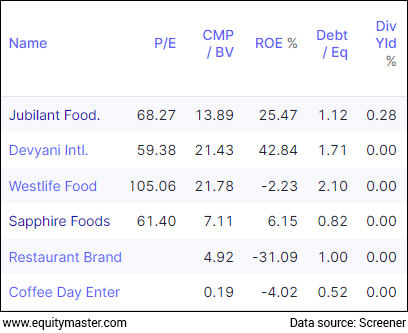
One such QSR stocks that commands a significant premium over its peers in Jubilant Foodworks.
Jubilant FoodWorks, part of the Jubilant Bhartia group, is one of India's largest food service companies. It holds the franchise rights for two international brands, Domino's Pizza and Dunkin' Donuts. The company also launched its first homegrown brand - Hong's Kitchen in Chinese cuisine segment.

When a business derives 56% of revenues from 15% of its customers, it's clear that the business is heavily user dependent.
So, what does the business do to retain high value customers without compromising on margins? It offers a Loyalty program.
The loyalty program can help retain these customers when competition is increasing among organised players. Plus, it can drive higher order frequency.
Retention of these customers and higher order frequency may drive growth (higher number of orders) as well as profitability (operating leverage).
Despite the incremental costs of loyalty program, the margins are retained, as these costs replace some of the promotional expenses incurred in normal course.
Secondly, the loyalty program is also likely to drive higher traffic to the business' app. The customer can receive loyalty points across platforms but the rewards can only be redeemed through company's app. Higher customer traffic in own app can be a long-term competitive advantage.
So, Jubilant FoodWorks launched a simple milestone-based loyalty program (Cheesy Rewards) in 2022. Hereby, customers could get a free pizza after every sixth eligible orders.
This was a well thought out post pandemic plan that allowed Jubilant FoodWorks (owner of pizza brand Domino's) to bounce back from competition and inflation woes that had begun to threaten growth and profits.
The loyalty program was very successful with enrolments crossing 10.6 m and order contribution from them stood at nearly 40% by December 2022.
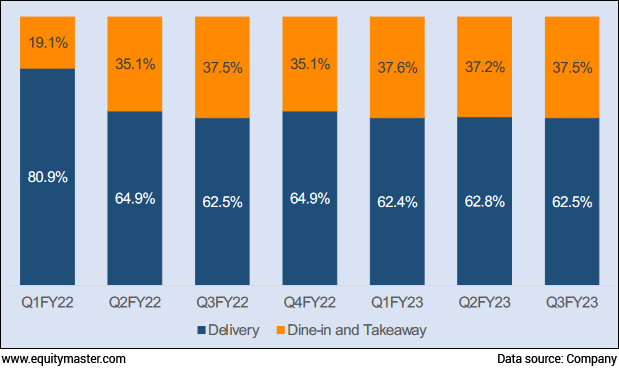
Jubilant FoodWorks' Channel Mix
Plus, as the cost of loyalty program rewards were booked as discounts to customers, the program was not margin dilutive.
Jubilant FoodWorks has the largest market share in the pizza segment and is one of the leading players in the food service industry. Since 1995, the company has exclusive rights with Domino's Pizza, to develop, establish, own and operate restaurants in India. Plus, it now has franchises in Sri Lanka Bangladesh and Nepal too.
Jubilant FoodWorks also operates Dunkin' franchise in India since 2012 and has gained exclusive rights to develop, own and operate Popeyes restaurants in India, Nepal and Bhutan since 2022. The company has managed to sustain and grow through continued addition of stores and brand portfolio, increased consumer preference, growth in online sales and menu innovation.
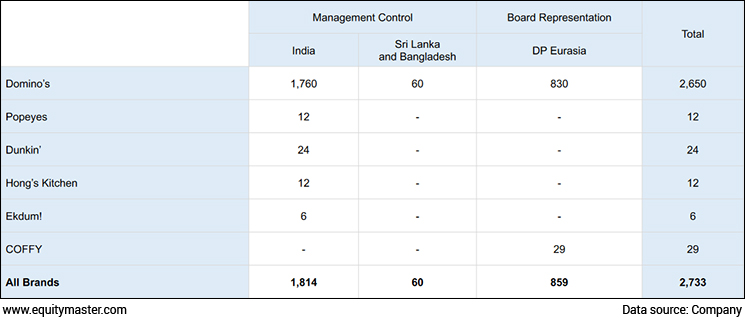
Jubilant FoodWorks' Network of Brands
During the pandemic, the compulsion to stay indoors eventually accelerated the consumer shift towards online food ordering. Most importantly, it made non-home food much more acceptable outside special occasions, especially in the smaller towns.
Post pandemic, the dine-In and on-premise consumption trends have certainly returned. But at the same time, delivery and takeaway channel adoption remain elevated.
Secular trends of young population, rising urbanisation, growing affluence, accelerated shifts towards digitalisation and shift in favour of the organised sector are the biggest catalysts favouring the business of Jubilant FoodWorks.
Jubilant is also set for massive Growth in Physical and Digital Presence
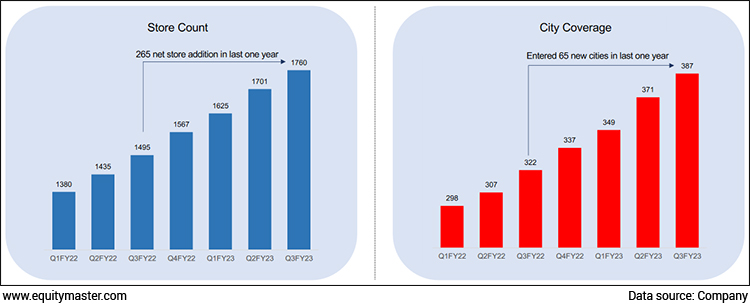
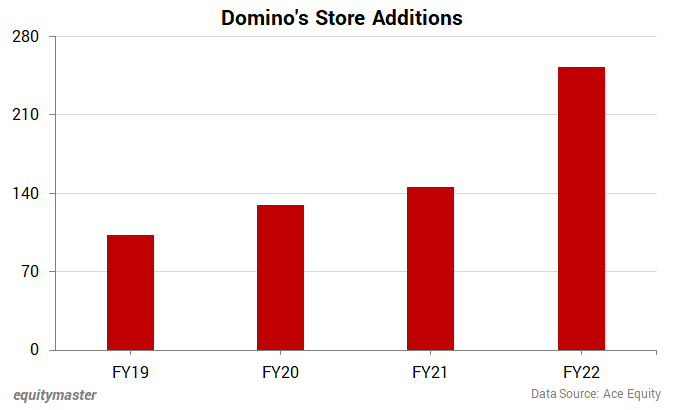
Jubilant FoodWorks had cited plans to open 250 Domino's stores by the end of 2023. Its competition (Sapphire Foods and Devyani International) have also been aggressively opening Pizza Hut Stores.
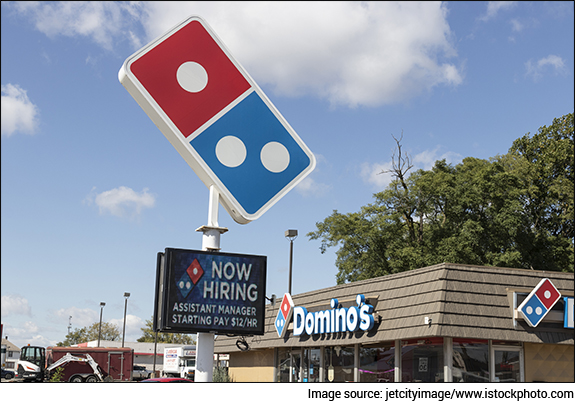
Domino's is likely to open a greater number of stores as compared to Pizza Hut in India this year. At the same time it plans to shrink delivery radiuses, and thus delivery time, putting stores as close as possible to as many customers as possible.
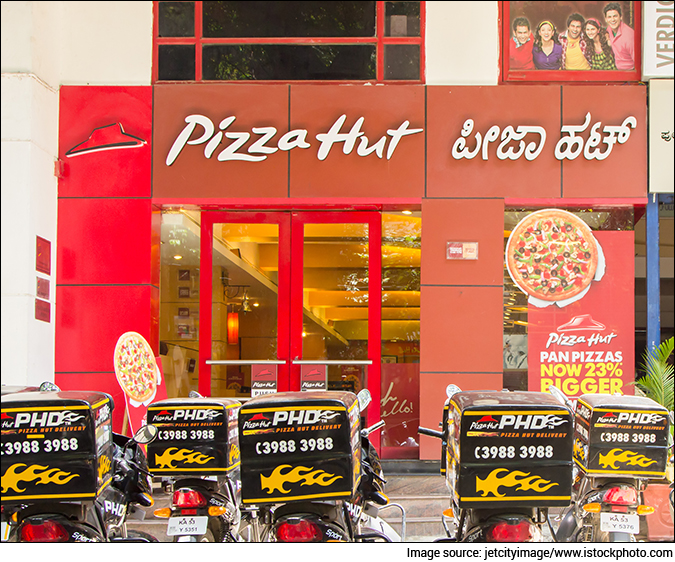
Thus, Jubilant FoodWorks is well placed to stand out from the crowd in the intensely competitive food service industry.
Growth in Network Franchise
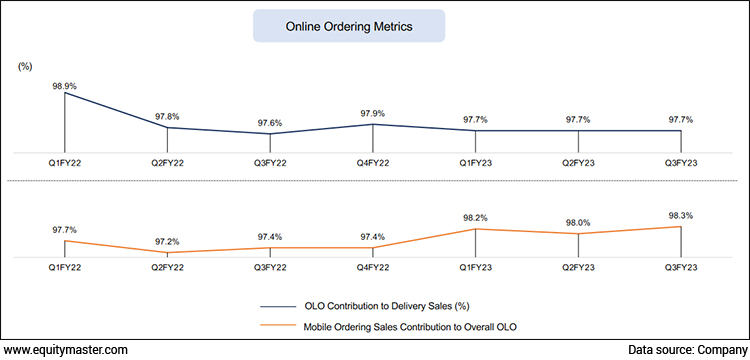
The technology investments of the company have also paid off. Domino's app has gained traction. The cumulative app downloads have increased by 4.4 times in three years.
But there are also some concerns that one must keep in mind for Jubilant FoodWorks
Revenue Concentration in Domino's
Domino's has contributed a major portion to Jubilant FoodWorks' revenue historically. The company intends to meaningfully transform into a multi-brand multi-country food service entity.
Multiple brand launches - Dunkin' in 2012, Hong's Kitchen - 2019, Ekdum! - 2020 and Popeyes in 2022 - demonstrate that the company is trying to establish new growth vectors.
While Domino's with 2,650 stores remains the flagship brand and growth driver, the company had a meaningful network of 83 stores of other brands in India by the end of December 2022.
Execution Risk
The management of Jubilant FoodWorks' is focusing on growth in operations in Bangladesh and Sri Lanka where it can leverage the Domino's brand. It also plans to scale up new brands such as Popeyes for which Jubilant FoodWorks' has the right to operate in India, Bangladesh, Nepal and Bhutan.
Furthe, the management is repositioning the Dunkin' brand with a coffee-first brand in line with the global positioning by its franchisor - Inspire Brands.
As per Jubilant FoodWorks' management, the company plans to expand its brand portfolio, along with geographical diversification of operations,. This may expose the company to execution risks. Having said that the company's experience of over 25 years of running quick service restaurant brands profitably while generating free cash flow offers margin of safety.
Important to note that the debt-to-equity ratio of the company at about 1.1x also remains a key execution risk for the company.
Competitive Pressure and Raw Material Cost Inflation
Jubilant FoodWorks' witnessed intense pressure on operating margins in FY23 due to inflation in input costs. Thus, the business is exposed to competition from both organised and unorganised quick service restaurants. While, the company's scale, brand and penetration level allow it to take moderate price hikes and negotiate with suppliers over time, temporary margin pressures cannot be ruled out.
Now what is unique about Jubilant FoodWorks' compared to its listed peers?
The QSR business segment is very competitive in India. There are several new stores opening and several others closing every day but Jubilant has secured a niche position in the market. Currently, its competitors in the QSR segment are Westlife Development (McDonald's), Devyani International (KFC, Pizza hut, Costa coffee), Burger King, Subway, and others. Most of the other listed players have very little track record of consistent profitability like Jubilant.
Jubilant Foodworks has built such a successful franchisee model which wouldn't have been possible without a supply chain center. Jubilant has 8 supply chain centers. Supply chain centers have strict quality standards and that's why the company's food items taste fresh and uniform.
The stock of Jubilant Foodworks gained 4x in the past decade. Question is whether the stock can continue to create value despite inflation and stiff competition.
Despite the post pandemic business recovery, the stock Jubilant Foodworks has almost halved in the past 18 months. It is important to study the fundamentals and future prospects carefully before taking a call on the valuations of the stock.
Please note this is not a view on the stock. Please do your due diligence carefully and consult your investment advisor before allocating to any QSR stock.
Hope you like this video. Thanks for watching.

Tanushree Banerjee (Research Analyst), is the editor of Stock Select and Forever Stocks. Tanushree started her career at Equitymaster covering the banking and financial sector stocks and scrutinising RBI policies. Over the last decade, she developed Equitymaster's research processes that helped us pick out various multibaggers, across all sectors. A firm believer of "safety first" when it comes to investing, Tanushree closely follows the investing philosophies of Warren Buffett, Jeremy Grantham, and Joel Greenblatt.
ABOUT EQUITYMASTER
Since 1996, Equitymaster has been the source for honest and credible opinions on investing in India. With solid research and in-depth analysis Equitymaster is dedicated towards making its readers- smarter, more confident and richer every day. Here's why hundreds of thousands of readers spread across more than 70 countries Trust Equitymaster.
PREMIUM PRODUCTS
- Hidden Treasure
- Forever Stocks
- Super Sector Stocks
- Equitymaster Venture
- Microcap Millionaires
- Momentum Profits
- Double Income
- Midcap Value Alert
- Exponential Profits
- Annual Breakout Alert
- Lazy Millionaire
- Phase One Alert
- Smallcap AlphaQuest
- InsiderPro Stocks
- StockSelect
- Private Briefing
- Active Wealth Multiplier 2030
- FundSelect
- Fund Advantage
QUICK LINKS
POPULAR TOPICS
- Multibagger Penny Stocks
- Basics of Value Investing
- Benjamin Graham
- How to Invest in Gold
- How to Invest in Silver
- Best Stocks to Buy Today
- Best Small-cap Stocks to Buy
- Best Bluechip Stocks to Buy
- Guide to Penny Stocks
- How to Invest in the Share Market
- Warren Buffett - The Value Investor
- Pick the Best Multibagger Stocks
TRENDING TOPICS
- Best Defence Stocks in India
- Upcoming Dividend Stocks
- Best Semiconductor Stocks in India
- Data Center Stocks in India
- Best Railway Stocks in India
- Best Solar Stocks in India
- Fastest Growing Stocks in India
- List of BSE Sensex 30 Stocks
- Adani Group Shares
- Stocks Recently Bought by FIIs in India
- Top Value Stocks in India


LEGAL DISCLAIMER:
Investment in securities market are subject to market risks. Read all the related documents carefully before investing.
Registration granted by SEBI, enlistment with BSE as IA and RA, and certification from NISM in no way guarantee performance of the intermediary or provide any assurance of returns to investors.
All rights reserved. Any act of copying, reproducing or distributing any content from this website whether wholly or in part, for any purpose without the permission of Quantum Information Services Private Limited is strictly prohibited and shall be deemed to be copyright infringement.
Quantum Information Services Private Limited (QIS) is a SEBI registered Research Analyst (bearing registration no INH000021128) and Investment Adviser(Reg. No: INA000000680). Consequent upon the merger of Equitymaster Research Private Limited into QIS, effective October 30, 2025 QIS owns and operates brand 'Equitymaster' and website www.equitymaster.com. This does not constitute or is not intended to constitute an offer to buy or sell, or a solicitation to an offer to buy or sell financial products, units or securities and QIS including its employees, personnel, directors, associates will not be liable for any losses (direct or indirect) incurred or investment(s) made or decisions taken/or not taken based on the information provided herein. All content and information is provided on an 'As Is' basis by QIS. Information herein is believed to be reliable but QIS does not warrant its completeness or accuracy and expressly disclaims all warranties and conditions of any kind, whether express or implied. The services rendered by QIS are on a best effort basis. QIS does not assure or guarantee the user any minimum or fixed returns. The securities quoted, if any are for illustration only and are not recommendatory. Use of this information is at the user's own risk. The user must make his own investment decisions based on his specific investment objective and financial position and using such independent advisors as he believes necessary. This is not directed for access or use by anyone in a country, especially, USA, Canada or the European Union countries, where such use or access is unlawful or which may subject QIS or its affiliates to any registration or licensing requirement.
The performance data quoted represents past performance and does not guarantee future results. As a condition to accessing QIS's content and website, you agree to our Terms and Conditions of Use, available here
Equitymaster requests your view! Post a comment on "How to Look for Healthy Option in QSR Stocks". Click here!
Comments are moderated by Equitymaster, in accordance with the Terms of Use, and may not appear
on this article until they have been reviewed and deemed appropriate for posting.
In the meantime, you may want to share this article with your friends!