

Investment in securities market are subject to market risks. Read all the related documents carefully before investing
India's Bull Market
Has The Pause Finally Ended?
Global developments could be setting the stage for a new rally
**Important: We hate spam as much as you do. Check out our Privacy Policy and Terms Of Use.
5 Penny Stocks Recently Bought by FIIs and DIIs to Watch Out for in 2025
 Image source: Darren415/www.istockphoto.com
Penny stocks are like the underdogs of the stock market - low in price, high in potential, and often overlooked.
They are priced at less than Rs 100 per share and have a market cap of less than Rs 1,000 crore.
Investing in them could either result in significant gains or steep losses making them unsuitable for the faint hearted investors.
Owing to their ability to make quick profits in a very short period, penny stocks have caught the attention of institutional investors like Foreign Institutional Investors (FII) and Domestic Institutional Investors (DII).
In March 2025, institutional investors turned net buyers, reversing the trend in the last 11 months.
With FIIs and DIIs showing interest in the stock market, we decided to shortlist five penny stocks that they are betting on.
Take a look...
#1 Uco Bank
First on the list is Uco Bank, a public sector bank.
It is engaged in providing a wide range of banking and financial services, including retail banking, corporate banking, and treasury operations.
As of December 2024, the bank has 3,263 domestic branches, three representative offices overseas, 2,478 ATMs and 10,653 business correspondents.
It has a retail loan book of over Rs 500 billion (bn) and corporate advances worth Rs 690 bn. The company also has a strong MSME portfolio worth Rs 362 bn.
The latest shareholding data for UCO Bank shows an increase of 4.03% in DII ownership, taking it from 1.33% in the December 2024 quarter to 5.36% in the March 2025 quarter. This is primarily because LIC, banks, and other institutional investors have increased their stake in the company.
On the other hand, the FII ownership has increased by 0.42% in the same quarter.
However, the government of India, the promoter, has reduced its stake by 4.44% during the quarter. This is primarily because the regulation on the minimum public shareholding being 25%. In line with this move, the lenders have been allotted shares under qualified institutional placement (QIP).
Moreover, the bank is planning to issue fresh shares up to Rs 2.7 bn to bring down the government's stake to 75%.
Going forward, the bank is focussing on improving its asset quality and profitability by focussing on low cost deposits and retail term deposits and reduce dependence on bulk deposits. It also plans to focus on flagship products such as agri gold loans and horticulture loans to improve its business.
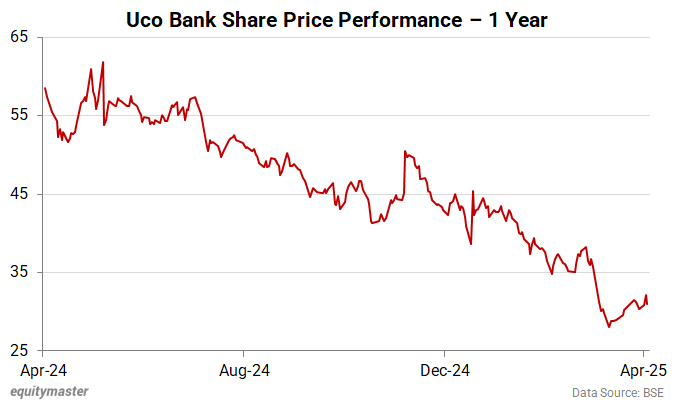
For more details, check out Uco Bank's financial factsheet and latest quarterly results.
#2 Punjab and Sind Bank
Second on the list is Punjab and Sind Bank.
This public sector bank is engaged in the business of deposits, loans and advances, and remittance collections.
As of March 2025, the company has a network of 1,610 branches, 1,047 ATMs and 2,041 business correspondents across 367 districts in India.
Over the years, the company has been reducing its share of corporate loans and increasing the share of other loans to make its loan book more diversified.
It has also reduced its net NPAs in financial year 2025 by over Rs 35 bn, improving its asset quality.
The latest shareholding data for Punjab and Sind Bank shows an increase of 3.67% in DII ownership, taking it from 0.65% in the December 2024 quarter to 4.32% in the March 2025 quarter. This is primarily because insurance companies, banks and other institutional investors have increased their stake in the company in the March 2025 quarter.
On the other hand, the FII ownership has increased by 0.7% in the same quarter.
However, the promoter (the government of India) has reduced its stake by 4.4% in the quarter to meet the minimum public shareholding regulation of 25%. The government stake will further go down to 75% by 2026.
Going forward, the bank plans to add more branches to its network. It continues to focus on improving its asset quality across retail, agri, and MSME categories.
The company also plans to expand its digital portfolio by adding more digital products such as car loans, home loans and MSME loans.
It has introduced several new initiatives to move to digital transactions, it plans to introduce more including tab banking, UPI lite, and central bank digital currency in financial year 2026.
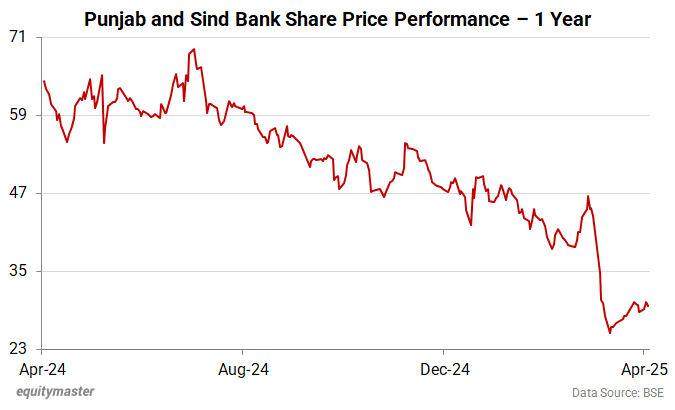
For more details, check out Punjab and Sind Bank's financial factsheet and latest quarterly results.
#3 Central Bank of India
Next on the list is another public sector bank, the Central Bank of India.
The bank is engaged in offering treasury operations, corporate and wholesale banking, and retail banking.
It has over 4,545 branches with majority of them in rural and semi urban areas. The bank also has 4,085 ATMs and 12,260 business correspondents.
The company has diversified loan book worth over Rs 3,724 bn covering retail, agri, corporate and MSME loans.
The latest shareholding data for Central Bank of India shows an increase of 3.05% in DII ownership, taking it from 2.82% in the December 2024 quarter to 5.87% in the March 2025 quarter. This is primarily because mutual funds, and other institutional investors have increased their stake in the company in the March 2025 quarter.
On the other hand, the FII ownership has increased by 0.9% in the same quarter.
However, the promoter (the government of India) has reduced its stake by 3.8% in the quarter from 93.08% to 89.27% to meet the minimum public shareholding regulation of 25%. The government stake will further go down to 75% by 2026 to meet the regulation.
The bank aims to achieve 10-12% in business growth and 14-15% in advance growth in FY26. It launched a new digital platform and super app with over 200 services aimed at enhancing customer engagement and operational efficiency.
Going forward, the bank aims to expand its footprint in the country and launch new products to grow its business.
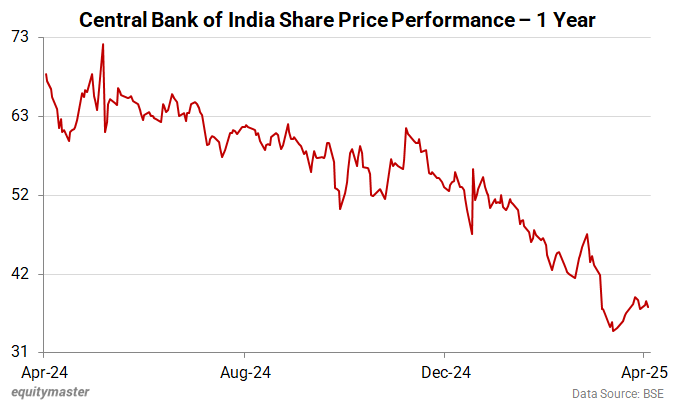
For more details, check out Central Bank of India's financial factsheet and latest quarterly results.
#4 Ujjivan Small Finance Bank
Fourth on the list is Ujjivan Small Finance Bank.
The bank started its operations as a non-banking financial company (NBFC) and now grew into a mass market bank catering to the financially unserved and underserved segments.
It mainly offers retail banking, wholesale banking and treasury services to its customers.
The bank has a network of 753 branches, 613 ATMs, and 8,000 electronic collection retail points across 326 districts in India though which it serves its 950 thousand customers.
At the end of March 2025, the gross loan book stands at Rs 321 bn and deposit base at Rs 376 bn diversified across various segments and customers.
The latest shareholding data for Ujjivan Small Finance Bank shows an increase of 1.89% in DII ownership, taking it from 6.58% in the December 2024 quarter to 8.47% in the March 2025 quarter. This is primarily because Sundaram Small Cap Mutual Fund, insurance companies, and other institutional investors have increased their stake in the company in the March 2025 quarter.
On the other hand, the FII ownership has increased by 1.64% in the same quarter primarily due to increase in take by Bowhead India Fund.
However, the promoters have completely diluted their stake in the company in May 2024. This is because the promoter, Ujjivan Financial Services Limited has reverse merged into Ujjivan Small Finance Bank as per the RBI guidelines and the rest of the shares are reclassified as institutional investors and public.
Ujjivan Small Finance Bank has an established position in micro finance space making it the third largest small finance bank in the country. To keep its leadership position intact the company is launching new products especially in the secured loans segment to grow its loan book.
It is focussing on improving its asset quality by reducing the net non-performing assets (NNPA).
Moreover, the company wants to increase the share of digital transactions and is taking various initiatives to meet its goal.
It also wants to diversify its revenue streams and increase fee and commission-based incomes.
Overall, the bank is taking several steps to grow its business in the medium term.
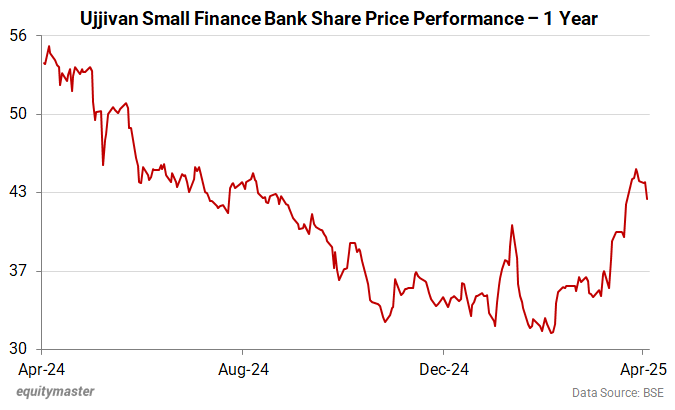
For more details, check out Ujjivan Small Finance Bank's financial factsheet and latest quarterly results.
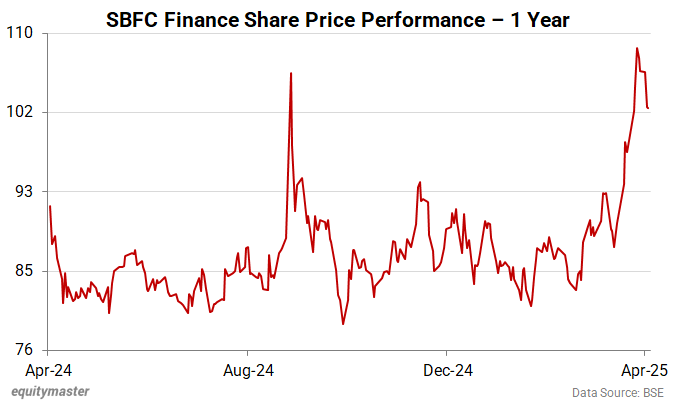
#5 SBFC Finance
Last on the list is SBFC Finance.
Incorporated in 2008, SBFC Finance is a systematically important non deposit taking NBFC. It specialises in offering secured MSME loans and loan against gold.
The company has the highest assets under management (AUM) among MSME-focused companies.
At the end of March 2025 its AUM stands at Rs 87 bn, a whopping 28% growth compared to financial year 2024.
It has a network of 205 branches across 164 cities in India, with a major presence in south India. SBFC Finance has inhouse origination of loans and has a risk management framework limiting its reliance on direct selling agents.
It also entered into a co-origination agreement with ICICI Bank which contributed to almost 21% of the disbursements of the company.
The latest shareholding data for SBFC Finance shows an increase of 1.2% in DII ownership, taking it from 16.47% in the December 2024 quarter to 17.67% in the March 2025 quarter. This is primarily because mutual funds, insurance companies, and other institutional investors have increased their stake in the company in the March 2025 quarter.
On the other hand, the FII ownership has increased by 1.61% in the same quarter.
However, the promoter holding reduced by 1.42% from 54.75% to 53.3% on account of a block deal where the promoters sold over 1 crore equity shares at Rs 82 per share.
Despite a reduction in promoter holding, the management is positive about its growth and gave a guidance of around 5-7%. The company expects to achieve RoE (return on equity) of 15% by the end of financial year 2026 from the current 10.8% level.
It doesn't plan on launching new products and is focussing on its existing products to grow its business.
For more details, check out SBFC Finance's financial factsheet and latest quarterly results.
Conclusion
The aggressive buying of penny stocks by FIIs and DIIs indicates that the institutional investors are ready to bet on high-risk high reward opportunities in India after a very volatile period.
Several factors have led to this, the first being attractive valuations post significant market correction. A market correction has allowed the institutional investors to acquire undervalued stocks at appealing prices.
Second, positive macro indicators such as interest rate cuts will push economic growth.
Finally, diversification beyond largecaps will help FIIs and DIIs earn higher returns.
However, it's important to note that penny stocks are very volatile and are exposed to sharp price swings.
Hence to succeed, it is important for investors to do a thorough market research, focus on diversifying the portfolio, and maintain a long-term perspective to manage risks.
--- Advertisement ---
Investment in securities market are subject to market risks. Read all the related documents carefully before investing
Which businesses are most likely to emerge stronger over the next 3 to 5 years?
After screening thousands of listed companies, comparing industries, and examining balance sheets...
Our research team discovered some of the strongest opportunities in what we call... Essential Stocks.
Opportunities like this do not remain hidden forever.
Disclaimer: This article is for information purposes only. It is not a stock recommendation and should not be treated as such. Learn more about our recommendation services here...
ABOUT EQUITYMASTER
Since 1996, Equitymaster has been the source for honest and credible opinions on investing in India. With solid research and in-depth analysis Equitymaster is dedicated towards making its readers- smarter, more confident and richer every day. Here's why hundreds of thousands of readers spread across more than 70 countries Trust Equitymaster.
PREMIUM PRODUCTS
- Hidden Treasure
- Forever Stocks
- Big Wave Profits
- Equitymaster Venture
- Microcap Millionaires
- Momentum Profits
- Double Income
- Midcap Value Alert
- Exponential Profits
- Annual Breakout Alert
- Lazy Millionaire
- Phase One Alert
- Smallcap AlphaQuest
- InsiderPro Stocks
- StockSelect
- Private Briefing
- Active Wealth Multiplier 2030
- FundSelect
- Fund Advantage
QUICK LINKS
POPULAR TOPICS
- Multibagger Penny Stocks
- Basics of Value Investing
- Benjamin Graham
- How to Invest in Gold
- How to Invest in Silver
- Best Stocks to Buy Today
- Best Small-cap Stocks to Buy
- Best Bluechip Stocks to Buy
- Guide to Penny Stocks
- How to Invest in the Share Market
- Warren Buffett - The Value Investor
- Pick the Best Multibagger Stocks
TRENDING TOPICS
- Best Defence Stocks in India
- Upcoming Dividend Stocks
- Best Semiconductor Stocks in India
- Data Center Stocks in India
- Best Railway Stocks in India
- Best Solar Stocks in India
- Fastest Growing Stocks in India
- List of BSE Sensex 30 Stocks
- Adani Group Shares
- Stocks Recently Bought by FIIs in India
- Top Value Stocks in India


LEGAL DISCLAIMER:
Investment in securities market are subject to market risks. Read all the related documents carefully before investing.
Registration granted by SEBI, enlistment with BSE as IA and RA, and certification from NISM in no way guarantee performance of the intermediary or provide any assurance of returns to investors.
All rights reserved. Any act of copying, reproducing or distributing any content from this website whether wholly or in part, for any purpose without the permission of Quantum Information Services Private Limited is strictly prohibited and shall be deemed to be copyright infringement.
Quantum Information Services Private Limited (QIS) is a SEBI registered Research Analyst (bearing registration no INH000021128) and Investment Adviser(Reg. No: INA000000680). Consequent upon the merger of Equitymaster Research Private Limited into QIS, effective October 30, 2025 QIS owns and operates brand 'Equitymaster' and website www.equitymaster.com. This does not constitute or is not intended to constitute an offer to buy or sell, or a solicitation to an offer to buy or sell financial products, units or securities and QIS including its employees, personnel, directors, associates will not be liable for any losses (direct or indirect) incurred or investment(s) made or decisions taken/or not taken based on the information provided herein. All content and information is provided on an 'As Is' basis by QIS. Information herein is believed to be reliable but QIS does not warrant its completeness or accuracy and expressly disclaims all warranties and conditions of any kind, whether express or implied. The services rendered by QIS are on a best effort basis. QIS does not assure or guarantee the user any minimum or fixed returns. The securities quoted, if any are for illustration only and are not recommendatory. Use of this information is at the user's own risk. The user must make his own investment decisions based on his specific investment objective and financial position and using such independent advisors as he believes necessary. This is not directed for access or use by anyone in a country, especially, USA, Canada or the European Union countries, where such use or access is unlawful or which may subject QIS or its affiliates to any registration or licensing requirement.
The performance data quoted represents past performance and does not guarantee future results. As a condition to accessing QIS's content and website, you agree to our Terms and Conditions of Use, available here
Equitymaster requests your view! Post a comment on "5 Penny Stocks Recently Bought by FIIs and DIIs to Watch Out for in 2025". Click here!
Comments are moderated by Equitymaster, in accordance with the Terms of Use, and may not appear
on this article until they have been reviewed and deemed appropriate for posting.
In the meantime, you may want to share this article with your friends!