


Equitymaster's 2026 Grand Festive Offer
Two Research Reports, Six Stocks
3 Small Cap, 3 Large Cap
**Important: We hate spam as much as you do. Check out our Privacy Policy and Terms Of Use.
Pros and Cons of Investing in Vedanta
 Vedanta logo source: https://www.vedantalimited.com/
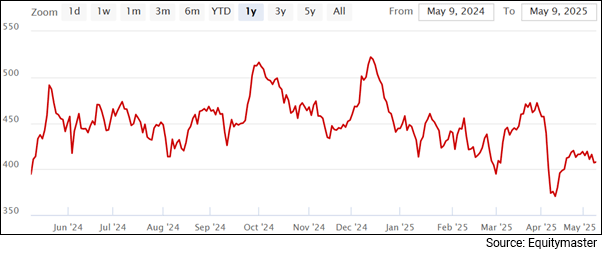
The share price of Vedanta has not set the Indian stock market on fire recently, even though the long term returns are good.
Since the lows of the covid crash in March 2020, the stock has delivered a compounded annual growth rate (CAGR) of about 45%. The share price went up about 7 times before the recent correction over the last few months.
Investors have been extremely bullish on the stock since late 2023 when the stock went on a vertical upmove. This was due to the news of the demerger/restructuring plan announced by the management. The plan was approved in February 2025.
But over the last year or so, the stock has been a bit of a laggard. While not suffering from a major decline, the stock has not moved up either.
Vedanta Share Price - 1 Year
So, what's the outlook for the stock today? Can investors finally consider it now?
In this editorial, we will discuss the pros and cons of investing in the stock of Vedanta.
Pros
#1 Upcoming Demerger
The company is undergoing a major restructuring which is expected to unlock value for shareholders.
The board of the company approved a demerger plan to split the company into separate entities. The original demerger plan was to demerge it into 6 entities which was reduced to 5 entities. Latest media reports suggest the company might settle for a demerger into 4 entities.
Every new entities will house key sub-segments, such as aluminium, oil & gas, power, steel & ferrous, base metals, Hindustan Zinc, and new segments. The parent company will likely retain some existing businesses. At present, Vedanta Ltd and Hindustan Zinc are the only listed entities.
Under the demerger, the shareholders of Vedanta will receive one share of each of the new companies for every share of Vedanta.
The idea behind this demerger is to enable each business to pursue its own strategic initiatives.
The company believes this will simplify the group's structure, allowing direct access for investors to invest in pure plays. It expects to generate more value over the long-term, through multiple expansions of the pure-play entities.
On 18 February 2025, Vedanta held meetings with its shareholders, secured creditors, and unsecured creditors, all of whom overwhelmingly supported the restructuring plan. The management expects to complete the entire process by September 2025.
While the plan is now in motion, it remains subject to statutory, government, and regulatory approvals.
If executed successfully, this demerger could pave the way for a more agile and growth-driven Vedanta Group in the years ahead.
#2 Improving Financials
The company is not well-known for having great fundamentals.
Debt levels have been high. Margins have fluctuated wildly. Sales growth has been lumpy. And the company has reported losses in the past.
But things have improved over the last few years.
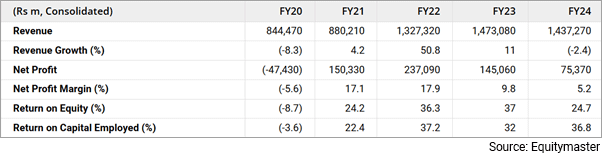
Between 2020 to 2024, Vedanta's net sales have grown 9.3%, while the bottomline has turned profitable. This has been due to a focus on cost control and a production ramp-up across its businesses.
The average RoE and RoCE between 2020 and 2024 have been at 24.4% and 25%, respectively.
Vedanta's Financial Snapshot (FY22-24)
In FY25, Vedanta reported a consolidated profit of Rs 250.09 billion (bn), nearly double that of the year before. Revenue grew about 10% to Rs 1.5 trillion. Ebitda was 37% higher at Rs 435.41 bn, with an Ebitda margin of 34%.
Vedanta also recorded its ever-highest annual production of aluminium at 2,422 KT. The company's Indian zinc operations achieved highest ever mined and refined metal production at 1,095 KT and 1,052 KT respectively.
Cons
#1 External Factors
The imposition of tariffs by the Trump administration, particularly on metals like copper, zinc, nickel, and tin, has raised concerns about increased costs and reduced demand.
Weaker demand growth in China, combined with supply gluts, is likely to pose a challenge for metal prices and asset values.
Also, global economic growth forecasts are being revised downward, with fears of a US recession.
This economic uncertainty has negatively impacted investor sentiment leading to muted sentiment on Dalal Street regarding metal and mining stocks.
#2 High Debt
As per to the company's latest investor presentation, net debt stands at Rs 535.21 bn and the net debt to Ebitda ratio is 1.2.
Both are very high figures which should be cause for concern for investors. The demerger plan intends to reduce the debt burden on the demerged entities. However, the details of the same are awaited.
About Vedanta
Vedanta is engaged in the exploration, production, and sale of minerals such as zinc, lead, silver, copper, aluminium, iron ore, and oil & gas.
It also operates in commercial power generation, steel manufacturing, and port operations in India, as well as glass substrate manufacturing in South Korea and Taiwan.
Vedanta has strategic assets in India, South Africa, Namibia, and operational presence in the US, Asia-Pacific, Europe, the Middle East, and Africa.
To make informed investing decisions, it's crucial to assess the company's fundamentals, including its financial performance, corporate governance practices, and growth prospects, rather than relying solely on hype or market speculation.
For more details, checkout the Vedanta company fact sheet and quarterly results.
We have recently covered a detailed dividend editorial comparing Vedanta and NALCO. Do take a look.
You can also compare Vedanta with its peers.
To know what's moving the Indian stock markets today, check out the most recent share market updates here.
Happy investing.
Disclaimer: This article is for information purposes only. It is not a stock recommendation and should not be treated as such. Learn more about our recommendation services here...
ABOUT EQUITYMASTER
Since 1996, Equitymaster has been the source for honest and credible opinions on investing in India. With solid research and in-depth analysis Equitymaster is dedicated towards making its readers- smarter, more confident and richer every day. Here's why hundreds of thousands of readers spread across more than 70 countries Trust Equitymaster.
PREMIUM PRODUCTS
- Hidden Treasure
- Forever Stocks
- Big Wave Profits
- Equitymaster Venture
- Microcap Millionaires
- Momentum Profits
- Double Income
- Midcap Value Alert
- Exponential Profits
- Annual Breakout Alert
- Lazy Millionaire
- Phase One Alert
- Smallcap AlphaQuest
- InsiderPro Stocks
- StockSelect
- Private Briefing
- Active Wealth Multiplier 2030
- FundSelect
- Fund Advantage
QUICK LINKS
POPULAR TOPICS
- Multibagger Penny Stocks
- Basics of Value Investing
- Benjamin Graham
- How to Invest in Gold
- How to Invest in Silver
- Best Stocks to Buy Today
- Best Small-cap Stocks to Buy
- Best Bluechip Stocks to Buy
- Guide to Penny Stocks
- How to Invest in the Share Market
- Warren Buffett - The Value Investor
- Pick the Best Multibagger Stocks
TRENDING TOPICS
- Best Defence Stocks in India
- Upcoming Dividend Stocks
- Best Semiconductor Stocks in India
- Data Center Stocks in India
- Best Railway Stocks in India
- Best Solar Stocks in India
- Fastest Growing Stocks in India
- List of BSE Sensex 30 Stocks
- Adani Group Shares
- Stocks Recently Bought by FIIs in India
- Top Value Stocks in India


LEGAL DISCLAIMER:
Investment in securities market are subject to market risks. Read all the related documents carefully before investing.
Registration granted by SEBI, enlistment with BSE as IA and RA, and certification from NISM in no way guarantee performance of the intermediary or provide any assurance of returns to investors.
All rights reserved. Any act of copying, reproducing or distributing any content from this website whether wholly or in part, for any purpose without the permission of Quantum Information Services Private Limited is strictly prohibited and shall be deemed to be copyright infringement.
Quantum Information Services Private Limited (QIS) is a SEBI registered Research Analyst (bearing registration no INH000021128) and Investment Adviser(Reg. No: INA000000680). Consequent upon the merger of Equitymaster Research Private Limited into QIS, effective October 30, 2025 QIS owns and operates brand 'Equitymaster' and website www.equitymaster.com. This does not constitute or is not intended to constitute an offer to buy or sell, or a solicitation to an offer to buy or sell financial products, units or securities and QIS including its employees, personnel, directors, associates will not be liable for any losses (direct or indirect) incurred or investment(s) made or decisions taken/or not taken based on the information provided herein. All content and information is provided on an 'As Is' basis by QIS. Information herein is believed to be reliable but QIS does not warrant its completeness or accuracy and expressly disclaims all warranties and conditions of any kind, whether express or implied. The services rendered by QIS are on a best effort basis. QIS does not assure or guarantee the user any minimum or fixed returns. The securities quoted, if any are for illustration only and are not recommendatory. Use of this information is at the user's own risk. The user must make his own investment decisions based on his specific investment objective and financial position and using such independent advisors as he believes necessary. This is not directed for access or use by anyone in a country, especially, USA, Canada or the European Union countries, where such use or access is unlawful or which may subject QIS or its affiliates to any registration or licensing requirement.
The performance data quoted represents past performance and does not guarantee future results. As a condition to accessing QIS's content and website, you agree to our Terms and Conditions of Use, available here
Equitymaster requests your view! Post a comment on "Pros and Cons of Investing in Vedanta". Click here!
Comments are moderated by Equitymaster, in accordance with the Terms of Use, and may not appear
on this article until they have been reviewed and deemed appropriate for posting.
In the meantime, you may want to share this article with your friends!