

Investment in securities market are subject to market risks. Read all the related documents carefully before investing

Small Cap Companies
Dominating Their Domains
See Full Details**Important: We hate spam as much as you do. Check out our Privacy Policy and Terms Of Use.
Top Green Hydrogen Shares in India 2024: Green Hydrogen Companies to Add to Your Watchlist
 Image source: onurdongel/www.istockphoto.com
The Indian government recently announced a massive auction to buy 200,000 tonnes more green hydrogen-based ammonia than it originally planned on behalf of the fertiliser sector.
The decision, announced on Saturday, 22 June 2024, two weeks after the tender's launch, is a result of higher-than-expected demand for the product.
It had earlier launched a tender for ten-year contracts in which it planned to purchase 539,000 tonnes a year of green hydrogen-derived ammonia, to be split across eleven projects with delivery points across the country.
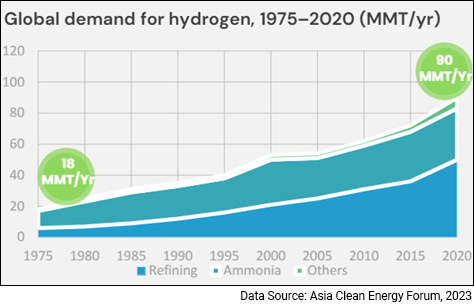
This is a significant step towards demand creation of green hydrogen and its derivatives in the country.
The Indian government had launched the National Green Hydrogen Mission on 4 January 2023 with an outlay of Rs 197 bn up to FY30.
The goal was to become Aatmanirbhar (self-reliant) through clean energy and serve as an inspiration for the global clean energy transition.
The initial demand growth for this green fuel is expected to stem from mature markets such as refineries, ammonia, and methanol, which are already using hydrogen as an industrial feedstock and in chemical processes.
In the longer term, steel and heavy-duty trucking are likely to drive most of the demand growth, accounting for almost 52% of total demand by 2050.
So, which listed companies are leading the way when it comes to green hydrogen?
Here's the entire list of green hydrogen stocks, covering the entire value chain of this futuristic fuel.
#1 Reliance Industries
First on the list is Reliance Industries.
Reliance Industries is the largest Indian private-sector corporation. It has evolved from being a textiles and polyester company to an integrated player across energy, materials, retail, telecom, entertainment, and digital services.
Reliance Industries is one of India's largest manufacturers of green hydrogen.
The company's green hydrogen is used for domestic consumption and global sales, contributing significantly to reducing carbon emissions.
Moreover, this company uses both green hydrogen and CO2 as raw materials to create a plan for developing new green chemicals, fertilisers, and e-fuels.
In line with its focus on green hydrogen, Reliance Industries signed an agreement in May 2024 with Norway's Nel ASA for sourcing technology to make electrolysers for green hydrogen production.
The agreement provides Mukesh Ambani's Reliance with an exclusive license for Nel's alkaline electrolysers in India and also allows the company to manufacture Nel's alkaline electrolysers for captive purposes globally.
Further, Reliance is building a Dhirubhai Ambani Green Energy Giga Complex over 5,000 acres in Jamnagar, Gujarat, India. Part of the complex are different giga factories, including an electrolyser manufacturing factory, for the production of green hydrogen.
The company had earlier said it is collaborating with Denmark's Stiesdal A/S for their HydroGen electrolysers manufacturing in India.
Reliance was also allotted 300 megawatts (MW) of capacity in 2024 under the government's production-linked incentive scheme (PLI) for electrolyser manufacturing.
Going forward, it plans to transition to green hydrogen production by 2025 and become net zero by 2035.
The company plans to invest Rs 750 billion (bn) over three years to set up its clean energy business.
It also plans to invest Rs 5 trillion (tn) in the next 10-15 years to set up a 100 GW renewable-energy power plant and green-hydrogen ecosystem development.
For more details, see the Reliance Industries company fact sheet and quarterly results.
#2 Adani Green Energy
Next on the list is Adani Green Energy.
The company is involved in renewable energy generation and ancillary activities.
Adani Green Energy develops, builds, owns, and operates solar and wind power projects, solar parks, hybrid power generation projects, etc.
Currently, Adani Green Energy is developing a 30 GW renewable energy plant on barren land at Khavda in Kutch of Gujarat over an area of 538 sq. km, after which it would become the planet's largest power plant regardless of the energy source.
The area of the project in Khavda is five times the size of Paris and almost as large as Mumbai.
It's a hybrid renewable energy cluster where during the morning hours, solar energy is generated and during the evening hours, wind generation is generated. It has an operationalised capacity of 2,000 MW solar energy.
Currently, the company largely exports from its existing solar module manufacturing capacity of 4 GW. Its solar modules and wind turbine manufacturing capacities are located at Mundra in Gujarat.
The company has long-term expertise in developing mega-scale renewable energy projects.
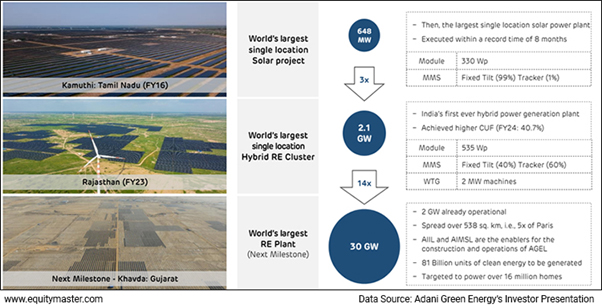
In FY25, the company plans to add 1 GW of wind turbine capacity, taking the overall wind turbine manufacturing capacity to 2.5 GW, and another 2.5 GW may be added by the end of the financial year 2027.
With this project, India is poised to avoid about 58 million tonnes of CO2 emissions annually.
Going forward, the company plans to invest about Rs 1.5 trillion (tn) by 2030.
For more details, see the Adani Green Energy company fact sheet and quarterly results.
#3 Adani Total Gas
Next on the list is Adani Total Gas.
The company is a joint venture between Adani Group and Total Energies.
While Adani Green Energy focuses on large-scale green hydrogen production, its sister company, Adani Total Gas (ATGL), is taking a different but equally crucial approach in the green hydrogen space: blending.
Adani Total is pioneering green hydrogen blending projects in India.
Their focus lies on seamlessly integrating green hydrogen with existing natural gas infrastructure.
For the same, the company in November 2023 launched a groundbreaking green hydrogen blending pilot project in Ahmedabad. This project aims to blend green hydrogen with natural gas supplied to over 4,000 residential and commercial customers.
Green hydrogen is produced using electrolysis of water with electricity generated by renewable energy. Hydrogen blending is less carbon-intensive than burning gas but has the same heating capabilities.
The project is expected to be commissioned by FY25, and the percentage of green hydrogen will be gradually increased in the blend to up to 8% or more, depending on regulatory approvals.
The Ahmedabad pilot project serves as a crucial first step. Upon successful completion, Adani Total Gas plans to gradually expand the supply of hydrogen-blended fuel to larger parts of the city and other areas under their license.
The company is actively seeking collaboration with various stakeholders, including regulatory bodies. This collaborative approach aims to share learnings from the pilot project and contribute to developing a robust green hydrogen blending ecosystem in India.
Going forward, Adani Total Gas plans to maintain a leadership position in green hydrogen blending.
For more details, see the Adani Total Gas company fact sheet and quarterly results.
#4 L&T
Next on the list is L&T.
Semiconductors, 5G telecom, renewable energy, SpaceTech, metro rail, and defence.
How many Indian companies have won orders in each of these segments recently? The only company is L&T.
The company is the most respected multinational conglomerate that operates in over 50 countries with unmatched capabilities in all its businesses, including construction, engineering, technology, and manufacturing.
The company, in March 2024, commissioned its first indigenously manufactured hydrogen electrolyser at the green hydrogen plant in Hazira, Gujarat.
This signifies L&T foray into domestic electrolyser manufacturing.
It is equipped with two stacks and an electrolyser processing unit ML-400 and offers exceptional flexibility and thermal stability.
Additionally, L&T's newly established entity, L&T Electrolysers, focuses on manufacturing pressurised alkaline electrolysers using technology from McPhy Energy in France.
The company plans to utilise its upcoming giga-scale Hazira facility to meet the increasing demand for green hydrogen while maximising product localisation through an enhanced local supply chain and automation for cost competitiveness.
Back in August 2023, it had announced that along with IOC and ReNew formed a company called GH4India Private. Each company has a 33.3% stake in GH4India.
Together, they will invest up to US$ 4 bn in their green hydrogen businesses over the next three to five years.
Apart from this, the company is working on setting up the world's largest green hydrogen plant being built by a Saudi-based green hydrogen company - NEOM Green.
Going forward, L&T plans to expand its focus on green hydrogen projects in global markets, aiming to strengthen its presence in the sustainable energy sector.
For more details about the company, check out L&T's fact sheet and quarterly results.
#5 Adani Enterprises
Next on the list is Adani Enterprises.
Building upon its success in power, oil & gas, infrastructure, and airports, Adani Enterprises is now poised to make significant inroads into the green hydrogen sector.
Adani Enterprises through its wholly owned subsidiary Adani New Industries has spent US$ 2.5 billion (bn) so far in developing a backward integrated value chain for its green hydrogen project
It's on track to implement the first phase of the project with an annual capacity of 1 m tons by FY27.
The aim is to increase the capacity to 3 m tons in the next ten years with an investment of US$ 50 bn.
The green hydrogen plant is coming up at Mundra in Gujarat.
The backward integration includes developing a fully integrated value chain across solar, wind, electrolysers, and allied equipment for the generation of green hydrogen and its associated sustainable derivatives.
Green hydrogen is one of the major thrust areas for the group, and it is spending massively on the production of supply chain products for the generation of green hydrogen such as solar-polysilicon, ingots, wafers, cell and module, and wind turbine generators.
Further, the company is committing to over US$ 50 bn over the next 10 years to build the world's largest green hydrogen ecosystem in India.
The massive investment will help Adani become a green hydrogen giant, globally and put India on the map as the cheapest producer of hydrogen.
For more details, see the Adani Enterprises company fact sheet and quarterly results.
#6 NTPC
Next on the list is NTPC.
NTPC is a key player in the power sector, producing and distributing large quantities of electricity to various utility providers.
The power giant is committed to the development of renewable energy in the country and its potential to decarbonise the energy sector.
The company in February 2024, announced plans to build the country's largest green hydrogen project in Andhra Pradesh.
Its subsidiary, NTPC Green Energy signed a land lease agreement with the Andhra Pradesh Industrial Infrastructure Corporation (APIIC), owned by the state government, to build a green hydrogen hub on 1,200 acres of land close to Pudimadaka.
NTPC is eyeing a capacity of 1,200 tonnes of green hydrogen per day.
Further, the company, in January 2024, signed an agreement with the government of Maharashtra for the development of green hydrogen and its derivatives, such as green ammonia and green methanol of up to 1 m tonne capacity per annum.
As per the statement, the agreement also includes the creation of pumped storage projects of 2 gigawatts (GW) and the development of renewable energy projects with or without storage of up to 5 GW in the state.
Furthermore, NTPC along with its renewable energy subsidiary have entered into non-binding memoranda of understanding (MoUs) with Rajasthan Rajya Vidyut Utpadan Nigam in March 2024, to enhance energy efficiency and significantly boost renewable energy production in Rajasthan.
The company has set a target of producing 150,000 tonnes of green hydrogen per year by 2030.
NTPC, which has around 3.4 GW of RE capacity throughout India, is targeting to have 60 GW by 2032. The company already has a project pipeline of 22 GW.
NTPC is also planning an initial public offering for its renewable energy subsidiary NTPC Green Energy Ltd (NGEL) to procure funds and to lay out some strategy initiatives.
For more details about the company, see the NTPC company fact sheet and quarterly results.
#7 Indian Oil Corporation (IOC)
Next on the list is the Indian Oil Corporation (IOC).
A company that was primarily dependent on fossil fuels to generate revenue, IOC is now exploring the green hydrogen space.
The management believes that oil will continue to be a dominant fuel for the next few years, but they are preparing for a transition, which will involve a combination of green hydrogen and biofuels.
The company in April 2024, relaunched tenders for its maiden green hydrogen plant to be set up in Panipat.
The company has cancelled its initial tender for the same after it led to bidders approaching the Delhi High Court.
The cancelled tender had called for a 10-kilo tonnes per annum capacity unit to be set up on a build, own operate, and transfer basis at the state-owned oil marketing company's Panipat refinery and petrochemicals complex.
In the last tender, prospective bidders had flagged a conflict of interest on IOCL's part. This was owing to GH4India Pvt Ltd, IOCL's joint venture with infrastructure and engineering major L&T.
The revised tender has removed the controversial ROFR (right of first refusal) clause, which The Independent Green Hydrogen Producers Association (IGHPA) alleged was designed in favour of IOCL's JV company GH4 India.
The new tender demands a consortium or joint venture participating in the tender to have a maximum of three members, with each having a minimum 26% stake. The previous tender didn't mandate the minimum stake requirement.
IOC also has plans to set up units at all its refineries as part of the Rs 2.4 tn green transition plan to achieve net zero carbon emission status by 2046.
The company aims to increase the share of green hydrogen in its overall hydrogen portfolio to 50% in the next 5-10 years and 100% by 2040.
IOC plans to use the green hydrogen it produces as a replacement for carbon-emitting fuels to process crude oil into value-added products such as petrol and diesel.
For more details, check out IOC's financial factsheet and its latest quarterly results.
#8 ONGC
Next on the list is Oil and Natural Gas Corporation (ONGC).
ONGC is India's largest crude oil and natural gas producer, accounting for roughly 70% of the country's domestic production.
The company is actively charting its course in the green hydrogen revolution. Like IOC, ONGC is setting its sights on becoming a major green hydrogen producer.
It has announced ambitious plans to build two green ammonia plants, each with a capacity of 1 MTPA. This translates to around 180 KTPA (Kilo Tonnes Per Annum) of green hydrogen production.
ONGC plans a phased rollout for their green hydrogen production facilities. The plants are expected to be operational by 2027, contributing significantly to India's green hydrogen targets.
Further, the company received approval from the Petroleum and Natural Gas Ministry in January 2024 for the formation of a subsidiary company for green energy and gas business.
The subsidiary will engage in businesses related to green hydrogen, hydrogen blending, renewable energy including solar, wind and hybrid, bio-fuels and bio-gas business and liquefied natural gas (LNG).
The proposed name of the company is 'ONGC Green' (IPO-bound) subject to the approval of the Ministry of Corporate Affairs.
Furthermore, in June 2022, ONGC announced a memorandum of understanding with renewables developer Greenko to jointly develop a 1.3 GW electrolyser facility supplying one million tonnes a year of green ammonia production.
The firm has also more recently floated plans for a one-million-tonnes-a-year renewable NH3 facility in the port city of Mangalore - although it is unclear whether this is being jointly developed with Greenko or is a separate project.
The company is planning to spend Rs 850 bn on developing two million tonnes of green ammonia annual production capacity by 2035.
For more details, see the ONGC company fact sheet and quarterly results.
#9 GAIL
Next on the list is GAIL.
India's largest natural gas company is at the forefront of the green hydrogen revolution.
GAIL has established itself as a frontrunner by successfully commissioning India's first green hydrogen plant in April 2024.
Located at their Vijaipur complex in Madhya Pradesh, this 10 MW (megawatt) plant produces around 4.3 tonnes of green hydrogen daily with a purity of 99.9%.
It uses electricity produced from renewable sources, such as solar energy, to split water to produce green hydrogen.
Besides sourcing renewable power through open access, GAIL is also setting up around 20 MW solar power plants at Vijaipur to meet the requirement of green power for the 10 MW PEM electrolyser.
While GAIL is blending hydrogen with natural gas on an experimental basis in Indore in its CGD (city gas distribution) network to test its success, it aims to escalate blending ratios after necessary approvals based on the test results.
Current regulations provide for blending only 5% hydrogen with natural gas. GAIL is conducting joint studies with Engineers India Limited and IIT Kanpur to further blend hydrogen with natural gas.
The company has already successfully implemented the blending of natural gas with green hydrogen, which it supplies to Aavantika Gas, one of GAIL's Joint Venture (JV) Companies with HPCL.
Apart from this, GAIL has entered into a MoU with Gujarat Alkalies and Chemicals to set up a 500 KLPD (kilo litre per day) bioethanol plant in Gujarat. The following is company's carbon transmission plan.

The company said it plans to invest Rs 260 bn in its renewable portfolio by 2030, which will take the renewable energy capacity to 3 GW, of which 10% of the portfolio will be hydrogen.
It also aims to produce 50,000 tonnes per annum of hydrogen by 2030.
For more details, see the GAIL company fact sheet and quarterly results.
#10 Adani Power
Next on the list is Adani Power.
Another subsidiary of the Adani group, Adani Power is also on the list of green hydrogen companies in India. The company is engaged in conserving biodiversity, water management, emission management, waste management, etc.
As part of decarbonisation efforts, Adani Power will use green ammonia along with conventional fuel coal to run the boiler of 330 MW at its Mundra plant in Gujarat.
The quantum of green ammonia will be up to 20% of the total fuel requirement.
Green ammonia, produced from green hydrogen, which in turn is produced through electrolysis using renewable energy, would be a feedstock for the boilers.
Ammonia does not contain carbon, and there will be no CO2 emission from its combustion, making it a long-term carbon-neutral alternative to fossil fuels.
Adani Power has partnered with IHI and Kowa-Japan for the pilot project and is examining its expansion to other APL units and stations as well.
Kowa is active in energy-saving and energy-creating products, while IHI is a heavy industry company, which has ammonia firing technology.
For more details, see the Adani power company fact sheet and quarterly results.
#11 BPCL
Next on the list is Bharat Petroleum Corporation (BPCL).
BPCL, a major Indian state-owned oil and gas company, is strategically approaching the green hydrogen landscape.
The company signed a memorandum of understanding (MoU) with Cochin International Airport Ltd (CIAL) in 2024 to establish an integrated green hydrogen plant and a fuelling station within the premises of Kochi Airport.
Under the agreement, BPCL would oversee the establishment of the green hydrogen plant and fuelling station at Kochi Airport, providing technology and managing operations. The initial plant output will be harnessed to power vehicles within the airport.
BPCL clarified that the initiative is a pilot project aimed at gaining experience in managing hydrogen for the automobile sector.
The oil marketing company (OMC) added that the collaboration marks the establishment of India's first fuel station with green hydrogen in Southern India.
The MOU outlines plans for a 1,000 KW project at Kochi Airport, scheduled to be completed in 2025.
The company plans to use Bhabha Atomic Research Centre's (BARC) alkaline electrolyser technology for it.
Using the alkaline electrolyser technology would bring down the costs by 20-30% from the current US$ 800 per KW.
For more details, see the BPCL company fact sheet and quarterly results.
#12 Oil India
Next on the list is Oil India.
Oil India is one of the largest exploration and production companies.
It is engaged in the business of exploration, development, production, and transportation of crude oil, natural gas, and LPG (liquefied petroleum gas).
In 2022, the company commissioned its first green hydrogen plant with 99.99% purity. Oil India was the first in the country to pilot a green hydrogen plant with an installed capacity of 10 kg per day, which is located in Assam.
This plant produces green hydrogen from the electricity generated from the existing 500 kilowatts (KW) solar plant using a 100 kW Anion Exchange Membrane (AEM) Electrolyser array.
The company plans to invest Rs 250 bn in renewable energy to achieve net zero emissions by 2040.
For more details, see the Oil India company fact sheet and quarterly results.
#13 HPCL
Next on the list is Hindustan Petroleum (HPCL).
HPCL is a refining company and a marketer of petroleum products.
It is also engaged in the production of hydrocarbons and offers services to manage exploration and production (E&P) blocks.
HPCL successfully commissioned India's first pilot-scale SOE system in May 2024. This highly efficient technology boasts a 99.99% green hydrogen purity and offers a significant advantage over traditional alkaline electrolysers.
Notably, this SOE system doesn't rely on rare earth materials, slashing energy consumption by 20-30% compared to other electrolysers. This is considered to be a giant leap for the Green Hydrogen Mission.
They're setting up a 370-tonne-per-annum (TPA) green hydrogen plant at their Visakh refinery in Andhra Pradesh.
This project is part of a larger brownfield expansion plan and demonstrates HPCL's commitment to integrating green hydrogen into its operations. HPCL setting up a green hydrogen plant in Andhra.
HPCL boasts indigenously developed hydrogen pressure swing adsorption (H2 PSA) technology, a crucial step in purifying green hydrogen for various applications.
HPCL has ambitious plans to increase its green hydrogen production capacity to 16,870 tpa by 2027-28, signifying its long-term commitment towards green hydrogen.
For more details, check out the HPCL fact sheet and quarterly results.
#14 JSW Energy
Next on the list is JSW Energy.
JSW Energy, a leading Indian power company, is at the forefront of the green hydrogen revolution in India.
The company in June 2024 announced that it is developing India's largest commercial-scale green hydrogen project.
This venture marks a significant milestone as the first in the nation to produce green steel.
The company has made significant progress in green hydrogen, including a seven-year agreement to supply 3,800 tons per annum to JSW Steel, along with green oxygen.
Detailed engineering and equipment ordering are complete, with commissioning expected in Q4FY25.
Additionally, the company has been allocated a capacity of 6,800 TPA under the Strategic Interventions for Green Hydrogen Transition (SIGHT) program by SECI.
Further, JSW Neo Energy Ltd, an arm of JSW Energy Ltd, has received the Letter of Award (LoA) for setting up 6.5 ktpa (kilotonnes per annum) green hydrogen production facility in the auction conducted by Solar Energy Corp. of India (SECI) under the Strategic Interventions for Green Hydrogen Transition (SIGHT) Scheme.
The company has also signed a Memorandum of Understanding (MoU) with JSW Steel Ltd to supply an additional 85,000 to 90,000 TPA of green hydrogen and 720,000 TPA of green oxygen by 2030.
The capacity is to be commissioned within 36 months from the date of LoA.
Under the scheme, JSW will receive incentives for three years starting from the date of commencement of green hydrogen production.
For more details, see the JSW Energy company fact sheet and quarterly results.
#15 CESC
CESC is an integrated power utility that generates and distributes electricity across 567 sq. km. of its licensed area in West Bengal, catering to over 4 m customers.
The company boasts a total capacity of 2,143 megawatts (MW).
While coal-fired power plants remain CESC's core business, the company is actively diversifying its portfolio to renewable energy. It is acquiring land for setting up a solar-wind hybrid portfolio in Gujarat.
CESC Projects, a subsidiary of CESC, has won a bid to build India's largest green hydrogen plant (10,500 tonnes/year) under a government scheme. This pilot project is expected to launch within 3 years, paving the way for future expansion in clean hydrogen production.
This innovative project, a first for the RP-Sanjiv Goenka Group (CESC's parent), will utilize renewable energy to produce clean hydrogen fuel.
This aligns with the national Green Hydrogen Mission and positions CESC as a leader in this emerging clean energy sector.
For more details, see CESC financial fact sheet and its latest quarterly results.
#16 Engineers India
Engineers India is a leading global engineering consultancy and EPC (engineering, procurement and construction) company.
It is a one-stop shop for project management, consultancy and engineering services catering to the hydrocarbon, petrochemicals, fertilizers and infrastructure.
The company's experience with hydrogen and ammonia projects, both on the technical side and execution side, positions them well to offer valuable services to manufacturers and operators venturing into green hydrogen.
Looking ahead, Engineers India is confident that the Indian government's recent push for green hydrogen, with incentives for up to half a million tonnes of annual capacity, will open exciting doors for the company.
While the policy is still under public consultation, once finalized, it will likely lead to large-scale aggregation and demand generation. This will give Engineers India a leg up in the form of economies of scale.
Apart from this, the PLI scheme for electrolyzers will also kick up the activity, benefiting the EPC player further.
At present, renewable energy projects account for 7-8% of total revenues. However, considering the scope of green hydrogen and other renewable energy projects, the company is targeting 15-20% over the next few years.
#17 NLC India
NLC India is a power generation and mining company, owned by the Government of India.
At present, a large part of the business comes from power generation (more than 80% of revenues) whereas the balance is from lignite (brown coal) mining.
NLC India has already invested in green hydrogen with a pilot project underway. The company has issued a consultancy order to Engineers India for its 4 MW green hydrogen plant. This positions the company ahead of the curve, capitalizing on early mover benefits.
Its existing lignite infrastructure, power plants, and land resources can be strategically repurposed for green hydrogen production, offering a cost-effective advantage.
#18 Confidence Petroleum
Confidence Petroleum manufactures liquefied petroleum gas (LPG) cylinders and supplies auto LPG in India with its network of bottling plants and auto LPG dispensing stations across India.
The company announced its foray into the burgeoning market of green hydrogen with the manufacturing of type four cylinders.
This cylinder is being manufactured by 'Silversky Exim Pvt Ltd', a subsidiary of its subsidiary company Confidence Futuristic Energetech.
The company, through the production of these cylinders, is set to revolutionize the hydrogen/nitrogen/CNG storage industry and harness the power of green hydrogen.
This foray signifies Confidence group's commitment to spearheading the global energy transition towards a cleaner and greener future.
By prioritising innovation and environmental stewardship, the company aims to revolutionise the hydrogen storage industry and promote sustainable energy solutions.
Looking ahead, the company aims to become a fully integrated energy player in the country.
It aims to expand its auto LPG dispensing stations (from 248 in fiscal 2023 to 500 in fiscal 2025), CNG stations (from 32 in FY23 to 200 in FY25) and LPG sales volumes (from 14,000 MT in FY23 to 25,000 MT ) by FY25.
#19 Gensol Engineering
Gensol Engineering forayed into the realm of green hydrogen in February 2024, securing its inaugural Green Hydrogen project.
The company emerged as the lowest bidder for NHPC's Kargil Green Hydrogen Mobility Station EPC project.
Additionally, the company has successfully won a bid under the Central government's production-linked incentive (PLI) scheme for the manufacturing capacity of an advanced electrolyser plant.
This strategic move positions Gensol Engineering to play a significant role in India's ambitious target of producing 5 m metric tons of green hydrogen annually by 2030.
Apart from venturing into EPC projects for green hydrogen, the company is further diversifying into EV manufacturing and leasing, aiming to spend over Rs 1.2-1.3 bn in FY25.
While this allows for multiple revenue streams and reduced reliance on a single sector the company runs the risk of spreading itself too thinly across too many sectors or projects.
Eventually this can lead to inefficiencies, lack of expertise in any one area and increased complexity in management.
However, it's premature to pass judgment on this potential risk at present.
The company aims to spend an additional Rs 9 bn in purchasing vehicles for its EV leasing business in FY25.
To know more, check out its financial factsheet and latest financial results.
#20 Advait Infratech
In 2023, Advait Infratech forayed into sustainable energy via manufacturing electrolysers and fuel cell assembly, the principal equipment for manufacturing green hydrogen.
In 2024, the company announced signing Memorandum of Understanding (MoU) with the Government of Gujarat.
It announced the signing of MoU with the Government of Gujarat, marking a significant stride forward. These MoU entails a proposed investment of Rs 450 million.
Under the first MoU, Advait Infratech will engage in the manufacturing and assembly of fuel cells and electrolysers at Kadi, Mehsana, Gujarat.
The second MoU focuses on the design, manufacturing, testing, and supply of an Emergency Restoration System at the same location during the same year.
Apart from this, the company with KPI Green Energy inked a Memorandum of Understanding (MoU) with the government of Uttarakhand.
This landmark agreement is set to pave the way for the establishment of a colossal 500 MW solar park under the captive power producer (CPP) segment.
Going forward, the company plans to bolster its position in the green hydrogen space by expanding its renewable energy capacity.
#21 Inox India
Inox India produces cryogenic apparatus, holding a prime position among the global leaders in cryogenic tank manufacturing.
Since 1999, Inox India has been offering end-to-end solutions for liquid hydrogen storage and transportation, available in all sizes.
Now, with the global focus shifting towards green hydrogen, the demand for the company's products to store and transport hydrogen is only expected to rise.
Going forward, the company plans to capitalise on these opportunities in the green hydrogen sector as part of the global clean energy transition.
To broaden its international presence, the company plans to expand their standard cryogenic and non-cryogenic equipment business into global markets.
In 2023, Inox India even exported hydrogen tanks to a company in South Korea. Exports account for more than 60% of its total revenue.
To know more about the company, check out its financial factsheet and latest financial results.
#22 KPI Green Energy
KPI Green Energy is a power-generating company in Gujarat, backed by decades of invaluable experience in the renewable energy sector.
The company has a total capacity of 346 MW as of the first half of FY24 and aims to reach 1,000 MW by 2030.
Via its subsidiary, KPF Green Hydrogen & Ammonia Technology Private, the company is involved in the business of green hydrogen & ammonia with a vision to be a global leader in the supply of clean energy.
It specialises in providing on-site green hydrogen plants tailored to meet continuous demand, incorporating renewable energy setups at suitable locations.
Additionally, it offers bulk deliveries of high-purity green hydrogen via versatile cascade trailers, customised to meet diverse customer requirements.
Furthermore, the services extend to supporting application development across various sectors for sustained demand.
To know more about the company, check out its financial factsheet and latest financial results.
#23 Man Industries
Man Industries is making a strategic move into the burgeoning hydrogen market.
Recognising the immense potential of clean hydrogen as a future energy source, the company has begun producing pipes specifically designed for hydrogen transportation.
This presents a massive opportunity, especially with the world moving towards net zero carbon emissions by 2050.
The hydrogen generation market in India is estimated to reach US$ 22-23 bn by 2030.
This is because hydrogen, as a source of clean energy, is expected to become more popular worldwide.
Man Industries has invested resources in research and development to make it compatible and make the most of the high-growth space.
Further, the company has recently announced the successful completion of pipe testing for secure hydrogen conveyance.
This milestone for Man Industries was accomplished in Italy by RINA Consulting - Centro Sviluppo Materiali SPA, affirming the sector's leadership in ensuring the safe and efficient transportation of hydrogen.
#24 Thermax
Energy leader Thermax has joined hands with an Australian company called Fortescue Future Industries (FFI).
Together, both the companies are planning to establish fully integrated green hydrogen projects for commercial and industrial customers in India.
This green hydrogen can be used in refineries, fertilisers and steel industries.
#25 Sadhna Nitro Chem
Sadhana Nitro Chem is an India-based company engaged in producing intermediate speciality chemicals.
In December 2023, the company revealed plans to establish a state-of-the-art green hydrogen facility tailored for captive usage.
The envisioned facility, set to harness solar and wind energy, will boast a collective capacity of 15 to 20 MW for self-consumption once operational.
Sadhana Nitro Chem aims to expand internationally, particularly in the Asia-Pacific region, to tap into new markets and customers.
Additionally, the company is focusing on new product development to meet the evolving needs of its customers in the green hydrogen industry.
The company is likely to seek partnerships with other companies and research institutions to accelerate its green hydrogen development.
#26 Va Tech Wabag
VA Tech Wabag is a leading global player in the water technology space, providing comprehensive solutions for water and wastewater treatment, desalination, and industrial water treatment.
The Chennai-based company aims to position itself as a key water partner for organisations focused on green hydrogen production, utilising its internal capabilities and expertise.
While green hydrogen currently faces economic challenges, numerous entities are investing in the sector with the expectation that costs will decrease over time.
Va Tech Wabag foresees a shift in the next five years, similar to the success witnessed in the solar power segment. Despite initial scepticism about solar energy two decades ago, it has now become a competitive force against thermal power.
Water plays a crucial role in hydrogen production, serving as a raw material. The cleanliness of water is paramount, as impurities can lead to electrode scaling and decreased efficiency.
Va Tech Wabag sees its role in ensuring a secure and clean water supply for hydrogen production.
The production of green hydrogen involves the integration of three essential components: green energy, electrodes, and water.
As a water partner, Wabag is well-positioned to construct, operate, and maintain water treatment plants, offering top green hydrogen companies a dependable source of clean water.
The company has garnered interest from several entities seeking Wabag's expertise as a water partner in their green hydrogen initiatives.
In Conclusion
With continuous innovation, supportive policies and growing demand, the green hydrogen landscape in India is poised for exponential growth.
Keep all these players on your watchlist, as they could become the next big names in the clean energy space.
However, despite the prospects of strong returns, ensure that you study the fundamentals and understand their growth potential.
Do your homework, then invest smartly.
Happy Investing!
--- Advertisement ---
Investment in securities market are subject to market risks. Read all the related documents carefully before investing
Which businesses are most likely to emerge stronger over the next 3 to 5 years?
After screening thousands of listed companies, comparing industries, and examining balance sheets...
Our research team discovered some of the strongest opportunities in what we call... Essential Stocks.
Opportunities like this do not remain hidden forever.
Disclaimer: This article is for information purposes only. It is not a stock recommendation and should not be treated as such. Learn more about our recommendation services here...

Ayesha Shetty is a financial writer with the StockSelect team at Equitymaster. An engineer by qualification, she uses her analytical skills to decode the latest developments in financial markets. This reflects in her well-researched and insightful articles. When she is not busy separating financial fact from fiction, she can be found reading about new trends in technology and international politics.
ABOUT EQUITYMASTER
Since 1996, Equitymaster has been the source for honest and credible opinions on investing in India. With solid research and in-depth analysis Equitymaster is dedicated towards making its readers- smarter, more confident and richer every day. Here's why hundreds of thousands of readers spread across more than 70 countries Trust Equitymaster.
PREMIUM PRODUCTS
- Hidden Treasure
- Forever Stocks
- Big Wave Profits
- Equitymaster Venture
- Microcap Millionaires
- Momentum Profits
- Double Income
- Midcap Value Alert
- Exponential Profits
- Annual Breakout Alert
- Lazy Millionaire
- Phase One Alert
- InsiderPro Stocks
- StockSelect
- Private Briefing
- Active Wealth Multiplier 2030
- FundSelect
- Fund Advantage
QUICK LINKS
POPULAR TOPICS
- Multibagger Penny Stocks
- Basics of Value Investing
- Benjamin Graham
- How to Invest in Gold
- How to Invest in Silver
- Best Stocks to Buy Today
- Best Small-cap Stocks to Buy
- Best Bluechip Stocks to Buy
- Guide to Penny Stocks
- How to Invest in the Share Market
- Warren Buffett - The Value Investor
- Pick the Best Multibagger Stocks
TRENDING TOPICS
- Best Defence Stocks in India
- Upcoming Dividend Stocks
- Best Semiconductor Stocks in India
- Data Center Stocks in India
- Best Railway Stocks in India
- Best Solar Stocks in India
- Fastest Growing Stocks in India
- List of BSE Sensex 30 Stocks
- Adani Group Shares
- Stocks Recently Bought by FIIs in India
- Top Value Stocks in India


LEGAL DISCLAIMER:
Investment in securities market are subject to market risks. Read all the related documents carefully before investing.
Registration granted by SEBI, enlistment with BSE as IA and RA, and certification from NISM in no way guarantee performance of the intermediary or provide any assurance of returns to investors.
All rights reserved. Any act of copying, reproducing or distributing any content from this website whether wholly or in part, for any purpose without the permission of Quantum Information Services Private Limited is strictly prohibited and shall be deemed to be copyright infringement.
Quantum Information Services Private Limited (QIS) is a SEBI registered Research Analyst (bearing registration no INH000021128) and Investment Adviser(Reg. No: INA000000680). Consequent upon the merger of Equitymaster Research Private Limited into QIS, effective October 30, 2025 QIS owns and operates brand 'Equitymaster' and website www.equitymaster.com. This does not constitute or is not intended to constitute an offer to buy or sell, or a solicitation to an offer to buy or sell financial products, units or securities and QIS including its employees, personnel, directors, associates will not be liable for any losses (direct or indirect) incurred or investment(s) made or decisions taken/or not taken based on the information provided herein. All content and information is provided on an 'As Is' basis by QIS. Information herein is believed to be reliable but QIS does not warrant its completeness or accuracy and expressly disclaims all warranties and conditions of any kind, whether express or implied. The services rendered by QIS are on a best effort basis. QIS does not assure or guarantee the user any minimum or fixed returns. The securities quoted, if any are for illustration only and are not recommendatory. Use of this information is at the user's own risk. The user must make his own investment decisions based on his specific investment objective and financial position and using such independent advisors as he believes necessary. This is not directed for access or use by anyone in a country, especially, USA, Canada or the European Union countries, where such use or access is unlawful or which may subject QIS or its affiliates to any registration or licensing requirement.
The performance data quoted represents past performance and does not guarantee future results. As a condition to accessing QIS's content and website, you agree to our Terms and Conditions of Use, available here
Equitymaster requests your view! Post a comment on "Top Green Hydrogen Shares in India 2024: Green Hydrogen Companies to Add to Your Watchlist". Click here!
Comments are moderated by Equitymaster, in accordance with the Terms of Use, and may not appear
on this article until they have been reviewed and deemed appropriate for posting.
In the meantime, you may want to share this article with your friends!