


Equitymaster's 2026 Grand Festive Offer
Two Research Reports, Six Stocks
3 Small Cap, 3 Large Cap
**Important: We hate spam as much as you do. Check out our Privacy Policy and Terms Of Use.
Hidden Powerhouses: 5 Small Cap Power Stocks to Keep an Eye on in 2025
 Image source: igorbondarenko/www.istockphoto.com
As India continues its ambitious push towards becoming a global economic powerhouse, the power sector is a critical pillar for its growth.
With an estimated 400 million (m) people set to enter the middle class by 2030 and the government's target of achieving 500 GW (gigawatt) of non-fossil fuel-based energy capacity by 2030, the demand for energy is set to surge.
The country is undergoing a transformative energy transition, with an emphasis on renewable energy, modernisation of grid infrastructure, and privatisation in the distribution sector.
Small-cap stocks in the power sector, often overlooked, are expected to benefit from these big changes.
Hence, let's examine 5 such stocks selected from Equitymaster's screener for India's Best Small Cap Power Stocks.
#1 BF Utilities
First on this list is BF Utilities.
BF Utilities primarily generates wind power which is then utilised by Bharat Forge at its plant in Pune. Other than that, it's involved in the infrastructure business.
In FY24, the infrastructure segment generated 98% of the revenue (Rs 9,668 m) with a strong operating profit margin of 55%.
The windmill segment contributed the remaining 2% of the revenue (Rs 217 m), with a much lower margin of 4%.
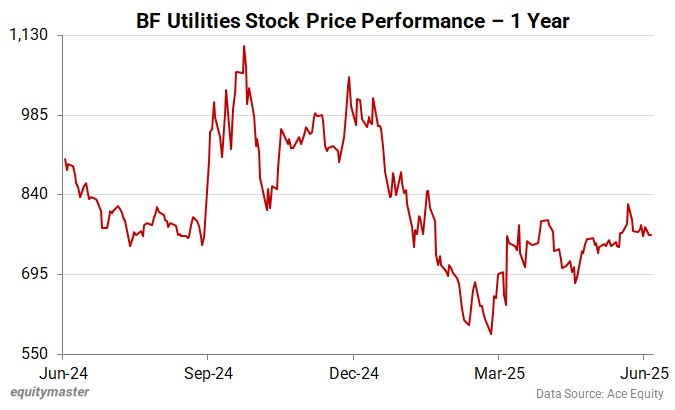
Coming to the financials, the company's revenue has grown at a compounded average growth rate (CAGR) of 10% in the last three years while its net profit has grown at a CAGR of 190.2%.
The company's three-year average return on equity (RoE) and return on capital employed (RoCE) were 7.3% and 9.2%, respectively.
BF Utilities has a focus on wind power and could look to expand its wind energy projects further.
Additionally, with the growing demand for solar power in India, the company may diversify into solar energy projects too.
The company is likely to continue investing in its power transmission and distribution network.
With an increasing focus on reducing transmission losses and improving grid efficiency, BF Utilities may upgrade its existing infrastructure and extend its coverage to new regions.
The company may also explore smart grid technologies that help manage power distribution more effectively, integrating renewable energy sources and making the grid more resilient.
To know more, check out BF Utilities' financial factsheet and latest quarterly results.
#2 RattanIndia Power
Second on this list is RattanIndia Power.
RattanIndia Power is one of India's largest private power generation companies, with a 1,350 MW (megawatt) thermal power plant at Amravati, Maharashtra.
The Amravati thermal power plant has a long-term Power Purchase Agreement (PPA) for supply of 1,200 MW to the Maharashtra State Electricity Distribution Company Ltd (MSEDCL).
Furthermore, the company has a Fuel Supply Agreement (FSA) with Southeastern Coalfields Ltd (SECL), for 6.1 MMT (million metric ton) of coal.
In FY24, the Amravati Plant remained available to supply at above 85% plant availability in line with the provisions of the PPA.
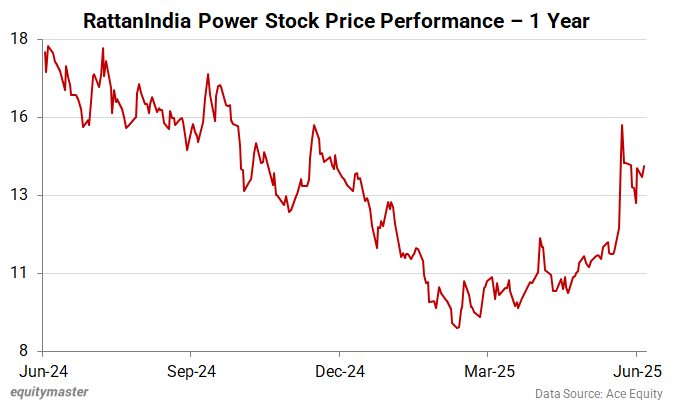
Coming to the financials, the company's revenue has grown at a CAGR of 29.2% in the last three years.
As of June 2024, the management has guided the following:
The company's revenue is largely driven by PPA, with 90% of its plant's capacity already contracted.
The management anticipates stable revenue growth, with potential upside from regulatory receivables.
The operating profit is projected to remain in the range of Rs 10-11 billion (bn), supported by debt reduction and promising expansion plans, contributing to a positive outlook for the future.
The company is evaluating options for capacity expansion at the Amravati plant or exploring opportunities in renewable energy projects.
For thermal plant expansion, plans include the addition of 660 MW or 800 MW units, potentially requiring an equity investment of Rs 15 bn.
The accumulated regulatory receivables of over Rs 25 bn are expected to be realized over the next two to three years, adding to the company's cash flows.
The company launched merchant sales in January 2024, initially selling around 28 MW, with plans to expand this to approximately 100 MW.
To know more, check out RattanIndia Power's financial factsheet and latest quarterly results.
#3 Oriana Power
Next on this list is Oriana Power.
Oriana Power is engaged in two main business verticals: Engineering Procurement and Construction (EPC) and operations of solar power projects and solar energy solutions on a BOOT (build, own, operate, transfer) basis.
In 2024, the company conceptualized new growth verticals, including Battery Energy Storage Systems (BESS), Green Hydrogen, and Compressed Biogas (CBG).
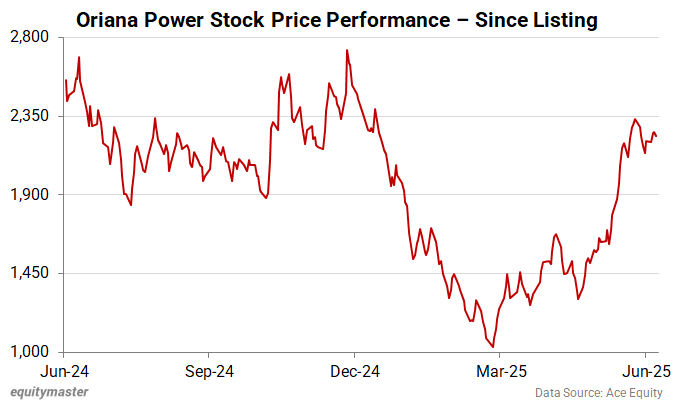
The company's revenue has grown at a CAGR of 123.6% in the last three years while its net profit has grown at a CAGR of 169.3%.
The company's three-year average RoE and RoCE were 53.3% and 58.4%, respectively.
Oriana Power has secured 400 MW of BESS orders across key states including Rajasthan, Karnataka, Telangana, and Tamil Nadu, with 100 MW-hour capacity in each region.
The company aims to target 1 GW of BESS capacity by FY26, with an additional 600 MW-hour of storage capacity planned. Additionally, BESS margins are expected to be slightly better than solar EPC, with BESS projects having a lifespan of 20-25 years.
It is actively engaging with large power consumers to provide hybrid solutions combining solar power with energy storage.
The company plans to establish 500 MW of electrolyser gigafactory in Madhya Pradesh by FY26, with an estimated US$ 30 m capex funded 80% through debt and 20% via equity, supported by internal cash flows and bank finance.
Furthermore, the company is developing a 225 TPD (Tons Per Day) e-methanol project, with a state subsidy under review and a non-binding offtake agreement already signed. It's targeting 50,000 MTPA of e-fuel derivatives by 2028.
It has a strategic focus on international offtake from markets like Japan, Europe, and the US.
The management views CBG as a potential 20-25% annual revenue opportunity, though progress has been slow. It aims to increase contributions, particularly in upstream green biomass in the future.
Going forward, the management has guided for Rs 20-25 billion (bn) in revenue, with EPC expected to contribute around 80% of FY26 revenue, driven by solar, BESS, CBG, and IPP (Independent Power Producer) EPC.
No revenue from hydrogen is anticipated in FY26, while BESS and other segments will make up 20% of revenue.
From FY27-29, BESS is expected to contribute 30-40% of revenue, while hydrogen and its derivatives are anticipated to become a material revenue source post-2028.
The margins are expected to remain stable in line with FY25.
Additionally, Oriana Power is preparing to migrate from SME to the main board, expanding its leadership and compliance teams to facilitate the transition.
To know more, check out Oriana Power's financial factsheet.
#4 ACME Solar Holdings
Fourth is ACME Solar Holdings.
ACME Solar Holdings is a renewable energy company in India with a portfolio of solar, wind, hybrid, and firm and dispatchable renewable energy (FDRE) projects.
FDRE projects include storage components (battery or pumped hydro), allowing ACME to deliver power during peak demand periods, complementing intermittent energy sources.
It has secured long-term PPAs, typically lasting 25 years, with both government and private entities. These agreements ensure stable cash flow and mitigate demand risk, with most PPAs featuring fixed tariff rates to minimise revenue volatility.
The company finances its projects through a blend of equity and debt, with debt covering around 75% of the total costs. It has successfully attracted funding from both local lenders and international investors.
Additionally, the company has a strong track record of refinancing debt on more favorable terms, utilising green bonds listed on international exchanges to reduce financing costs and extend the debt tenure.
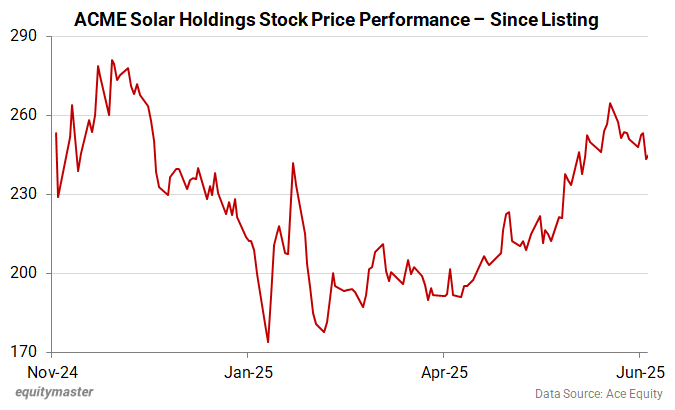
The company's revenue has grown at a CAGR of 36.9% in the last three years while its net profit has grown at a CAGR of 158.5%.
The company's three-year average RoE and RoCE were 7.3% and 9.2%, respectively.
In FY25, the company's operational capacity grew from approximately 1,350 MW at the start of FY25 to about 2,700 MW by year-end. Its project portfolio now totals around 7 GW, including 1,900 MW from new bids across FDRE, hybrid, and solar technologies.
In the near term, 450 MW is ready to begin generating revenue imminently.
The Sikar plant will initially operate in the merchant market. The management plans to migrate to a PPA as opportunities arise. Once fully operational, Sikar is expected to generate an annual topline of Rs 2.3-2.4 bn.
ACME Solar has 4.3 GW of under-construction capacity, with 750 MW of PPAs in the final stages. Notably, 80% of these projects (3,380 MW) are dedicated to FDRE and hybrid solutions, reflecting a clear strategic pivot.
The company has full grid connectivity for its entire under-construction portfolio, with an additional 2,500 MW secured for future bids.
Land acquisition is over 50% for solar and 60% for wind projects. It has also applied for 10,000+ acres of government land, supporting its future pipeline.
Going forward, it has secured Rs 165 bn in debt sanctions for 1,700 MW of under-construction projects (including BESS projects).
The equity portion for capex is supported by internal accruals and unutilised credit lines, with management confirming it has no plans to raise additional equity for the current pipeline.
In FY27, 1.89 GW is planned as per signed PPAs, with around 2 GW under construction (PPAs pending) likely to be commissioned post-FY27.
The target is for 7 GW contracted capacity by FY28 and 10 GW by FY30, with significantly higher installed capacity. The management has paused aggressive bidding and is now focused on execution and merchant market optimisation.
The company aims to launch its first pilot BESS project (200 MW) by late Q2 FY26, with large-scale BESS expected by Q3 FY26. All batteries will be sourced from Tier-1 Chinese suppliers.
For FDRE projects, commissioning is scheduled for May-June 2026, with management aiming to prepone the timeline via short-term open access where possible.
To know more, check out ACME Solar Holdings' financial factsheet and latest quarterly results.
#5 PTC India
Last on this list is PTC India.
PTC India is in the power trading business.
PTC undertakes trading activities which include long-term trading of power generated from large power projects as well as short-term trading arising because of supply and demand mismatches.
It's a co-promoter of India's first electricity exchange (IEX) and does cross border trade with Nepal, Bhutan, and Bangladesh.
It's promoted by Power Grid Corporation of India Ltd (PGCIL), NTPC Ltd (NTPC), Power Finance Corporation Ltd (PFC), and NHPC Ltd (NHPC).
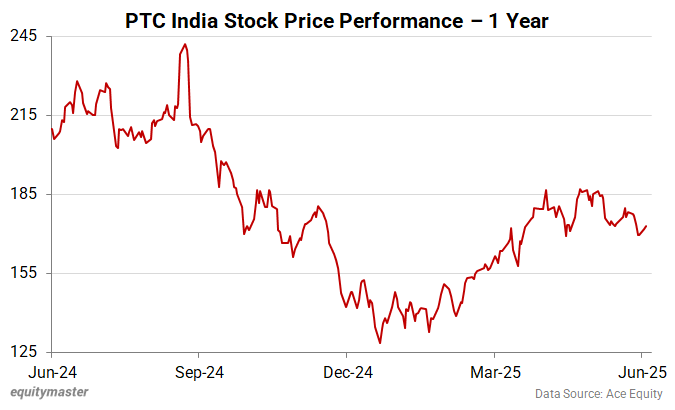
The company's three-year average RoE and RoCE were 9.8% and 11.6%, respectively.
The company signed a new agreement with Bhutan for up to 2,000 MW of winter exports.
The divestment of PTC Energy Ltd (PEL) to ONGC Green was completed in March 2025 for Rs 11.8 bn. An exceptional profit of Rs 5.2 bn was recorded in Q4 from this transaction.
The retained capital from the PEL sale will be reinvested into profitable ventures for future growth. The company is also exploring the acquisition of renewable projects, either domestically or in friendly countries like Bhutan, though no deals have been finalised yet.
PTC is essentially debt-free, with any remaining debt used only for short-term liquidity.
The Bangladesh receivables have improved significantly, now standing at Rs 5.8 bn (down from Rs 7 bn), with a comfortable position and no more than two months outstanding.
The surcharge income continues to be a significant contributor. While the management expects some volatility and cyclicity, they anticipate ongoing demand due to persistent DISCOM (distribution company) liquidity stress.
Going forward, the management is confident about medium-term demand growth of 6-8% CAGR, driven by economic growth and favorable monsoons.
To know more, check out PTC India's financial factsheet and latest quarterly results.
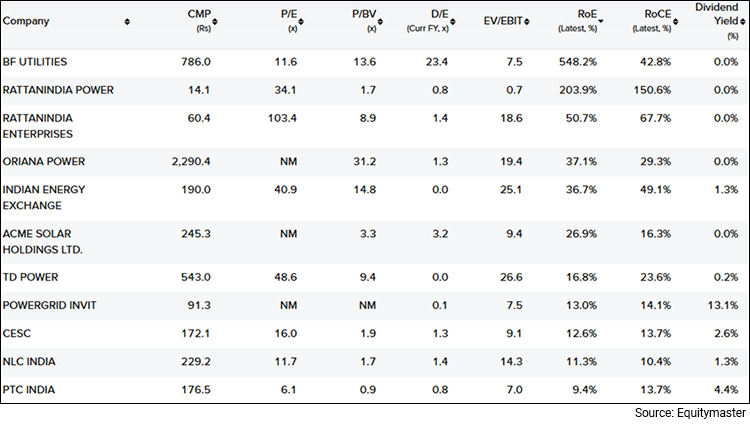
Snapshot of India's Best Small Cap Power Stocks on Equitymaster's Stock Screener
Here's a table that shows the India's best small-cap power stocks across various parameters.
Conclusion
As India's power sector undergoes rapid transformation, it presents a wealth of opportunities for investors, particularly in the small-cap segment.
The country is shifting towards a cleaner, more sustainable energy mix. This transition is driven by massive investments in renewable energy, advancements in smart grid technology, and a strong focus on energy access for all.
Small-cap stocks, often more agile and innovative, are well-positioned to tap into this growth, especially as private players increasingly enter the market.
While small-cap stocks carry a higher risk, they also hold the potential for significant rewards, especially in a booming sector like energy.
Investors should evaluate the company's fundamentals, corporate governance, and valuations of the stock as key factors when conducting due diligence before making investment decisions.
Happy Investing.
Disclaimer: This article is for educational purposes only. It is not a recommendation and should not be treated as such. Learn more about our recommendation services here...
ABOUT EQUITYMASTER
Since 1996, Equitymaster has been the source for honest and credible opinions on investing in India. With solid research and in-depth analysis Equitymaster is dedicated towards making its readers- smarter, more confident and richer every day. Here's why hundreds of thousands of readers spread across more than 70 countries Trust Equitymaster.
PREMIUM PRODUCTS
- Hidden Treasure
- Forever Stocks
- Super Sector Stocks
- Equitymaster Venture
- Microcap Millionaires
- Momentum Profits
- Double Income
- Midcap Value Alert
- Exponential Profits
- Annual Breakout Alert
- Lazy Millionaire
- Phase One Alert
- Smallcap AlphaQuest
- InsiderPro Stocks
- StockSelect
- Private Briefing
- Active Wealth Multiplier 2030
- FundSelect
- Fund Advantage
QUICK LINKS
POPULAR TOPICS
- Multibagger Penny Stocks
- Basics of Value Investing
- Benjamin Graham
- How to Invest in Gold
- How to Invest in Silver
- Best Stocks to Buy Today
- Best Small-cap Stocks to Buy
- Best Bluechip Stocks to Buy
- Guide to Penny Stocks
- How to Invest in the Share Market
- Warren Buffett - The Value Investor
- Pick the Best Multibagger Stocks
TRENDING TOPICS
- Best Defence Stocks in India
- Upcoming Dividend Stocks
- Best Semiconductor Stocks in India
- Data Center Stocks in India
- Best Railway Stocks in India
- Best Solar Stocks in India
- Fastest Growing Stocks in India
- List of BSE Sensex 30 Stocks
- Adani Group Shares
- Stocks Recently Bought by FIIs in India
- Top Value Stocks in India


LEGAL DISCLAIMER:
Investment in securities market are subject to market risks. Read all the related documents carefully before investing.
Registration granted by SEBI, enlistment with BSE as IA and RA, and certification from NISM in no way guarantee performance of the intermediary or provide any assurance of returns to investors.
All rights reserved. Any act of copying, reproducing or distributing any content from this website whether wholly or in part, for any purpose without the permission of Quantum Information Services Private Limited is strictly prohibited and shall be deemed to be copyright infringement.
Quantum Information Services Private Limited (QIS) is a SEBI registered Research Analyst (bearing registration no INH000021128) and Investment Adviser(Reg. No: INA000000680). Consequent upon the merger of Equitymaster Research Private Limited into QIS, effective October 30, 2025 QIS owns and operates brand 'Equitymaster' and website www.equitymaster.com. This does not constitute or is not intended to constitute an offer to buy or sell, or a solicitation to an offer to buy or sell financial products, units or securities and QIS including its employees, personnel, directors, associates will not be liable for any losses (direct or indirect) incurred or investment(s) made or decisions taken/or not taken based on the information provided herein. All content and information is provided on an 'As Is' basis by QIS. Information herein is believed to be reliable but QIS does not warrant its completeness or accuracy and expressly disclaims all warranties and conditions of any kind, whether express or implied. The services rendered by QIS are on a best effort basis. QIS does not assure or guarantee the user any minimum or fixed returns. The securities quoted, if any are for illustration only and are not recommendatory. Use of this information is at the user's own risk. The user must make his own investment decisions based on his specific investment objective and financial position and using such independent advisors as he believes necessary. This is not directed for access or use by anyone in a country, especially, USA, Canada or the European Union countries, where such use or access is unlawful or which may subject QIS or its affiliates to any registration or licensing requirement.
The performance data quoted represents past performance and does not guarantee future results. As a condition to accessing QIS's content and website, you agree to our Terms and Conditions of Use, available here
Equitymaster requests your view! Post a comment on "Hidden Powerhouses: 5 Small Cap Power Stocks to Keep an Eye on in 2025". Click here!
Comments are moderated by Equitymaster, in accordance with the Terms of Use, and may not appear
on this article until they have been reviewed and deemed appropriate for posting.
In the meantime, you may want to share this article with your friends!