

Investment in securities market are subject to market risks. Read all the related documents carefully before investing
India's Bull Market
Has The Pause Finally Ended?
Global developments could be setting the stage for a new rally
**Important: We hate spam as much as you do. Check out our Privacy Policy and Terms Of Use.
Why Paytm Plunged 40% in the First 6 Months of the Year
 Paytm Logo source: https://paytm.com
Warren Buffett's US$ 300 million (m) investment in Paytm made people confident about Paytm's impending success.
Little did anyone know that Buffett's first and only investment in India would turn sour.
The struggle for Paytm, once an up-and-coming fintech startup, is far from over. Instead of bringing fortunes to its investors, the Paytm stock has turned into a nightmare.
Almost every investor who was anticipating huge gains from Paytm has incurred heavy losses from the very first day of Paytm's listing on the stock market.
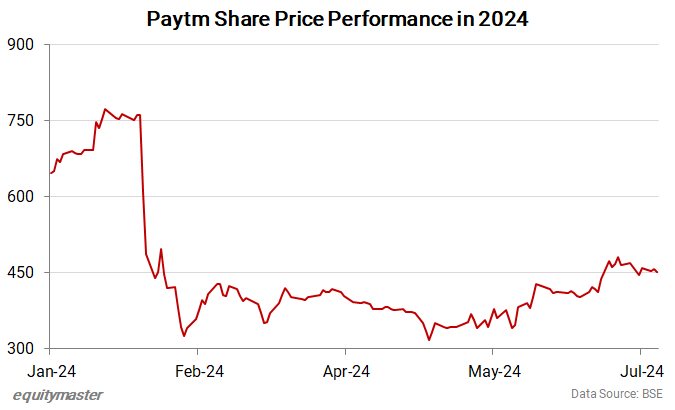
The year 2024 has exacerbated the situation, with the stock plummeting over 40% in the first six months alone.
Here's what is dragging this stock down.
#1 RBI Restriction on Paytm Payments Bank
The downfall of Paytm's share started in January with the Reserve Bank of India (RBI) on 31 January 2024 imposing major business restrictions on Paytm Payments Bank.
These restrictions include a ban on accepting fresh deposits and making credit transactions.
So effective 29 February 2024, Paytm Payments Bank will not be allowed to accept fresh deposits, undertake credit transactions, or top-ups in any customer accounts. This also includes prepaid instruments, wallets, FASTags, and NCMC cards, among others.
Note that RBI's action comes after the bank came under non-compliance and supervisory concerns.
In March 2022, the central bank had barred Paytm Payments Bank from onboarding new customers.
Following the latest restrictions, top brokerage houses have voiced serious concerns and suggest that this will significantly impact operations.
Just to put things into context, RBI had put a ban on HDFC Bank too some two years ago and it took over 15 months for the central bank to lift the ban.
So imagine how long it will take here. The RBI has conducted a comprehensive IT audit and continued to identify non-compliance against Paytm Payments Bank.
#2 FII Selling
With this problem coming to the fore, March 2024 saw the problem further exacerbated by foreign institutional investors (FIIs) reducing their stakes in the company.
In the March 2024 quarter, FIIs decreased their holdings to 60.4%, down 3.3% from the previous quarter's 63.7%.
Continuing this selling spree, FIIs further reduced their holdings to 58.3%, down an additional 2%.
This dragged the stock lower.
#3 Senior Level Resignation
In April 2024, Paytm faced a new set of challenges with several high-level exits. Surinder Chawla, the managing director (MD) and chief executive officer (CEO) of Paytm Payments Bank, stepped down that month.
Additionally, Sumit Mathur, the company's chief marketing officer, left after a year-long tenure to join Glanbia Performance Nutrition.
The situation worsened in May 2024 with the resignation of Bhavesh Gupta, president and chief operating officer (COO). Gupta's departure marked the third senior resignation in recent months.
His resignation came just as the company was preparing to announce its annual and fourth-quarter results, with Gupta citing personal reasons. This spate of high-level departures raised concerns that more exits might follow.
In addition, Varun Sridhar, the chief executive of Paytm Money, also stepped down to take on the role of CEO at Paytm Services, a subsidiary responsible for distributing mutual funds and other wealth management products.
These successive resignations have further pressured the company's stock, contributing to its downward trend.
#4 Weak Q1 Results
Lastly, for the June 2024 quarter, Paytm reported a 36% year-on-year decline in revenue, dropping to Rs 15 billion (bn) from Rs 23.4 bn in the same period a year earlier.
Of the Rs 15 bn in revenue, the payments business contributed Rs 9 bn, financial services accounted for Rs 2.8 bn, and the remaining revenue came from marketing services.
Earnings Before Interest, Tax, Depreciation, and Amortisation (EBITDA) for the June quarter, before accounting for Employee Stock Ownership Plans (ESOPs), showed a loss of Rs 5.4 bn.
Additionally, Paytm's net loss widened significantly, increasing two and a half times to Rs 8.4 bn from Rs 3.6 bn a year ago.
This increase in losses is attributed to the ongoing impact of the Reserve Bank of India's (RBI) curbs, which have shut down the payments bank business.
#5 Related Party Dealings Warning
Coming to July 2024, Paytm's parent company, One 97 Communications, recently received an administrative warning letter from the market regulator, SEBI.
The regulator stated that certain transactions in FY22 between Paytm and the now-defunct Paytm Payments Bank were conducted without approval from the company's audit committee or its shareholders.
In response to the administrative warning, Paytm asserted that it has consistently adhered to all listing regulations and will address the market regulator's concerns with a detailed response.
The administrative warning, detailed in a letter dated 15 July 2024, and uploaded by One 97 Communications to the exchanges on Monday, focuses on related party transactions valued at Rs 3.2 bn and Rs 360 m, respectively.
These transactions, conducted during FY22, did not receive the requisite approval from either the audit committee or the shareholders, according to the market regulator.
The company claimed it had provided a cumulative numerical value of the transactions with Paytm Payments Bank for reference by the shareholders. It argued that transactions between subsidiaries of One 97 Communications and Paytm Payments Bank did not qualify as related party transactions during FY22.
However, the board and audit committee considered transactions between One 97 Communications and/or its subsidiaries with Paytm Payments Bank as material-related party transactions and passed resolutions to keep such transactions within specified limits.
The market regulator pointed out discrepancies between the company's assertions of compliance and the transactions categorised as material-related party transactions by the board and audit committee.
These violations have been viewed very seriously. The market regulator instructed Paytm to present the letter to its board for corrective actions and to provide a report on the measures taken within 10 days thereafter.
Following this update, the company's stock has been on a downward trend.
What Next?
Following setbacks from the shutdown of its payments banking unit earlier this year, Paytm is optimistic about improvements in key operating metrics, including gross merchandise value and the addition of merchant devices.
In response to mounting losses, the company has implemented a cost-saving strategy aimed at reducing employee expenses by Rs 4-5 bn annually. Employee costs are expected to decrease from July to September.
Looking ahead to FY25, Paytm aims to achieve at least one profitable quarter. The company plans to enhance its financial services by cross-selling products such as lending, insurance, and wealth management through an expanded distribution model and deeper partnerships with lenders and insurers.
In the lending sector, Paytm will focus on a distribution-only model for personal and merchant loans, avoiding collection responsibilities. They also plan to pilot secured lending products, including micro loan against property (LAP) loans.
Additionally, Paytm intends to streamline operations by reducing non-core assets and businesses, thereby improving profitability and focus.
How Shares of Paytm have Performed Recently
Over five days, Paytm shares are down by 2%, while it is down 30 % in 2024 so far.
Over the past year, the stock has declined 44%.
The company touched its 52-week high of Rs 998.3 on 20 October 2023 and its 52-week low of Rs 310 on 9 May 2024.
About Paytm
Paytm is India's leading financial services company that offers payments and financial solutions to consumers.
It's an Indian-based mobile internet company and a subsidiary of One97 Communications Limited.
For more details about the company, you can have a look at Paytm's factsheet and quarterly result.
You can also compare Paytm with its peers.
To know what's moving the Indian stock markets today, check out the most recent share market updates here.
--- Advertisement ---
Investment in securities market are subject to market risks. Read all the related documents carefully before investing
Which businesses are most likely to emerge stronger over the next 3 to 5 years?
After screening thousands of listed companies, comparing industries, and examining balance sheets...
Our research team discovered some of the strongest opportunities in what we call... Essential Stocks.
Opportunities like this do not remain hidden forever.
Disclaimer: This article is for information purposes only. It is not a stock recommendation and should not be treated as such. Learn more about our recommendation services here...
ABOUT EQUITYMASTER
Since 1996, Equitymaster has been the source for honest and credible opinions on investing in India. With solid research and in-depth analysis Equitymaster is dedicated towards making its readers- smarter, more confident and richer every day. Here's why hundreds of thousands of readers spread across more than 70 countries Trust Equitymaster.
PREMIUM PRODUCTS
- Hidden Treasure
- Forever Stocks
- Big Wave Profits
- Equitymaster Venture
- Microcap Millionaires
- Momentum Profits
- Double Income
- Midcap Value Alert
- Exponential Profits
- Annual Breakout Alert
- Lazy Millionaire
- Phase One Alert
- Smallcap AlphaQuest
- InsiderPro Stocks
- StockSelect
- Private Briefing
- Active Wealth Multiplier 2030
- FundSelect
- Fund Advantage
QUICK LINKS
POPULAR TOPICS
- Multibagger Penny Stocks
- Basics of Value Investing
- Benjamin Graham
- How to Invest in Gold
- How to Invest in Silver
- Best Stocks to Buy Today
- Best Small-cap Stocks to Buy
- Best Bluechip Stocks to Buy
- Guide to Penny Stocks
- How to Invest in the Share Market
- Warren Buffett - The Value Investor
- Pick the Best Multibagger Stocks
TRENDING TOPICS
- Best Defence Stocks in India
- Upcoming Dividend Stocks
- Best Semiconductor Stocks in India
- Data Center Stocks in India
- Best Railway Stocks in India
- Best Solar Stocks in India
- Fastest Growing Stocks in India
- List of BSE Sensex 30 Stocks
- Adani Group Shares
- Stocks Recently Bought by FIIs in India
- Top Value Stocks in India


LEGAL DISCLAIMER:
Investment in securities market are subject to market risks. Read all the related documents carefully before investing.
Registration granted by SEBI, enlistment with BSE as IA and RA, and certification from NISM in no way guarantee performance of the intermediary or provide any assurance of returns to investors.
All rights reserved. Any act of copying, reproducing or distributing any content from this website whether wholly or in part, for any purpose without the permission of Quantum Information Services Private Limited is strictly prohibited and shall be deemed to be copyright infringement.
Quantum Information Services Private Limited (QIS) is a SEBI registered Research Analyst (bearing registration no INH000021128) and Investment Adviser(Reg. No: INA000000680). Consequent upon the merger of Equitymaster Research Private Limited into QIS, effective October 30, 2025 QIS owns and operates brand 'Equitymaster' and website www.equitymaster.com. This does not constitute or is not intended to constitute an offer to buy or sell, or a solicitation to an offer to buy or sell financial products, units or securities and QIS including its employees, personnel, directors, associates will not be liable for any losses (direct or indirect) incurred or investment(s) made or decisions taken/or not taken based on the information provided herein. All content and information is provided on an 'As Is' basis by QIS. Information herein is believed to be reliable but QIS does not warrant its completeness or accuracy and expressly disclaims all warranties and conditions of any kind, whether express or implied. The services rendered by QIS are on a best effort basis. QIS does not assure or guarantee the user any minimum or fixed returns. The securities quoted, if any are for illustration only and are not recommendatory. Use of this information is at the user's own risk. The user must make his own investment decisions based on his specific investment objective and financial position and using such independent advisors as he believes necessary. This is not directed for access or use by anyone in a country, especially, USA, Canada or the European Union countries, where such use or access is unlawful or which may subject QIS or its affiliates to any registration or licensing requirement.
The performance data quoted represents past performance and does not guarantee future results. As a condition to accessing QIS's content and website, you agree to our Terms and Conditions of Use, available here
Equitymaster requests your view! Post a comment on "Why Paytm Plunged 40% in the First 6 Months of the Year". Click here!
Comments are moderated by Equitymaster, in accordance with the Terms of Use, and may not appear
on this article until they have been reviewed and deemed appropriate for posting.
In the meantime, you may want to share this article with your friends!