

Investment in securities market are subject to market risks. Read all the related documents carefully before investing

The 3 Smallcaps Richa
Found Hardest to Reject
DISCOVER 3 YOUNG TITANS TO BUY NOW**Important: We hate spam as much as you do. Check out our Privacy Policy and Terms Of Use.
5 Fundamentally Strong, beaten Down Bluechip Stocks
 Image source: sefa ozel/www.istockphoto.com
Blue-chip stocks are large, well-established companies known for their stable performance and strong market presence.
However, they are not immune to corrections. Short-term headwinds can affect their businesses too.
In recent months, a few fundamentally strong and widely held companies have seen their share prices decline, in some cases, by as much as 45%.
Here are five such stocks...
#1 Coal India
First on the list is Coal India.
Coal India, India's leading coal producer, is a public-sector undertaking (PSU) under the Ministry of Coal in the Government of India. It plays a crucial role in fulfilling the nation's energy requirements.
It possesses a near-monopoly in coal mining, controlling 48% of India's total proven coal reserves, representing 78-80% of domestic coal production.
In FY25, it produced the highest ever coal at 785 metric tonnes (MT). Revenue stayed flat at Rs 1.4 trillion (tn), while net profit fell 5.5% to Rs 353 billion (bn).

Looking ahead, Coal India has guided for 875 MT of volume in FY26, and over 900 MT in FY27.
It anticipates sustained coal demand until FY30, with projections reaching 1.043 billion tonnes (BT) and potentially 1.227 BT by FY30.
The company expects the power sector's demand to grow at a rate of about 3%, in line with its supply.
To finance this, the company plans to invest around Rs 800 bn by FY30, about Rs 200 bn per year. The company plans to have 75% of its supply base for the power sector and 25% for the non-power sector. It is also expanding into other essential minerals too.
It also setting up a 50 megawatt solar power project to enhance cost efficiency while creating a more environmentally friendly business.
Check out Coal India's financial factsheet and quarterly results to know more.
#2 Tata Motors
Second on the list is Tata Motors.
Tata Motors, part of the Tata Group, is a leading global automobile company.
The company sells passenger vehicles (PVs), utility vehicles (UVs), and commercial vehicles (CVs) in about 125 countries. It also has a presence in the premium PV market through Jaguar Land Rover (JLR).
It leads the CV segment in India and ranks third in the PV segment. Moreover, it dominates the electric vehicle (EV) segment with a 38% market share in the first half ending June 2025.
The company has been negatively impacted by the consumption slowdown in India. Its electric vehicle market share has also declined from 67% to 38% due to tough competition.
In addition to this, JLR has also been hit hard by tariffs on the European Union.
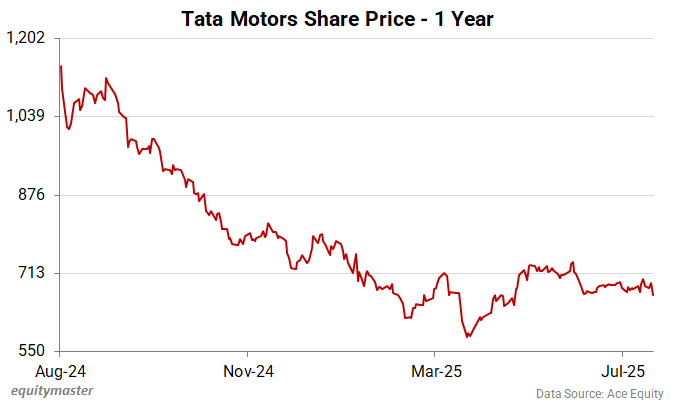
In FY25, its financial performance was also muted. Revenue declined 1.3% to Rs 4.4 tn, while net profit fell 11.5% to Rs 281.5 bn. It's eyeing a gradual recovery.
JLR contributes 71% to Tata Motors' revenue and 79% to operating profit.
Looking ahead, in the CV segment, the company aims to achieve 40% market share by FY27 from 37% currently.
For this, it plans to improve the product portfolio, refocus on e-bus tenders under an asset-light model, and invest in enhanced safety and alternative fuels.
In the PV space, it plans to have a 16% share by FY27, and 18-20% by FY30, up from 13.2%.
It will launch new products and expand network capacity in high-growth segments with an investment of Rs 330-350 bn during FY26-30.
Tata Motors will introduce over 15 new nameplates and 23 facelifts and refreshments across multiple powertrains, including the Sierra, Avinya Range EV, and other products by FY30.
It also plans to regain some of the lost market share in the EV segment. The business achieved operating profitability in FY25. The management plans to sustain it.
Meanwhile, JLR continues to face challenges and has lowered guidance for FY26. Nevertheless, it plans to invest £ 18 bn over five years, which will be funded entirely from internal sources.
Tata Motors is also demerging its PV and CV businesses to unlock shareholder value.
Check out Tata Motors' financial factsheet and quarterly results to know more.
#3 IndusInd Bank
Third on the list is IndusInd Bank.
IndusInd Bank is promoted by the Hinduja Group. It is India's fifth-largest private bank in terms of total assets and total business as of June 2025. The company has 42 million (m) customers.
The bank has a pan-India presence with 3,110 bank branches, 3,804 branches of Bharat Financial Inclusion, 297 vehicle finance marketing outlets, and 3,052 ATMs.
Disclosure of losses from legacy foreign exchange derivative contracts and stewardship concerns have been areas of concern. Its share price has fallen by 44% over the last year.
The bank's net interest income fell 14% to Rs 46.4 bn in Q1FY26, while total revenue declined 4% to Rs 144 bn.
Net profit crashed 72% to Rs 6 bn, due to higher provisions and weaker asset quality.
The bank's gross NPA ratio increased 51 basis points (bps) to 3.64%, while net NPA increased 17 bps to 1.12%.

Its advances also declined to Rs 3.3 tn from Rs 3.5 tn. Deposits remained stable at Rs 3.9 tn, with current account savings account (CASA) deposits at 31.5%.
Looking ahead, IndusInd Bank aims to rebuild, having fully accounted for identified issues in its FY25 financials.
It plans to start FY26 on a clean slate, but the recovery can be long.
Its core franchise remains strong, with a capital adequacy ratio of 16.24% and a provision coverage ratio of 70%.
It plans to focus on secured retail (home loans) and MSME assets, while remaining cautious on microfinance. It's also investing in scaling direct digital business, and its mobile app INDIE.
Check out IndusInd Bank's financial factsheet and quarterly results to know more.
#4 IRCTC
Fourth on the list is IRCTC.
IRCTC is a Mini Ratna Category 1, Central Public Sector Enterprise.
It's the only company authorized by the Indian government to provide online railway tickets, catering services, and packaged drinking water at railway stations and trains in India.
It manages catering and hospitality services at railway stations, on trains, and in other vital locations.
It also promotes domestic travel and international tourism by developing budget hotels, special tour packages, and e-ticketing services.
Coming to its financials, revenue rose 10% to Rs 46.7 bn. Catering revenue grew 9% to Rs 21.2 bn, contributing 45.5% to total revenue.
Internet ticketing revenue grew 10% to Rs 14.3 bn, accounting for 30.5%. Rail Neer revenue grew 16% to Rs 3.9 bn, while tourism revenue grew 8% to Rs 7.5 bn.
The internet ticketing segment's profit before tax (PBT) rose 10.5% to Rs 11.8 bn. This segment accounts for 67% of profit before tax.
In total, net profit increased 18% to Rs 13.2 bn.

Looking ahead, IRCTC expects a clear trajectory of long-term sustainable growth and plans to focus more on tourism to drive this expansion.
It is also aiming to develop a unified portal by integrating all online travel agents to improve hotel and air travel bookings. It plans to diversify into non-railway revenue streams.
The e-catering business, which is growing at 63% annual rate, will also see strong growth as more Amrit and Vande Bharat trains are introduced.
Check out the IRCTC's financial factsheet and quarterly results to know more.
#5 Life Insurance Corporation
Fifth on the list is Life Insurance Corporation.
Life Insurance Corporation (LIC) is the largest insurance provider in India. It holds a market share of over 57% in new business premiums and 66% in policies.
Moreover, it is the second-largest public sector company in India by market capitalization. It's also the world's fourth-largest insurer.
The company offers participating and non-participating insurance products, such as unit-linked insurance products, savings insurance products, term insurance products, annuities, and pension products.
It sells products through 1.5 m agents, which is 47.6% of the entire life insurance industry. It's assets under management (AUM) is Rs 54 tn, up 6% from FY24.
Revenue rose 5% to Rs 8.9 tn, while net profit rose about 20% to Rs 483 bn. However, the key performance indicators remained sluggish.

The value of annual premium equivalent (APE), which measures total premiums earned, declined 60 bps to Rs 568 bn in FY25.
Group APE also declined 40 bps to Rs 186 bn. Net value of new business (VNB) grew 4.5% to Rs 100 bn, with VNB margin at 17.6%.
The company's new business premium in group policies also remained flat at Rs 1.6 tn.
The focus is on improving the product mix and on high-yielding products. It launched six high-yielding products in FY24 and four new non-par products in FY25.
The company plans to regain market share in specific categories and geographies.
The government is considering introducing a composite license for the insurance sector. This would also allow LIC to enter the health insurance sector, providing a significant opportunity with its extensive distribution network.
Check out LIC's financial factsheet and quarterly results to know more.
Conclusion
Beaten-down stocks often carry a mix of caution and potential.
But blue-chip stocks offer confidence due to their strong market position and steady business.
While their share prices have fallen, these companies continue to focus on execution, growth, and course corrections where needed.
For investors willing to look beyond the short-term noise, these stocks should be on your watchlist.
However, instead of relying only on hype, it is necessary to carefully analyze the company's fundamentals, including financial performance, corporate governance, and growth prospects.
Happy Investing.
--- Advertisement ---
Investment in securities market are subject to market risks. Read all the related documents carefully before investing
Which businesses are most likely to emerge stronger over the next 3 to 5 years?
After screening thousands of listed companies, comparing industries, and examining balance sheets...
Our research team discovered some of the strongest opportunities in what we call... Essential Stocks.
Opportunities like this do not remain hidden forever.
Disclaimer: This article is for education purposes only. It is not a recommendation and should not be treated as such. Learn more about our recommendation services here...
ABOUT EQUITYMASTER
Since 1996, Equitymaster has been the source for honest and credible opinions on investing in India. With solid research and in-depth analysis Equitymaster is dedicated towards making its readers- smarter, more confident and richer every day. Here's why hundreds of thousands of readers spread across more than 70 countries Trust Equitymaster.
PREMIUM PRODUCTS
- Hidden Treasure
- Forever Stocks
- Big Wave Profits
- Equitymaster Venture
- Microcap Millionaires
- Momentum Profits
- Double Income
- Midcap Value Alert
- Exponential Profits
- Annual Breakout Alert
- Lazy Millionaire
- Phase One Alert
- InsiderPro Stocks
- StockSelect
- Private Briefing
- Active Wealth Multiplier 2030
- FundSelect
- Fund Advantage
QUICK LINKS
POPULAR TOPICS
- Multibagger Penny Stocks
- Basics of Value Investing
- Benjamin Graham
- How to Invest in Gold
- How to Invest in Silver
- Best Stocks to Buy Today
- Best Small-cap Stocks to Buy
- Best Bluechip Stocks to Buy
- Guide to Penny Stocks
- How to Invest in the Share Market
- Warren Buffett - The Value Investor
- Pick the Best Multibagger Stocks
TRENDING TOPICS
- Best Defence Stocks in India
- Upcoming Dividend Stocks
- Best Semiconductor Stocks in India
- Data Center Stocks in India
- Best Railway Stocks in India
- Best Solar Stocks in India
- Fastest Growing Stocks in India
- List of BSE Sensex 30 Stocks
- Adani Group Shares
- Stocks Recently Bought by FIIs in India
- Top Value Stocks in India


LEGAL DISCLAIMER:
Investment in securities market are subject to market risks. Read all the related documents carefully before investing.
Registration granted by SEBI, enlistment with BSE as IA and RA, and certification from NISM in no way guarantee performance of the intermediary or provide any assurance of returns to investors.
All rights reserved. Any act of copying, reproducing or distributing any content from this website whether wholly or in part, for any purpose without the permission of Quantum Information Services Private Limited is strictly prohibited and shall be deemed to be copyright infringement.
Quantum Information Services Private Limited (QIS) is a SEBI registered Research Analyst (bearing registration no INH000021128) and Investment Adviser(Reg. No: INA000000680). Consequent upon the merger of Equitymaster Research Private Limited into QIS, effective October 30, 2025 QIS owns and operates brand 'Equitymaster' and website www.equitymaster.com. This does not constitute or is not intended to constitute an offer to buy or sell, or a solicitation to an offer to buy or sell financial products, units or securities and QIS including its employees, personnel, directors, associates will not be liable for any losses (direct or indirect) incurred or investment(s) made or decisions taken/or not taken based on the information provided herein. All content and information is provided on an 'As Is' basis by QIS. Information herein is believed to be reliable but QIS does not warrant its completeness or accuracy and expressly disclaims all warranties and conditions of any kind, whether express or implied. The services rendered by QIS are on a best effort basis. QIS does not assure or guarantee the user any minimum or fixed returns. The securities quoted, if any are for illustration only and are not recommendatory. Use of this information is at the user's own risk. The user must make his own investment decisions based on his specific investment objective and financial position and using such independent advisors as he believes necessary. This is not directed for access or use by anyone in a country, especially, USA, Canada or the European Union countries, where such use or access is unlawful or which may subject QIS or its affiliates to any registration or licensing requirement.
The performance data quoted represents past performance and does not guarantee future results. As a condition to accessing QIS's content and website, you agree to our Terms and Conditions of Use, available here
Equitymaster requests your view! Post a comment on "5 Fundamentally Strong, beaten Down Bluechip Stocks". Click here!
Comments are moderated by Equitymaster, in accordance with the Terms of Use, and may not appear
on this article until they have been reviewed and deemed appropriate for posting.
In the meantime, you may want to share this article with your friends!