

Investment in securities market are subject to market risks. Read all the related documents carefully before investing
Two Years of Market Correction
Is This Your Buying Window?
See Where the Opportunities are Emerging for the Next 3-5 Years
**Important: We hate spam as much as you do. Check out our Privacy Policy and Terms Of Use.
Top 5 Undervalued Railway Stocks to Watch Out for in the Current Market
 Image source: Dinesh Hukmani/www.istockphoto.com
The Indian railway sector has undeniably emerged as a hotbed of investment activity in recent times. The sector's transformative journey, fuelled by substantial government support and strategic initiatives, has culminated in a remarkable surge in stock prices.
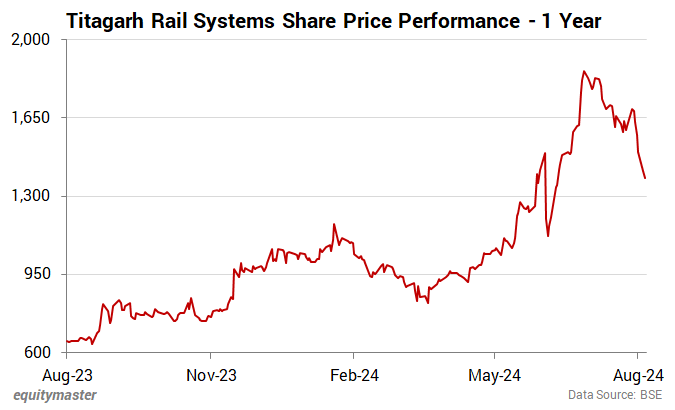
Companies like Titagarh Rail Systems skyrocketing by an astonishing 1,470% over three years have captivated the attention of seasoned and novice investors alike.
However, the euphoria surrounding the sector has led to a valuation bubble. The rapid ascent of stock prices has created a challenging environment for investors seeking entry or expansion of their positions.
Many stocks are now trading at premium valuations, making it difficult to justify investments based on traditional valuation metrics.
This presents a unique dilemma for investors: how to capitalise on the sector's long-term growth prospects without falling victim to overvaluation.
To address this challenge, in today's article, we will look at 5 undervalued stocks within the railway sector that can be a rewarding strategy.
#1 IRFC
Leading the list is IRFC.
The stock is trading at price to earnings (PE) ratio of 36.4x, which is lower than the industry PE of 63.8x.
The company is the financing arm of the Indian Railways. It's a Government of India enterprise under the Ministry of Railways.
IRFC's principal business is to borrow funds from the financial markets to finance the acquisition/creation of assets, which are then leased out to the Indian Railways.
This expertise will be invaluable in structuring and managing the financing of the government's ambitious new train acquisition program.
The Indian government's capital investment in railway expansion translates into a substantial funding requirement for Indian Railways.
IRFC's strategic positioning as the financing arm makes it a prime beneficiary of this growth. IRFC also boasts a robust financial profile with a clean record (nil gross NPA) and low operating expenses.
For FY24, the company reported a revenue of Rs 166.5 billion (bn), up 12% against Rs 237.6 bn a year back. Meanwhile, its net profit jumped 4% to Rs 64.1 bn.
The company in its annual report posted on 6 August 2024 spoke about exploring project financing opportunities across various sectors.
The company is exploring opportunities for investments in railway infrastructure projects such as dedicated freight lines, high-speed rail corridors, multi-modal logistics parks, non-conventional energy sources for the railway network etc.
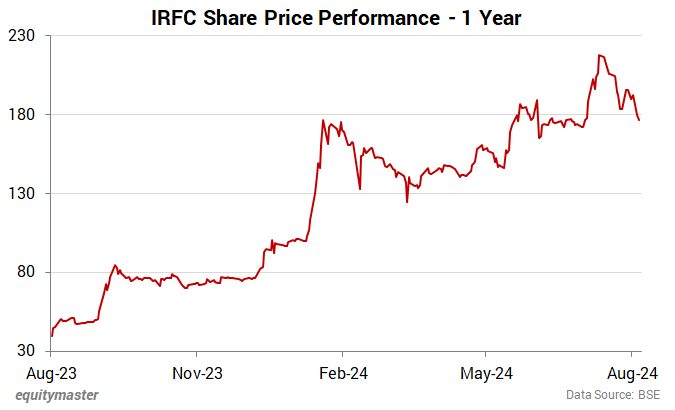
For more details, see the IRFC company fact sheet and quarterly results.
#2 RITES
Next on the list is RITES.
The stock's PE ratio stands at 38.9x, noticeably lower than the industry benchmark of 63.8x.
RITES, formerly known as Rail India Technical and Economic Service Limited, is a Navratna central public sector undertaking under India's Ministry of Railways.
It was incorporated in 1974 and is a multidisciplinary engineering and consultancy organisation providing a comprehensive range of services from concept to commissioning in all facets of transport infrastructure and related technologies.
The company is a leading player in the transport consultancy and engineering sector in India.
Rites on 6 August 2024 signed a Memorandum of Understanding (MoU) with the Housing and Urban Development Corporation (HUDCO).
Under this partnership, RITES and HUDCO will collaborate to undertake a comprehensive range of consultancy projects/services from concept to commissioning in the infrastructure space. Additionally, RITES will provide consultancy to projects being financed by HUDCO.
RITES board has recently announced that it will be issuing 1:1 bonus shares for its shareholders which means that for each existing share of the company held, the shareholders will be credited with one additional share.
The company has also declared a dividend of Rs 2.5 per share to reward its shareholders.
Further, the company informed that the record date set for the purpose of payment of the dividend has been fixed as 8 August.
For the June 2024 quarter, Rites reported an 11% YoY decline in revenue to Rs 4.9 bn. Meanwhile, the net profit fell 24.4% to Rs 0.9 bn.
RITES plans to continue expanding its order book, which stood at Rs 56.9 bn as of 31 March 2024. This includes projects in consultancy, turnkey, exports, leasing, and REMCL.
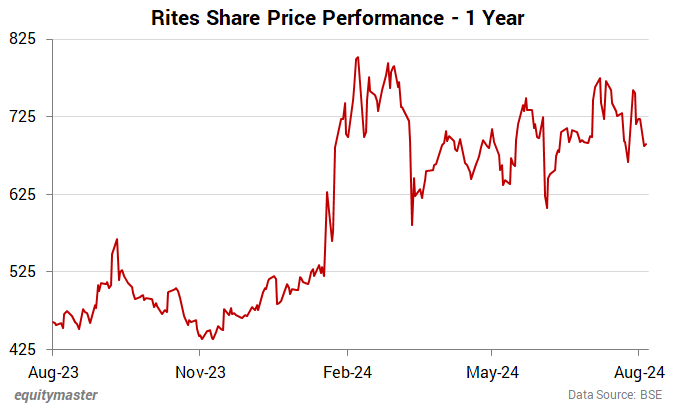
For more details, see the RITES company fact sheet and quarterly results.
#3 Container Corporation
Next on the list is the Container Corporation of India.
The stock is trading at price to earnings (PE) ratio of 48.2x, which is lower than the industry PE of 63.8x.
The company is a public-sector undertaking managed by the Indian Ministry of Railways. It was set up in 1966 to containerise cargo transport in the country.
Concor's core businesses include cargo carriers, terminal operators, warehouse operators & MMLP operations. It handles nearly 75% of the containers transported via railways.
Rail container transportation is a capital-intensive business, and Concor has an enviable first-mover advantage in this segment. Until 2006, it was the sole operator in the industry.
Since 2006, other players have entered this industry, but none of them have been able to replicate the network and infrastructure that Concor has.
The government on 29 July 2024 put the privatisation of Container Corporation of India Ltd (Concor) on the backburner.
In November 2019, the Union Cabinet approved the strategic sale of a 30.8% stake, along with management control, in Concor, a Navratna PSU under the Railways Ministry. The government currently holds 54.8% of Concor.
For FY24, its revenue grew to Rs 90.2 bn, up 6%. Meanwhile, the net profit grew 6.2% to 16.4 bn in FY24.
The company aims to establish around 20 mega distribution centres across India. These centres will be rail-connected and offer comprehensive transportation solutions.
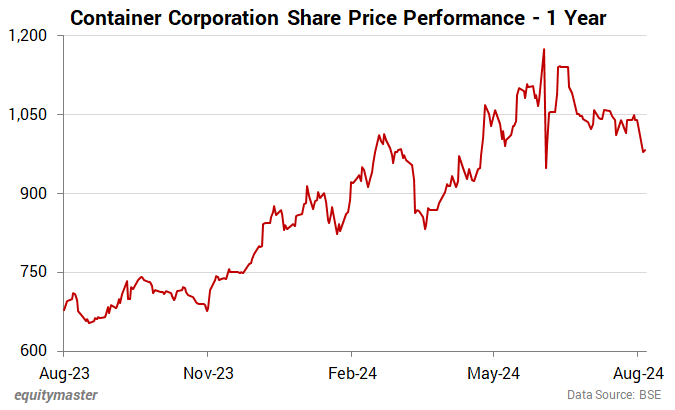
For more details, see the Container Corporation company fact sheet and quarterly results.
#4 RailTel Corporation
Next on the list is RailTel Corporation of India.
The stock's PE ratio stands at 59.4x, lower than the industry benchmark of 63.8x.
The company is a public sector enterprise that owns a pan-India fibre optic network through which it provides broadband and multimedia services.
The company also undertakes modernisation and maintenance of the communications network of Indian Railways.
It has two major lines of business, namely, the telecom and projects. Through telecom, it provides internet and passive infrastructure services, and through the projects segment, it lays and maintains optical fibre cable networks for other entities.
The company has an exclusive seamless right of way (ROW) along 67,950 km of railway track, passing through over 7,300 stations across the country.
RailTel is contributing to the implementation of Kavach by partnering with Quadrant Future Tek Limited. This collaboration aims to explore and deliver Kavach projects for Indian Railways and abroad.
In a significant move to bolster cybersecurity in Indian Railways, RailTel has announced a strategic partnership with Cylus, a leading cybersecurity firm specialising in rail industry solutions, to implement advanced cybersecurity measures across Indian Railways' extensive infrastructure.
Beyond this core function, RailTel has diversified into telecom networks, data centres, and hosting services and project execution.
For the June 2024 quarter, the company reported a 19% YoY rise in revenue at Rs 5.6 bn. Meanwhile, the net profit came in up 27% to Rs 486.7 million (m).
RailTel aims to further expand its fibre optic network to reach remote areas, providing high-speed internet connectivity to underserved regions.
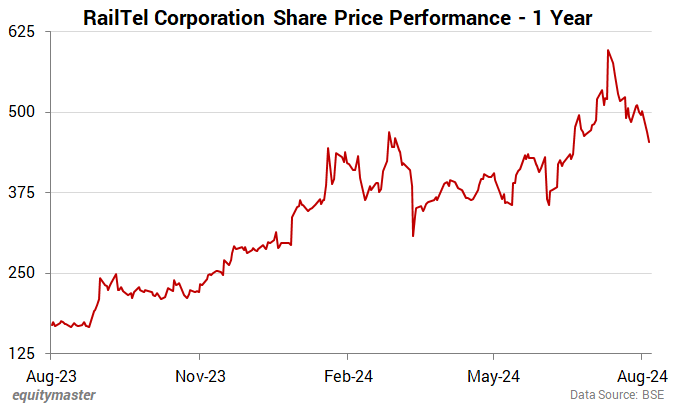
For more details, see the RAILTEL CORP OF INDIA company fact sheet and quarterly results.
#5 Titagarh Rail Systems
Last on our list is the Titagarh Rail System.
The stock's PE ratio stands at 61.4x, lower than the industry benchmark of 63.8x.
The company is mainly engaged in the manufacturing and selling of freight wagons, including semi-high-speed trains, metros, passenger coaches, and propulsion equipment.
It is also breaking new ground by becoming the first private sector company to manufacture Vande Bharat trains, demonstrating the growing role of private players in India's railway sector.
A high manufacturing capacity has helped the company secure orders worth Rs 280 bn in the financial year 2024, as against Rs 275 bn in the financial year 2023.
Some of the high-value orders include wagon orders from Indian Railways, Vande Barat, Surat Metro, Ahmedabad Metro, and wheelset manufacturing.
Apart from this, the company is eyeing the export market to benefit from the China plus one sentiment and growing global demand for wagons.
It aims to 'Make in India, Make for the World' and is investing heavily in capex to increase its wagons, and coaches' capacity. It is also working on backward integration of the propulsion system for metro rail, which the company is currently importing from outside.
The company is also planning to invest Rs 80 bn to ramp up its passenger vehicle and traditional freight business over the next two years.
With the company investing heavily in capex, more high-value orders are expected to pour in, taking the order book upwards.
For more details, see the TITAGARH RAILSYSTEMS company fact sheet and quarterly results.
Conclusion
While this stocks are set to benefit, here's the thing to keep in mind while hoping to earn from the railway sector.
One limitation of Top Indian railway stocks is their susceptibility to regulatory changes and government policies.
The railway sector in India is heavily regulated, and decisions made by regulatory bodies or changes in government policies can significantly impact the operations and profitability of railway companies.
This includes issues such as fare hikes, changes in freight rates, or alterations in investment plans, which can affect the financial performance and stock prices of railway companies.
Further, Indian Railways carries a significant debt burden, which can limit their ability to invest in upgrades and expansion plans. This debt can also restrict dividend payouts to shareholders.
This massive Rs 10-12 tn modernisation plan will help Indian railways to keep pace with economic growth. This investment will cover crucial aspects such as track laying, safety technology, and station upgrades.
For the financial year 2023-24, Indian Railways was given a budget of Rs 2.4 trillion by the government. Of this, 70% has already been used.
This highlights the need for funds. The proposed procurement of trains will involve maintenance contracts and specific conditions mandating their production within India, leveraging existing railway infrastructure.
The Indian Railways at present operates 10,754 daily train trips, and the plans to add 3,000 more trains aim to eradicate waiting lists.
This will enhance the performance of companies operating in the railway sector, providing them with more opportunities.
With so many triggers for growth, railway stocks could potentially benefit over the near term.
However, conduct thorough research before you invest in any of them. Sustained research must not be compromised despite the positive odds.
--- Advertisement ---
Investment in securities market are subject to market risks. Read all the related documents carefully before investing
Which businesses are most likely to emerge stronger over the next 3 to 5 years?
After screening thousands of listed companies, comparing industries, and examining balance sheets...
Our research team discovered some of the strongest opportunities in what we call... Essential Stocks.
Opportunities like this do not remain hidden forever.
Disclaimer: This article is for information purposes only. It is not a stock recommendation and should not be treated as such. Learn more about our recommendation services here...
Equitymaster requests your view! Post a comment on "Top 5 Undervalued Railway Stocks to Watch Out for in the Current Market". Click here!
2 Responses to "Top 5 Undervalued Railway Stocks to Watch Out for in the Current Market"
Krishna Kumar
Aug 9, 2024IRFC undervalued? Its price to book value is 4.7 which is like a Bajaj Finance valuation. A company with 15-20 employees and one office is being sold at such a valuation and you call it most undervalued based on peer comparison PE? Which are its peers that is operating on a fixed margin of 0.35%
ABOUT EQUITYMASTER
Since 1996, Equitymaster has been the source for honest and credible opinions on investing in India. With solid research and in-depth analysis Equitymaster is dedicated towards making its readers- smarter, more confident and richer every day. Here's why hundreds of thousands of readers spread across more than 70 countries Trust Equitymaster.
PREMIUM PRODUCTS
- Hidden Treasure
- Forever Stocks
- Big Wave Profits
- Equitymaster Venture
- Microcap Millionaires
- Momentum Profits
- Double Income
- Midcap Value Alert
- Exponential Profits
- Annual Breakout Alert
- Lazy Millionaire
- Phase One Alert
- Smallcap AlphaQuest
- InsiderPro Stocks
- StockSelect
- Private Briefing
- Active Wealth Multiplier 2030
- FundSelect
- Fund Advantage
QUICK LINKS
POPULAR TOPICS
- Multibagger Penny Stocks
- Basics of Value Investing
- Benjamin Graham
- How to Invest in Gold
- How to Invest in Silver
- Best Stocks to Buy Today
- Best Small-cap Stocks to Buy
- Best Bluechip Stocks to Buy
- Guide to Penny Stocks
- How to Invest in the Share Market
- Warren Buffett - The Value Investor
- Pick the Best Multibagger Stocks
TRENDING TOPICS
- Best Defence Stocks in India
- Upcoming Dividend Stocks
- Best Semiconductor Stocks in India
- Data Center Stocks in India
- Best Railway Stocks in India
- Best Solar Stocks in India
- Fastest Growing Stocks in India
- List of BSE Sensex 30 Stocks
- Adani Group Shares
- Stocks Recently Bought by FIIs in India
- Top Value Stocks in India


LEGAL DISCLAIMER:
Investment in securities market are subject to market risks. Read all the related documents carefully before investing.
Registration granted by SEBI, enlistment with BSE as IA and RA, and certification from NISM in no way guarantee performance of the intermediary or provide any assurance of returns to investors.
All rights reserved. Any act of copying, reproducing or distributing any content from this website whether wholly or in part, for any purpose without the permission of Quantum Information Services Private Limited is strictly prohibited and shall be deemed to be copyright infringement.
Quantum Information Services Private Limited (QIS) is a SEBI registered Research Analyst (bearing registration no INH000021128) and Investment Adviser(Reg. No: INA000000680). Consequent upon the merger of Equitymaster Research Private Limited into QIS, effective October 30, 2025 QIS owns and operates brand 'Equitymaster' and website www.equitymaster.com. This does not constitute or is not intended to constitute an offer to buy or sell, or a solicitation to an offer to buy or sell financial products, units or securities and QIS including its employees, personnel, directors, associates will not be liable for any losses (direct or indirect) incurred or investment(s) made or decisions taken/or not taken based on the information provided herein. All content and information is provided on an 'As Is' basis by QIS. Information herein is believed to be reliable but QIS does not warrant its completeness or accuracy and expressly disclaims all warranties and conditions of any kind, whether express or implied. The services rendered by QIS are on a best effort basis. QIS does not assure or guarantee the user any minimum or fixed returns. The securities quoted, if any are for illustration only and are not recommendatory. Use of this information is at the user's own risk. The user must make his own investment decisions based on his specific investment objective and financial position and using such independent advisors as he believes necessary. This is not directed for access or use by anyone in a country, especially, USA, Canada or the European Union countries, where such use or access is unlawful or which may subject QIS or its affiliates to any registration or licensing requirement.
The performance data quoted represents past performance and does not guarantee future results. As a condition to accessing QIS's content and website, you agree to our Terms and Conditions of Use, available here
Dilip Zambare
Oct 10, 2024Awareness about Good details of stock