

Investment in securities market are subject to market risks. Read all the related documents carefully before investing
India's Bull Market
Has The Pause Finally Ended?
Global developments could be setting the stage for a new rally
**Important: We hate spam as much as you do. Check out our Privacy Policy and Terms Of Use.
India's Forgotten Stocks: Is Asian Paints Losing its Shine?
Editor's note: Richa Agarwal will be LIVE today at the Small Cap Proxy Players Briefing. Book your spot and claim this bonus guide.
 Image source: Rattankun Thongbun/www.istockphoto.com
For years, Asian Paints has operated like a compounding machine, driven by double-digit sales growth, rising profits, and an undisputed leadership position in the paint industry.
On the surface, there seems little to fault. But a closer look at its stock price over the past few years tells a different story. Well-funded groups entered the sector, trying to gain a share in the paints sector.
Asian Paints has felt the heat as subdued demand and rising competition took a toll on growth. As a result, valuations have softened, weighed down further by muted discretionary spending.
However, now may be the right time to re-examine Asian Paints.
Let's do a deep dive...
About Asian Paints
Asian Paints operates in the business of paints and home decor.
The company is India's foremost paint and decor powerhouse. It ranks among the top ten decorative coatings companies globally, with a group turnover of Rs 338 billion (bn).
With operations spanning 14 countries and 26 state-of-the-art manufacturing facilities, Asian Paints reaches homes in over 60 nations.
In India, Asian Paints has established over 1.69 lakh retail touchpoints across India. This vast network is continuously expanding, with new touchpoints emerging in smaller towns and cities.
The company's global footprint is strengthened through a diverse family of brands, including Asian Paints Berger, Apco Coatings, SCIB Paints, Taubmans, Asian Paints Causeway, and Kadisco Asian Paints.
Breaking Down the Business Segments
The company operates across three business segments: decorative and home decor, industrial, and international businesses.
The decorative and home decor accounts for 87.4% (Rs 295 bn) of the company's revenue.
This includes offerings for the 'bottom of the pyramid,' such as Neo Bharat, and the Sparc range under Tractor Emulsion and Ace, and premium and luxury emulsions like Protek, Royale Glitz, and Nilaya Arc.
Asian Paints also offers end-to-end personalized interior design with professional execution.
The company is also a leading integrated home decor player. Under this, it offers modular kitchens and wardrobes, bath fittings, decorative lighting, uPVC windows, and doors.
Asian Paints Home Decor Business

It is a leading company in decorative lighting, operating under the White Teak brand.
While in wall covering, Asian Paints holds the leading position, with collaborations with global players like Pierre Frey and Sanderson Design Group.
In furniture and fabrics, it is the number two player, operating 72 beautiful home stores across 54 cities.
Asian Paints Business Segments
| Segment | Revenue (2024-25) | Contribution (%) |
|---|---|---|
| Decorative and Home Decor (Rs bn) | 295.5 | 87.4 |
| International Business (Rs bn) | 30.7 | 9.1 |
| Industrial Business (Rs bn) | 11.8 | 3.5 |
| Consolidated Revenue (Rs bn) | 338 | NA |
Asian Paints' international operation accounts for 9.1% of revenue. It operates in 13 countries across four key regions, including South Asia, the Middle East, Africa, and the South Pacific.
Industrial segments account for 3.5% of revenue. It operates through a joint venture with PPG Industries, focusing on automotive, general industrial, and marine coatings.
Decorative and Home Decor Business
Asian Paints has been grappling with several sector challenges. This includes competition from new entrants and lower discretionary spending due to slower economic growth.
The management termed FY25 a challenging year for the entire domestic coatings industry, with subdued demand. They pointed out that the organised paint industry, especially the decorative sector, recorded negative growth in FY25, which is unprecedented in the last two decades.
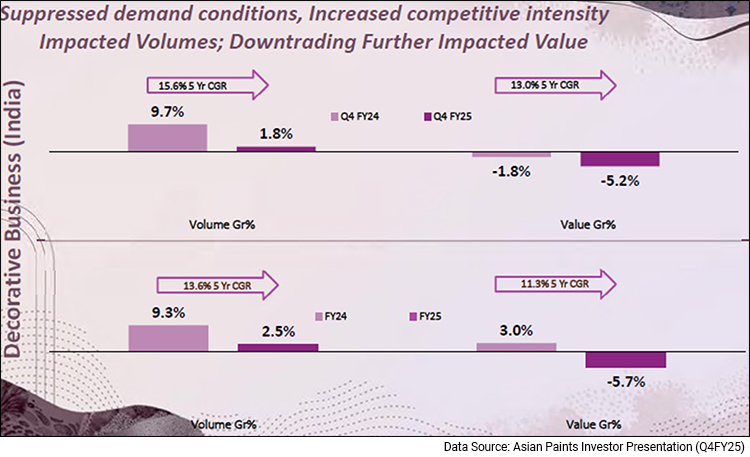
This has weighed on its financials, dampening growth. In FY25, standalone revenue declined 5.4% year-on-year (YoY) to Rs 294 bn, nearly flat compared with Rs 295 bn in FY23. The subdued growth came despite a 2.5% rise in volumes.
However, value declined 5.7%, a sign that competition is intensifying and eroding its pricing power.
Positively, volume growth of 3.9% in Q1 FY26 was the highest since Q2 FY25 - indicating that demand may be reviving. However, value growth still remain negative, but improved to -1.2%, from -3% in Q1 FY25.
Discounting by new entrants to gain market share forced Asian Paints to offer promotional benefits and reduce its prices.
This company's net fixed assets, increased from Rs 46.4 bn (FY23) to Rs 79.3 bn in FY25, but demand has not kept pace with the expansion. As a result, asset turnover fell sharply to 3.7, from a high of 6.5.
Asian Paints Decorative Business Financial Snapshots
The kitchen business remained flat at Rs 3.9 bn, and the bath segment saw only 5% growth to Rs 3.5 bn. Both of these segments are still in the red, impacting their financials.
White Teak revenue declined 20% to Rs 1 bn due to headwinds driven by BIS specifications, weak urban markets, and import challenges. The company has written down Rs 1 bn investment in White Teak. It has recognized a fair value loss of Rs 785 m on derivative contracts for future stake purchases in White Teak.
Earnings before interest, tax, depreciation, and amortization (EBITDA) fell 19.6% YoY to Rs 63 bn. EBITDA margin also declined to 21.4%, against 25.2% in FY24.
As a result, profit after tax (PAT) fell 32.6% YoY to Rs 35.8 bn, even lower than Rs 410 bn in FY23.
This subdued profitability has also weighed on its return ratios. The return on capital employed fell to 28.4%, from a high of 41.2% in FY24.
The slow growth and high valuation have led to its share price returning just 28.3% over the last 5 years.
Going forward, the company also expects competition to remain intense, but it's banking on brand saliency to drive growth recovery.
The company anticipates an improvement in demand, particularly in urban markets. A normal monsoon, government spending, an income tax cut, and a potential GST reduction are expected to boost demand.
International Business Faces Headwinds
Beyond the standalone business, the international business reported 0.2% growth to Rs 30.7 bn, driven by the Middle East, which grew 14%.
The Middle East is the biggest market, accounting for 37.4% of international business revenue. This is followed by Asia (40.9%), Africa (18.3%), and the South Pacific.
Other markets, like Africa, de-grew 24%, Asia (+3%), and the South Pacific stayed flat. Africa's business was impacted by currency devaluation and high inflation in Egypt and Ethiopia.
The company estimates geopolitical situations in many geographies will remain uncertain, which may impact the growth of this segment. However, it remains a small part of the overall business.
Industrial segment revenue rose 6% to Rs 21.4 bn, while profit before tax rose 5% to Rs 3.7 bn. The segment recorded broad-based growth driven by the general industrial and automotive segments.
Asian Paints Consolidated Financials
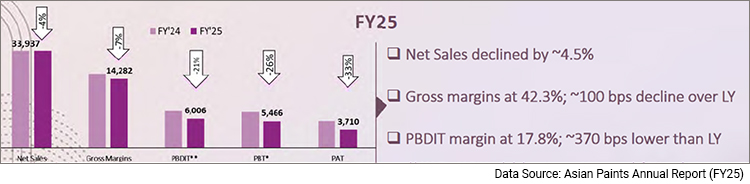
Asian Paints' consolidated revenue declined 4% to Rs 339 bn, led by the subdued performance of the paints business.
Gross margin fell 7%, meaning it's making less profit on each unit sold after covering direct production costs. PAT fell 3.3% to Rs 37.1 bn.
Cautious Outlook
In FY26, Asian Paints aims for single-digit value and volume growth in its business. The EBITDA margin is expected to be 18-20%.
The company is focusing on long-term sustainable growth driver, not short-term gains. However, in the times to come, innovation, brand prominence and new offerings are expected to drive good growth amid intense competition.
This is expected to be driven by an anticipated recovery in government spending, mid-to-luxury housing, and rural demand, following a good monsoon.
The company plans to focus on innovation, having launched over 300 new products and secured more than 130 patents in the last five years.
A futuristic, environmentally friendly emulsion plant (vinyl acetate monomer emulsion) is being set up with an investment of over Rs 30 bn. To this end, the company plans capital expenditures of Rs 7-8 bn each in FY26 and FY27.
This plant, one of only four globally with such technology, is expected to be partially operational by March-April 2026 and fully operational by April 2027.
It will significantly enhance margins and product quality due to the versatility, environmental benefits (low volatile organic compounds and no odor), and unique properties of the emulsion.
The white cement plant in Fujairah, Dubai, with a capacity of 2.75 lakh tonnes, was scheduled to be completed by June 2025. This marks Asian Paints' entry into the cement industry, with potential for future expansion into other types of cement.
In addition, the company continues its premiumization drive, including revamped packaging and ingredient marketing for products like Ultima Protek with graphene and Royal with Teflon.
Simultaneously, it's offering value propositions for products like Ace and Tractor Emulsion, utilizing campaigns such as 'Budget Kam Warranty Mein Dum'.
In the home decor segment, it plans to deepen category penetration in existing stores by offering comprehensive decor solutions under one roof using technology-based in-store innovations.
In the beautiful homes' stores, the company is expanding premium retail formats, such as Beautiful Homes Studio and Signature Stores.
The company is expanding its distribution reach, anticipating vast potential from smaller towns, suburbs, and smart cities.
The strategy for international markets is to consolidate its position as one of the top two players in countries where it operates, with a significant presence in the Middle East.
Conclusion
Asian Paints finds itself at a crossroads. Once a relentless compounding story, the company is now navigating muted demand, stiffer competition, and pressure on profitability.
While valuations have cooled to historical averages, a recovery in housing, government spending, and rural demand could revive growth.
With its strong brand, wide distribution, and renewed focus on innovation, Asian Paints still holds long-term promise, but investors must weigh near-term challenges against its structural strengths.
However, instead of relying only on hype, it is necessary to carefully analyze the company's fundamentals, including financial performance, corporate governance practices, and growth prospects.
Happy investing.
--- Advertisement ---
Investment in securities market are subject to market risks. Read all the related documents carefully before investing
Which businesses are most likely to emerge stronger over the next 3 to 5 years?
After screening thousands of listed companies, comparing industries, and examining balance sheets...
Our research team discovered some of the strongest opportunities in what we call... Essential Stocks.
Opportunities like this do not remain hidden forever.
Disclaimer: This article is for information purposes only. It is not a stock recommendation and should not be treated as such. Learn more about our recommendation services here...
ABOUT EQUITYMASTER
Since 1996, Equitymaster has been the source for honest and credible opinions on investing in India. With solid research and in-depth analysis Equitymaster is dedicated towards making its readers- smarter, more confident and richer every day. Here's why hundreds of thousands of readers spread across more than 70 countries Trust Equitymaster.
PREMIUM PRODUCTS
- Hidden Treasure
- Forever Stocks
- Big Wave Profits
- Equitymaster Venture
- Microcap Millionaires
- Momentum Profits
- Double Income
- Midcap Value Alert
- Exponential Profits
- Annual Breakout Alert
- Lazy Millionaire
- Phase One Alert
- Smallcap AlphaQuest
- InsiderPro Stocks
- StockSelect
- Private Briefing
- Active Wealth Multiplier 2030
- FundSelect
- Fund Advantage
QUICK LINKS
POPULAR TOPICS
- Multibagger Penny Stocks
- Basics of Value Investing
- Benjamin Graham
- How to Invest in Gold
- How to Invest in Silver
- Best Stocks to Buy Today
- Best Small-cap Stocks to Buy
- Best Bluechip Stocks to Buy
- Guide to Penny Stocks
- How to Invest in the Share Market
- Warren Buffett - The Value Investor
- Pick the Best Multibagger Stocks
TRENDING TOPICS
- Best Defence Stocks in India
- Upcoming Dividend Stocks
- Best Semiconductor Stocks in India
- Data Center Stocks in India
- Best Railway Stocks in India
- Best Solar Stocks in India
- Fastest Growing Stocks in India
- List of BSE Sensex 30 Stocks
- Adani Group Shares
- Stocks Recently Bought by FIIs in India
- Top Value Stocks in India


LEGAL DISCLAIMER:
Investment in securities market are subject to market risks. Read all the related documents carefully before investing.
Registration granted by SEBI, enlistment with BSE as IA and RA, and certification from NISM in no way guarantee performance of the intermediary or provide any assurance of returns to investors.
All rights reserved. Any act of copying, reproducing or distributing any content from this website whether wholly or in part, for any purpose without the permission of Quantum Information Services Private Limited is strictly prohibited and shall be deemed to be copyright infringement.
Quantum Information Services Private Limited (QIS) is a SEBI registered Research Analyst (bearing registration no INH000021128) and Investment Adviser(Reg. No: INA000000680). Consequent upon the merger of Equitymaster Research Private Limited into QIS, effective October 30, 2025 QIS owns and operates brand 'Equitymaster' and website www.equitymaster.com. This does not constitute or is not intended to constitute an offer to buy or sell, or a solicitation to an offer to buy or sell financial products, units or securities and QIS including its employees, personnel, directors, associates will not be liable for any losses (direct or indirect) incurred or investment(s) made or decisions taken/or not taken based on the information provided herein. All content and information is provided on an 'As Is' basis by QIS. Information herein is believed to be reliable but QIS does not warrant its completeness or accuracy and expressly disclaims all warranties and conditions of any kind, whether express or implied. The services rendered by QIS are on a best effort basis. QIS does not assure or guarantee the user any minimum or fixed returns. The securities quoted, if any are for illustration only and are not recommendatory. Use of this information is at the user's own risk. The user must make his own investment decisions based on his specific investment objective and financial position and using such independent advisors as he believes necessary. This is not directed for access or use by anyone in a country, especially, USA, Canada or the European Union countries, where such use or access is unlawful or which may subject QIS or its affiliates to any registration or licensing requirement.
The performance data quoted represents past performance and does not guarantee future results. As a condition to accessing QIS's content and website, you agree to our Terms and Conditions of Use, available here
Equitymaster requests your view! Post a comment on "India's Forgotten Stocks: Is Asian Paints Losing its Shine?". Click here!
Comments are moderated by Equitymaster, in accordance with the Terms of Use, and may not appear
on this article until they have been reviewed and deemed appropriate for posting.
In the meantime, you may want to share this article with your friends!