

Investment in securities market are subject to market risks. Read all the related documents carefully before investing
Equitymaster's 2026 Grand Festive Offer:
Get Rs 20,000 Worth of Research
For Rs 2,950 + GST.
**Important: We hate spam as much as you do. Check out our Privacy Policy and Terms Of Use.
4 Rare Earth Magnet Stocks to Watch Amid India's Rs 7,300 Crore Initiative
 Image source: ChatGPT
India is taking a big leap toward making itself self-reliant in rare earth magnets.
The government has approved a first-of-its-kind Rs 73 bn (Rs 7,300 crore) scheme to set up rare earth magnet processing units and supply chains domestically. Soon to be placed before the Union Cabinet led by Prime Minister Narendra Modi, the plan details are:
- Capital expenditure: Rs 65 bn
- Operational expenditure: Rs 8 bn
The goal is to build a homegrown value chain spanning the conversion of NdPr (neodymium-praseodymium) oxide into sintered NdFeB (neodymium-iron-boron) magnets. These are critical to sectors such as automobile, electronics, wind energy, and defence.
The REPM production includes mining, beneficiation, processing, extraction, refining to rare earth oxide, conversion to metal and alloy, and finally magnet manufacturing.
The proposed scheme will incentivise facilities capable of undertaking the final three stages: Converting rare earth oxide to metal, metal to alloy, and alloy to magnet.
This move comes in the wake of China's export restrictions earlier this year on seven rare earth elements and finished magnets, which now require licenses and end-use declarations for exports.
It aims to build a fully indigenous magnet ecosystem with an annual production capacity of up to 6,000 tonnes, enough to meet India's domestic demand, and is expected to run for seven years.
With this initiative, domestic companies in the rare earth and magnet manufacturing space are poised to gain momentum. Here are some stocks to watch.
#1 Hindustan Zinc
First on the list is Hindustan Zinc.
Hindustan Zinc Ltd (HZL) is India's leading zinc-lead producer and a heavyweight in the global metal space. Beyond its core business, the company is making a subtle shift into critical minerals.
Hindustan Zinc, a subsidiary of Indian natural resources conglomerate Vedanta, wants to mine and process neodymium, a rare earth used in permanent magnets.
HZL has emerged as one of the key private players to win bids in the government's fifth tranche of critical mineral auctions, which, for the first time, included blocks of potash, tungsten, and rare earth elements. The company successfully secured a rare earth monzonite block, a non-radioactive deposit distinct from the bit-sand monazite typically mined by Indian Rare Earths Ltd.
This positions HZL as a first mover in India's private rare earth exploration space-especially for neodymium, an essential component for permanent magnets used in EVs and renewable energy systems.
Further, Hindustan Zinc is exploring partnerships across AI- and drone-based exploration technologies, collaborating with international experts from Australia, South Africa, Chile, and China to enhance efficiency and discovery, as highlighted by Chairperson Priya Agarwal Hebbar at the company's 59th Annual General Meeting.
With India's push to build a self-reliant rare earth magnet ecosystem, Hindustan Zinc stands out as a stock to watch, backed by its early move into developing domestic sources of neodymium-a crucial element used in high-performance permanent magnets.
For more details, see the HINDUSTAN ZINC company fact sheet and quarterly results.
#2 GMDC
Next on the list is GMDC.
GMDC has long been known as Gujarat's lignite champion. But the state-run miner is slowly shifting gears from a traditional coal and bauxite producer to a forward-looking critical minerals player.
The company is developing one of the world's largest rare earth deposits at Ambadungar in Gujarat's Chhota Udepur district. The site will feature an open-pit mine, modern processing plants, workshops, and even residential facilities, built to create a state-of-the-art mining and living ecosystem.
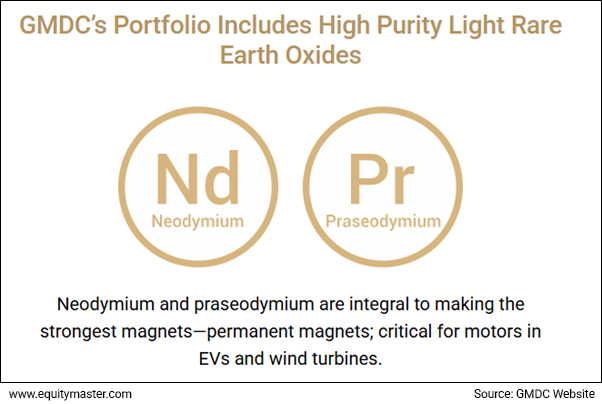
The Ambadungar deposit is rich in light rare earth elements (LREEs), which are vital for industries worldwide.
The mixed rare earth carbonate produced here will be sent to GMDC's upcoming separation plant in Bharuch, where it will be converted into high-value rare earth oxides like neodymium, praseodymium, lanthanum, and cerium - materials essential for everything from EV motors and magnets to glass and optical components.
GMDC's vision is to create a complete rare earth value chain in India, right from mining to processing and end-product manufacturing.
With India's new rare earth magnet scheme focused on boosting domestic processing and manufacturing capabilities, GMDC is one of the top stocks to watch, given its ambitious plans to build an integrated rare earth ecosystem within India.
For more details, see the GMDC company fact sheet and quarterly results.
#3 NALCO
Next on the list is NALCO
The company is known for aluminium production, is diversifying into critical minerals through both domestic exploration and overseas ventures.
The company is now entering into critical mineral extraction.
It is part of a joint venture called Khanij Bidesh India Ltd (KABIL), which has acquired five lithium mines in Argentina and is conducting detailed exploration to assess commercial viability.
NALCO is also exploring the possibilities of investing in lithium refining operations in Australia and is looking at acquiring exploration rights for critical mineral blocks in India when auctions occur.
Additionally, Nalco is working on extracting gallium, another critical mineral, with plans for commercial production within two years.
Media reports indicate that NALCO is setting up a prototype facility at its Damanjodi refinery, which is expected to be ready within eight to nine months, followed by a year of testing before commencing commercial production. Once operational, the facility will make NALCO the first company in India to manufacture gallium commercially by 2027.
With its growing presence in lithium and gallium-both critical to the rare earth magnet value chain-NALCO is well-positioned to benefit from the government's new rare earth magnet scheme, making it one of the top stocks to watch in this space.
The Navratna company will extract gallium from the waste generated from its alumina refinery, and in the process, making it the only manufacturer of gallium in the country.
This project will make NALCO the only domestic producer of gallium, a rare metal that plays a key role in neodymium-iron-boron (NdFeB) magnets. When added in small amounts, gallium can significantly enhance the magnet's performance, improving both its coercivity and thermal stability.
For more details, see the NALCO company fact sheet and quarterly results.
#4 Sona Comstar
Next on the list is Sona Comstar.
The company has historically been strong in differential gears and starter motors, holding significant market shares globally and dominating the Indian market for differential gears.
But now Sona Comstar has been strategically prioritising electrification, with a large portion of its revenue and order book coming from battery electric vehicles (BEV). Its products for EVs include EV traction motors and EV differential assemblies.
The company is also diversifying its product portfolio and market segments, moving beyond traditional automotive applications to include components for drones, eVTOLs (electric vertical take-off and landing vehicles), AGVs (automated guided vehicles), AMRs (autonomous mobile robots), industrial robots, and humanoid robots.
Sona Comstar is one of India's leading importers of rare earth magnets. But it is now set to begin domestic production of these critical components. It's the first Indian company to announce plans for local magnet production after the government's program became public.
- 'Being the largest importer of rare earth magnets, we are the single largest affected party in the country. We have to look at India's self-sufficiency on magnets and are working with the government on it.' - Sona Comstar CEO, Vivek Vikram Singh
The company supplies gears and motors to car makers such as Tesla and Stellantis, and imported around 120 MT of magnets from China in the last financial year.
The company has the funds for local manufacturing, citing its five-fold increase in revenue to more than US$ 400 m over the past five years.
For more details, see the SONA COMSTAR company fact sheet and quarterly results.
Conclusion
India currently imports almost all of its rare-earth permanent magnet needs. Government estimates place domestic demand at around 4,010 tonnes a year, expected to almost double to 8,220 tonnes by 2030.

The recently approved Rs 73 bn scheme to set up rare earth magnet processing units and supply chains is expected to accelerate the development of a self-reliant domestic ecosystem. This initiative is likely to benefit companies involved across the rare earth and magnet value chain.
However, investors should remain cautious of execution risks and the long gestation period associated with such large-scale infrastructure and mining projects.
Investors should evaluate the company's fundamentals, corporate governance, and valuations of the stock as key factors when conducting due diligence before making investment decisions.
--- Advertisement ---
Investment in securities market are subject to market risks. Read all the related documents carefully before investing
Which businesses are most likely to emerge stronger over the next 3 to 5 years?
After screening thousands of listed companies, comparing industries, and examining balance sheets...
Our research team discovered some of the strongest opportunities in what we call... Essential Stocks.
Opportunities like this do not remain hidden forever.
Disclaimer: This article is for information purposes only. It is not a stock recommendation and should not be treated as such. Learn more about our recommendation services here...
Equitymaster requests your view! Post a comment on "4 Rare Earth Magnet Stocks to Watch Amid India's Rs 7,300 Crore Initiative". Click here!
2 Responses to "4 Rare Earth Magnet Stocks to Watch Amid India's Rs 7,300 Crore Initiative"
ABOUT EQUITYMASTER
Since 1996, Equitymaster has been the source for honest and credible opinions on investing in India. With solid research and in-depth analysis Equitymaster is dedicated towards making its readers- smarter, more confident and richer every day. Here's why hundreds of thousands of readers spread across more than 70 countries Trust Equitymaster.
PREMIUM PRODUCTS
- Hidden Treasure
- Forever Stocks
- Big Wave Profits
- Equitymaster Venture
- Microcap Millionaires
- Momentum Profits
- Double Income
- Midcap Value Alert
- Exponential Profits
- Annual Breakout Alert
- Lazy Millionaire
- Phase One Alert
- Smallcap AlphaQuest
- InsiderPro Stocks
- StockSelect
- Private Briefing
- Active Wealth Multiplier 2030
- FundSelect
- Fund Advantage
QUICK LINKS
POPULAR TOPICS
- Multibagger Penny Stocks
- Basics of Value Investing
- Benjamin Graham
- How to Invest in Gold
- How to Invest in Silver
- Best Stocks to Buy Today
- Best Small-cap Stocks to Buy
- Best Bluechip Stocks to Buy
- Guide to Penny Stocks
- How to Invest in the Share Market
- Warren Buffett - The Value Investor
- Pick the Best Multibagger Stocks
TRENDING TOPICS
- Best Defence Stocks in India
- Upcoming Dividend Stocks
- Best Semiconductor Stocks in India
- Data Center Stocks in India
- Best Railway Stocks in India
- Best Solar Stocks in India
- Fastest Growing Stocks in India
- List of BSE Sensex 30 Stocks
- Adani Group Shares
- Stocks Recently Bought by FIIs in India
- Top Value Stocks in India


LEGAL DISCLAIMER:
Investment in securities market are subject to market risks. Read all the related documents carefully before investing.
Registration granted by SEBI, enlistment with BSE as IA and RA, and certification from NISM in no way guarantee performance of the intermediary or provide any assurance of returns to investors.
All rights reserved. Any act of copying, reproducing or distributing any content from this website whether wholly or in part, for any purpose without the permission of Quantum Information Services Private Limited is strictly prohibited and shall be deemed to be copyright infringement.
Quantum Information Services Private Limited (QIS) is a SEBI registered Research Analyst (bearing registration no INH000021128) and Investment Adviser(Reg. No: INA000000680). Consequent upon the merger of Equitymaster Research Private Limited into QIS, effective October 30, 2025 QIS owns and operates brand 'Equitymaster' and website www.equitymaster.com. This does not constitute or is not intended to constitute an offer to buy or sell, or a solicitation to an offer to buy or sell financial products, units or securities and QIS including its employees, personnel, directors, associates will not be liable for any losses (direct or indirect) incurred or investment(s) made or decisions taken/or not taken based on the information provided herein. All content and information is provided on an 'As Is' basis by QIS. Information herein is believed to be reliable but QIS does not warrant its completeness or accuracy and expressly disclaims all warranties and conditions of any kind, whether express or implied. The services rendered by QIS are on a best effort basis. QIS does not assure or guarantee the user any minimum or fixed returns. The securities quoted, if any are for illustration only and are not recommendatory. Use of this information is at the user's own risk. The user must make his own investment decisions based on his specific investment objective and financial position and using such independent advisors as he believes necessary. This is not directed for access or use by anyone in a country, especially, USA, Canada or the European Union countries, where such use or access is unlawful or which may subject QIS or its affiliates to any registration or licensing requirement.
The performance data quoted represents past performance and does not guarantee future results. As a condition to accessing QIS's content and website, you agree to our Terms and Conditions of Use, available here
Naresh Taneja
Oct 13, 2025Good information but your subscription is very very expansive.Compare with ET,Super pro Moneycontrol.
And if your tele marketing girls could be polite and seek feedback.Trade Brains,Financial express are free.