

Investment in securities market are subject to market risks. Read all the related documents carefully before investing
Two Years of Market Correction
Is This Your Buying Window?
See Where the Opportunities are Emerging for the Next 3-5 Years
**Important: We hate spam as much as you do. Check out our Privacy Policy and Terms Of Use.
Cochin Shipyard: The Quiet Compounder in India's Maritime Revival
 Image source: Jash Shah/www.istockphoto.com
When you buy into a business, you want to know what you are really buying. Is it a one-trick pony that lives and dies by a single customer? Or is it a sturdy workhorse that can pull steady earnings through all kinds of weather?
In the case of Cochin Shipyard Limited (CSL), that question goes to the heart of what makes a company truly durable.
For years, CSL built some of the Indian Navy's most complex ships - aircraft carriers, patrol boats, anti-submarine vessels. That made for impressive headlines, but it also made CSL's fortunes depend heavily on government contracts.
At one point, almost nine out of every ten rupees in its order book came from defence. Reliable, yes. But also limiting. After all, a company tied too tightly to the government's budget cycles can only grow as fast as those cycles allow.
Now CSL stands at an important turning point. The company has just poured billions of rupees into two major projects: the New Dry Dock (NDD) and the International Ship Repair Facility (ISRF).
These are the foundation of a strategic shift, away from a narrow focus on defence and toward broader, higher margin international shipbuilding and ship repair.
Can CSL use these assets to change its business model in a way that produces steadier, fatter profits over time?
Read on...
Two Businesses Under One Roof
It helps to think of CSL as two businesses.
1. Shipbuilding
This business makes new ships - from aircraft carriers and patrol vessels to commercial tankers and platform supply ships. These projects are large, complex, and long. They tie up huge amounts of working capital.
Also, these contracts are mostly fixed price so CSL cannot pass cost overruns back to the customer. That is why shipbuilding margins have historically been modest. In Q1 FY26, the EBIT margin was just over 8%.
2. Ship Repair and Upgrades
This side handles maintenance, refitting, and modernisation. Jobs run faster, cash comes in quicker, and margins are higher. In Q1 FY26, EBIT margin for repairs was 44.2%. Repair may only account for about 7% of the long-term order book, but its profits are higher. That profit cushion is what helps pay for the fixed costs of the new NDD and ISRF.
Strategic Growth Initiatives
CSL's future growth rests on how well it uses the major investments it has already made and how effectively it works with the right partners.
The new facilities that came online in January 2024 now give the company a platform to compete for larger and more profitable work.
- New Dry Dock (NDD): The new dry dock allows CSL to build much larger ships than before, including Suezmax oil tankers, big container ships, and Capesize bulk carriers. With this dock, the company can now target up to six large carriers a year, a big step up from where it stood earlier.
- International Ship Repair Facility (ISRF): The ISRF is aimed at capturing the shortage of global ship repair capacity. This will be a driver of high margins. The work here is short-cycle, high-value, and can provide steady cash flow while the larger shipbuilding projects take time to mature.
- Block Fabrication Facility: CSL is planning a new block fabrication yard near Kochi. This ensures that large ship projects can be handled at a faster pace. The investment is necessary if the company is to move from single, complex defence projects to higher-volume commercial work.
Leveraging Partnerships to Build a Real Advantage
CSL signed an MoU in July 2025 for long-term cooperation with HD Korea Shipbuilding & Offshore Engineering (HD KSOE). This agreement brings in advanced shipbuilding technology and operating standards that can help India compete with established South Korean and Chinese yards.
India's natural edge lies in labour. The average shipyard worker costs about US$ 1,200 a year, compared with more than US$ 21,000 in South Korea. On paper, that gives India one of the strongest labour cost advantages in the world.
But in practice, this benefit has been offset by expensive financing, heavy dependence on imported materials, and slow logistics marked by high port charges and weak road links. The new Dry Dock and the technology transfer from HD KSOE aim to close that gap.
Also, the government's decision to classify large ship projects as infrastructure opens the door to cheaper capital.
Together, these steps allow CSL to use its labour advantage more effectively.
| Factor | India (CSL/MDL/GRSE) | South Korea | China | India's Position |
|---|---|---|---|---|
| Labor Cost (Annual/Worker) | US$ 1,192 | US$ 21,317 | 50% of Korea/Japan | Strongest Factor |
| Financing Costs | 10-10.5% | 5-6% | 4-8% | Major Disadvantage |
| Raw Materials | Heavy import reliance | Mature global sourcing | Cheapest steel | Cost Pressure |
| Infrastructure/Logistics | Historically weak | Highly developed | Highly developed | Improving (NDD/ISRF) |
CSL is positioning itself for export and commercial work. The success of this plan depends on how quickly it can scale operations at the New Dry Dock and absorb technology from HD KSOE.
Building for a Greener Future
Cochin Shipyard is taking part in India's move toward cleaner maritime transportation. Alongside Mazagon Dock Shipbuilders, it is building one of the country's first ships powered by green hydrogen fuel cells, using homegrown technology.
The project is backed by the National Green Hydrogen Mission, which has set aside about Rs 1.15 bn through FY26 for infrastructure and technology development.
This early involvement gives CSL a head start. It keeps the company aligned with future fuel mandates and places it at the center of emerging hydrogen hubs at Tuticorin and Paradip.
Financials
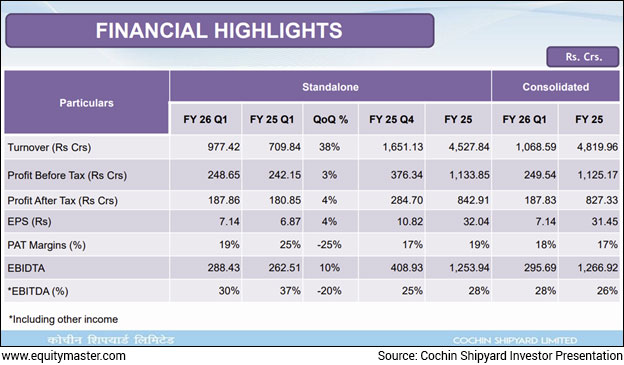
In 1Q FY26, Cochin Shipyard turned in a strong performance. Revenue from operations was up about 39% from the same period last year, driven mainly by the ship repair business,
Even with higher fixed costs from the new facilities coming online, profitability held steady. Operating profit rose roughly 36% YoY, with margins essentially unchanged, and net profit moved up sharply as well.
In FY26, revenue grew 25.8% to Rs 48.2 bn. Operating profit rose to Rs 12.8 bn, up from Rs 11.9 bn YoY. Net profit advanced to Rs 8.3 bn from Rs 7.8 bn. Margins remained healthy despite the costs of expansion projects.
| Year Ending | Mar-21* | Mar-22* | Mar-23* | Mar-24* | Mar-25* | |
|---|---|---|---|---|---|---|
| Net Sales | Rs m | 28,189 | 31,909 | 23,646 | 38,305 | 48,200 |
| Sales Growth | % | -17.60 | 13.20 | -25.90 | 62.00 | 25.80 |
| Operating Profit | Rs m | 9,136 | 8,899 | 4,688 | 11,917 | 12,836 |
| Operating Margin | % | 32.41 | 27.89 | 19.82 | 31.11 | 26.63 |
| Net profit | Rs m | 6,087 | 5,640 | 3,047 | 7,833 | 8,273 |
| Net Margin | % | 21.60 | 17.70 | 12.90 | 20.40 | 17.20 |
Order Book and Revenue Visibility
Cochin Shipyard's order book remains strong and well balanced. In FY26, the company reported a backlog of about Rs 211-225 bn, which translates into nearly five years of revenue visibility.
| Segment | Value (Rs) | Share (%) | Cycle / Margin Profile |
|---|---|---|---|
| Total Order Book | 211-225 | 100 | 4.5-5 Years Visibility |
| Defense Shipbuilding | 137.15 | 65 | Long Cycle |
| Commercial Shipbuilding | 59 | 28 | Medium Cycle |
| Ship Repair | 15 | 7 | Short Cycle, High Margin |
Defence contracts still form the bulk of the order book, but the mix is changing. The share of defense projects has come down from about 88% a few years ago to 66% as of June 2025.
Commercial shipbuilding now accounts for roughly 27%, with export orders making up around 20% of total value. Ship repair contributes another 7%, or about Rs 15 bn.
This marks real progress in diversification. CSL's revenue is becoming broader, less dependent on government orders, and better positioned to handle changes in demand.
Management Guidance and Long-Term Trajectory
Management expects revenue to grow meaningfully on the back of their new facilities coming online and a strong order book in execution.
They are targeting higher profit margins. Beyond this year, they laid out a plan for sustained growth over the next 5-10 years.
Large facilities like the New Dry Dock take time to translate into profits because shipbuilding cycles run long. In contrast, the International Ship Repair Facility is expected to deliver right away.
That means profitability depends heavily on getting high-margin repair work through the system quickly, while the shipbuilding side ramps up more slowly.
Instead of just focusing on new builds, CSL is leaning more into Maintenance, Repair, and Overhaul (MRO) contracts. These are high-margin and short-cycle, and they feed directly into the ISRF.
The recent large MRO contract with the Defence Ministry is an example of this. It locks in stable defense-related repair work while international customers like Maersk bring in commercial volume.
Final Due Diligence Note
Cochin Shipyard is in a strong strategic position. Its foundation is secured by sovereign defence mandates, which provide reliable visibility into future revenues.
At the same time, the company has moved from simply building capacity to putting that capacity to work on high-volume international projects.
But the risks should not be ignored. Long-cycle defence contracts tie up working capital and leave the company exposed to execution delays.
New facilities, while impressive, create immediate pressure to fill capacity and scale utilisation quickly. If the assets are not fed with enough high-margin work profitability will be impacted.
Success depends on external and internal factors. Externally, the stability of partnerships with Maersk and HD KSOE will determine whether the commercial order flow is durable.
Internally, governance and operational discipline will determine whether CSL can deliver at the promised scale.
Investors should evaluate the company's fundamentals, corporate governance, and valuations of the stock as key factors when conducting due diligence before making investment decisions.
Happy investing.
--- Advertisement ---
Investment in securities market are subject to market risks. Read all the related documents carefully before investing
Which businesses are most likely to emerge stronger over the next 3 to 5 years?
After screening thousands of listed companies, comparing industries, and examining balance sheets...
Our research team discovered some of the strongest opportunities in what we call... Essential Stocks.
Opportunities like this do not remain hidden forever.
Disclaimer: This article is for information purposes only. It is not a stock recommendation and should not be treated as such. Learn more about our recommendation services here...
ABOUT EQUITYMASTER
Since 1996, Equitymaster has been the source for honest and credible opinions on investing in India. With solid research and in-depth analysis Equitymaster is dedicated towards making its readers- smarter, more confident and richer every day. Here's why hundreds of thousands of readers spread across more than 70 countries Trust Equitymaster.
PREMIUM PRODUCTS
- Hidden Treasure
- Forever Stocks
- Big Wave Profits
- Equitymaster Venture
- Microcap Millionaires
- Momentum Profits
- Double Income
- Midcap Value Alert
- Exponential Profits
- Annual Breakout Alert
- Lazy Millionaire
- Phase One Alert
- Smallcap AlphaQuest
- InsiderPro Stocks
- StockSelect
- Private Briefing
- Active Wealth Multiplier 2030
- FundSelect
- Fund Advantage
QUICK LINKS
POPULAR TOPICS
- Multibagger Penny Stocks
- Basics of Value Investing
- Benjamin Graham
- How to Invest in Gold
- How to Invest in Silver
- Best Stocks to Buy Today
- Best Small-cap Stocks to Buy
- Best Bluechip Stocks to Buy
- Guide to Penny Stocks
- How to Invest in the Share Market
- Warren Buffett - The Value Investor
- Pick the Best Multibagger Stocks
TRENDING TOPICS
- Best Defence Stocks in India
- Upcoming Dividend Stocks
- Best Semiconductor Stocks in India
- Data Center Stocks in India
- Best Railway Stocks in India
- Best Solar Stocks in India
- Fastest Growing Stocks in India
- List of BSE Sensex 30 Stocks
- Adani Group Shares
- Stocks Recently Bought by FIIs in India
- Top Value Stocks in India


LEGAL DISCLAIMER:
Investment in securities market are subject to market risks. Read all the related documents carefully before investing.
Registration granted by SEBI, enlistment with BSE as IA and RA, and certification from NISM in no way guarantee performance of the intermediary or provide any assurance of returns to investors.
All rights reserved. Any act of copying, reproducing or distributing any content from this website whether wholly or in part, for any purpose without the permission of Quantum Information Services Private Limited is strictly prohibited and shall be deemed to be copyright infringement.
Quantum Information Services Private Limited (QIS) is a SEBI registered Research Analyst (bearing registration no INH000021128) and Investment Adviser(Reg. No: INA000000680). Consequent upon the merger of Equitymaster Research Private Limited into QIS, effective October 30, 2025 QIS owns and operates brand 'Equitymaster' and website www.equitymaster.com. This does not constitute or is not intended to constitute an offer to buy or sell, or a solicitation to an offer to buy or sell financial products, units or securities and QIS including its employees, personnel, directors, associates will not be liable for any losses (direct or indirect) incurred or investment(s) made or decisions taken/or not taken based on the information provided herein. All content and information is provided on an 'As Is' basis by QIS. Information herein is believed to be reliable but QIS does not warrant its completeness or accuracy and expressly disclaims all warranties and conditions of any kind, whether express or implied. The services rendered by QIS are on a best effort basis. QIS does not assure or guarantee the user any minimum or fixed returns. The securities quoted, if any are for illustration only and are not recommendatory. Use of this information is at the user's own risk. The user must make his own investment decisions based on his specific investment objective and financial position and using such independent advisors as he believes necessary. This is not directed for access or use by anyone in a country, especially, USA, Canada or the European Union countries, where such use or access is unlawful or which may subject QIS or its affiliates to any registration or licensing requirement.
The performance data quoted represents past performance and does not guarantee future results. As a condition to accessing QIS's content and website, you agree to our Terms and Conditions of Use, available here
Equitymaster requests your view! Post a comment on "Cochin Shipyard: The Quiet Compounder in India's Maritime Revival". Click here!
Comments are moderated by Equitymaster, in accordance with the Terms of Use, and may not appear
on this article until they have been reviewed and deemed appropriate for posting.
In the meantime, you may want to share this article with your friends!