


Equitymaster's 2026 Grand Festive Offer
Two Research Reports, Six Stocks
3 Small Cap, 3 Large Cap
**Important: We hate spam as much as you do. Check out our Privacy Policy and Terms Of Use.
Elon Musk Wants to Enter India. Here Are the 4 Sectors Starlink Would Hit First
 Image source: dem10/www.istockphoto.com
Elon Musk wants to enter India. India hasn't said yes.
On Wednesday, 7 October 2026, the world's richest man said 'certain oligarchs' were blocking Starlink from India. He named nobody. 'You can guess who they are,' he wrote.
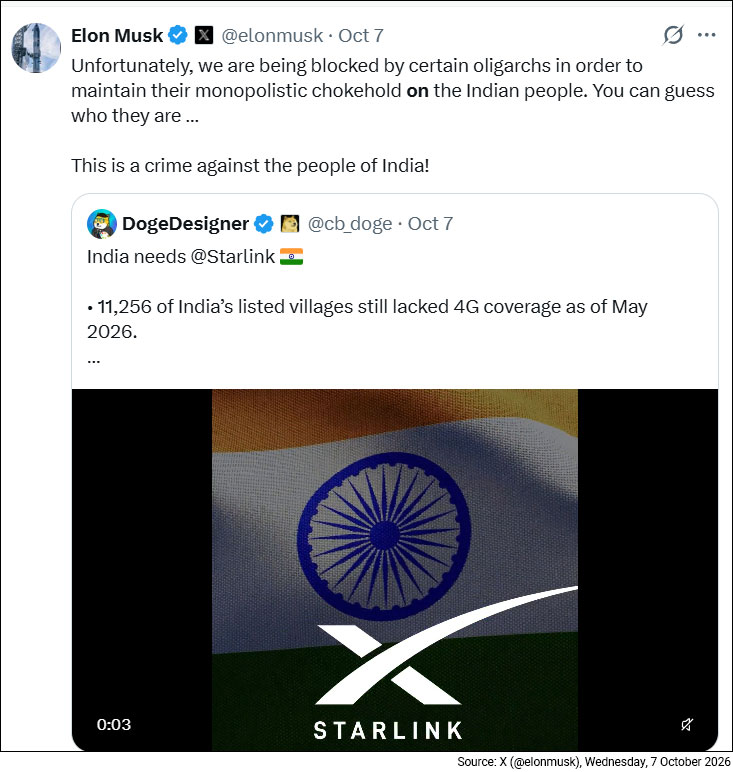
Starlink says it is ready. It has built twenty gateway sites in India. It still needs spectrum, a second round of security clearance, and approval for foreign direct investment (FDI). Spectrum pricing for every satellite operator still needs Cabinet sign-off.
But the real story isn't the fight. It's the businesses that already sell internet in India, from space and on the ground... and what happens to them when Starlink switches on.
It won't hit them all the same way. Four sectors sit closest to it. Here is how each one works, and where Starlink fits in.
1. Satellite communication services: Starlink sells the same product
This sector rents satellite links to banks, ships, airlines, oil fields, mines, and government users who can't get fiber. Most of these links run on satellites about 36,000 kilometers up, so response times are slow.
Starlink's satellites fly at 540 to 570 kilometers. The Indian National Space Promotion and Authorisation Centre (IN-SPACe), the space regulator, has approved 4,408 of them for India. The shorter trip means quicker response times, and that is the very thing these customers pay for.
The Indian market is small by telecom standards. IMARC Group puts satellite broadband services at US$ 394 million (m) in 2025.
Nelco, a Tata Power subsidiary, is the listed name with the deepest exposure. In March 2023, about 26% of all small-dish satellite terminals installed in India ran on Nelco's network. In 2019, it also won a licence to offer internet on planes and ships in India.
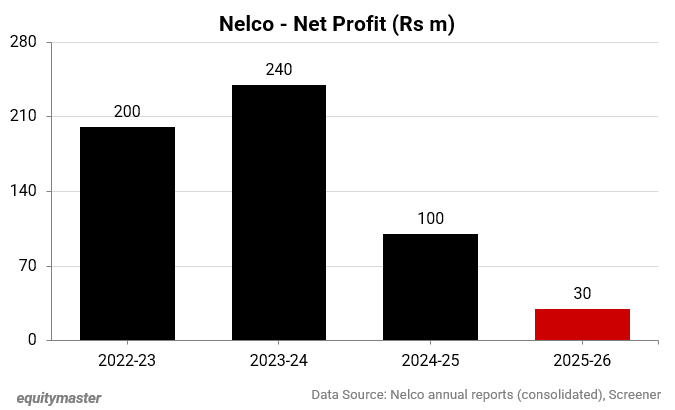
Its profits were shrinking even before Starlink's launch. Revenue stood at Rs 3.07 billion (bn) in FY26, against Rs 3.13 bn three years earlier.
Net profit fell from Rs 240 m to Rs 30 m over two years. The return on capital employed (ROCE) dropped from 23% to 7% over the same two years.
Now the Starlink link. Starlink already sells Nelco's main products abroad.
- Enterprise links: Starlink markets business plans worldwide. In India, it has not yet published those prices.
- Planes: By June 2026, Starlink had signed 41 airlines, covering more than 7,000 aircraft under installation or contract. In-flight internet is one of Nelco's growth areas.
- Phones from space: Starlink has applied to IN-SPACe for a network of nearly 30,000 satellites that can talk straight to phones. A phone-to-satellite venture in which Nelco holds a minority stake targets an early-2028 launch.
Three features decide how this plays out. First, 65% to 70% of Nelco's revenue comes from recurring bandwidth fees, on contracts of one to three years. Each renewal gives a customer a chance to compare.
Second, Nelco owns no satellites. It leases capacity, and in August 2025 it signed up to sell low-orbit service from Eutelsat OneWeb, a direct Starlink rival.
Third, The Economic Times reported in April 2025 that Starlink had held talks with Nelco and state-run Bharat Sanchar Nigam (BSNL). Neither has announced a deal.
So, Nelco could meet Starlink as a rival, a partner, or both.
Want To Read The Full Article?
Enter your email to continue reading on Equitymaster.
Important: We hate spam as much as you do. Check out our Privacy Policy and Terms Of Use.
By submitting your email address, you also sign up for Profit Hunter, a daily newsletter from Equitymaster covering exciting investing ideas and opportunities in India.

Gaurav Bhosale, Research Analyst at Equitymaster, is a former athlete and CFA Level 2 candidate. He applies first-principles thinking to break down complex business models into their fundamentals, relentlessly challenging assumptions to deliver high-conviction research.
ABOUT EQUITYMASTER
Since 1996, Equitymaster has been the source for honest and credible opinions on investing in India. With solid research and in-depth analysis Equitymaster is dedicated towards making its readers- smarter, more confident and richer every day. Here's why hundreds of thousands of readers spread across more than 70 countries Trust Equitymaster.
PREMIUM PRODUCTS
- Hidden Treasure
- Forever Stocks
- Big Wave Profits
- Equitymaster Venture
- Microcap Millionaires
- Momentum Profits
- Double Income
- Midcap Value Alert
- Exponential Profits
- Annual Breakout Alert
- Lazy Millionaire
- Phase One Alert
- Smallcap AlphaQuest
- InsiderPro Stocks
- StockSelect
- Private Briefing
- Active Wealth Multiplier 2030
- FundSelect
- Fund Advantage
QUICK LINKS
POPULAR TOPICS
- Multibagger Penny Stocks
- Basics of Value Investing
- Benjamin Graham
- How to Invest in Gold
- How to Invest in Silver
- Best Stocks to Buy Today
- Best Small-cap Stocks to Buy
- Best Bluechip Stocks to Buy
- Guide to Penny Stocks
- How to Invest in the Share Market
- Warren Buffett - The Value Investor
- Pick the Best Multibagger Stocks
TRENDING TOPICS
- Best Defence Stocks in India
- Upcoming Dividend Stocks
- Best Semiconductor Stocks in India
- Data Center Stocks in India
- Best Railway Stocks in India
- Best Solar Stocks in India
- Fastest Growing Stocks in India
- List of BSE Sensex 30 Stocks
- Adani Group Shares
- Stocks Recently Bought by FIIs in India
- Top Value Stocks in India


LEGAL DISCLAIMER:
Investment in securities market are subject to market risks. Read all the related documents carefully before investing.
Registration granted by SEBI, enlistment with BSE as IA and RA, and certification from NISM in no way guarantee performance of the intermediary or provide any assurance of returns to investors.
All rights reserved. Any act of copying, reproducing or distributing any content from this website whether wholly or in part, for any purpose without the permission of Quantum Information Services Private Limited is strictly prohibited and shall be deemed to be copyright infringement.
Quantum Information Services Private Limited (QIS) is a SEBI registered Research Analyst (bearing registration no INH000021128) and Investment Adviser(Reg. No: INA000000680). Consequent upon the merger of Equitymaster Research Private Limited into QIS, effective October 30, 2025 QIS owns and operates brand 'Equitymaster' and website www.equitymaster.com. This does not constitute or is not intended to constitute an offer to buy or sell, or a solicitation to an offer to buy or sell financial products, units or securities and QIS including its employees, personnel, directors, associates will not be liable for any losses (direct or indirect) incurred or investment(s) made or decisions taken/or not taken based on the information provided herein. All content and information is provided on an 'As Is' basis by QIS. Information herein is believed to be reliable but QIS does not warrant its completeness or accuracy and expressly disclaims all warranties and conditions of any kind, whether express or implied. The services rendered by QIS are on a best effort basis. QIS does not assure or guarantee the user any minimum or fixed returns. The securities quoted, if any are for illustration only and are not recommendatory. Use of this information is at the user's own risk. The user must make his own investment decisions based on his specific investment objective and financial position and using such independent advisors as he believes necessary. This is not directed for access or use by anyone in a country, especially, USA, Canada or the European Union countries, where such use or access is unlawful or which may subject QIS or its affiliates to any registration or licensing requirement.
The performance data quoted represents past performance and does not guarantee future results. As a condition to accessing QIS's content and website, you agree to our Terms and Conditions of Use, available here
Equitymaster requests your view! Post a comment on "Elon Musk Wants to Enter India. Here Are the 4 Sectors Starlink Would Hit First". Click here!
Comments are moderated by Equitymaster, in accordance with the Terms of Use, and may not appear
on this article until they have been reviewed and deemed appropriate for posting.
In the meantime, you may want to share this article with your friends!