India's banking industry has changed beyond recognition over the years. It began with the founding of RBI in 1935, the nationalisation of major banks in 1969, and the opening of doors for private banks in the 1990s.
Financial inclusion and digital payments have brought hundreds of millions of new customers into the system. Today, rising incomes, formalisation of the economy, low credit penetration, and revival in loan demand are strong tailwinds driving banking sector growth.
Two major banks, Axis Bank and Kotak Mahindra Bank, are expanding heavily to capture this growth.
Let's compare these two banks across various parameters to see who is better equipped to get a slice of this growth.
It has four business segments, namely treasury, retail banking (including digital banking), corporate/wholesale banking and other banking business.
The bank has kept its group structure lean, built around focused subsidiaries such as Axis Asset Management, Axis Capital, Axis Securities, Axis Finance, Freecharge, and Axis Bank UK.
As of March 2026, the company operates 6,275 branches and 12,796 ATMs and cash recyclers, with nearly 47% of branches in rural and semi-urban areas. It serves about 54 million (m) customers with over 101,000 employees, and has 7 international offices, including Singapore, Dubai, and GIFT City.
Axis Bank has successfully completed the acquisition of Citibank's India consumer business in 2023, which helped strengthen Axis's Burgundy wealth business.
Kotak Mahindra Bank
Kotak Mahindra Bank, headquartered in Mumbai, was initially established in 1985 as a bill discounting business, Kotak Capital Management Finance.
Later, the company transitioned into a vehicle financing business through a joint venture with Mahindra and became Kotak Mahindra Finance. In 2003, it became India's first non-banking finance corporation (NBFC) to convert into a bank.
Unlike Axis, which earns most of its income from lending, Kotak operates as a financial services ecosystem. Its banking arm is built around consumer banking, business banking, commercial banking and treasury. The group companies add income from broking, investment banking, asset management, and insurance.
The key subsidiaries are Kotak Securities, Kotak Mahindra Capital, Kotak Mahindra Prime, Kotak Mahindra Asset Management and Kotak Life Insurance.
As of March 2026, Kotak runs 2,276 branches and 2,727 ATMs, a network about a third the size of Axis's. It serves roughly 52 m customers with over 112,000 employees, and has a consolidated balance sheet of about Rs 10,000 bn.
After the merger with ING Vysya Bank in 2015, Kotak Mahindra Bank added scale to its business, particularly in South India. In 2017, the bank launched Kotak 811, its full-service digital banking platform, to widen its customer base.
In April 2024, the Reserve Bank of India (RBI) barred Kotak from onboarding new customers through online and mobile channels and from issuing fresh credit cards, citing IT-related supervisory concerns. In 2025, this restriction was lifted after remedial action and an external audit. During this period, the bank's growth softened compared to Axis Bank.
| Particulars |
Axis Bank |
Kotak Mahindra Bank |
| Market Cap (in Rs billion)* |
3,874.1 |
4,377.1 |
Source: Equitymaster| *as of 7th October 2026
If we compare the two companies based on their marketcap, then Kotak Mahindra Bank is leading with a marketcap of Rs 4,377.1 bn as against Axis Bank's Rs 3,874.1 bn.
Despite having less than half of Axis's balance sheet, Kotak's market cap is roughly 13% higher, as investors pay a premium for its stronger returns, margins, capital cushion, and diversified earnings.
![]()
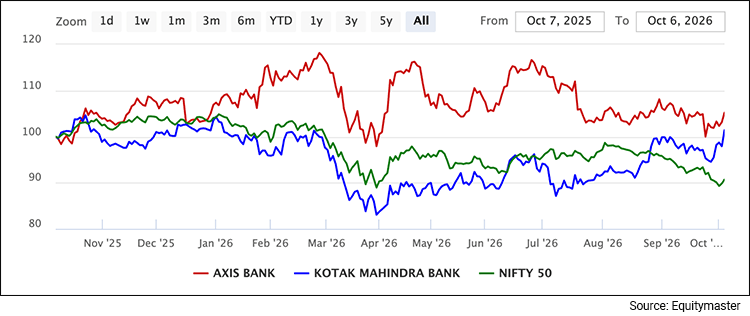
Over the past year, Axis Bank has given a return of 5%, and Kotak has given a return of 3%. While these are not excellent returns, both banks managed to beat the market index Nifty 50, which fell by almost 10% during the same period.
Axis Bank held up due to steady domestic lending, whereas Kotak's share grew on account of a sharp rebound in strong loan and deposit growth.
Interest Income
For both Axis and Kotak Bank, interest income comes mainly from loans and advances. A small part of the interest comes from investments and on balances with the RBI and other banks.
While Axis has a larger base with respect to interest income (almost 1.9 times higher), its interest income grew at a 14% CAGR (compound annual growth rate), as against Kotak's 15.6%. Faster loan growth and a rich asset mix have helped Kotak's interest income grow strongly against Axis.
However, the growth slowed sharply for both banks in FY26, despite an increase in advances, indicating that yields are falling.
Kotak also earns a better margin than Axis. Its net interest margin was 57.6% in FY26, as against 44.1% for Axis. This means Kotak is keeping far more of each rupee it earns than Axis.
Interest income
| Interest income (Rs m) |
Mar-22 |
Mar-23 |
Mar-24 |
Mar-25 |
Mar-26 |
5-Year CAGR |
| Axis Bank |
6,88,461 |
8,74,484 |
11,27,591 |
12,73,741 |
13,25,382 |
14.00% |
| Kotak Mahindra Bank |
3,37,406 |
4,21,511 |
5,62,366 |
6,56,688 |
6,97,812 |
15.60% |
| Interest expense (Rs m) |
Mar-22 |
Mar-23 |
Mar-24 |
Mar-25 |
Mar-26 |
5-Year CAGR |
| Axis Bank |
3,49,227 |
4,33,892 |
6,13,907 |
7,10,363 |
7,40,750 |
16.20% |
| Kotak Mahindra Bank |
1,15,535 |
1,44,111 |
2,25,672 |
2,82,709 |
2,96,200 |
20.70% |
| Net interest income (Rs m) |
Mar-22 |
Mar-23 |
Mar-24 |
Mar-25 |
Mar-26 |
5-Year CAGR |
| Axis Bank |
3,39,234 |
4,40,592 |
5,13,683 |
5,63,378 |
5,84,633 |
11.50% |
| Kotak Mahindra Bank |
2,21,871 |
2,77,399 |
3,36,694 |
3,73,979 |
4,01,612 |
12.60% |
| NII as % of interest income |
Mar-22 |
Mar-23 |
Mar-24 |
Mar-25 |
Mar-26 |
| Axis Bank |
49.30% |
50.40% |
45.60% |
44.20% |
44.10% |
| Kotak Mahindra Bank |
65.80% |
65.80% |
59.90% |
56.90% |
57.60% |
Source: Equitymaster
Profitability
Both banks earn profits from net interest income, the gap between the interest they earn on loans and the interest they pay on deposits. Apart from this, fee income and treasury gains also contribute to the profits.
For Axis Bank, the net profit grew at a CAGR of 13.3% due to strong growth in interest income followed by fees. Strong loan growth, despite an increase in provisions, has also mainly helped the profit growth.
For Kotak Bank, the interest income growth has helped the profit growth of 9.8% (CAGR) in the last five years.
However, Kotak has an ecosystem advantage over Axis, which means growth in the loan book alone did not push the profits upwards. The profit growth is also aided by its capital markets, asset management and insurance arms.
Coming to the margins, Kotak's profit margin averaged around 33% in the last five years, whereas Axis's is nearly half at 19.6%.
This means that, although Axis has a higher profit base, Kotak converts more of each rupee of income into profit and has been more consistent.
Profitability
| PAT (in Rs m) |
Mar-22 |
Mar-23 |
Mar - 2024 |
Mar-25 |
Mar-26 |
5-Year CAGR |
| Axis Bank |
1,41,193 |
1,08,185 |
2,63,862 |
2,80,551 |
2,63,849 |
13.30% |
| Kotak Mahindra Bank |
1,20,894 |
1,49,250 |
1,82,132 |
2,21,260 |
1,92,879 |
9.80% |
| Net Profit Margin |
Mar-22 |
Mar-23 |
Mar - 2024 |
Mar-25 |
Mar-26 |
| Axis Bank |
20.50% |
12.40% |
23.40% |
22.00% |
19.90% |
| Kotak Mahindra Bank |
35.80% |
35.40% |
32.40% |
33.70% |
27.60% |
Source: Equitymaster
Deposits
Axis deposits were Rs 13,338 bn in March 2026, which is about 2.4 times that of Kotak's deposits.
Over the last five years, Axis has added Rs 5,129 bn in deposits, which is higher than Kotak's deposit growth of Rs 2,568 bn, which clearly shows Axis is adding more deposits in absolute terms.
However, Kotak is closing the deposit gap consistently. In FY22, Axis Bank's deposits were 2.6 times Kotak's deposits. The CAGR growth of Kotak Bank is also higher at 12.8% against 10.2% for Axis Bank.
If we look at the CASA ratio (Current Account Savings Account), which tells how much of a bank's deposits sit in current and savings accounts, which cost far less than term deposits, then Axis Bank's CASA is at 40% for FY26, against Kotak's, which is 43.27%.
This shows that Kotak has higher low-cost deposits, indicating its interest cost is lower than Axis, which is why Kotak's profits and net interest margin are higher than Axis.
Deposits
| Deposit (in Rs m ) |
Mar-22 |
Mar-23 |
Mar-24 |
Mar-25 |
Mar-26 |
5-Year CAGR |
| Axis Bank |
82,09,140 |
94,58,250 |
1,06,71,020 |
1,17,09,210 |
1,33,37,910 |
10.20% |
| Kotak Mahindra Bank |
31,00,870 |
36,12,730 |
44,52,690 |
49,47,070 |
56,69,400 |
12.80% |
| Deposit Growth (%) |
Mar-22 |
Mar-23 |
Mar-24 |
Mar-25 |
Mar-26 |
| Axis Bank |
- |
15.20% |
12.80% |
9.70% |
13.90% |
| Kotak Mahindra Bank |
- |
16.50% |
23.30% |
11.10% |
14.60% |
Source: Equitymaster
Advances
Axis advances stood at Rs 12,824 bn in FY26, 2.26 times higher than Kotak's advances. Over the last five years, Axis has added Rs 5.5 bn in advances as against Rs 2.6 bn for Kotak.
Axis is adding more deposits in absolute terms. However, Kotak's advances have been increasing at a faster rate than Axis. In the last five years, Kotak's advances grew at a CAGR of 13.2% as against 12.1% for Axis.
For Axis, the growth came from strong growth in corporate loans, followed by SME loans, and retail loans. For Kotak, on the other hand, retail and SME secured loans have driven the growth, followed by corporate loans.
Due to RBI's restrictions, unsecured loans have taken a hit but are slowly recovering.
The advances-to-deposits ratio (also called the credit-deposit ratio) shows how much of a bank's deposits has been lent out. A higher ratio means more of its funds are earning loan yields, but it also means less headroom to lend further without raising more deposits. A lower ratio means more room to grow, but more money sitting in lower-yielding investments.
In the last five years, Axis has been using more of its deposits to grow its loan book faster. Kotak, on the other hand, has been steadily maintaining its advances-to-deposits ratio at 98.5%, which suggests more balanced growth.
Clearly, Axis has the bigger loan book and is growing faster right now, but its growth is skewed toward corporate lending. Kotak's growth is steadier and more secured, retail and SME-driven.
Advances
| Advances (in Rs m ) |
Mar-22 |
Mar-23 |
Mar-24 |
Mar-25 |
Mar-26 |
5-Year CAGR |
| Axis Bank |
72,53,761 |
86,83,875 |
99,93,335 |
1,08,12,295 |
1,28,23,922 |
12.10% |
| Kotak Mahindra Bank |
30,44,736 |
35,91,075 |
43,03,516 |
48,61,655 |
56,57,679 |
13.20% |
| Advances Growth (%) |
Mar-22 |
Mar-23 |
Mar-24 |
Mar-25 |
Mar-26 |
| Axis Bank |
- |
19.70% |
15.10% |
8.20% |
18.60% |
| Kotak Mahindra Bank |
- |
17.90% |
19.80% |
13.00% |
16.40% |
Advances to Deposits
| Advances to deposits (%) |
Mar-22 |
Mar-23 |
Mar-24 |
Mar-25 |
Mar-26 |
| Axis Bank |
88.40% |
91.80% |
93.60% |
92.30% |
96.10% |
| Kotak Mahindra Bank |
98.20% |
99.40% |
96.60% |
98.30% |
99.80% |
Source: Equitymaster
Asset Quality
To measure the asset quality, we must look at the bank's gross non performing assets (GNPA), net NPAs and provision coverage ratio.
Gross NPAs tell us the share of loans that have gone bad or not been paid for 90+ days; net NPAs tell us what is remaining after provisions; and the provision coverage ratio (PCR) tells us how much of the bad loans the bank has already provided for, so a higher number means a stronger cushion.
Both banks have cleaned up their NPA sharply at their GNPAs sit at the same level of 1.23% in FY26.
Kotak's net NPAs sit slightly lower at 0.31% as against Axis Bank's 0.37%.
Now coming to the PCR, at the end of FY26, Axis Bank's PCR stands at 70% as against Kotak's 80.5%. This means Axis has set aside a lower amount of provisions against each rupee of bad loans compared to Kotak.
Non-Performing Assets
| GNPA (%) |
Mar-22 |
Mar-23 |
Mar-24 |
Mar-25 |
Mar-26 |
| Axis Bank |
2.82% |
2.02% |
1.43% |
1.28% |
1.23% |
| Kotak Mahindra Bank |
2.37% |
1.76% |
1.38% |
1.45% |
1.23% |
| Net NPA (%) |
Mar-22 |
Mar-23 |
Mar-24 |
Mar-25 |
Mar-26 |
| Axis Bank |
0.73% |
0.40% |
0.30% |
0.33% |
0.37% |
| Kotak Mahindra Bank |
0.71% |
0.41% |
0.36% |
0.36% |
0.31% |
| Provision Coverage Ratio (%) |
Mar-22 |
Mar-23 |
Mar-24 |
Mar-25 |
Mar-26 |
| Axis Bank |
75.00% |
81.00% |
79.00% |
75.00% |
70.00% |
| Kotak Mahindra Bank |
79.10% |
83.80% |
80.10% |
80.40% |
80.50% |
Source: Equitymaster
Financial Efficiency
Capital adequacy ratio shows the bank's capital as a share of its risk-weighted assets, a measure of how well it can absorb losses. Higher means safer.
Return on equity (RoE) shows profit earned on shareholders' money, whereas Return on Assets (RoA) shows profit earned on every rupee of assets, which is the cleanest test of how efficiently a bank operates.
Kotak has held a capital adequacy ratio (CAR) of 20-22% in the last five years, whereas Axis has a CAR of around 16-18%.
Both are well above the RBI's mandate of 11.5%, but Kotak has more room to absorb shocks and fund growth without raising capital.
Kotak ROA is 1.9% at the end of FY26, whereas Axis Bank's stood at 1.4%. This indicates Kotak is earning more from every rupee of assets.
However, the ROA of Kotak has declined in the last few years. The ROE of Axis is 12.4% at the end of FY26, and Kotak's is 10.6%. Axis had a more volatile ROE compared to Kotak's steady ROE.
Clearly, Kotak is the more efficient and better-capitalised bank (higher ROA and CAR), while Axis currently shows a higher ROE, partly because it uses more leverage.
Financial Efficiency
| Capital Adequacy Ratio |
Mar-22 |
Mar-23 |
Mar-24 |
Mar-25 |
Mar-26 |
| Axis Bank |
18.50% |
17.60% |
16.60% |
17.10% |
16.40% |
| Kotak Mahindra Bank |
22.70% |
20.80% |
20.60% |
22.30% |
22.40% |
| ROE |
Mar-22 |
Mar-23 |
Mar-24 |
Mar-25 |
Mar-26 |
| Axis Bank |
12.00% |
8.40% |
16.90% |
15.10% |
12.40% |
| Kotak Mahindra Bank |
12.40% |
13.30% |
14.00% |
14.10% |
10.60% |
| ROA |
Mar-22 |
Mar-23 |
Mar-24 |
Mar-25 |
Mar-26 |
| Axis Bank |
1.20% |
0.80% |
1.70% |
1.70% |
1.40% |
| Kotak Mahindra Bank |
2.20% |
2.40% |
2.40% |
2.50% |
1.90% |
Source: Equitymaster
Dividends
Both banks pay low dividends, retaining most profits to fund loan growth.
In the last five years, Axis has maintained the dividend per share at Re 1, whereas Kotak has increased the dividend per share consistently each year.
The dividend yield is almost the same at 0.1% for both banks, and the dividend payout for Kotak is slightly higher than Axis in FY26.
Dividend
| Dividend Per Share (Rs) |
Mar-22 |
Mar-23 |
Mar-24 |
Mar-25 |
Mar-26 |
5-Year CAGR |
| Axis Bank |
1 |
1 |
1 |
1 |
1 |
0.20% |
| Kotak Mahindra Bank |
0.04 |
0.06 |
0.08 |
0.1 |
0.65 |
74.70% |
| Dividend Yield |
Mar-22 |
Mar-23 |
Mar-24 |
Mar-25 |
Mar-26 |
| Axis Bank |
0.10% |
0.10% |
0.10% |
0.10% |
0.10% |
| Kotak Mahindra Bank |
0.10% |
0.10% |
0.10% |
0.10% |
0.20% |
| Dividend Payout Ratio |
Mar-22 |
Mar-23 |
Mar-24 |
Mar-25 |
Mar-26 |
| Axis Bank |
2.20% |
2.80% |
1.20% |
1.10% |
1.20% |
| Kotak Mahindra Bank |
0.40% |
0.40% |
0.40% |
0.40% |
3.40% |
Source: Equitymaster
Valuation
Price-to-earnings (PE) tells us how much a person is willing to pay for one rupee of a company's earnings, and price-to-book value (PB) tells us how much they are willing to pay for one rupee of its book value. A high ratio usually indicates the share is trading at a premium against its peers.
Axis Bank's PE and PB stand at 13.9 and 1.8 against 21.6 and 2.3 of Kotak. This shows Axis Bank is trading at a discount when compared to Kotak.
If we compare the stocks against their own average, both the stocks are trading at a similar multiple compared to their 3-year average.
Axis looks cheaper while Kotak's premium rests on quality and safety. The question for investors is whether that premium is worth paying.
| Valuation |
Axis Bank* |
3-Year Average |
Kotak Mahindra Bank* |
3-Year Average |
| P/E (x) |
13.9 |
13.7 |
21.6 |
20.2 |
| P/B (x) |
1.8 |
2.1 |
2.3 |
2.6 |
Source: Equitymaster |* as of 7th October 2026
Management guidance and future growth prospects
The management of Axis Bank has set specific targets for its growth.
The loan book growth is expected to be ahead of the industry by 300 bps, due to strong corporate and SME demand. The net interest margin is also expected to improve over the next 12-15 months.
On expansion, the bank added about 400 branches in FY26 and plans another 500 in FY27, with around 60% outside metro cities, as it aims to reach 700 districts and gradually shift its loan mix toward retail and SME.
Kotak's management is prioritising responsible and profitable growth. Although they haven't given any numbers as guidance, they expect the credit costs to come down and improve efficiency.
The CEO, Ashok Vaswani, wants Kotak to become India's third-largest private lender by profit and has said the bank is open to acquisitions, including large ones, to put its surplus capital to work.
In June 2026, the bank agreed to acquire Deutsche Bank's retail, private banking, and wealth business in India, subject to regulatory approvals, which strengthens its affluent and SME focus.
Which Banking Stock is Better: Axis Bank or Kotak Mahindra Bank?
Both Axis Bank and Kotak Mahindra Bank are delivering good growth.
Axis Bank has the bigger network and customer base, higher net interest income and net profit, and a larger advances and deposit base. It has also grown profit faster over the last four years, and its FY26 return on equity is higher.
Kotak Mahindra Bank, on the other hand, has grown interest income, deposits, and advances faster.
It has slightly better asset quality, with lower net NPAs and higher provisions against bad loans, a stronger capital adequacy ratio and a higher return on assets. It also pays a higher dividend payout, though both payouts are small.
Investors currently value Kotak at a premium; its market cap is about 13% higher than Axis's, despite a balance sheet less than half the size.
Going ahead, the success of both banks will depend on how well they protect margins as interest rates settle, grow loans without compromising asset quality, keep raising low-cost deposits, and convert recent investments into profit.
For Axis Bank, the challenge is growing profits while maintaining a corporate-heavy loan book and a provision cushion.
For Kotak Bank, the challenge lies in successfully integrating the Deutsche Bank acquisition and speeding up growth without taking on riskier loans.
Hence, it is important that you consider your investment goals, risk appetite, and investment horizon along with the bank's fundamentals and financials before making any investing decision.
--- Advertisement ---
Investment in securities market are subject to market risks. Read all the related documents carefully before investing
Which businesses are most likely to emerge stronger over the next 3 to 5 years?
After screening thousands of listed companies, comparing industries, and examining balance sheets...
Our research team discovered some of the strongest opportunities in what we call... Essential Stocks.
Opportunities like this do not remain hidden forever.
Disclaimer: This article is for information purposes only. It is not a stock recommendation and should not be treated as such. Learn more about our recommendation services here...


 Axis Bank logo source: https://www.axis.bank.in/


Equitymaster requests your view! Post a comment on "Which Banking Stock is Better: Axis Bank vs Kotak Mahindra Bank?". Click here!
Comments are moderated by Equitymaster, in accordance with the Terms of Use, and may not appear
on this article until they have been reviewed and deemed appropriate for posting.
In the meantime, you may want to share this article with your friends!