


Equitymaster's 2026 Grand Festive Offer
Two Research Reports, Six Stocks
3 Small Cap, 3 Large Cap
**Important: We hate spam as much as you do. Check out our Privacy Policy and Terms Of Use.
Tata Motors Demerger Impact: Why Shares Fell 40% and What Investors Should Know
 Image source: Jash Shah/www.istockphoto.com
Tata Group investors have little to celebrate this year.
Nearly half of the Tata Group's 30 listed companies, about 13 in total, have posted double-digit declines this year, highlighting broader weakness across India's most influential conglomerate.
According to ACE Equity data, 10 of the group's major stocks have slumped between 30% and 60% from their 52-week highs.
Amid the market chatter surrounding Tata stocks, Tata Motors took center stage on Tuesday, with its shares plunging nearly 40% in early trade.
Why did Tata Motors Shares Slipped 40% today?
The shares of Tata Motors were discovered at a price of Rs 400 apiece on NSE on 14 October, appearing to have dropped nearly 40% after a special pre-open session on stock exchanges.
On BSE, the shares opened at Rs 399 apiece. The stock then dropped nearly 2% to trade at Rs 391.35 apiece.
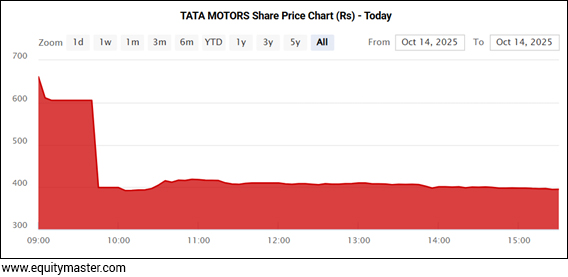
This comes as the stock, which now represents its passenger vehicle business, adjusted to the demerger of its commercial vehicle segment.
Following the price adjustment, the company's total market capitalisation stood near Rs 1.45 trillion (tn).
The sharp fall seen on apps is essentially a technical adjustment linked to the value of the commercial vehicle division being removed from the main company.
On 13 October 2025, Monday, was the last day to buy Tata Motors shares to become eligible for the demerged company's stock. Tuesday marks the record date, which is used to determine which shareholders will receive the new shares.
Tata Motors is operating under the T+1 settlement cycle, which means that transactions are settled the next trading day.
The ongoing derivative contracts of Tata Motors expired on Monday. Fresh contracts for the newly adjusted entity, called Tata Motors Passenger Vehicles Limited (TMPVL), were introduced on Tuesday and began trading at 10 am.
About Tata Motors Demerger
In August last year, Tata Motors' board approved the demerger of its commercial and passenger vehicle divisions into two independent listed entities to sharpen strategic focus and unlock value. The move aims to allow each business to pursue its growth priorities more effectively while strengthening capital allocation and operational efficiency.
Under the new structure, the passenger vehicle arm will now operate as Tata Motors Passenger Vehicles Limited (TMPVL), while the commercial vehicle division will be listed separately as Tata Motors Limited (TML), likely by mid-November.
The demerger follows a 1:1 share entitlement ratio, meaning every Tata Motors shareholder will receive one fully paid-up share of Rs 2 in Tata Motors Commercial Vehicles Limited (TMLCV) of the same class.
Following the reorganisation, the existing listed company, Tata Motors Limited, has been renamed Tata Motors Passenger Vehicles Limited, which will continue to manage the passenger vehicle business - including its investments in electric mobility and Jaguar Land Rover (JLR).
Meanwhile, TML Commercial Vehicles Limited will adopt the name Tata Motors Limited once the listing process is complete.
The Ministry of Corporate Affairs issued a Fresh Certificate of Incorporation on 13 October 2025, confirming the name change.
The company has since begun updating its details with stock exchanges. However, shares of TMLCV will not be available for trading until the listing and trading approvals are obtained, a process that generally takes 45-60 days after filing the necessary applications.
Tata Motors set 14 October as the record date to determine eligible shareholders for the demerger and 10 October for identifying debenture holders of the non-convertible debentures to be transferred to TMLCV.
The demerger officially took effect on 1 October and the subsequent price adjustment took place today, reflecting the separation of the commercial vehicle business from the passenger vehicle and JLR operations.
What the Tata Motors Demerger Means for Investors?
The Tata Motors demerger is seen as a step to unlock value, allowing investors to evaluate the passenger vehicle and commercial vehicle businesses independently. This separation provides greater clarity on each division's performance and potential.
Investor sentiment will also be influenced by Jaguar Land Rover's (JLR) recovery, as the UK-based subsidiary restarted phased manufacturing on 8 October following a cyberattack in early September. Full production is expected only after the holiday season due to the scale of restoration required.
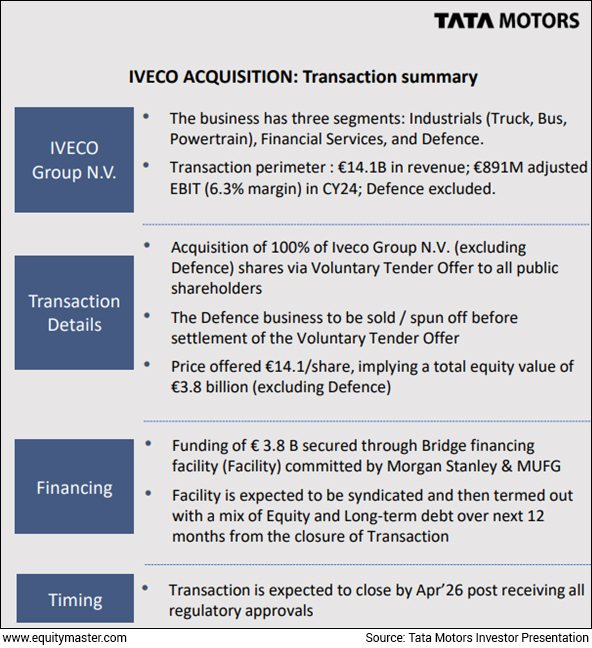
Near-term volatility is anticipated as the stock adjusts to the new structure. Longer-term performance will depend on JLR's production recovery and the success of TML Commercial Vehicles (TMLCV) post-Iveco integration.
Domestic Tailwinds
While September was a tough month for JLR, it brought some good news for Tata Motors at home. The festive season got a boost thanks to GST rate cuts, which gave small cars a much-needed push.
Tata Motors responded by slashing prices on popular models like Altroz, Harrier, Safari, and Nexon making them more affordable for buyers.
New EV and SUV launches are also helping lift domestic sales. In the EV space, demand tends to spike 2-3 times whenever Tata Motors launches a new model. September saw a doubling of EV sales year-on-year to 9,191 units.
With charging infrastructure expanding and range anxiety easing, the company expects steady demand growth in the coming years.
Tata Motors aims to capture half of the Indian EV market's steady-state share and is backing this up by expanding its charging network to 400,000 points, including 500 fast "mega charging" stations.
Should You Buy the Dip?
Whether to buy the dip depends on an investor's risk appetite and investment horizon.
Given the recent financial performance, it would be prudent to closely monitor earnings recovery and liquidity improvements before making any investment decisions.
Investors should carefully evaluate the company's fundamentals, corporate governance, and stock valuations while conducting due diligence.
--- Advertisement ---
Investment in securities market are subject to market risks. Read all the related documents carefully before investing
Which businesses are most likely to emerge stronger over the next 3 to 5 years?
After screening thousands of listed companies, comparing industries, and examining balance sheets...
Our research team discovered some of the strongest opportunities in what we call... Essential Stocks.
Opportunities like this do not remain hidden forever.
Disclaimer: This article is for information purposes only. It is not a stock recommendation and should not be treated as such. Learn more about our recommendation services here...
ABOUT EQUITYMASTER
Since 1996, Equitymaster has been the source for honest and credible opinions on investing in India. With solid research and in-depth analysis Equitymaster is dedicated towards making its readers- smarter, more confident and richer every day. Here's why hundreds of thousands of readers spread across more than 70 countries Trust Equitymaster.
PREMIUM PRODUCTS
- Hidden Treasure
- Forever Stocks
- Big Wave Profits
- Equitymaster Venture
- Microcap Millionaires
- Momentum Profits
- Double Income
- Midcap Value Alert
- Exponential Profits
- Annual Breakout Alert
- Lazy Millionaire
- Phase One Alert
- Smallcap AlphaQuest
- InsiderPro Stocks
- StockSelect
- Private Briefing
- Active Wealth Multiplier 2030
- FundSelect
- Fund Advantage
QUICK LINKS
POPULAR TOPICS
- Multibagger Penny Stocks
- Basics of Value Investing
- Benjamin Graham
- How to Invest in Gold
- How to Invest in Silver
- Best Stocks to Buy Today
- Best Small-cap Stocks to Buy
- Best Bluechip Stocks to Buy
- Guide to Penny Stocks
- How to Invest in the Share Market
- Warren Buffett - The Value Investor
- Pick the Best Multibagger Stocks
TRENDING TOPICS
- Best Defence Stocks in India
- Upcoming Dividend Stocks
- Best Semiconductor Stocks in India
- Data Center Stocks in India
- Best Railway Stocks in India
- Best Solar Stocks in India
- Fastest Growing Stocks in India
- List of BSE Sensex 30 Stocks
- Adani Group Shares
- Stocks Recently Bought by FIIs in India
- Top Value Stocks in India


LEGAL DISCLAIMER:
Investment in securities market are subject to market risks. Read all the related documents carefully before investing.
Registration granted by SEBI, enlistment with BSE as IA and RA, and certification from NISM in no way guarantee performance of the intermediary or provide any assurance of returns to investors.
All rights reserved. Any act of copying, reproducing or distributing any content from this website whether wholly or in part, for any purpose without the permission of Quantum Information Services Private Limited is strictly prohibited and shall be deemed to be copyright infringement.
Quantum Information Services Private Limited (QIS) is a SEBI registered Research Analyst (bearing registration no INH000021128) and Investment Adviser(Reg. No: INA000000680). Consequent upon the merger of Equitymaster Research Private Limited into QIS, effective October 30, 2025 QIS owns and operates brand 'Equitymaster' and website www.equitymaster.com. This does not constitute or is not intended to constitute an offer to buy or sell, or a solicitation to an offer to buy or sell financial products, units or securities and QIS including its employees, personnel, directors, associates will not be liable for any losses (direct or indirect) incurred or investment(s) made or decisions taken/or not taken based on the information provided herein. All content and information is provided on an 'As Is' basis by QIS. Information herein is believed to be reliable but QIS does not warrant its completeness or accuracy and expressly disclaims all warranties and conditions of any kind, whether express or implied. The services rendered by QIS are on a best effort basis. QIS does not assure or guarantee the user any minimum or fixed returns. The securities quoted, if any are for illustration only and are not recommendatory. Use of this information is at the user's own risk. The user must make his own investment decisions based on his specific investment objective and financial position and using such independent advisors as he believes necessary. This is not directed for access or use by anyone in a country, especially, USA, Canada or the European Union countries, where such use or access is unlawful or which may subject QIS or its affiliates to any registration or licensing requirement.
The performance data quoted represents past performance and does not guarantee future results. As a condition to accessing QIS's content and website, you agree to our Terms and Conditions of Use, available here
Equitymaster requests your view! Post a comment on "Tata Motors Demerger Impact: Why Shares Fell 40% and What Investors Should Know". Click here!
Comments are moderated by Equitymaster, in accordance with the Terms of Use, and may not appear
on this article until they have been reviewed and deemed appropriate for posting.
In the meantime, you may want to share this article with your friends!