

Investment in securities market are subject to market risks. Read all the related documents carefully before investing
Two Years of Market Correction
Is This Your Buying Window?
See Where the Opportunities are Emerging for the Next 3-5 Years
**Important: We hate spam as much as you do. Check out our Privacy Policy and Terms Of Use.
Which Smallcap Stocks Have Net Cash Exceeding 30% of Their Market Cap?
 Image source: syahrir maulana/www.istockphoto.com
A company that holds more cash than the market asks for its shares is the oldest kind of bargain in investing.
The logic is simple: if the cash is real and free to use, the buyer gets the business for less than nothing.
But in practice, the picture is harder, because a cash balance is only worth what a minority shareholder can eventually get out of it.
And many cash-rich smallcaps have been cheap for years because the cash stays inside the company.
In today's article, we will look at five smallcap stocks which have net cash worth over 30% of their market capitalisation.
We started by filtering the names from the BSE Smallcap index, which has more than 1,200+ companies. We then deducted borrowings from its gross cash using the latest balance sheet figures.
Let's start.
#1 Den Networks
First on the list is Den Networks.
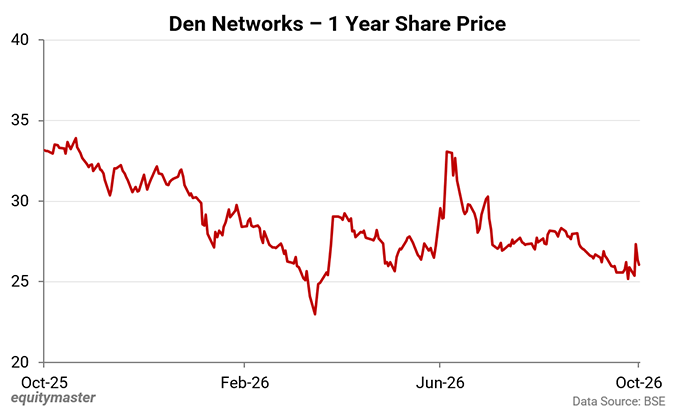
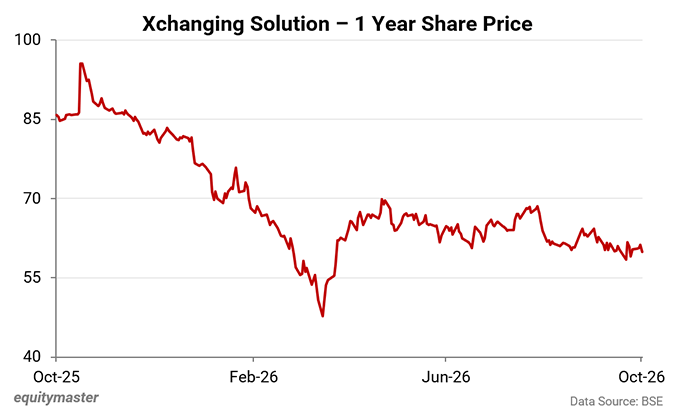
The company trades at Rs 26.06, with a market cap of Rs 12.6 billion (bn). It is 28% below its 52-week high of Rs 35.95, with promoter group holding 74.9%.
The company is an Indian mass media and entertainment company. It provides cable TV, over-the-top (OTT) entertainment, and broadband services.
They primarily focus on distributing television channels through a digital cable distribution network and also offer high-speed internet.
It operates cable TV distribution covering 500+ cities/towns across 13 key states.
The company's cash and cash equivalents were Rs 34.2 bn at 30 September 2026, up from Rs 33.8 bn at 30 June, and the company reports no gross debt.
That is 2.7 times the market cap. Put another way, if the cash is taken at face value, the market is valuing the operating business at minus Rs 21.6 bn (market cap less cash).
The company's operating business is weak. In Q2 FY27, its revenue fell 3.3% to Rs 2.3 bn. Subscription income fell 15% to Rs 860 million (m), while placement and marketing income rose 9% to Rs 1.4 bn.
Its EBITDA fell from Rs 190 m to Rs 100 m, a margin of 4%. Profit held up because other income was Rs 610 m, more than six times EBITDA. Profit after tax rose 5% to Rs 370 m.
Overall, the market is not ignoring the cash so much as doubting that minority shareholders will ever see it.
The company does not pay any dividend, while its subscription income is also falling, and the promoter holds three quarters of the company.
Until there is a dividend, buyback or open offer, the discount can stay as wide as it is. The cash already earns about 7% inside the company.
Want To Read The Full Article?
Enter your email to continue reading on Equitymaster.
Important: We hate spam as much as you do. Check out our Privacy Policy and Terms Of Use.
By submitting your email address, you also sign up for Profit Hunter, a daily newsletter from Equitymaster covering exciting investing ideas and opportunities in India.
ABOUT EQUITYMASTER
Since 1996, Equitymaster has been the source for honest and credible opinions on investing in India. With solid research and in-depth analysis Equitymaster is dedicated towards making its readers- smarter, more confident and richer every day. Here's why hundreds of thousands of readers spread across more than 70 countries Trust Equitymaster.
PREMIUM PRODUCTS
- Hidden Treasure
- Forever Stocks
- Big Wave Profits
- Equitymaster Venture
- Microcap Millionaires
- Momentum Profits
- Double Income
- Midcap Value Alert
- Exponential Profits
- Annual Breakout Alert
- Lazy Millionaire
- Phase One Alert
- Smallcap AlphaQuest
- InsiderPro Stocks
- StockSelect
- Private Briefing
- Active Wealth Multiplier 2030
- FundSelect
- Fund Advantage
QUICK LINKS
POPULAR TOPICS
- Multibagger Penny Stocks
- Basics of Value Investing
- Benjamin Graham
- How to Invest in Gold
- How to Invest in Silver
- Best Stocks to Buy Today
- Best Small-cap Stocks to Buy
- Best Bluechip Stocks to Buy
- Guide to Penny Stocks
- How to Invest in the Share Market
- Warren Buffett - The Value Investor
- Pick the Best Multibagger Stocks
TRENDING TOPICS
- Best Defence Stocks in India
- Upcoming Dividend Stocks
- Best Semiconductor Stocks in India
- Data Center Stocks in India
- Best Railway Stocks in India
- Best Solar Stocks in India
- Fastest Growing Stocks in India
- List of BSE Sensex 30 Stocks
- Adani Group Shares
- Stocks Recently Bought by FIIs in India
- Top Value Stocks in India


LEGAL DISCLAIMER:
Investment in securities market are subject to market risks. Read all the related documents carefully before investing.
Registration granted by SEBI, enlistment with BSE as IA and RA, and certification from NISM in no way guarantee performance of the intermediary or provide any assurance of returns to investors.
All rights reserved. Any act of copying, reproducing or distributing any content from this website whether wholly or in part, for any purpose without the permission of Quantum Information Services Private Limited is strictly prohibited and shall be deemed to be copyright infringement.
Quantum Information Services Private Limited (QIS) is a SEBI registered Research Analyst (bearing registration no INH000021128) and Investment Adviser(Reg. No: INA000000680). Consequent upon the merger of Equitymaster Research Private Limited into QIS, effective October 30, 2025 QIS owns and operates brand 'Equitymaster' and website www.equitymaster.com. This does not constitute or is not intended to constitute an offer to buy or sell, or a solicitation to an offer to buy or sell financial products, units or securities and QIS including its employees, personnel, directors, associates will not be liable for any losses (direct or indirect) incurred or investment(s) made or decisions taken/or not taken based on the information provided herein. All content and information is provided on an 'As Is' basis by QIS. Information herein is believed to be reliable but QIS does not warrant its completeness or accuracy and expressly disclaims all warranties and conditions of any kind, whether express or implied. The services rendered by QIS are on a best effort basis. QIS does not assure or guarantee the user any minimum or fixed returns. The securities quoted, if any are for illustration only and are not recommendatory. Use of this information is at the user's own risk. The user must make his own investment decisions based on his specific investment objective and financial position and using such independent advisors as he believes necessary. This is not directed for access or use by anyone in a country, especially, USA, Canada or the European Union countries, where such use or access is unlawful or which may subject QIS or its affiliates to any registration or licensing requirement.
The performance data quoted represents past performance and does not guarantee future results. As a condition to accessing QIS's content and website, you agree to our Terms and Conditions of Use, available here
Equitymaster requests your view! Post a comment on "Which Smallcap Stocks Have Net Cash Exceeding 30% of Their Market Cap?". Click here!
Comments are moderated by Equitymaster, in accordance with the Terms of Use, and may not appear
on this article until they have been reviewed and deemed appropriate for posting.
In the meantime, you may want to share this article with your friends!