


Equitymaster's 2026 Grand Festive Offer
Two Research Reports, Six Stocks
3 Small Cap, 3 Large Cap
**Important: We hate spam as much as you do. Check out our Privacy Policy and Terms Of Use.
Best Credit Rating Stock: CARE Ratings vs CRISIL vs ICRA
 Image source: ipopba/www.istockphoto.com
Whether it's 'AAA' or 'AA', a credit rating of the underlying company can make a lot of difference for investors. It increases investor confidence, and their growth outlook towards a company.
That's the power of credit rating and credit rating agencies in India.
The credit rating industry has witnessed significant growth and transformation in recent years in India. This is primarily due to economic development, increased investor awareness, increasing financial investments.
With high economic activity and growing government capex, the need for funding is going to rise, and so will the need for credit rating.
In this fast-growing industry, three major players are CRISIL, CARE Ratings, and ICRA.
Let's compare them using various parameters to understand which one's a better player.
Business Overview
# CARE Ratings
Incorporated in 1993, CARE Ratings is a leading credit rating agency in India.
As a credit rating agency, it provides credit ratings to corporates which help them raise capital for various needs. The credit ratings also help investors take informed decisions based on their risk appetite.
Apart from rating services, CARE offers advisory and research services and risk and compliance services to its clients.
The company has over 4,500 clients with offices across India and ten other countries.
# CRISIL
CRISIL is one of the largest rating agencies in India. It offers rating services, research, risk and policy advisory services to over 35,000 large and medium scale entities.
The company has a strong presence in India and offices in 12 other countries, including USA, UK, UAE, Switzerland, Poland, China, and Japan.
Being a subsidiary of S&P Global, CRISIL leverages its parent company's brand to explore new opportunities.
# ICRA
ICRA was set up in 1991 as a credit rating agency to offer credit rating and industry research services to corporates.
Moodys Investor Services, one of the largest rating agencies in the world, is an indirect promoter of ICRA, and helps ICRA leverage its global research base, and technical capabilities.
ICRA has 13 offices across India including New Delhi, Gurugram, Mumbai, Kolkata, and Hyderabad. It also has presence in Nepal and Sri Lanka through its subsidiaries.
| Particulars | CARE Ratings | CRISIL | ICRA |
|---|---|---|---|
| Market Cap (in Rs billion) * | 37.5 | 360.9 | 70.9 |
Between the three companies, CRISIL is the largest company in terms of market capitalisation. CRISIL's market cap is Rs 361 billion (bn), which is almost five times bigger than ICRA (Rs 71 bn) and ten times bigger than CARE Ratings (Rs 37 bn).
CRISIL is also leading in terms of market share of over 60%, followed by CARE Ratings, and ICRA. CRISIL also has a larger customer base and geographical presence when compared to CARE Ratings and ICRA.
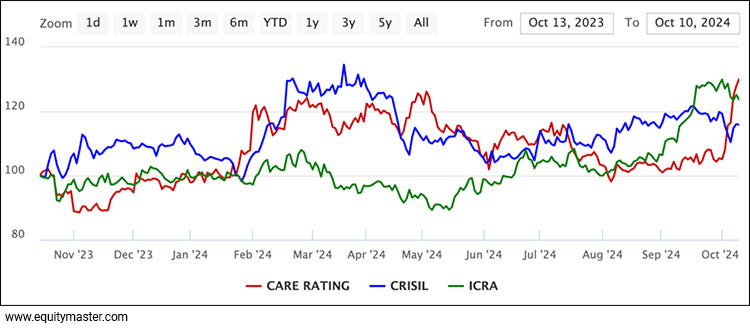
In terms of stock market performance, CARE Ratings and ICRA are slightly ahead of CRISIL with a 25% return in the last year, whereas CRISIL's shares gave a 20% return during the same period.
In the last one year, credit rating agencies have seen a lot of volatility in their share price movement. This is despite a strong growth in revenue and profits.
This is primarily because new SEBI guidelines and weak investor sentiment have led to marginal growth in the share price of these companies.
# Revenue
The primary source of revenue for rating agencies is the fees they charge from corporates for providing rating services. However, the business model of each of the three companies is slightly different.
For CARE Ratings, ratings income contributes 94% of the revenue, followed by consultancy, and license fees.
For CRISIL, on the other hand, the research business contributes 65% of the revenue, followed by the ratings and advisory business which contributes only 28% and 7% of the revenue respectively.
In the case of ICRA, 59% of revenue is generated from the ratings business, followed by knowledge services (34%), market services (5%), and consultancy services (2%).
In the last five years, the revenue of CARE, CRISIL, and ICRA grew by a compound annual growth rate (CAGR) of 6.4%, 12.6%, and 6.8% respectively.
Clearly, CRISIL is leading in terms of revenue and revenue growth. It also has a more diversified revenue profile than the other two companies.
Revenue
| Net Sales (in Rs m) | Mar-20 | Mar-21 | Mar-22 | Mar-23 | Mar-24 | 5-Year CAGR |
|---|---|---|---|---|---|---|
| CARE Ratings | 2,436 | 2,484 | 2,476 | 2,790 | 3,317 | 6.40% |
| CRISIL | 17,317 | 19,818 | 23,007 | 27,687 | 31,395 | 12.60% |
| ICRA | 3,211 | 3,011 | 3,428 | 4,032 | 4,461 | 6.80% |
# Profitability
The profitability of a company can be assessed through earnings before interest tax depreciation and amortisation (EBITDA) and net profit growth and margins.
For CRISIL, the major contributor of profit is the ratings business. Despite accounting for only 28% of the revenue, it contributes over 50% to the profits.
For ICRA and CARE Ratings, the ratings business is a major contributor to profits.
In the last five years, the EBITDA of CRISIL grew at a CAGR of 13%, and its net profit grew at a CAGR of 13.9% on account of high growth in its high margin ratings business.
For CARE Ratings, the EBITDA and net profit grew at a CAGR of 7.1% and 4.2% respectively. The ratings business again helped in profit growth.
In the case of ICRA, the EBITDA and net profit grew by a CAGR of 9.2% and 9.4%, respectively, on account of growth in the ratings and knowledge services business.
In terms of margins, ICRA has the highest EBITDA and net profit margin, followed by CARE and CRISIL.
However, in terms of profit growth, CRISIL clearly outpaced the other two companies.
Profitability
| EBITDA (in Rs m) | Mar-20 | Mar-21 | Mar-22 | Mar-23 | Mar-24 | 5-Year CAGR |
|---|---|---|---|---|---|---|
| CARE Ratings | 1,128 | 1,271 | 1,068 | 1,373 | 1,588 | 7.10% |
| CRISIL | 5,287 | 5,938 | 6,875 | 8,521 | 9,751 | 13.00% |
| ICRA | 1,438 | 1,240 | 1,615 | 1,925 | 2,237 | 9.20% |
| PAT (in Rs m) | Mar-20 | Mar-21 | Mar-22 | Mar-23 | Mar-24 | 5-Year CAGR |
| CARE Ratings | 835 | 910 | 768 | 855 | 1,026 | 4.20% |
| CRISIL | 3,440 | 3,547 | 4,658 | 5,644 | 6,584 | 13.90% |
| ICRA | 972 | 827 | 1,135 | 1,367 | 1,522 | 9.40% |
| Gross Profit Margin (%) | Mar-20 | Mar-21 | Mar-22 | Mar-23 | Mar-24 | |
| CARE Ratings | 46.30% | 51.20% | 43.10% | 49.20% | 47.90% | |
| CRISIL | 30.50% | 30.00% | 29.90% | 30.80% | 31.10% | |
| ICRA | 44.80% | 41.20% | 47.10% | 47.70% | 50.10% | |
| Net Profit Margin | Mar-20 | Mar-21 | Mar-22 | Mar-23 | Mar-24 | |
| CARE Ratings | 34.30% | 36.60% | 31.00% | 30.60% | 30.90% | |
| CRISIL | 19.90% | 17.90% | 20.20% | 20.40% | 21.00% | |
| ICRA | 30.30% | 27.50% | 33.10% | 33.90% | 34.10% |
# Debt Management
Monitoring debt is very important as it helps understand weather the company is overleveraged or underleveraged and what are the company's fixed financial obligations.
All the three rating companies have zero debt primarily because they operate on asset light model and have low working capital requirements.
Moreover, the companies generate enough cash from profits to fund any business expansions.
Each of the companies has huge plans to expand their business and grow their market share.
CARE Ratings is focusing on investing in Artificial intelligence (AI) to improve the quality of ratings and detect fraud early. It has also partnered with Tresata, a software company based out of the USA.
CRISIL, on the other hand, is focussing on expanding its business inorganically. It recently acquired a renewable energy consulting company to expand its advisory business.
It also plans to grow internationally by acquiring companies in existing and new geographies.
ICRA is leveraging technology to uphold its high standards of quality and reliability and broadening its reach through inorganic acquisitions.
Given that the companies have zero debt and high cashflows, any expansion opportunities can be easily funded through internal accruals.
# Financial Efficiency
We can measure the financial efficiency of a business by checking its return on equity (RoE) and return on capital employed (RoCE) numbers.
These return ratios indicate a company's ability to generate returns from the equity and capital invested. A high and consistently growing ratio is considered better.
The five-year average RoE for CARE Ratings, CRISIL, and ICRA is 14.3%, 30.5%, and 13.7%, respectively, whereas the five-year average RoCE is 19.4%, 41.2%, and 18.6%, respectively.
The RoE and RoCE of all three companies have consistently grown over the last three years on account of rising profits.
Financial Efficiency
| Return on Equity (RoE) | Mar-20 | Mar-21 | Mar-22 | Mar-23 | Mar-24 |
|---|---|---|---|---|---|
| CARE Ratings | 16.40% | 16.10% | 12.00% | 12.80% | 14.40% |
| CRISIL | 31.10% | 28.20% | 30.40% | 32.10% | 30.50% |
| ICRA | 13.90% | 10.90% | 13.50% | 14.40% | 15.60% |
| Return on Capital Employed (RoCE) | Mar-20 | Mar-21 | Mar-22 | Mar-23 | Mar-24 |
| CARE Ratings | 20.60% | 21.10% | 15.50% | 19.00% | 20.80% |
| CRISIL | 44.50% | 37.60% | 40.90% | 42.60% | 40.40% |
| ICRA | 19.00% | 15.10% | 18.20% | 19.20% | 21.50% |
# Dividend
Companies share their profits with the shareholders in the form of dividends.
A high and consistent dividend is a good sign for a business as it indicates steady profitability.
In the last five years, CRISIL and ICRA increased their dividend per share by a CAGR of 11.3% and 29.9%, respectively.
CARE Ratings, on the other hand, reduced its dividend by a CAGR of 1.3% during the same period.
For CARE Ratings, the average dividend yield and dividend payout are 3.8% and 65.8%, respectively, whereas for CRISIL, the average dividend yield and dividend payout are 1.6% and 65.8%, respectively.
The average dividend yield and dividend payout for ICRA is 1.5% and 47.5%, respectively.
All three companies are dividend paymasters, but clearly, CARE Ratings is leading in terms of dividends as it has the highest yield.
Dividend
| Dividend Per Share (Rs) | Mar-20 | Mar-21 | Mar-22 | Mar-23 | Mar-24 | 5-Year CAGR |
|---|---|---|---|---|---|---|
| CARE Ratings | 19.2 | 16.8 | 16.9 | 24.8 | 18 | -1.30% |
| CRISIL | 31.6 | 32.8 | 45.8 | 48 | 54 | 11.30% |
| ICRA | 27 | 27 | 28 | 130 | 100 | 29.90% |
| Dividend Yield | Mar-20 | Mar-21 | Mar-22 | Mar-23 | Mar-24 | |
| CARE Ratings | 5.90% | 4.10% | 3.30% | 3.90% | 1.60% | |
| CRISIL | 1.70% | 1.70% | 1.60% | 1.60% | 1.20% | |
| ICRA | 1.20% | 0.80% | 0.70% | 2.90% | 1.80% | |
| Dividend Payout Ratio | Mar-20 | Mar-21 | Mar-22 | Mar-23 | Mar-24 | |
| CARE Ratings | 68.80% | 55.10% | 65.60% | 86.90% | 52.40% | |
| CRISIL | 67.30% | 67.50% | 72.00% | 62.10% | 60.00% | |
| ICRA | 26.80% | 31.50% | 23.80% | 91.80% | 63.40% |
# Valuation
Valuation ratios help us estimate the intrinsic value of a company and help us analyse whether a company's shares are overvalued or undervalued compared to its peers.
The two popular valuation ratios are price to earnings (P/E) and price to book value (P/B). A high ratio indicates the shares are overvalued, a low ratio indicates the shares are undervalued.
The P/E ratios of CARE Ratings, CRISIL, and ICRA are 34.8x, 52.9x, and 45.3x, respectively. In terms of P/E, CRISIL shares are highly overvalued compared to the other two companies.
The P/B ratios of CARE Ratings, CRISIL, and ICRA are 5x, 15.3x, and 6.6x, respectively. Even in terms of P/B, CRISIL shares are highly overvalued when compared to its peers.
When compared to the industry average, CRISIL and ICRA shares are overvalued, whereas CARE Ratings shares are undervalued.
| Valuations | CARE Ratings | CRISIL | ICRA |
|---|---|---|---|
| P/E (x) | 34.8 | 52.9 | 45.3 |
| P/B (x) | 5 | 15.3 | 6.6 |
Which is the Better Ratings Company: CARE Ratings, CRISIL or ICRA?
In terms of revenue growth and profit growth, CRISIL is leading the race among the three companies.
However, CARE Ratings is leading in terms of profit margins and dividend payments.
CARE Ratings, one of the well-recognised rating agencies in India, is focusing on expanding its market share.
It plans to expand to new geographies and improve its non-ratings revenue from 1-2% to around 40-50% in the medium term.
The company also plans to improve its revenue beyond Rs 3,500 million (m) in the next two years.
It is focusing on investing in AI to improve its ratings quality and expand its presence in and outside India.
ICRA is exploring opportunities in new areas such as ESG assessment, research, and risk analytics to gradually expand its reach.
Apart from this, it is focusing on organic and inorganic growth to expand its revenue.
It is also planning to diversify its revenue through geographical expansion and horizontal expansion across various services.
CRISIL, on the other hand, is continuously acquiring companies to expand its ratings and advisory services business. It is also on the lookout for any opportunities that can help expand its reach.
Overall, all three rating companies are planning to expand their operations and improve their revenue.
With the pace of economic activity, corporate activity will pick up, and the need for credit rating will also increase.
To add to this, investors are demanding more accountability and transparency in ratings, which will also create new opportunities for these rating agencies.
However, it is important to treat rating stocks with utmost caution, given that they are subject to the regulatory environment.
Happy Investing!
--- Advertisement ---
Investment in securities market are subject to market risks. Read all the related documents carefully before investing
Which businesses are most likely to emerge stronger over the next 3 to 5 years?
After screening thousands of listed companies, comparing industries, and examining balance sheets...
Our research team discovered some of the strongest opportunities in what we call... Essential Stocks.
Opportunities like this do not remain hidden forever.
Disclaimer: This article is for information purposes only. It is not a stock recommendation and should not be treated as such. Learn more about our recommendation services here...
ABOUT EQUITYMASTER
Since 1996, Equitymaster has been the source for honest and credible opinions on investing in India. With solid research and in-depth analysis Equitymaster is dedicated towards making its readers- smarter, more confident and richer every day. Here's why hundreds of thousands of readers spread across more than 70 countries Trust Equitymaster.
PREMIUM PRODUCTS
- Hidden Treasure
- Forever Stocks
- Big Wave Profits
- Equitymaster Venture
- Microcap Millionaires
- Momentum Profits
- Double Income
- Midcap Value Alert
- Exponential Profits
- Annual Breakout Alert
- Lazy Millionaire
- Phase One Alert
- Smallcap AlphaQuest
- InsiderPro Stocks
- StockSelect
- Private Briefing
- Active Wealth Multiplier 2030
- FundSelect
- Fund Advantage
QUICK LINKS
POPULAR TOPICS
- Multibagger Penny Stocks
- Basics of Value Investing
- Benjamin Graham
- How to Invest in Gold
- How to Invest in Silver
- Best Stocks to Buy Today
- Best Small-cap Stocks to Buy
- Best Bluechip Stocks to Buy
- Guide to Penny Stocks
- How to Invest in the Share Market
- Warren Buffett - The Value Investor
- Pick the Best Multibagger Stocks
TRENDING TOPICS
- Best Defence Stocks in India
- Upcoming Dividend Stocks
- Best Semiconductor Stocks in India
- Data Center Stocks in India
- Best Railway Stocks in India
- Best Solar Stocks in India
- Fastest Growing Stocks in India
- List of BSE Sensex 30 Stocks
- Adani Group Shares
- Stocks Recently Bought by FIIs in India
- Top Value Stocks in India


LEGAL DISCLAIMER:
Investment in securities market are subject to market risks. Read all the related documents carefully before investing.
Registration granted by SEBI, enlistment with BSE as IA and RA, and certification from NISM in no way guarantee performance of the intermediary or provide any assurance of returns to investors.
All rights reserved. Any act of copying, reproducing or distributing any content from this website whether wholly or in part, for any purpose without the permission of Quantum Information Services Private Limited is strictly prohibited and shall be deemed to be copyright infringement.
Quantum Information Services Private Limited (QIS) is a SEBI registered Research Analyst (bearing registration no INH000021128) and Investment Adviser(Reg. No: INA000000680). Consequent upon the merger of Equitymaster Research Private Limited into QIS, effective October 30, 2025 QIS owns and operates brand 'Equitymaster' and website www.equitymaster.com. This does not constitute or is not intended to constitute an offer to buy or sell, or a solicitation to an offer to buy or sell financial products, units or securities and QIS including its employees, personnel, directors, associates will not be liable for any losses (direct or indirect) incurred or investment(s) made or decisions taken/or not taken based on the information provided herein. All content and information is provided on an 'As Is' basis by QIS. Information herein is believed to be reliable but QIS does not warrant its completeness or accuracy and expressly disclaims all warranties and conditions of any kind, whether express or implied. The services rendered by QIS are on a best effort basis. QIS does not assure or guarantee the user any minimum or fixed returns. The securities quoted, if any are for illustration only and are not recommendatory. Use of this information is at the user's own risk. The user must make his own investment decisions based on his specific investment objective and financial position and using such independent advisors as he believes necessary. This is not directed for access or use by anyone in a country, especially, USA, Canada or the European Union countries, where such use or access is unlawful or which may subject QIS or its affiliates to any registration or licensing requirement.
The performance data quoted represents past performance and does not guarantee future results. As a condition to accessing QIS's content and website, you agree to our Terms and Conditions of Use, available here
Equitymaster requests your view! Post a comment on "Best Credit Rating Stock: CARE Ratings vs CRISIL vs ICRA". Click here!
Comments are moderated by Equitymaster, in accordance with the Terms of Use, and may not appear
on this article until they have been reviewed and deemed appropriate for posting.
In the meantime, you may want to share this article with your friends!