

Investment in securities market are subject to market risks. Read all the related documents carefully before investing
Last Day: Exclusive Festive Offer

Recommendations at 70% OFF Today
And Lock-in Your Second Year at Only Rs 95*
**Important: We hate spam as much as you do. Check out our Privacy Policy and Terms Of Use.
Better Transformer Stock: Voltamp Transformers vs Transformers & Rectifiers India
 Voltamp Transformers logo source: https://www.voltamptransformers.com/
Transformers & Rectifiers India logo source: https://www.transformerindia.com/
India's power grid is expanding faster than the transformer makers can keep up.
The Central Electricity Authority wants installed transformer capacity to rise by 776,330 MVA to 1,847,280 MVA by FY27, yet only about 30% of that target was met by FY25.
India's transformer market is projected to grow from about $2.6 billion (bn) to US$5.6 bn by 2034, backed by strong growth in India's transmission expansion, the 500 gigawatts of renewable energy target by 2030, and new demand from data centres, electric vehicles (EV) and hydrogen.
While the entire transformer sector is competing for a share of this growth, we compared two listed players, Voltamp Transformers and Transformers & Rectifiers India, in detail across various parameters to see who is better equipped to ride this growth wave.
Business Overview
Voltamp Transformers
Voltamp Transformers is a Vadodara-based company with over 62 years of experience.
It specialises in oil-filled and dry-type transformers which are also fire-safe and hence suit power, oil & gas, petrochemicals, steel, cement, data centres, green energy, commercial buildings and process industries.
The company's range covers oil-filled power and distribution transformers up to 120 MVA, dry-type transformers up to 10 MVA, compact substations and ring main units.
Within dry-type transformers, it commands roughly 40% market share.
The company had two manufacturing plants in Vadodara with a combined capacity of 14,000 MVA.
Another plant opened on 7, Oct 2026, designed for transformers up to 250 MVA at 220 kV, with a first-phase capacity of about 6,000 MVA.
It sells to government and semi-government utilities, refineries, fertiliser plants, and pharma, paper, steel and cement companies.
The company also provides turnkey services through EPC (Engineering, Procurement, and Construction) to L&T, Technip, Tata Projects, Toyo Engineering, Petrofac and Engineers India.
Transformers & Rectifiers India
Ahmedabad-based Transformers and Rectifiers India (TARIL) has been building transformers for four decades.
It makes power, distribution, and speciality transformers for utilities, EPC players, industrial clients, and renewable developers.
The company makes power transformers up to 1,000 MVA (Mega-Volt-Ampere) and 1,200 kV (Kilovolt), reactors up to 765 kV, and furnace, rectifier and traction transformers.
TARIL has three manufacturing plants near Ahmedabad with an installed capacity of 75,000 MVA.
Its customer base leans towards government and large private buyers. Some customers include PowerGrid, NTPC, Adani Renewables, Tata Power, JSW, GETCO, Torrent Power, and Jindal Steel & Power.
The company recently entered the nuclear sector, supplying generator transformers for Nuclear Power Corporation of India's Kaiga project. It also supplies large data centres.
TARIL is mainly domestic by choice, and the management said the exports will stay below 10-15% of the business. Countries the company has exported to in the past include Russia, Kazakhstan, Mexico, Iran, and the USA.
The major difference between the two companies is that TARIL makes large, custom-engineered extra-high-voltage transformers and reactors, mainly for grid and utility projects, while Voltamp makes mid-voltage oil-filled and dry-type transformers, mainly for industrial and EPC customers.
| Particulars | Voltamp Transformers | Transformers & Rectifiers India |
|---|---|---|
| Market Cap (in Rs billion)* | 108 | 99 |
| Order Book (in Rs million)** | 23,400 | 66,300 |
Between the two companies, Voltamp has a slightly higher market cap than TARIL. HoweverHYPERLINK "https://www.equitymaster.com/detail.asp?date=09/01/2026&story=2&title=Low-PE-Strong-Growth-Is-this-Transformer-Stock-Geared-for-Growth&utm_source=archive-page&utm_medium=website&utm_campaign=views-on-news&utm_content=story", TARIL's order book is three times higher than Voltamp's.
TARIL's order book is much more utility-heavy, with power transformers contributing 83% of it, and reactors 9%. By September 30, its order book grew to Rs 72,370 million (m), with most of the order book being long-cycle grid projects.
Voltamp's Rs 23,400 m order book covers 18,045 MVA with short-cycle industrial and EPC orders. Almost Rs 3,000 m worth of the order book is legacy fixed-price work, which squeezes margins.
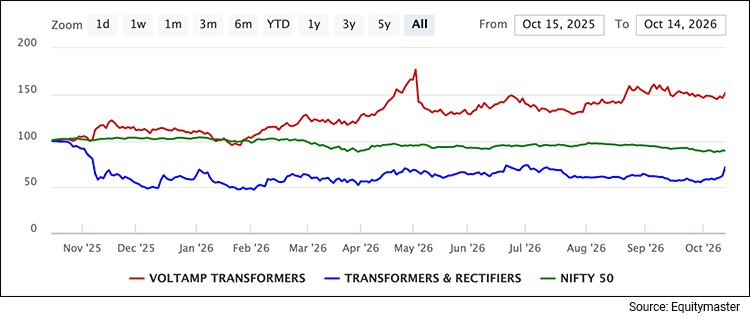
On the bourses, Voltamp's shares grew 49% in the last year, beating both TARIL (which fell 31%) and the Nifty 50 (which fell 10%).
Voltamp's shares grew on account of strong revenue growth and growing orders from data centres.
TARIL shares, on the other hand, fell after it missed its own targets, trimmed management revenue and order book guidance, and underutilized its plant due to expansion.
Revenue
For TARIL, power transformers contribute 56% of the revenue, followed by speciality transformers (11%), reactors (10%), distribution transformers (6%), furnace transformers (3%), and rectifier transformers (1%).
Over the last five years, the company's revenue grew at a compound annual growth rate (CAGR) of 21.4% due to a shift toward higher-margin extra-high-voltage transformers for utilities.
Output also rose to a record 33,763 MVA in FY26.
For Voltamp, products contribute 96% of revenue, mainly oil-filled power and distribution transformers, dry-type transformers and compact substations.
Voltamp's growth has been steadier, driven by volumes. The sales rose to 16,514 MVA in FY26, which is only 11% growth, on account of lower capacity utilisation due to expansion.
TARIL has grown faster by moving into bigger, higher-voltage utility transformers, while Voltamp has grown steadily on industrial demand but is now limited by capacity until its new plants ramp up.
Revenue
| Net Sales (in Rs m) | Mar -2022 | Mar -2023 | Mar -2024 | Mar -2025 | Mar -2026 | 4-Year CAGR |
|---|---|---|---|---|---|---|
| Voltamp Transformers | 11,272 | 13,851 | 16,162 | 19,342 | 21,537 | 17.6% |
| Transformers & Rectifiers India | 11,549 | 13,952 | 12,874 | 20,145 | 25,049 | 21.4% |
Profitability
Voltamp's EBITA and net profit rose sharply until FY24, then slipped in the next two financial years, with EBITDA margin dropping from 25.4% to 19.6% and PAT margin from 19% to 14.2%.
Several reasons pushed the margins down, including costlier imported raw material after the rupee weakened, one-time labour code provisions in Q4FY26, and a legacy book of fixed-price orders that couldn't pass on cost increases.
For TARIL, profits grew steadily, with EBITDA and PAT margins rising from a low of 7.3% and 1.2% to 17.7% and 10.9%, respectively.
The main drivers of profit growth are the shift to extra-high-voltage transformers, which carry better margins; better plant utilisation, which spreads fixed costs over more output; and the company's backward integration, which ensures steady in-house supply of raw materials at lower costs.
Although Voltamp earns higher profits and has higher margins, they are falling as costs rise, whereas TARIL's low margins are climbing on account of better product mix and utilisation.
Profitability
| EBITDA (in Rs m) | Mar -2022 | Mar -2023 | Mar -2024 | Mar -2025 | Mar -2026 | 4-Year CAGR |
|---|---|---|---|---|---|---|
| Voltamp Transformers | 1,819 | 2,710 | 4,113 | 4,509 | 4,219 | 23.4% |
| Transformers & Rectifiers India | 839 | 1,296 | 1,399 | 3,592 | 4,440 | 51.7% |
| PAT (in Rs m) | Mar -2022 | Mar -2023 | Mar -2024 | Mar -2025 | Mar -2026 | 4-Year CAGR |
|---|---|---|---|---|---|---|
| Voltamp Transformers | 1,328 | 1,999 | 3,074 | 3,254 | 3,054 | 23.1% |
| Transformers & Rectifiers India | 143 | 423 | 470 | 2,164 | 2,722 | 108.9% |
| Gross Profit Margin | Mar -2022 | Mar -2023 | Mar -2024 | Mar -2025 | Mar -2026 |
|---|---|---|---|---|---|
| Voltamp Transformers | 16.1% | 19.6% | 25.4% | 23.3% | 19.6% |
| Transformers & Rectifiers India | 7.3% | 9.3% | 10.9% | 17.8% | 17.7% |
| Net Profit Margin | Mar -2022 | Mar -2023 | Mar -2024 | Mar -2025 | Mar -2026 |
|---|---|---|---|---|---|
| Voltamp Transformers | 11.8% | 14.4% | 19.0% | 16.8% | 14.2% |
| Transformers & Rectifiers India | 1.2% | 3.0% | 3.7% | 10.7% | 10.9% |
Debt Management
Voltamp is a debt-free company and funds all its expansions through internal cash.
In the last few years, it has built its Jarod power-transformer plant, which cost Rs 2 bn and began commercial production on October 7 2026.
It also recently approved Rs 250 m to buy land near Vadodara for future expansion.
The company is also building a 2,300 MVA dry-type plant near Vadodara with a capex of Rs 900 m and is expected to start commercial production in September 2027.
TARIL, meanwhile, has significantly reduced its debt and plans to become a zero-debt company.
Over the last two years, the company invested Rs 6 bn in capex to expand capacity at existing facilities. So far, it has increased its capacity from 12,000 to 35,000 MVA at the Changodar plant, and it has now started another 15,000 MVA capacity addition at the Moraiya plant.
For the next few years, it has chalked out backward integration projects worth Rs 10 bn and three greenfield facilities at Chiyada, due by Q1 FY28.
The company plans to use a mix of QIP proceeds, leasing, internal accruals and debt if needed to fund this project. Management says the expanded capacity can support revenue potential of Rs 50-60 bn.
Clearly, Voltamp is spending small amounts from cash, while TARIL is making a much bigger bet with a mix of funding, so its debt position is the one to watch.
Debt Management
| Debt to Equity Ratio (x) | Mar -2022 | Mar -2023 | Mar -2024 | Mar -2025 | Mar -2026 |
|---|---|---|---|---|---|
| Voltamp Transformers | 0.00 | 0.00 | 0.00 | 0.00 | 0.00 |
| Transformers & Rectifiers India | 0.20 | 0.20 | 0.10 | 0.10 | 0.10 |
Financial Efficiency
In the last five years, the return on capital employed (RoCE) and return on equity (ROE) for both companies have improved significantly.
For Voltamp, RoCE grew to a peak of 29.5% before falling to 22.7% in FY26, and RoE followed a similar pattern, peaking at 22.7% before falling to 17%.
Falling profits have affected Voltamp's return ratios.
TARIL, on the other hand, saw a steady increase in return ratios, with RoE rising from 4% to 18.1% and RoCE going from 16.2% to 26.4%. Better plant utilisation, a richer product mix and lower debt drove the return ratios up.
Voltamp's return ratios are high but sliding, while TARIL's are rising and have now overtaken them. However, TARIL's heavy capex and long working-capital cycle will test whether return ratios will hold.
Financial Efficiency
| ROCE | Mar -2022 | Mar -2023 | Mar -2024 | Mar -2025 | Mar -2026 |
|---|---|---|---|---|---|
| Voltamp Transformers | 18.5% | 23.6% | 29.5% | 27.6% | 22.7% |
| Transformers & Rectifiers India | 16.2% | 22.9% | 19.0% | 25.2% | 26.4% |
| ROE | Mar -2022 | Mar -2023 | Mar -2024 | Mar -2025 | Mar -2026 |
|---|---|---|---|---|---|
| Voltamp Transformers | 14.1% | 18.1% | 22.7% | 20.5% | 17.0% |
| Transformers & Rectifiers India | 4.0% | 10.7% | 8.5% | 17.3% | 18.1% |
Dividend
Voltamp is a clear dividend payer. The dividend per share rose from Rs 35 to Rs 100, a 30% CAGR growth in the last five years.
The payout ratio grew from 26% to 33%, and the dividend yield stayed at a modest 1.2%. Zero debt helps fund both capex and dividends.
For TARIL, dividends are very nominal. The dividend per share is Rs 0.3 per share, with a payout of 2.8% and a yield of 0.1%.
High capex may be why dividends are so low. The company is reinvesting most of its profits to increase its capacity.
Voltamp shares almost a third of its profits with its shareholders, while TARIL keeps almost everything for growth.
Dividend
| Dividend Per Share (Rs) | Mar -2022 | Mar -2023 | Mar -2024 | Mar -2025 | Mar -2026 | 4-Year CAGR |
|---|---|---|---|---|---|---|
| Voltamp Transformers | 35.0 | 60.0 | 90.0 | 100.0 | 100.0 | 30.0% |
| Transformers & Rectifiers India | 0.1 | 0.1 | 0.1 | 0.2 | 0.3 | 37.5% |
| Dividend Yield | Mar -2022 | Mar -2023 | Mar -2024 | Mar -2025 | Mar -2026 |
|---|---|---|---|---|---|
| Voltamp Transformers | 1.8% | 2.2% | 0.9% | 1.4% | 1.2% |
| Transformers & Rectifiers India | 0.5% | 0.3% | 0.1% | 0.0% | 0.1% |
| Dividend Payout Ratio | Mar -2022 | Mar -2023 | Mar -2024 | Mar -2025 | Mar -2026 |
|---|---|---|---|---|---|
| Voltamp Transformers | 26.7% | 30.4% | 29.6% | 31.1% | 33.1% |
| Transformers & Rectifiers India | 13.9% | 4.7% | 6.1% | 2.8% | 2.8% |
Valuation
Voltamp trades at a price-to-earnings (PE) of 33.1x and a price-to-book value (PB) of 5.8x. These are almost in line with its 3-year average of 28.6x (PE) and 6x (PB).
For TARIL, the PE and PB stand at 37.2x and 6.3x, respectively, while the three-year averages are much higher at 74.1x and 11.5x, respectively.
Sharp growth in profits and falling share price could be the reason for lower multiples than its three-year average.
Between the two, TARIL now trades at a higher P/E than Voltamp despite weaker dividends and heavier capex. That premium makes sense only if TARIL delivers on its growth plans.
Voltamp's multiple depends more on holding margins as input costs stay high.
| Valuations | Voltamp Transformers | 3-Year Average | Transformers & Rectifiers India | 3-Year Average |
|---|---|---|---|---|
| P/E (x) | 33.1 | 28.6 | 37.2 | 74.1 |
| P/B (x) | 5.8 | 6.0 | 6.3 | 11.5 |
Management Guidance and Future Prospects
TARIL's management has guided revenue growth of 25%, with an EBITDA margin of 16% and a PAT margin of 9-10% for FY27. It also wants the working capital cycle to remain at 120 days, down from the current 154 days.
Although the management has trimmed the revenue growth from the initial estimate of 35%, it maintains its FY29 target of Rs 80 bn in revenue.
The Changodar expansion (Rs 1.5 bn, taking capacity from 12,000 to 35,000 MVA) should start commercial production by November 2026. At present, the plant is only being utilised at 33%, and after the expansion, it expects 65% utilisation by the end of FY27 and 85% utilisation by the end of FY28.
The Moraiya plant utilisation is also expected to improve to 80-85% by FY28.
This expansion is expected to support revenue of Rs 50-60 bn, nearly reaching the company's estimated revenue target.
Recently, the company has become the first Indian-origin company to win an order to repair an HVDC converter transformer, and management is working toward full HVDC converter transformer capability, which it expects in about 18 months.
In addition, the company is focusing on backward integration. Today, only 10-15% of raw material needs are met in-house, and the company aims to cover 80-85% in-house.
To do so, it plans to invest Rs 9-10 bn in capex. This reduces exposure to supply disruptions and gives TARIL control over quality, delivery time and cost.
The company is also targeting new segments such as data centres and battery energy storage (BESS) transformers, with BESS orders expected in Q3 FY27.
Voltamp's management hasn't given any guidance on its numbers. However, it has laid out extensive capacity expansion plans to grow its revenue, funded entirely through internal cash accruals.
The two plants it already invested in are expected to lift the total capacity by 60% over the existing base of about 14,000 MVA.
The Jarod plant, which recently opened, is expected to reach a capacity utilisation of 60% in FY27 and 100% in FY28.
Voltamp is targeting high-demand segments such as data centers, renewables, EV infrastructure, and semiconductor-linked investment. The move into 220 kV power transformers at Jarod takes it into higher-value work than its traditional range.
TARIL's outlook rests on ramping capacity and finishing backward integration, while Voltamp's rests on two new plants funded from cash, with demand strong.
Which is a Better Transformer Company: Voltamp Transformers or Transformers & Rectifiers India?
Between the two companies, TARIL has a higher order book, higher sales, higher EBITDA, and better return ratios.
However, it has debt on its books and has planned heavy capex. Hence, the challenge lies in how well the company will be able to utilise its capacity and earn higher revenue.
Voltamp, on the other hand, has higher net profit, better profit margins, and pays a higher dividend. However, the company's expansion plan should support its falling margins.
Both companies have significant growth prospects backed by strong demand due to high grid and transmission spending, a renewable energy target of 500 gigawatts by 2030, and new load from data centres, EVs and hydrogen.
However, this high-growth industry isn't without challenges. There are supply-chain and lead-time problems, limited component suppliers and geopolitical disruptions.
Hence, it is important that you do thorough research on the company, its fundamentals, potential tailwinds and risks before considering any stock for investment.
--- Advertisement ---
Investment in securities market are subject to market risks. Read all the related documents carefully before investing
Which businesses are most likely to emerge stronger over the next 3 to 5 years?
After screening thousands of listed companies, comparing industries, and examining balance sheets...
Our research team discovered some of the strongest opportunities in what we call... Essential Stocks.
Opportunities like this do not remain hidden forever.
Disclaimer: This article is for information purposes only. It is not a stock recommendation and should not be treated as such. Learn more about our recommendation services here...
ABOUT EQUITYMASTER
Since 1996, Equitymaster has been the source for honest and credible opinions on investing in India. With solid research and in-depth analysis Equitymaster is dedicated towards making its readers- smarter, more confident and richer every day. Here's why hundreds of thousands of readers spread across more than 70 countries Trust Equitymaster.
PREMIUM PRODUCTS
- Hidden Treasure
- Forever Stocks
- Big Wave Profits
- Equitymaster Venture
- Microcap Millionaires
- Momentum Profits
- Double Income
- Midcap Value Alert
- Exponential Profits
- Annual Breakout Alert
- Lazy Millionaire
- Phase One Alert
- Smallcap AlphaQuest
- InsiderPro Stocks
- StockSelect
- Private Briefing
- Active Wealth Multiplier 2030
- FundSelect
- Fund Advantage
QUICK LINKS
POPULAR TOPICS
- Multibagger Penny Stocks
- Basics of Value Investing
- Benjamin Graham
- How to Invest in Gold
- How to Invest in Silver
- Best Stocks to Buy Today
- Best Small-cap Stocks to Buy
- Best Bluechip Stocks to Buy
- Guide to Penny Stocks
- How to Invest in the Share Market
- Warren Buffett - The Value Investor
- Pick the Best Multibagger Stocks
TRENDING TOPICS
- Best Defence Stocks in India
- Upcoming Dividend Stocks
- Best Semiconductor Stocks in India
- Data Center Stocks in India
- Best Railway Stocks in India
- Best Solar Stocks in India
- Fastest Growing Stocks in India
- List of BSE Sensex 30 Stocks
- Adani Group Shares
- Stocks Recently Bought by FIIs in India
- Top Value Stocks in India


LEGAL DISCLAIMER:
Investment in securities market are subject to market risks. Read all the related documents carefully before investing.
Registration granted by SEBI, enlistment with BSE as IA and RA, and certification from NISM in no way guarantee performance of the intermediary or provide any assurance of returns to investors.
All rights reserved. Any act of copying, reproducing or distributing any content from this website whether wholly or in part, for any purpose without the permission of Quantum Information Services Private Limited is strictly prohibited and shall be deemed to be copyright infringement.
Quantum Information Services Private Limited (QIS) is a SEBI registered Research Analyst (bearing registration no INH000021128) and Investment Adviser(Reg. No: INA000000680). Consequent upon the merger of Equitymaster Research Private Limited into QIS, effective October 30, 2025 QIS owns and operates brand 'Equitymaster' and website www.equitymaster.com. This does not constitute or is not intended to constitute an offer to buy or sell, or a solicitation to an offer to buy or sell financial products, units or securities and QIS including its employees, personnel, directors, associates will not be liable for any losses (direct or indirect) incurred or investment(s) made or decisions taken/or not taken based on the information provided herein. All content and information is provided on an 'As Is' basis by QIS. Information herein is believed to be reliable but QIS does not warrant its completeness or accuracy and expressly disclaims all warranties and conditions of any kind, whether express or implied. The services rendered by QIS are on a best effort basis. QIS does not assure or guarantee the user any minimum or fixed returns. The securities quoted, if any are for illustration only and are not recommendatory. Use of this information is at the user's own risk. The user must make his own investment decisions based on his specific investment objective and financial position and using such independent advisors as he believes necessary. This is not directed for access or use by anyone in a country, especially, USA, Canada or the European Union countries, where such use or access is unlawful or which may subject QIS or its affiliates to any registration or licensing requirement.
The performance data quoted represents past performance and does not guarantee future results. As a condition to accessing QIS's content and website, you agree to our Terms and Conditions of Use, available here
Equitymaster requests your view! Post a comment on "Better Transformer Stock: Voltamp Transformers vs Transformers & Rectifiers India". Click here!
Comments are moderated by Equitymaster, in accordance with the Terms of Use, and may not appear
on this article until they have been reviewed and deemed appropriate for posting.
In the meantime, you may want to share this article with your friends!