


Equitymaster's 2026 Grand Festive Offer
Two Research Reports, Six Stocks
3 Small Cap, 3 Large Cap
**Important: We hate spam as much as you do. Check out our Privacy Policy and Terms Of Use.
Why Smallcap Stocks Are Falling
 Image source: champc/www.istockphoto.com
Smallcap stocks crashed on 23 October 2026, pushing the Nifty Smallcap index down 7.5% for the week. According to reports, the index is now on track for its worst weekly performance in 20 months.
The NSE Nifty heatmap below, as of around 1 pm, sums it all up.
While the benchmark index, the NSE Nifty, had dropped 1.11%, the Nifty Smallcap 50 was down 3.42%, the Nifty Smallcap 500 was down 3.27%, and the Nifty Smallcap 400 was down 3.06%.
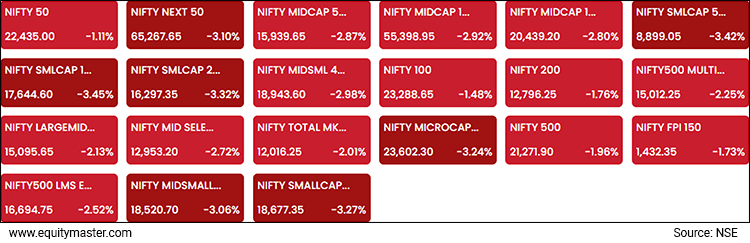
Markets were a sea of red, and the impact on smallcap stocks and microcaps was severe.
Top Losers from the Nifty Smallcap 50
| Name of Company | % loss |
|---|---|
| Karur Vysya Bank | 6.9% |
| TD Power | 6.6% |
| IIFL | 6.4% |
| INOX Wind | 6.0% |
| Delhivery | 5.7% |
| Bandhan Bank | 5.5% |
| KFintech | 5.3% |
Other top losers from the Nifty Smallcap 50 were PGEL, RBL Bank, PNB Housing, HFCL, MTAR Tech, Manappuram. Only two stocks were in the green: IGL and Anand Rathi.
Why Are Nifty Smallcap Stocks Falling?
Nifty Smallcap stocks are witnessing sharper selling pressure than the broader market. The decline reflects a combination of global uncertainties, rising crude oil prices, foreign investor outflows, and concerns about valuations.
The key factors are explained below:
#1 Houthi attacks and the risk of oil supply disruptions
Recent attacks by Yemen's Iran-aligned Houthi militants on Saudi infrastructure have heightened concerns about the security of oil production and shipping routes in the Middle East.
On 23 October, Brent crude rose to around US$ 114.47 a barrel, while US West Texas Intermediate crude climbed to around US$ 100.84.
#2 Reports of possible US attacks on Iran after the midterm elections
Reports that the US and Israel have drawn up plans for renewed strikes on Iran after the 3rd of November US midterm elections have added to geopolitical uncertainty.
#3 High valuations
Over the last few months, largecaps have fallen sharply, while smallcaps have fallen less. The gap now seems to be narrowing, resulting in intense selling pressure in small-cap stocks.
Some small-cap stocks have been trading at elevated valuations after earlier rallies, as investors chased growth.
When investors become concerned about future earnings growth or economic conditions, they may sell these shares to lock in profits.
Stocks with high price-to-earnings ratios can experience particularly sharp corrections.
#4 Smallcap stocks are more vulnerable to selling
In general, smallcap shares have lower trading liquidity than largecap stocks.
When many investors try to sell at once, prices can fall sharply because there may not be enough buyers at prevailing prices. This can amplify a market correction.
What Next?
The sharp fall in smallcap stocks highlights the risks of investing in a segment that can be particularly sensitive to changing market sentiment.
Rising crude oil prices, geopolitical tensions, concerns over valuations and limited liquidity can intensify selling pressure.
However, a broad market correction does not necessarily mean that every smallcap company has weak fundamentals or poor long-term prospects.
Investors should examine earnings growth, debt levels, cash flows, return ratios, and valuations before making investment decisions.
A steep price decline alone does not make a stock attractive. Careful fundamental analysis and adequate risk assessment remain essential, especially during periods of heightened volatility.
--- Advertisement ---
Investment in securities market are subject to market risks. Read all the related documents carefully before investing
Which businesses are most likely to emerge stronger over the next 3 to 5 years?
After screening thousands of listed companies, comparing industries, and examining balance sheets...
Our research team discovered some of the strongest opportunities in what we call... Essential Stocks.
Opportunities like this do not remain hidden forever.
Disclaimer: This article is for information purposes only. It is not a stock recommendation and should not be treated as such. Learn more about our recommendation services here...

Sunil Fernandes is a contributing writer at Equitymaster. He began his career as an equity research analyst in the mid-1990s and has since held senior editorial roles, including as a managing editor, across leading financial publications in India and abroad. At Equitymaster, he covers stocks, sectors, and market themes across India's listed universe, translating market developments into clear, well-researched insights for retail investors.
ABOUT EQUITYMASTER
Since 1996, Equitymaster has been the source for honest and credible opinions on investing in India. With solid research and in-depth analysis Equitymaster is dedicated towards making its readers- smarter, more confident and richer every day. Here's why hundreds of thousands of readers spread across more than 70 countries Trust Equitymaster.
PREMIUM PRODUCTS
- Hidden Treasure
- Forever Stocks
- Big Wave Profits
- Equitymaster Venture
- Microcap Millionaires
- Momentum Profits
- Double Income
- Midcap Value Alert
- Exponential Profits
- Annual Breakout Alert
- Lazy Millionaire
- Phase One Alert
- Smallcap AlphaQuest
- InsiderPro Stocks
- StockSelect
- Private Briefing
- Active Wealth Multiplier 2030
- FundSelect
- Fund Advantage
QUICK LINKS
POPULAR TOPICS
- Multibagger Penny Stocks
- Basics of Value Investing
- Benjamin Graham
- How to Invest in Gold
- How to Invest in Silver
- Best Stocks to Buy Today
- Best Small-cap Stocks to Buy
- Best Bluechip Stocks to Buy
- Guide to Penny Stocks
- How to Invest in the Share Market
- Warren Buffett - The Value Investor
- Pick the Best Multibagger Stocks
TRENDING TOPICS
- Best Defence Stocks in India
- Upcoming Dividend Stocks
- Best Semiconductor Stocks in India
- Data Center Stocks in India
- Best Railway Stocks in India
- Best Solar Stocks in India
- Fastest Growing Stocks in India
- List of BSE Sensex 30 Stocks
- Adani Group Shares
- Stocks Recently Bought by FIIs in India
- Top Value Stocks in India


LEGAL DISCLAIMER:
Investment in securities market are subject to market risks. Read all the related documents carefully before investing.
Registration granted by SEBI, enlistment with BSE as IA and RA, and certification from NISM in no way guarantee performance of the intermediary or provide any assurance of returns to investors.
All rights reserved. Any act of copying, reproducing or distributing any content from this website whether wholly or in part, for any purpose without the permission of Quantum Information Services Private Limited is strictly prohibited and shall be deemed to be copyright infringement.
Quantum Information Services Private Limited (QIS) is a SEBI registered Research Analyst (bearing registration no INH000021128) and Investment Adviser(Reg. No: INA000000680). Consequent upon the merger of Equitymaster Research Private Limited into QIS, effective October 30, 2025 QIS owns and operates brand 'Equitymaster' and website www.equitymaster.com. This does not constitute or is not intended to constitute an offer to buy or sell, or a solicitation to an offer to buy or sell financial products, units or securities and QIS including its employees, personnel, directors, associates will not be liable for any losses (direct or indirect) incurred or investment(s) made or decisions taken/or not taken based on the information provided herein. All content and information is provided on an 'As Is' basis by QIS. Information herein is believed to be reliable but QIS does not warrant its completeness or accuracy and expressly disclaims all warranties and conditions of any kind, whether express or implied. The services rendered by QIS are on a best effort basis. QIS does not assure or guarantee the user any minimum or fixed returns. The securities quoted, if any are for illustration only and are not recommendatory. Use of this information is at the user's own risk. The user must make his own investment decisions based on his specific investment objective and financial position and using such independent advisors as he believes necessary. This is not directed for access or use by anyone in a country, especially, USA, Canada or the European Union countries, where such use or access is unlawful or which may subject QIS or its affiliates to any registration or licensing requirement.
The performance data quoted represents past performance and does not guarantee future results. As a condition to accessing QIS's content and website, you agree to our Terms and Conditions of Use, available here
Equitymaster requests your view! Post a comment on "Why Smallcap Stocks Are Falling". Click here!
Comments are moderated by Equitymaster, in accordance with the Terms of Use, and may not appear
on this article until they have been reviewed and deemed appropriate for posting.
In the meantime, you may want to share this article with your friends!