

Investment in securities market are subject to market risks. Read all the related documents carefully before investing
India's Bull Market
Has The Pause Finally Ended?
Global developments could be setting the stage for a new rally
**Important: We hate spam as much as you do. Check out our Privacy Policy and Terms Of Use.
5 Stocks That May Split in 2026
 Image source: erhui1979/www.istockphoto.com
Stock prices across India's market leaders have raced ahead over the past two years, leaving investors wondering where the next opportunity might lie. The Nifty 50 has climbed more than 30% in that period, with mid-caps and industrial names outpacing even that.
Earnings momentum, steady domestic inflows and confidence in policy continuity have all contributed to the surge. Yet, this very strength has made valuations expensive across much of the market.
At these levels, many frontline stocks trade well above their historical averages. Finding fresh value therefore means looking beyond the obvious winners and paying attention to companies whose share prices have soared enough to make a stock split increasingly likely.
A split, after all, does not change fundamentals but often signals management confidence and improves liquidity by making shares more affordable.
From engineering and autos to electronics manufacturing, several industry leaders now fit that profile. Their share prices have multiplied, face values remain above Re 1, and the rally in their stocks has renewed chatter that a split could be on the horizon.
Here are five companies that may consider a stock split in 2026.
#1 Dixon Technologies
First on the list is Dixon Technologies.
Dixon Technologies manufactures a wide range of electronic products for leading global and domestic brands. It plays a crucial role in India's electronics manufacturing drive, with capabilities spanning mobiles, consumer electronics, lighting and appliances.
The stock has been on a strong run. It has gained around 9% in the past year, pushing its share price to one of the highest levels (Rs 15,157) in the contract manufacturing space. That kind of rally often prompts talk about a potential stock split, especially when the stock trades well above its long-term median valuation and the face value, at Rs 2, leaves room for another division.
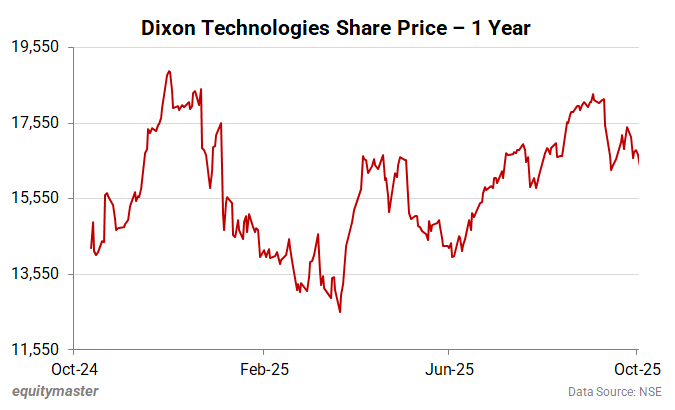
Dixon Technologies has already gone through one split in 2020, when the face value was reduced from Rs 10 to Rs 2. Since then, the price has continued to rise. This is a direct result of sustained earnings growth and strong market positioning.
In the September quarter (Q2 FY26), the company reported a 29% year-on-year rise in revenue, led by robust growth in mobiles and networking products. EBITDA margins improved on account of higher capacity utilisation and better sourcing efficiencies, even as demand in televisions and refrigerators remained subdued due to the GST rate adjustment.
Going forward, Dixon Technologies plans capex of about Rs 3 bn over the next three years for its components and display module expansion. The spending will be funded mainly through internal accruals.
Given the sharp price appreciation and face value of Rs 2, the stock is among the stronger candidates that could consider a split in 2026.
At current levels, the stock trades at a PE of about 13.8, in line with its 5-year median multiple of 14.2
To know more about the company, check out its financial factsheet and latest quarterly results.
#2 Siemens
Next on the list is Siemens.
Siemens provides automation, electrification and digitalisation solutions across industries, railways and infrastructure. The company's portfolio spans digital industries, smart infrastructure and mobility, giving it exposure to India's public capex cycle and private-sector modernisation.
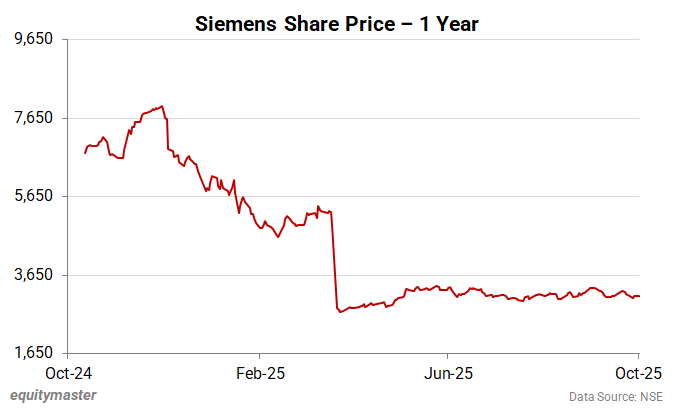
The stock is down over 10% in the past year. It currently trades around Rs 3,150, well above its long-term median valuation. Investors have begun speculating about a possible stock split given its high price and face value of Rs 2.
The last time the company underwent a split was in 2006- a 5:1 split in June 2006, aimed at improving liquidity.
In the June quarter, Siemens reported 15.5% year-on-year revenue growth, supported by healthy traction in its smart infrastructure and mobility segments. EBITDA margin stood at 12.4%, lower than 13% a year ago due to normalisation in digital industries and higher material costs.
Despite margin pressure, the company maintained a record order backlog of Rs 414.6 bn, up 7.2% year-on-year, underpinned by electrification, automation and rail projects.
Looking ahead, Siemens plans to sustain capex in vacuum interrupters and gas-insulated switchgear technologies, along with mobility product expansion. These investments will be largely funded through internal accruals.
Given its strong fundamentals, elevated share price and face value of Rs 2, Siemens could be among the large industrial stocks that consider a split in 2026.
At current levels, the stock trades at a PE of 65.4, a premium to its 5-year median of 47.
To know more about the company, check out its financial factsheet and latest quarterly results.
#3 Maruti Suzuki
Third on our list is Maruti Suzuki.
Maruti Suzuki is India's largest carmaker with a wide product mix across hatchbacks, sedans, SUVs and CNG vehicles. The company has been reshaping its portfolio towards premium and utility vehicles while expanding exports and capacity at its Kharkhoda plant.
The stock has surged over 42% in the past year, driven by robust exports, a shift toward high-margin SUVs and sustained earnings growth. It currently trades near Rs 16,000, and with a face value of Rs 5, investors see Maruti as another candidate for a stock split to improve liquidity.
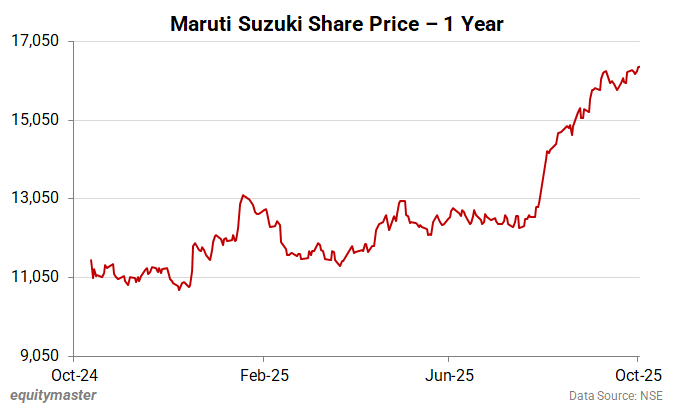
Meanwhile, the business continues to perform relatively well. In Q1 FY26, Maruti's revenue rose 8.1% year-on-year, aided by stronger exports (up 37.4%) even as domestic volumes were flat. EBITA margin stood at 12%, down from 14% a year earlier, due to adverse commodity prices, forex movement and initial costs linked to the new Kharkhoda greenfield plant.
The management attributed the lower margin to temporary factors and highlighted cost-reduction efforts and higher non-operating income as partial offsets.
Looking ahead, Maruti plans to ramp up capacity at Kharkhoda and expand its EV ecosystem, including battery and charging infrastructure. These investments will be funded mainly through internal accruals.
At current levels, the stock trades at a PE of about 35, inline with its 5-year median multiple of 35 times.
To know more about the company, check out its financial factsheet and latest quarterly results.
#4 Mahindra & Mahindra
Fourth on our list is Mahindra & Mahindra.
Mahindra & Mahindra is a diversified automobile and farm-equipment major with leadership in SUVs and tractors. The company continues to benefit from its wide product portfolio, strong brand recall and ongoing focus on electric mobility.
The stock has gained around 30% in the past year as investors cheered its steady earnings growth and EV expansion. At a price of roughly Rs 3,600, and a face value of Rs 5, M&M is among the few large auto stocks where investors see room for a potential stock split to improve liquidity. The last split occurred in 2010, when the face value was reduced from Rs 10 to Rs 5, and the steep rally since has reignited speculation about another.
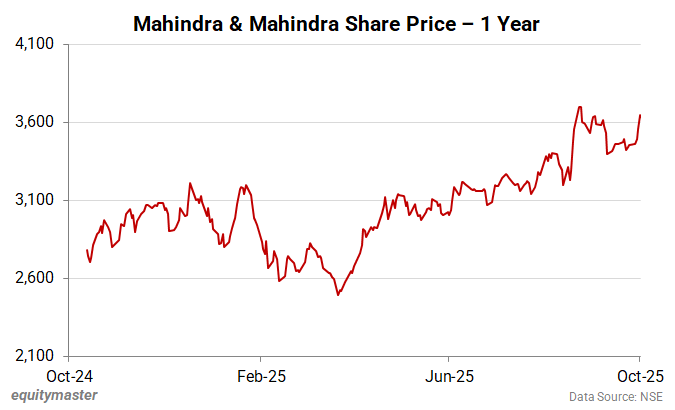
In Q1 FY26, consolidated revenue rose 22% year-on-year, driven by a 22% increase in SUV volumes and 10% growth in tractors. The auto business maintained a 10% margin, while the farm segment achieved a 19.8% PBIT margin, reflecting healthy demand and cost discipline.
The company's consolidated profit grew 24% and return on equity crossed 18% for the first time, supported by robust performance across group companies.
Looking ahead, M&M plans capex of about Rs 4.6 bn in FY25, focused on product development and EV launches, including its new BE and XEV range.
These investments are being funded through internal accruals. With the stock trading above its long-term median valuation and a strong momentum in both auto and farm businesses, Mahindra & Mahindra could emerge as one of the key large-cap candidates to consider a stock split in 2026.
Presently, the stock trades at about 32 times, a premium to its 5-year median PE of 27.
To know more about the company, check out its financial factsheet and latest quarterly results.
#5 Hitachi Energy India
Last on our list is Hitachi Energy India.
Hitachi Energy India supplies advanced grid, automation and electrification solutions that power industries, railways and renewable projects. The company has played a key role in strengthening India's transmission and energy infrastructure for more than seven decades.
The stock has been one of the standout gainers in the power-equipment space, rising about 22% over the past year. At a market price near Rs 16,400 and a face value of Rs 2, the high absolute price has raised the possibility of a stock split to make the shares more affordable to retail investors. The company has not undertaken a split since its listing under the Hitachi brand in 2020, when it was renamed from ABB Power Products and Systems India.
In Q1 FY26, the company reported 11% year-on-year growth in revenue, driven by strong execution in transmission and industrial projects. EBITDA improved on account of a better product mix, operational excellence and timely completion of high-margin orders.
Order inflows surged to an all-time high of Rs 113.4 bn, supported by major wins from PowerGrid and Adani Energy Solutions for large-scale transformer and HVDC projects.
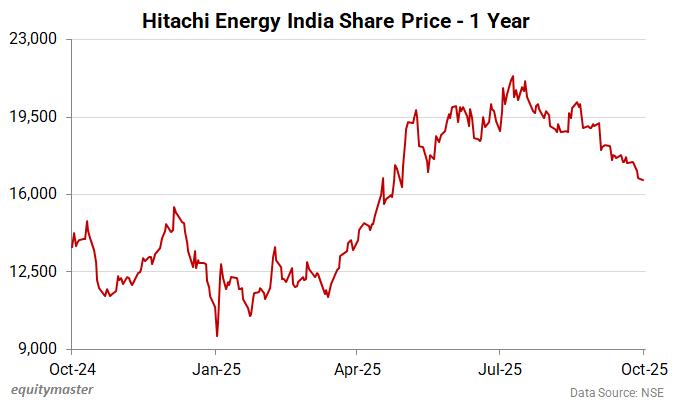
Looking ahead, Hitachi Energy plans to expand manufacturing capacity for power transformers, grid automation and service businesses. It is also investing in localising its Grid-eXpand and Grid-eMotion product lines, with funding largely through internal accruals. The company's record order book of Rs 291.3 bn provides strong visibility.
At current levels, the stock trades at a P/BV of 17.8 times, a premium to its 5-year median multiple of 15 times.
Given its high valuation, sustained growth and face value of Rs 2, Hitachi Energy could be among the top engineering names to consider a stock split in 2026.
To know more about the company, check out its financial factsheet and latest quarterly results.
Conclusion
Even in a richly valued market, it pays to look beyond momentum and focus on fundamentals. Stock splits may draw attention, but it is the underlying business strength that sustains value over time. Investors should see a split not as a reason to chase prices but as a reminder to revisit a company's earnings visibility, cash flows and governance standards.
The coming year could bring more companies to consider this step as their share prices climb to record levels. Yet the principle remains the same. Quality businesses with strong balance sheets and disciplined capital allocation continue to drive long-term wealth.
In a market where valuations leave little room for comfort, being selective matters more than ever.
Disclaimer: This article is for information purposes only. It is not a stock recommendation and should not be treated as such. Learn more about our recommendation services here...
ABOUT EQUITYMASTER
Since 1996, Equitymaster has been the source for honest and credible opinions on investing in India. With solid research and in-depth analysis Equitymaster is dedicated towards making its readers- smarter, more confident and richer every day. Here's why hundreds of thousands of readers spread across more than 70 countries Trust Equitymaster.
PREMIUM PRODUCTS
- Hidden Treasure
- Forever Stocks
- Big Wave Profits
- Equitymaster Venture
- Microcap Millionaires
- Momentum Profits
- Double Income
- Midcap Value Alert
- Exponential Profits
- Annual Breakout Alert
- Lazy Millionaire
- Phase One Alert
- Smallcap AlphaQuest
- InsiderPro Stocks
- StockSelect
- Private Briefing
- Active Wealth Multiplier 2030
- FundSelect
- Fund Advantage
QUICK LINKS
POPULAR TOPICS
- Multibagger Penny Stocks
- Basics of Value Investing
- Benjamin Graham
- How to Invest in Gold
- How to Invest in Silver
- Best Stocks to Buy Today
- Best Small-cap Stocks to Buy
- Best Bluechip Stocks to Buy
- Guide to Penny Stocks
- How to Invest in the Share Market
- Warren Buffett - The Value Investor
- Pick the Best Multibagger Stocks
TRENDING TOPICS
- Best Defence Stocks in India
- Upcoming Dividend Stocks
- Best Semiconductor Stocks in India
- Data Center Stocks in India
- Best Railway Stocks in India
- Best Solar Stocks in India
- Fastest Growing Stocks in India
- List of BSE Sensex 30 Stocks
- Adani Group Shares
- Stocks Recently Bought by FIIs in India
- Top Value Stocks in India


LEGAL DISCLAIMER:
Investment in securities market are subject to market risks. Read all the related documents carefully before investing.
Registration granted by SEBI, enlistment with BSE as IA and RA, and certification from NISM in no way guarantee performance of the intermediary or provide any assurance of returns to investors.
All rights reserved. Any act of copying, reproducing or distributing any content from this website whether wholly or in part, for any purpose without the permission of Quantum Information Services Private Limited is strictly prohibited and shall be deemed to be copyright infringement.
Quantum Information Services Private Limited (QIS) is a SEBI registered Research Analyst (bearing registration no INH000021128) and Investment Adviser(Reg. No: INA000000680). Consequent upon the merger of Equitymaster Research Private Limited into QIS, effective October 30, 2025 QIS owns and operates brand 'Equitymaster' and website www.equitymaster.com. This does not constitute or is not intended to constitute an offer to buy or sell, or a solicitation to an offer to buy or sell financial products, units or securities and QIS including its employees, personnel, directors, associates will not be liable for any losses (direct or indirect) incurred or investment(s) made or decisions taken/or not taken based on the information provided herein. All content and information is provided on an 'As Is' basis by QIS. Information herein is believed to be reliable but QIS does not warrant its completeness or accuracy and expressly disclaims all warranties and conditions of any kind, whether express or implied. The services rendered by QIS are on a best effort basis. QIS does not assure or guarantee the user any minimum or fixed returns. The securities quoted, if any are for illustration only and are not recommendatory. Use of this information is at the user's own risk. The user must make his own investment decisions based on his specific investment objective and financial position and using such independent advisors as he believes necessary. This is not directed for access or use by anyone in a country, especially, USA, Canada or the European Union countries, where such use or access is unlawful or which may subject QIS or its affiliates to any registration or licensing requirement.
The performance data quoted represents past performance and does not guarantee future results. As a condition to accessing QIS's content and website, you agree to our Terms and Conditions of Use, available here
Equitymaster requests your view! Post a comment on "5 Stocks That May Split in 2026". Click here!
Comments are moderated by Equitymaster, in accordance with the Terms of Use, and may not appear
on this article until they have been reviewed and deemed appropriate for posting.
In the meantime, you may want to share this article with your friends!