


Equitymaster's 2026 Grand Festive Offer
Two Research Reports, Six Stocks
3 Small Cap, 3 Large Cap
**Important: We hate spam as much as you do. Check out our Privacy Policy and Terms Of Use.
Should You Invest in Low PE Stocks?
 Image source: Orientfootage/www.istockphoto.com
Here is a simple and timeless piece of investing wisdom that you should never forget.
If you aspire to make extraordinary wealth from the stock market, then you need to hunt for companies with strong growth prospects.
But that's not all...
You need to buy these stocks at an attractive valuation.
What do we mean by that?
You need to buy high quality growth stocks when they're trading below their intrinsic values i.e., when they are undervalued.
Now that raises the question of how to find out if the stock is undervalued or not.
Well, investment professionals use many mathematical methods to determine this. One simple method that use can use - in fact, you should use this - is the price to earnings (PE) ratio.
The PE ratio is defined as the ratio of a company's current share price per share divided by its earnings per share. It tells you the price you need to pay for one rupee of a company's earnings.
For example, a stock with a PE ratio of 20 means you are paying 20 rupees for one rupee of its earnings. The higher the PE ratio, the more you are paying, i.e. the more expensive the stock.
By investing in a company which trades at a low PE ratio, you can be mostly sure that you're not overpaying for the stock.
Benjamin Graham - known as the father of value investing - believed that a great company trading at a PE ratio of less than 20 is worth investing in.
With the help of Equitymaster's Stock Screener, you can find stocks trading at a low PE ratio. The PE ratio on our screener is calculated on the basis of the company's trailing twelve month results.
Check out our screener's results for low PE stocks in India.
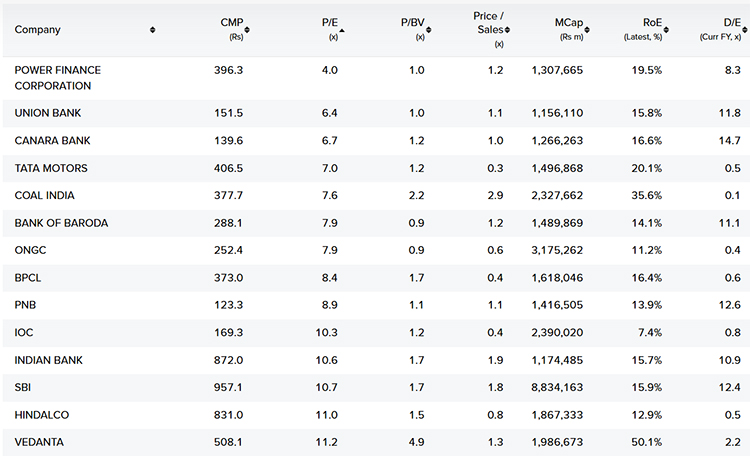
Should You Invest in Low PE Stocks in the Indian Stock Market?
The answer is both Yes and No.
Don't be confused! Here's what we mean...
- First, let's consider the positive aspect.
The PE ratio is very useful.
At a glance it will tell you how exactly how much the market is paying for the stock. In other words, how much investors - as a whole group - are bullish (or bearish) on the stock.
For comparison, the Nifty's PE at the time of writing is 22.5. This is in line with the historical trend.
Now imagine a high PE stock, let's say with a PE of 45 or more. Even if you know nothing about the company in question, you can still be confident that the stock is relatively expensive.
This is because investors are willing to pay 45 times the company's earnings to buy the stock today. They are doing this with the expectation that the company's earnings will grow fast. With this belief, they believe the PE of 45 is justified. This is called paying up for growth.
The opposite is also true.
A stock trading at a PE of 10 or 12 when the Nifty's PE is 20+ means that the market is not impressed with the company.
The reason could be anything: low growth, missed expectations, poor prospects of the sector, uncertainly about the management, a major upcoming event that could impact the financials, etc.
Even if you don't know the reason, you can still be confident that the stock is relatively cheap.
This ability to find out if a stock is cheap or expensive at a glance is very important to value conscious investors. These investors want a margin of safety in the valuations of the stock before they consider an investment. A low PE could be an indicator of just that.
- Now, let's consider the negative aspect.
The PE ratio doesn't tell you anything about the fundamentals of the company.
So, the PE ratio viewed in isolation is not a credible factor for investment. It can be used as a starting point for analysis but it shouldn't be the only factor.
In fact, we would go as far as to say that you should not invest in a company only because it is trading at a low PE.
You should dig deep to gauge the quality of a company's fundamentals. If a company trades at a price well below its intrinsic value, only then could it be a sound investment opportunity.
You will come across such investment opportunities if the company is not popular of some reason or when the stock market crashes.
But if you find low PE stocks in these situations, don't be overjoyed. There may be more than meets the eye. Dig deeper.
These stocks may turn out to be value traps. Value traps are stocks that are trading at very cheap valuations but never recover in terms of stock price performance. Just look at what HUL investors had to go through before the stock went up.
What You Should Look For
You should look for high quality value stocks with strong fundamentals and capable management.
These companies have sustainable competitive advantages (moats) to help them in good times or bad.
And how do you find such companies?
Here are the 4 filters used by the legendary investor Warren Buffett...
- Is the business easy to understand?
- Does the business have a moat?
- Is it run by an honest management team?
- Is it available at attractive valuations?
You can read more about these filters in this article by Rahul Shah, Co-Head of Research, Equitymaster.
How to Implement This Investing Strategy
The process of finding high-quality 'value stocks' involves the following 4 steps:
Step 1: Identify Your Circle of Competence
This comprises of identifying all the businesses that you are familiar with and thoroughly understand.
For value investors, it's important to invest only in businesses that they understand.
Focus solely on areas of business where you believe you have an edge over the average investor.
Likewise, staying away from what you don't understand is equally important.
Step 2: A Moat to Protect Your Castle
If we look at medieval castles, there is a deep moat around it. This moat was typically filled with water and crocodiles or other predators to keep the attackers/enemies away.
In value investing too, you should look to protect your castle.
In simple words, you should look for companies with a sustainable competitive advantage. Larger the advantage, wider is the moat. This moat would protect the business from competition.
Companies that have a wide moat are able to earn higher returns for its shareholders. They are able to do so consistently year after year, every year. This in turn is reflected in its stock price.
And if the company is able to use its competitive advantage to widen the moat over time, then it's the perfect business to be in.
Step 3: Able and Trustworthy Management
Perhaps among the various factors that need to be looked at before investing in a company, the management is the most important.
Able and trustworthy management means that management consistently demonstrates competence and works in the interest of shareholders.
There are 3 main factors in assessing management:
- The results of the company
- The treatment of the company's shareholders
- How well it allocates capital
Step 4: A Sensible Price
A sensible price for stock selection is nothing more than having a margin of safety discussed above.
It consists of assessing the company's true market value per share by various valuation methods.
These methods could be the discounted cash flow approach to find the intrinsic value or by using various valuation ratios like the widely used price to earnings (PE) or the price to book value (PB) ratios.
The dividend yield is also commonly used.
Happy investing.
--- Advertisement ---
Investment in securities market are subject to market risks. Read all the related documents carefully before investing
Which businesses are most likely to emerge stronger over the next 3 to 5 years?
After screening thousands of listed companies, comparing industries, and examining balance sheets...
Our research team discovered some of the strongest opportunities in what we call... Essential Stocks.
Opportunities like this do not remain hidden forever.
Disclaimer: This article is for information purposes only. It is not a stock recommendation and should not be treated as such. Learn more about our recommendation services here...
ABOUT EQUITYMASTER
Since 1996, Equitymaster has been the source for honest and credible opinions on investing in India. With solid research and in-depth analysis Equitymaster is dedicated towards making its readers- smarter, more confident and richer every day. Here's why hundreds of thousands of readers spread across more than 70 countries Trust Equitymaster.
PREMIUM PRODUCTS
- Hidden Treasure
- Forever Stocks
- Super Sector Stocks
- Equitymaster Venture
- Microcap Millionaires
- Momentum Profits
- Double Income
- Midcap Value Alert
- Exponential Profits
- Annual Breakout Alert
- Lazy Millionaire
- Phase One Alert
- Smallcap AlphaQuest
- InsiderPro Stocks
- StockSelect
- Private Briefing
- Active Wealth Multiplier 2030
- FundSelect
- Fund Advantage
QUICK LINKS
POPULAR TOPICS
- Multibagger Penny Stocks
- Basics of Value Investing
- Benjamin Graham
- How to Invest in Gold
- How to Invest in Silver
- Best Stocks to Buy Today
- Best Small-cap Stocks to Buy
- Best Bluechip Stocks to Buy
- Guide to Penny Stocks
- How to Invest in the Share Market
- Warren Buffett - The Value Investor
- Pick the Best Multibagger Stocks
TRENDING TOPICS
- Best Defence Stocks in India
- Upcoming Dividend Stocks
- Best Semiconductor Stocks in India
- Data Center Stocks in India
- Best Railway Stocks in India
- Best Solar Stocks in India
- Fastest Growing Stocks in India
- List of BSE Sensex 30 Stocks
- Adani Group Shares
- Stocks Recently Bought by FIIs in India
- Top Value Stocks in India


LEGAL DISCLAIMER:
Investment in securities market are subject to market risks. Read all the related documents carefully before investing.
Registration granted by SEBI, enlistment with BSE as IA and RA, and certification from NISM in no way guarantee performance of the intermediary or provide any assurance of returns to investors.
All rights reserved. Any act of copying, reproducing or distributing any content from this website whether wholly or in part, for any purpose without the permission of Quantum Information Services Private Limited is strictly prohibited and shall be deemed to be copyright infringement.
Quantum Information Services Private Limited (QIS) is a SEBI registered Research Analyst (bearing registration no INH000021128) and Investment Adviser(Reg. No: INA000000680). Consequent upon the merger of Equitymaster Research Private Limited into QIS, effective October 30, 2025 QIS owns and operates brand 'Equitymaster' and website www.equitymaster.com. This does not constitute or is not intended to constitute an offer to buy or sell, or a solicitation to an offer to buy or sell financial products, units or securities and QIS including its employees, personnel, directors, associates will not be liable for any losses (direct or indirect) incurred or investment(s) made or decisions taken/or not taken based on the information provided herein. All content and information is provided on an 'As Is' basis by QIS. Information herein is believed to be reliable but QIS does not warrant its completeness or accuracy and expressly disclaims all warranties and conditions of any kind, whether express or implied. The services rendered by QIS are on a best effort basis. QIS does not assure or guarantee the user any minimum or fixed returns. The securities quoted, if any are for illustration only and are not recommendatory. Use of this information is at the user's own risk. The user must make his own investment decisions based on his specific investment objective and financial position and using such independent advisors as he believes necessary. This is not directed for access or use by anyone in a country, especially, USA, Canada or the European Union countries, where such use or access is unlawful or which may subject QIS or its affiliates to any registration or licensing requirement.
The performance data quoted represents past performance and does not guarantee future results. As a condition to accessing QIS's content and website, you agree to our Terms and Conditions of Use, available here
Equitymaster requests your view! Post a comment on "Should You Invest in Low PE Stocks?". Click here!
Comments are moderated by Equitymaster, in accordance with the Terms of Use, and may not appear
on this article until they have been reviewed and deemed appropriate for posting.
In the meantime, you may want to share this article with your friends!