

Investment in securities market are subject to market risks. Read all the related documents carefully before investing
Two Years of Market Correction
Is This Your Buying Window?
See Where the Opportunities are Emerging for the Next 3-5 Years
**Important: We hate spam as much as you do. Check out our Privacy Policy and Terms Of Use.
5 High Dividend Yield Penny Stocks to Watch Out in 2025
 Image source: marrio31/www.istockphoto.com
Penny stocks, known for their low price and high growth potential, often attract investors looking for significant returns.
While many of these stocks carry higher risk, some stand out for offering high dividend yields, providing steady income alongside the possibility of capital appreciation.
As we approach 2025, a handful of penny stocks are emerging as attractive options for investors seeking a balance of income and growth.
High dividend yield penny stocks are appealing because they offer the chance to earn passive income, even if the stock price remains stable or grows slowly. Despite their low prices, some of these companies have strong fundamentals and a proven track record of rewarding shareholders.
In this article, we'll highlight five promising high-dividend-yield penny stocks that are worth monitoring in 2025.
Whether you're a seasoned investor or new to the market, these stocks could play a role in diversifying your portfolio while providing potential for long-term gains.
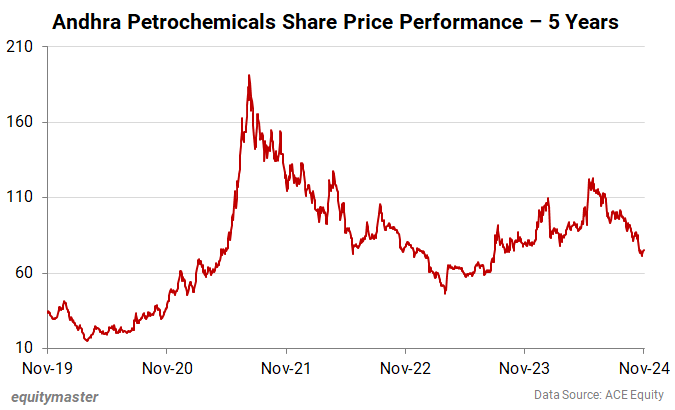
#1 Andhra Petrochemicals
First on our list is Andhra Petrochemicals.
The company manufactures and sells oxo alcohols. Its products are mainly used
by domestic manufacturers of di-octyl phthalate (DOP), which is used as a plasticizer to manufacture polyvinyl chloride (PVC).
At the current market price, the company's dividend yield is 2.68%.
Andhra Petrochemicals has paid consistent dividends over the past few years. The company has been maintaining a healthy dividend payout of 33.5% over the past three years.
Have a look at its dividend history.
Andhra Petrochemicals Dividend History (2007-2024)
| Year | Dividend per share (in Rs) |
|---|---|
| 24-Mar | 2 |
| 23-Mar | 1.5 |
| 22-Mar | 3 |
| 21-Mar | 1.5 |
| 20-Mar | 1.5 |
| 19-Mar | 0.5 |
| 11-Mar | 1 |
| 7-Mar | 1 |
Going forward, Andhra Petrochemicals stands to benefit from the trade protection measures, such as the anti-dumping duty (ADD) imposed on several countries for the import of NBA and 2EH.
It's also in a duopoly in the domestic oxo-alcohol market with Bharat Petroleum Corporation Limited (BPCL) being the other player.
he company has moderate capex plans in the near term towards value-added product, to be funded by internal accruals.
Despite its dividend history, the company has delivered poor sales and net profit growth over the last five years. Its return on equity (RoE) and return on capital employed (RoCE) stand at 11.4% and 17% respectively as of March 2024.
For more details about the company, check out Andhra Petrochemicals fact sheet and quarterly results.
#2 NHPC
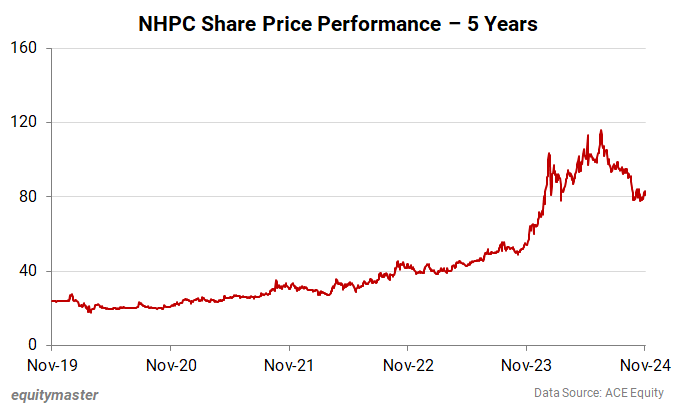
Second on our list is NHPC, India's leading hydroelectric generation firm.
The company supplies substantial power to utilities across eastern, northern and north-eastern regions through long-term Power Purchase Agreements (PPAs).
It boasts a total capacity of 7,000 MW, filling the gap during peak demand periods when solar power falls short.
NHPC's dividend yield stands at 2.32%. Its 3-year average dividend payout ratio stands at 50.6%.
Check out the company's dividend history.
NHPC Dividend History (2002-2024)
| Year | Dividend per share (in Rs) |
|---|---|
| 24-Mar | 1.9 |
| 23-Mar | 1.85 |
| 22-Mar | 1.81 |
| 21-Mar | 1.6 |
| 20-Mar | 1.5 |
| 19-Mar | 1.46 |
| 18-Mar | 1.4 |
| 17-Mar | 1.8 |
| 16-Mar | 1.5 |
| 15-Mar | 0.6 |
| 14-Mar | 0.3 |
| 13-Mar | 0.6 |
| 12-Mar | 0.7 |
| 11-Mar | 0.6 |
| 10-Mar | 0.55 |
| 9-Mar | 0.29 |
| 8-Mar | 0.27 |
| 7-Mar | 0.25 |
| 6-Mar | 0.22 |
| 5-Mar | 14.9 |
| 4-Mar | 15.4 |
| 3-Mar | 6.5 |
| 2-Mar | 3.8 |
In the past 5 years, the company has reported a poor revenue and net profit growth. It also has low return ratios.
Moreover, the expansion plans of NHPC exposes the company to the project execution and funding-related risks.
This is however, mitigated largely through the company's favourable capital structure, consistent cash flows from operations with adequate cash and bank balance and extensive experience in implementation of various projects in the past.
Looking ahead, the company has outlined a massive capex outlay for doubling the installed 7,000 MW capacity by financial year 2027. It has guided for a capex of Rs 90-100 bn for the next 10 years.
The company is also shifting its focus towards the solar energy segment. Out of 10,499 MW (megawatts) capacity under construction, the company has allocated 1,135 MW for solar power. It has recently signed a contract to develop additional 2,000 MW solar power capacity in Rajasthan.
Apart from that, about 9,090 MW solar power capacity is under tender and pipeline including as an intermediary procurer.
For more details, see the NHPC company fact sheet and quarterly results.
#3 Tamil Nadu Petroproducts
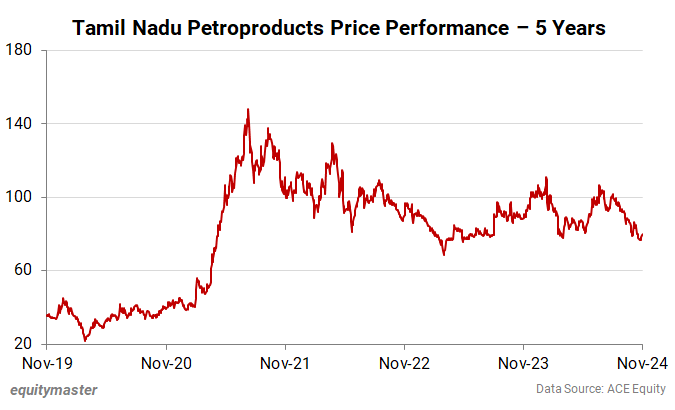
Third on our list Is Tamil Nadu Petroproducts (TPL).
The company manufactures and sells petrochemical products. It was established as a joint venture between SPIC Ltd and Tamil Nadu Industrial Development Corporation.
TPL has been in operations for more than three decades, and has three major divisions, namely, Linear Alkyl Benzene (LAB), Heavy Chemical Division (HCD), and Propylene Oxide (PO).
It is one of the leading manufacturers (about 15% of domestic capacity) of LAB in the domestic market and only manufacturer in South India. The company has established strong relationships with reputed players in the FMCG industry for LAB.
TPL's dividend yield is 1.5%. The company has been maintaining a healthy dividend payout of 17.1% over the past three years.
Tamil Nadu Petroproducts Dividend History (2005-2024)
| Year | Dividend per share (in Rs) |
|---|---|
| 24-Mar | 1.2 |
| 23-Mar | 1.5 |
| 22-Mar | 3 |
| 21-Mar | 2.5 |
| 20-Mar | 1.5 |
| 19-Mar | 1 |
| 18-Mar | 0.5 |
| 17-Mar | 0.5 |
| 16-Mar | 1 |
| 15-Mar | 0.5 |
| 14-Mar | 1 |
| 13-Mar | 1 |
| 12-Mar | 1.25 |
| 11-Mar | 1.25 |
| 10-Mar | 2.5 |
| 9-Mar | 2.5 |
| 8-Mar | 2.5 |
| 7-Mar | 2.4 |
| 6-Mar | 2.2 |
| 5-Mar | 2.2 |
Manali Petrochemicals (MPL) is a major customer of the company for its products such as Propylene Oxide, Chlorine, etc., and at times, TPL also purchases materials from MPL. TPL and MPL are not related parties.
Tamil Nadu petroproducts has reported poor sales growth over the last five years while its net profit has stayed flat.
During the pandemic, the use of LABSA skyrocketed abnormally, leading to a significant increase in LAB prices as well. This surge in prices had a direct impact on the costs incurred by FMCG companies.
As a result, users began to explore for alternatives, and Sodium Lauryl Ether Sulfate (SLES) was discovered to be less expensive than LAB, and replacement occurred faster due to its ease of use in liquid detergent, which is the most common form in the international market.
This impacted the company's sales. However, SLES is only expected to partially replace LABSA, considering the drawbacks of SLES in terms of product performance in heavy duty detergent applications & compatibility issues with other ingredients in formulation.
Going forward, the company has proposed to increase its capacity on account of an increase in demand from 120,000 MTPA to 145,000 MTPA at an estimated cost of around Rs 2.4 bn.
In the HCD division, TPL has proposed to replace the current mono-polar membrane technology for manufacturing of caustic soda with bipolar membrane technology with a new 250 TPD cell house with an electrolyser.
Note that the company has a low promoter holding of 34.5%.
For more details, check out Tamil Nadu Petroproducts fact sheet and quarterly results.
#4 Satia Industries
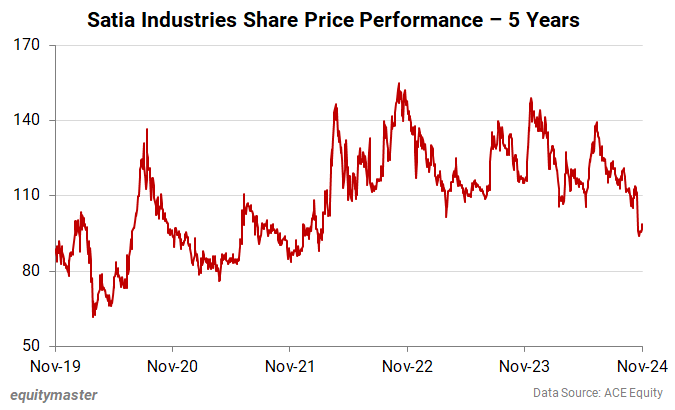
Fourth on our list is Satia Industries.
The company is one of the leading wood and agro-based paper manufacturers in India, with a fully integrated manufacturing setup.
It supplies paper directly to various state boards, accounting for over 40% of the business. It enjoys a 10-12% market share in the state orders.
The state orders are tender driven, funded by the government and generate higher margins, in comparison to the paper sold in the open markets.
Satia Industries has a dividend yield of 1.05%. The company has paid dividends consistently since 2017.
Satia Industries Dividend History (2015-2024)
| Year | Dividend per share (in Rs) |
|---|---|
| 24-Mar | 1 |
| 23-Mar | 0.4 |
| 22-Mar | 0.2 |
| 21-Mar | 0.1 |
| 20-Mar | 0.2 |
| 19-Mar | 2.5 |
| 18-Mar | 2.5 |
| 17-Mar | 2 |
| 15-Mar | 1 |
In recent years, the company's business has expanded significantly. Its revenue has grown at a compounded annual growth rate (CAGR) of 18% over the last five years led by the ramp up of new capacities while net profit has grown at 19% CAGR.
The expansion in FY22, accompanied by an increase in the pulp capacity to 284,700MT from 229,950MT. It has also improved the company's product profile by increasing the proportion of high-quality wood-based paper to 28% in FY24 from 25% in FY23.
The new capacity has also enabled the company to manufacture a higher quality copier paper in addition to catering to incremental demand from state education boards.
Looking ahead, Satia Industries plans to modernise its existing plants and machinery to improve efficiency and production quality.
The company is also considering setting up a new paper machine within its existing premises, which could potentially double its production capacity.
For more details, check out Satia Industries fact sheet and quarterly results.
#5 Manali Petrochemicals
Last on our list is Manali Petrochemicals.
The company manufactures and sells Propylene Oxide, Propylene Glycol and Polyols, which are used as industrial raw materials.
It is the only domestic manufacturer of Propylene Glycol. It is also the first and largest Indian manufacturer of Propylene Oxide which is the input material for the aforesaid derivative products.
Manali Petrochemicals has a dividend yield of 1.22%. The company has been paying dividends since 2006. Have a look at its dividend history.
Manali Petrochemicals Dividend History (2006-2024)
| Year | Dividend per share (in Rs) |
|---|---|
| 24-Mar | 0.75 |
| 23-Mar | 0.75 |
| 22-Mar | 2.5 |
| 21-Mar | 1.5 |
| 20-Mar | 0.75 |
| 19-Mar | 0.75 |
| 18-Mar | 0.5 |
| 17-Mar | 0.5 |
| 16-Mar | 0.5 |
| 15-Mar | 0.5 |
| 14-Mar | 0.5 |
| 13-Mar | 0.5 |
| 12-Mar | 0.6 |
| 11-Mar | 0.5 |
| 10-Mar | 0.38 |
| 9-Mar | 0.25 |
| 8-Mar | 0.5 |
| 7-Mar | 0.5 |
| 6-Mar | 0.75 |
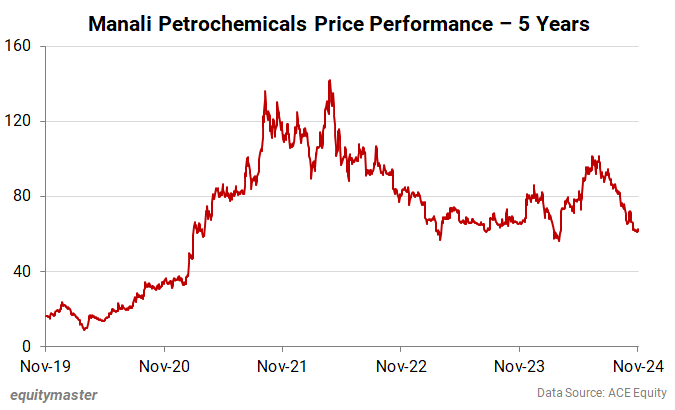
The company has delivered a poor sales growth of 5% over past five years while net profit has fallen by 18% on a CAGR basis.
The recent performance underscores the ongoing macroeconomic pressures facing Manali Petrochemicals, especially as it grapples with rising raw material costs and competition from cheaper imports.
This challenging environment has put the company in a difficult position, particularly given its inability to pass on rising input costs to customers. These factors have collectively affected its profit margins, reflecting the need for strategic adjustments.
Looking ahead, Manali Petrochemicals is adopting a balanced approach. The company plans to prioritise cost efficiencies to better manage operational expenses, which could help stabilise margins in the current competitive landscape.
Despite the domestic challenges, the strong contributions from its overseas subsidiaries have been a bright spot. These subsidiaries support the bottom line and demonstrate the potential of its diversified business structure.
These subsidiaries could play an increasingly important role in driving long-term performance, providing a crucial counterbalance to domestic market pressures.
In terms of expansion, reportedly, Manali Petrochemicals is progressing with plans to broaden its product portfolio and increase production capacities.
With both greenfield and brownfield projects in the pipeline, such as the propylene glycol and polyester polyol plants, Manali aims to strengthen its presence in high-demand sectors like pharmaceuticals and consumer goods.
For more details, check out Manali Petrochemicals factsheet and quarterly results.
Conclusion
Investing in high-dividend-yield penny stocks can be a strategic way to generate steady income while benefiting from the potential for capital appreciation.
The five stocks highlighted in this article demonstrate promising qualities, such as reliable cash flow and strong dividend payout histories, making them noteworthy candidates for 2025.
However, it's important to remember that penny stocks often come with greater risks due to their lower liquidity and higher volatility.
Thorough research, careful analysis, and an understanding of the underlying business models are crucial before committing your capital. Diversifying your investments and aligning them with your financial goals and risk tolerance can further protect your portfolio.
As 2025 unfolds, keeping an eye on these high-dividend-yield penny stocks could offer opportunities for income and growth.
By balancing risk and reward, these stocks may serve as a valuable addition to your investment strategy. Always consult a financial advisor if you're unsure about making investments in this space.
By the way, you can also check out the video version of this editorial on Equitymaster's YouTube channel.
Happy Investing!
--- Advertisement ---
Investment in securities market are subject to market risks. Read all the related documents carefully before investing
Which businesses are most likely to emerge stronger over the next 3 to 5 years?
After screening thousands of listed companies, comparing industries, and examining balance sheets...
Our research team discovered some of the strongest opportunities in what we call... Essential Stocks.
Opportunities like this do not remain hidden forever.
Disclaimer: This article is for information purposes only. It is not a stock recommendation and should not be treated as such. Learn more about our recommendation services here...

Ayesha Shetty is a financial writer with the StockSelect team at Equitymaster. An engineer by qualification, she uses her analytical skills to decode the latest developments in financial markets. This reflects in her well-researched and insightful articles. When she is not busy separating financial fact from fiction, she can be found reading about new trends in technology and international politics.
ABOUT EQUITYMASTER
Since 1996, Equitymaster has been the source for honest and credible opinions on investing in India. With solid research and in-depth analysis Equitymaster is dedicated towards making its readers- smarter, more confident and richer every day. Here's why hundreds of thousands of readers spread across more than 70 countries Trust Equitymaster.
PREMIUM PRODUCTS
- Hidden Treasure
- Forever Stocks
- Big Wave Profits
- Equitymaster Venture
- Microcap Millionaires
- Momentum Profits
- Double Income
- Midcap Value Alert
- Exponential Profits
- Annual Breakout Alert
- Lazy Millionaire
- Phase One Alert
- Smallcap AlphaQuest
- InsiderPro Stocks
- StockSelect
- Private Briefing
- Active Wealth Multiplier 2030
- FundSelect
- Fund Advantage
QUICK LINKS
POPULAR TOPICS
- Multibagger Penny Stocks
- Basics of Value Investing
- Benjamin Graham
- How to Invest in Gold
- How to Invest in Silver
- Best Stocks to Buy Today
- Best Small-cap Stocks to Buy
- Best Bluechip Stocks to Buy
- Guide to Penny Stocks
- How to Invest in the Share Market
- Warren Buffett - The Value Investor
- Pick the Best Multibagger Stocks
TRENDING TOPICS
- Best Defence Stocks in India
- Upcoming Dividend Stocks
- Best Semiconductor Stocks in India
- Data Center Stocks in India
- Best Railway Stocks in India
- Best Solar Stocks in India
- Fastest Growing Stocks in India
- List of BSE Sensex 30 Stocks
- Adani Group Shares
- Stocks Recently Bought by FIIs in India
- Top Value Stocks in India


LEGAL DISCLAIMER:
Investment in securities market are subject to market risks. Read all the related documents carefully before investing.
Registration granted by SEBI, enlistment with BSE as IA and RA, and certification from NISM in no way guarantee performance of the intermediary or provide any assurance of returns to investors.
All rights reserved. Any act of copying, reproducing or distributing any content from this website whether wholly or in part, for any purpose without the permission of Quantum Information Services Private Limited is strictly prohibited and shall be deemed to be copyright infringement.
Quantum Information Services Private Limited (QIS) is a SEBI registered Research Analyst (bearing registration no INH000021128) and Investment Adviser(Reg. No: INA000000680). Consequent upon the merger of Equitymaster Research Private Limited into QIS, effective October 30, 2025 QIS owns and operates brand 'Equitymaster' and website www.equitymaster.com. This does not constitute or is not intended to constitute an offer to buy or sell, or a solicitation to an offer to buy or sell financial products, units or securities and QIS including its employees, personnel, directors, associates will not be liable for any losses (direct or indirect) incurred or investment(s) made or decisions taken/or not taken based on the information provided herein. All content and information is provided on an 'As Is' basis by QIS. Information herein is believed to be reliable but QIS does not warrant its completeness or accuracy and expressly disclaims all warranties and conditions of any kind, whether express or implied. The services rendered by QIS are on a best effort basis. QIS does not assure or guarantee the user any minimum or fixed returns. The securities quoted, if any are for illustration only and are not recommendatory. Use of this information is at the user's own risk. The user must make his own investment decisions based on his specific investment objective and financial position and using such independent advisors as he believes necessary. This is not directed for access or use by anyone in a country, especially, USA, Canada or the European Union countries, where such use or access is unlawful or which may subject QIS or its affiliates to any registration or licensing requirement.
The performance data quoted represents past performance and does not guarantee future results. As a condition to accessing QIS's content and website, you agree to our Terms and Conditions of Use, available here
Equitymaster requests your view! Post a comment on "5 High Dividend Yield Penny Stocks to Watch Out in 2025". Click here!
Comments are moderated by Equitymaster, in accordance with the Terms of Use, and may not appear
on this article until they have been reviewed and deemed appropriate for posting.
In the meantime, you may want to share this article with your friends!