


Equitymaster's 2026 Grand Festive Offer
Two Research Reports, Six Stocks
3 Small Cap, 3 Large Cap
**Important: We hate spam as much as you do. Check out our Privacy Policy and Terms Of Use.
Bank of Japan Hikes Interest Rates: Impact of Indian Stocks
 Image source: genkur/www.istockphoto.com
Japan's central bank has hiked interest rates...and financial markets are a bit spooked.
But why?
What's the significance of this event and what could be the impact on the Indian stock market?
Let's find out...
The Event and its Significance
The Bank of Japan (BoJ), after a two-day meeting, raised its overnight call rate to 0.75% from 0.5%.
The move was widely expected by financial markets but is still considered significant.
This is because the interest rate in Japan are now at multi-decade highs.
The Japanese bond markets have been pricing in higher interest rates for some time. The yield on the benchmark 10-year bond in Japan has risen above 2%. This level is the highest since 2006.
Market Response
Financial markets had anticipated the rate hike. However, there is no certainty about future rate hikes.
Markets had earlier anticipated rate hikes up to 1% but the concern is that rate hikes could continue for longer than expected. Speculation in the markets is that the BoJ could hike overnight rates to as high as 2.5%. This would result in even higher long-term interest rates.
Such a move would be a historic turning point for global markets that have become used to rock-bottom interest rates in Japan, near zero.
This resulted in the 'Yen carry trade' in which speculators borrowed money from Japanese banks at very low cost and then invested it abroad, usually in US bonds at higher interest rates.
However, with rates rising, the carry trade is unwinding. This, in turn, has resulted in money leaving Japan for the US and other major economies. The US dollar has strengthened because of this.
Impact on the Indian Stock Market
The Indian stock market is not directly impacted by the Yen carry trade but there is an indirect impact.
With money flowing out of Japan and into (mostly) the US, the American currency is getting stronger.
The US dollar index has been reflecting this new reality for the last few months. In fact, from around July 2025, the dollar has essentially stopped falling and has been steady.
This has resulted in pressure on emerging market currencies like the India rupee which is trading at all-time lows which came close to the 91 level recently.
USDINR - Last 2 Weeks
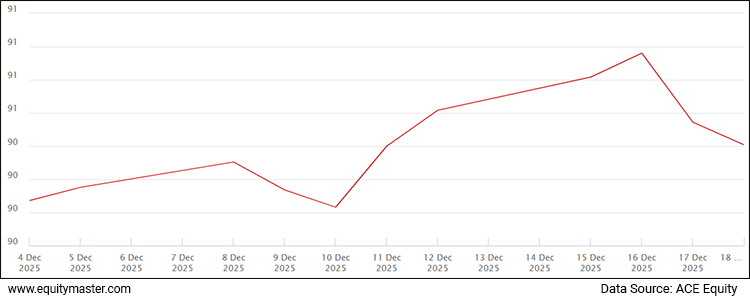
A weaker rupee results in imported inflation as all imports becomes expensive in rupee terms, even if the global prices stay the same.
This is especially problematic for crude oil imports because higher prices of imported crude oil, if passed on to consumers, will result in higher prices of everyday goods. This, in turn, will reduce consumption in the economy as a whole, negatively impacting GDP growth.
What to Watch
Investors should not only track the Japanese Yen or the Dollar index but should also keep an eye on the rupee as well as domestic inflation.
Inflation is relatively under control in India at the moment and this has allowed the RBI to cut interest rates which the stock market likes.
What the stock market won't like is the possibility of rising interest rates which will be on the table if inflation were to pick up.
Conclusion
Investors in the stock market will need to be aware that there are always winners and losers in the economy in the short term.
If the rupee continues to depreciate, for example, the winners would be exporters. They can either pocket the extra earnings as higher margins or offer higher discounts to global customers to increase market share.
And the losers would be importers. They would either have to absorb the currency depreciation in the form of lower margins or would have to raise prices, which would hurt their sales volume.
However, in the long term, the underlying fundamentals of the companies will be the deciding factor of stock market returns, and not currency movements and what the Bank of Japan does or where the dollar index ends up.
Thus, long term investors who have picked fundamentally strong stocks at reasonable valuations don't have much too worry about when it comes to Japanese interest rates.
Happy investing.
--- Advertisement ---
Investment in securities market are subject to market risks. Read all the related documents carefully before investing
Which businesses are most likely to emerge stronger over the next 3 to 5 years?
After screening thousands of listed companies, comparing industries, and examining balance sheets...
Our research team discovered some of the strongest opportunities in what we call... Essential Stocks.
Opportunities like this do not remain hidden forever.

Sarit Panackal, is Managing Editor at Equitymaster. Sarit found his calling at the age of 19 while in engineering college. Fascinated with the stock market, he spent more time studying finance than engineering. He joined Equitymaster as an analyst in 2013. He has worked closely with all our editors, including co-heads of research, Rahul Shah and Tanushree Banerjee. As Managing Editor, he oversees Equitymaster's publications and ensures the highest quality of content reaches you, the reader.
ABOUT EQUITYMASTER
Since 1996, Equitymaster has been the source for honest and credible opinions on investing in India. With solid research and in-depth analysis Equitymaster is dedicated towards making its readers- smarter, more confident and richer every day. Here's why hundreds of thousands of readers spread across more than 70 countries Trust Equitymaster.
PREMIUM PRODUCTS
- Hidden Treasure
- Forever Stocks
- Super Sector Stocks
- Equitymaster Venture
- Microcap Millionaires
- Momentum Profits
- Double Income
- Midcap Value Alert
- Exponential Profits
- Annual Breakout Alert
- Lazy Millionaire
- Phase One Alert
- Smallcap AlphaQuest
- InsiderPro Stocks
- StockSelect
- Private Briefing
- Active Wealth Multiplier 2030
- FundSelect
- Fund Advantage
QUICK LINKS
POPULAR TOPICS
- Multibagger Penny Stocks
- Basics of Value Investing
- Benjamin Graham
- How to Invest in Gold
- How to Invest in Silver
- Best Stocks to Buy Today
- Best Small-cap Stocks to Buy
- Best Bluechip Stocks to Buy
- Guide to Penny Stocks
- How to Invest in the Share Market
- Warren Buffett - The Value Investor
- Pick the Best Multibagger Stocks
TRENDING TOPICS
- Best Defence Stocks in India
- Upcoming Dividend Stocks
- Best Semiconductor Stocks in India
- Data Center Stocks in India
- Best Railway Stocks in India
- Best Solar Stocks in India
- Fastest Growing Stocks in India
- List of BSE Sensex 30 Stocks
- Adani Group Shares
- Stocks Recently Bought by FIIs in India
- Top Value Stocks in India


LEGAL DISCLAIMER:
Investment in securities market are subject to market risks. Read all the related documents carefully before investing.
Registration granted by SEBI, enlistment with BSE as IA and RA, and certification from NISM in no way guarantee performance of the intermediary or provide any assurance of returns to investors.
All rights reserved. Any act of copying, reproducing or distributing any content from this website whether wholly or in part, for any purpose without the permission of Quantum Information Services Private Limited is strictly prohibited and shall be deemed to be copyright infringement.
Quantum Information Services Private Limited (QIS) is a SEBI registered Research Analyst (bearing registration no INH000021128) and Investment Adviser(Reg. No: INA000000680). Consequent upon the merger of Equitymaster Research Private Limited into QIS, effective October 30, 2025 QIS owns and operates brand 'Equitymaster' and website www.equitymaster.com. This does not constitute or is not intended to constitute an offer to buy or sell, or a solicitation to an offer to buy or sell financial products, units or securities and QIS including its employees, personnel, directors, associates will not be liable for any losses (direct or indirect) incurred or investment(s) made or decisions taken/or not taken based on the information provided herein. All content and information is provided on an 'As Is' basis by QIS. Information herein is believed to be reliable but QIS does not warrant its completeness or accuracy and expressly disclaims all warranties and conditions of any kind, whether express or implied. The services rendered by QIS are on a best effort basis. QIS does not assure or guarantee the user any minimum or fixed returns. The securities quoted, if any are for illustration only and are not recommendatory. Use of this information is at the user's own risk. The user must make his own investment decisions based on his specific investment objective and financial position and using such independent advisors as he believes necessary. This is not directed for access or use by anyone in a country, especially, USA, Canada or the European Union countries, where such use or access is unlawful or which may subject QIS or its affiliates to any registration or licensing requirement.
The performance data quoted represents past performance and does not guarantee future results. As a condition to accessing QIS's content and website, you agree to our Terms and Conditions of Use, available here
Equitymaster requests your view! Post a comment on "Bank of Japan Hikes Interest Rates: Impact of Indian Stocks". Click here!
Comments are moderated by Equitymaster, in accordance with the Terms of Use, and may not appear
on this article until they have been reviewed and deemed appropriate for posting.
In the meantime, you may want to share this article with your friends!