


Equitymaster's 2026 Grand Festive Offer
Two Research Reports, Six Stocks
3 Small Cap, 3 Large Cap
**Important: We hate spam as much as you do. Check out our Privacy Policy and Terms Of Use.
If You'd Invested Rs 10,000 in PNB 10 Years Ago, Here's How Much You'd Have Today
 PNB logo source: https://www.pnbindia.in/
The year 2024 proved to be a rollercoaster for Indian stock markets, marked by significant volatility stemming from key events such as the Lok Sabha elections, the Union Budget, a slowdown in corporate earnings, and persistent inflation.
Geopolitical tensions, particularly between Israel and Iran in West Asia, combined with stimulus measures from China and fluctuations in the yen carry trade, further rattled equity markets throughout the year.
Amid this turbulence, public sector banks (PSBs) charted a comparatively steady course. Data from ACE Equity reveals that the Nifty PSU Bank Index on the National Stock Exchange (NSE) surged 24.08% in 2024 (as of December 11), far outperforming the Nifty Private Bank Index, which registered a modest gain of 3.94% during the same period.
One of the PSBs that stands out in this context is Punjab National Bank (PNB).
PNB provides a wide array of banking and financial services, including retail and commercial banking, agricultural and international banking, merchant banking, mutual funds, depository services, insurance, and e-services.
While its stock price took a major hit in 2017, has PNB manage to outperform the stock market over the past decade?
Before delving into this, let's first take a brief look at the bank's profile.
About Punjab National Bank
Punjab National Bank (PNB) is recognised as India's first Swadeshi Bank and is among the largest public sector banks in the country.
PNB provides a comprehensive range of banking services catering to retail, corporate, and SME customers. In addition to core banking, the bank extends housing finance, insurance, and asset reconstruction services through its subsidiaries and joint venture associates.
The bank's global presence includes branches in Hong Kong and Dubai, as well as an offshore banking unit in Mumbai. It also operates representative offices in Dubai, Shanghai, Sydney, and Dhaka. Furthermore, PNB has established two overseas subsidiaries, namely PNB International Limited in the UK and Druk PNB Bank Limited in Bhutan.
PNB vs Sensex
PNB's share price has witnessed a significant decline over the past decade, dropping sharply from Rs 218 a decade ago to Rs 101.7 as of 30 December 2024.
If you had invested Rs 10,000 in PNB ten years ago, your investment would now be worth just Rs 4,654. This reflects a staggering decline of 53.46% over the period, a significant underperformance.
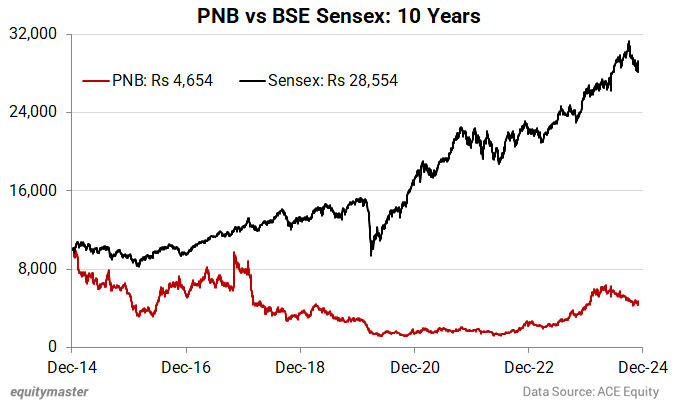
In comparison, the Sensex has seen impressive growth during the same period, increasing from 27,208.6 to 78,248 as of 24 December 2024.
This is a growth of 187.72%. Had you invested in the Sensex instead, your Rs 10,000 investment would have appreciated to Rs 28,554.
Since its debut in 2002, the company shares have zoomed by 1,264.3% but the stock has been on a downward spiral since 2017.
What Caused the Sharp Decline Over the Past Decade?
The decline in PNB's share price over the past decade reflects a combination of systemic issues, controversies, and external challenges.
The trouble began in 2017, marking the start of a challenging period for the bank. That year, the Modi government announced a Rs 2.1 trillion (tn) recapitalisation plan for public sector banks to address mounting bad loans and ensure financial stability.
The situation worsened in 2018, when PNB was rocked by a multi-billion-dollar fraud involving Nirav Modi, severely impacting its credibility and financial performance.
The shadow of this scandal lingered for years, with the bank finding it difficult to rebuild its image in the eyes of customers and investors.
As the bank attempted to recover, the COVID-19 pandemic hit in 2020, exacerbating its challenges. The economic slowdown and moratorium on loan repayments increased stress on PNB's asset quality, leading to higher provisioning and reduced profitability.
This further eroded investor confidence, as public sector banks faced the dual pressure of rising bad loans and declining credit growth.
Geo-political tensions and global economic uncertainties in the years that followed added to the bank's woes. The PSU banking sector failed to attract significant investor interest, with private sector banks and fintech companies gaining a competitive edge.
By 2024, PNB found itself embroiled in another controversy that dealt a blow to its reputation. A long-time customer, Yash Kapoor, reported that his family's locker-held for 64 years-had been mistakenly opened, resulting in the loss of valuables worth billions.
This incident raised serious concerns about the bank's internal processes and customer safety, further damaging its standing. The negative press and subsequent public backlash highlighted the erosion of trust, making it difficult for the bank to retain existing customers or attract new ones.
Adding to the challenges, the announcement of a capital-raising plan through Qualified Institutional Placement (QIP) in 2024 caused anxiety among investors due to concerns over share dilution.
The PSU banking sector as a whole failed to gain momentum, even after the BJP's third consecutive Lok Sabha election victory, as market sentiment remained subdued.
While PNB has made strides in improving asset quality, with higher recoveries and write-offs in recent quarters, these efforts have yet to reflect meaningfully in its stock price.
The combination of past controversies, operational challenges, and investor apprehensions has left PNB's share price significantly below its historical highs.
A Close Look at the Financials
For the September 2024 quarter, the bank's net interest income (NII) grew 5.9% YoY to Rs 105.2 billion (bn). The net profit for the quarter grew 145% to Rs 43 bn from Rs 17.6 bn a year back.
The gross non-performing asset (GNPA) ratio of the bank improved by 2.5% to 4.5% in the September 2024 quarter.
Similarly, net NPA fell to 0.5%, compared to 0.6% in the prior quarter, underscoring the bank's efforts to strengthen its balance sheet and manage credit risk effectively.
PNB's Financial Snapshot (FY22-24)
| (Rs m, Consolidated) | FY20 | FY21 | FY22 | FY23 | FY24 |
|---|---|---|---|---|---|
| Net Interest Income (NII) | 179,210 | 311,305 | 294,188 | 350,283 | 405,304 |
| NII Growth (%) | 2.5 | 73.7 | (-5.5) | 19.1 | 15.7 |
| Net Profit | 4,384 | 25,620 | 38,607 | 33,485 | 91,072 |
| Net Profit Margin (%) | 0.8 | 3.1 | 5.1 | 3.9 | 8.4 |
| Return on Equity (%) | 0.7 | 2.8 | 4 | 3.3 | 8.3 |
The 5-year CAGR for Punjab National Bank's NII is approximately 22.63%, while the 5-year CAGR for net profit is an impressive 113.49%.
The average RoE for the past five-year period is 3.8%.
What Next?
Punjab National Bank (PNB) has revised its gross non-performing assets (GNPA) guidance for FY25 to around 4%, reflecting its confidence in robust asset quality management.
As part of its expansion plans, the state-owned bank is set to establish a representative office in Dubai, strengthening its global presence.
To enhance profitability, PNB is focusing on growing its retail, agriculture, and MSME (RAM) portfolios, offering quality corporate loans, minimising financial slippages, and improving recovery mechanisms.
The bank is also targeting increased foreign exchange income and higher fee income by promoting third-party products.
In terms of deposits, PNB aims to boost its low-cost Current Account Savings Account (CASA) deposits, which accounted for 41.4% of total deposits as of March 2024.
The bank is working towards increasing this share to over 42% by the financial year's end. It is also attempting to maintain credit costs below 1% for the year.
Looking at business growth, PNB anticipates credit growth of 11-12% and deposit growth of 9-10% for the current financial year. The bank plans to raise Rs 175 bn through tier I and tier II bonds and private share placements, to reinforce its capital base for future expansion.
Conclusion
Punjab National Bank (PNB) is focusing on enhancing its digital banking capabilities, improving customer experience, and strengthening its balance sheet.
It also plans to add another 150 branches to its network in the domestic market and a representative office in Dubai during the current financial year. Currently, the bank has 10,136 branches in the country and an overseas presence, including in the UK, Bhutan and Nepal.
This aligns with, the Union Budget 2024-25 has laid a strong foundation for enhancing financial inclusion in India. One of its key initiatives is the establishment of 100 new India Post Payment Bank branches in the North East, aimed at improving access to banking services in underserved regions.
Furthermore, PNB plans to actively engage in the government's financial inclusion initiatives to reach underserved populations and expand its customer base.
Investors should evaluate the company's fundamentals, corporate governance, and valuations of the stock as key factors when conducting due diligence before making investment decisions.
--- Advertisement ---
Investment in securities market are subject to market risks. Read all the related documents carefully before investing
Which businesses are most likely to emerge stronger over the next 3 to 5 years?
After screening thousands of listed companies, comparing industries, and examining balance sheets...
Our research team discovered some of the strongest opportunities in what we call... Essential Stocks.
Opportunities like this do not remain hidden forever.
Disclaimer: This article is for information purposes only. It is not a stock recommendation and should not be treated as such. Learn more about our recommendation services here...
ABOUT EQUITYMASTER
Since 1996, Equitymaster has been the source for honest and credible opinions on investing in India. With solid research and in-depth analysis Equitymaster is dedicated towards making its readers- smarter, more confident and richer every day. Here's why hundreds of thousands of readers spread across more than 70 countries Trust Equitymaster.
PREMIUM PRODUCTS
- Hidden Treasure
- Forever Stocks
- Super Sector Stocks
- Equitymaster Venture
- Microcap Millionaires
- Momentum Profits
- Double Income
- Midcap Value Alert
- Exponential Profits
- Annual Breakout Alert
- Lazy Millionaire
- Phase One Alert
- Smallcap AlphaQuest
- InsiderPro Stocks
- StockSelect
- Private Briefing
- Active Wealth Multiplier 2030
- FundSelect
- Fund Advantage
QUICK LINKS
POPULAR TOPICS
- Multibagger Penny Stocks
- Basics of Value Investing
- Benjamin Graham
- How to Invest in Gold
- How to Invest in Silver
- Best Stocks to Buy Today
- Best Small-cap Stocks to Buy
- Best Bluechip Stocks to Buy
- Guide to Penny Stocks
- How to Invest in the Share Market
- Warren Buffett - The Value Investor
- Pick the Best Multibagger Stocks
TRENDING TOPICS
- Best Defence Stocks in India
- Upcoming Dividend Stocks
- Best Semiconductor Stocks in India
- Data Center Stocks in India
- Best Railway Stocks in India
- Best Solar Stocks in India
- Fastest Growing Stocks in India
- List of BSE Sensex 30 Stocks
- Adani Group Shares
- Stocks Recently Bought by FIIs in India
- Top Value Stocks in India


LEGAL DISCLAIMER:
Investment in securities market are subject to market risks. Read all the related documents carefully before investing.
Registration granted by SEBI, enlistment with BSE as IA and RA, and certification from NISM in no way guarantee performance of the intermediary or provide any assurance of returns to investors.
All rights reserved. Any act of copying, reproducing or distributing any content from this website whether wholly or in part, for any purpose without the permission of Quantum Information Services Private Limited is strictly prohibited and shall be deemed to be copyright infringement.
Quantum Information Services Private Limited (QIS) is a SEBI registered Research Analyst (bearing registration no INH000021128) and Investment Adviser(Reg. No: INA000000680). Consequent upon the merger of Equitymaster Research Private Limited into QIS, effective October 30, 2025 QIS owns and operates brand 'Equitymaster' and website www.equitymaster.com. This does not constitute or is not intended to constitute an offer to buy or sell, or a solicitation to an offer to buy or sell financial products, units or securities and QIS including its employees, personnel, directors, associates will not be liable for any losses (direct or indirect) incurred or investment(s) made or decisions taken/or not taken based on the information provided herein. All content and information is provided on an 'As Is' basis by QIS. Information herein is believed to be reliable but QIS does not warrant its completeness or accuracy and expressly disclaims all warranties and conditions of any kind, whether express or implied. The services rendered by QIS are on a best effort basis. QIS does not assure or guarantee the user any minimum or fixed returns. The securities quoted, if any are for illustration only and are not recommendatory. Use of this information is at the user's own risk. The user must make his own investment decisions based on his specific investment objective and financial position and using such independent advisors as he believes necessary. This is not directed for access or use by anyone in a country, especially, USA, Canada or the European Union countries, where such use or access is unlawful or which may subject QIS or its affiliates to any registration or licensing requirement.
The performance data quoted represents past performance and does not guarantee future results. As a condition to accessing QIS's content and website, you agree to our Terms and Conditions of Use, available here
Equitymaster requests your view! Post a comment on "If You'd Invested Rs 10,000 in PNB 10 Years Ago, Here's How Much You'd Have Today". Click here!
Comments are moderated by Equitymaster, in accordance with the Terms of Use, and may not appear
on this article until they have been reviewed and deemed appropriate for posting.
In the meantime, you may want to share this article with your friends!