

Investment in securities market are subject to market risks. Read all the related documents carefully before investing

The 3 Smallcaps Richa
Found Hardest to Reject
DISCOVER 3 YOUNG TITANS TO BUY NOW**Important: We hate spam as much as you do. Check out our Privacy Policy and Terms Of Use.
What China's CEO Meet Means for India's Top Semiconductor Stocks
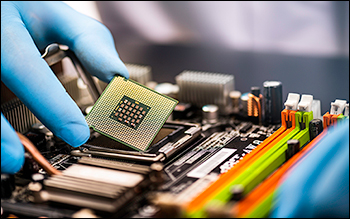 Image source: sefa ozel/www.istockphoto.com
Foreign portfolio investors (FPIs) reportedly sold Indian equities worth Rs 300 bn in just the first 15 days of March. The total outflow for the fiscal at nearly Rs 1.5 trillion was one of the highest since 2020.
Meanwhile, China is seeking to hold a meeting between President Xi Jinping and global CEOs. The planned meeting comes as Beijing is trying to stabilise falling foreign investment flows into China in recent years.
China is also keen for the support of international business leaders, many of whom have invested heavily in China, as it fends off the US government's hostile trade tariffs.
So, with China's recent technology success in DeepSeek and efforts to lure global business leaders, the FII fund flow from India to China cannot be ruled out.
In the worst case, it could also mean India losing some benefits of China+1 policy of global enterprises.
Therefore, India must particularly safeguard its turf when it comes to sectors where Indian businesses are competing with Chinese counterparts head-on.
India ranked third in terms of number of research papers published on semiconductor chip design and fabrication between 2018 and 2023. India's rank was above Japan, South Korea and Germany, according to the Emerging Technology Observatory maintained by Georgetown University, US.
Indian organisations contributed nearly 40,000 research papers, which was 8.4% of the global share. India's contribution to chip research grew 26% in the five-year period.
However, it seems China is the leader in the field, having overtaken the US, producing over 160,000 papers in the period, capturing 34% of the global share.
The semiconductor supply chain is, in fact, concentrated in specific regions.
The US is a leader in chip design, contributing around 64% to the global market. In contrast, manufacturing and assembly activities are primarily located in Asia.
Over the last 30 years, there has been a significant shift in manufacturing capacity towards Taiwan, South Korea, and China, which now hold over 85% of the global foundry market.
The regional concentration led to challenges in balancing supply and demand. This was especially exacerbated by the COVID-19 pandemic, highlighting the need for diversified and resilient supply chain strategies.
India has been progressing in multiple sectors of the chip design value chain. So far, there are more than half a million professionals aligned to chip design.
Also, almost every product company and design house including Qualcomm, AMD and Intel have a base in India.According to a report by Boston Consulting Group, Indian engineers account for about 19% of the global chip design talent.India's progress in semiconductor research is on the back of substantial increases in the government's budget allocation to semiconductor R&D (grew 1.4x in the past decade).
Driven by initiatives from the government, strategic partnerships and programs such as the Semiconductor Mission, PLI schemes, and Special Economic Zones, India now stands firmly on the semiconductor manufacturing map.
Today, India manufactures less than one percent of the world's semiconductors and, for the majority, it is reliant on imports. It's necessary for India to reduce its dependency on import of chips and improve its standing in the global electronics industry.
As per estimates, the Indian market for semiconductors is expected to cross US$ 100 bn by 2032 from around US$ 40 bn in 2024. This will be on the back of increased demand of smartphones, consumer electronics, development in automotive technologies, automation, and healthcare.
Few companies that are already invested in India's semiconductor supply chain are Tata Electronics, HCL Technologies, Dixon Technologies, Cyient, and ASM Technologies.
HCL Technologies already has a strong legacy of more than 25 years in the VLSI (very-large-scale integration) chip design segment along with rich experience of having worked with top chip manufacturers and design foundries across the globe. The company has recently opened a semiconductor design centre in Hyderabad.
Meanwhile, Dixon Technologies has entered an agreement with a Taiwanese company Foxconn to help set up a semiconductor assembly as well as testing plant in the country.
There is also an agreement between Tata Electronics and Taiwan's Powerchip Semiconductor Manufacturing Corp (PSMC).
Cyient has set up a wholly owned semiconductor business to focus on end-to-end turnkey application specific integrated circuit (ASIC) design and chip sales.
So, India's top semiconductor stocks are well poised to capitalise on the opportunities in both chip design and manufacturing over the next decade.
Nevertheless, the industry faces hurdles such as a shortage of labour, limited access to rare earth minerals and the need for a stable supply chain.
The key problem, however, will be the stiff competition from both American and Chinese counterparts.
In 2024, US' biggest chipmaker, Intel, received the largest government grant of US$ 8.5 billion for building new facilities. It will invest up to US$ 100 bn in chip facilities over the next five years.
The world's largest semiconductor chipmaker Taiwan Semiconductor Manufacturing Company (TSMC) also won a US$ 6.6 bn US subsidy for producing the most advanced 2 nanometer processor chips.
At present, most of the world's advanced chips, which are currently in high demand, are designed in the US and manufactured in Taiwan and South Korea. Of this, 90% come from TSMC.
National security concerns and the fear of missing out on having the world's best chips have prompted the US to bolster domestic chip production.
In 2022, the US government passed the CHIPS Act, promising US$ 52 bn to secure the semiconductor supply chain. The US is going all out to set up chip fabrication plants to be less reliant on other economies.
So, how does China's CEO meet impact India's semiconductor plans?
The Chinese chip companies are rapidly investing in new semiconductor factories to try and advance the nation's R&D capabilities.
China also needs to get around export controls imposed by the US and its allies. Those curbs are making it harder for Chinese companies to get access to the machines needed to make the most powerful chips.
Such curbs have been slowing the development of China's high-tech sector, which is seen as a threat to the US.
Also, China has tightened its grip on rare earth minerals, including gallium, germanium, and antimony, used in semiconductor production, and has imposed export restrictions, particularly to the US, citing national security concerns.
For months, China and the US have been involved in tit-for-tat export restrictions. The US hopes to cripple China's military and artificial intelligence (AI) advances as well as hamper its ambitions to become a global leader in clean energy and other technologies.
The trade war is affecting global supply chains for chip and semiconductor manufacturers and pushing prices up.
India's top semiconductor companies need access to both minerals and technology to accelerate growth and have a meaningful presence in the global supply chain.
Therefore, developments that threaten the benefits of China+1 for Indian manufacturing need to be thwarted with necessary policy and government incentives.
Study the semiconductor ecosystem thoroughly and keep the top semiconductor stocks in your watchlist.
Warm regards,
Tanushree Banerjee
Editor, StockSelect
Equitymaster Research Private Limited (formerly Equitymaster Agora Research Private Limited) (Research Analyst)

Tanushree Banerjee (Research Analyst), is the editor of Stock Select and Forever Stocks. Tanushree started her career at Equitymaster covering the banking and financial sector stocks and scrutinising RBI policies. Over the last decade, she developed Equitymaster's research processes that helped us pick out various multibaggers, across all sectors. A firm believer of "safety first" when it comes to investing, Tanushree closely follows the investing philosophies of Warren Buffett, Jeremy Grantham, and Joel Greenblatt.
ABOUT EQUITYMASTER
Since 1996, Equitymaster has been the source for honest and credible opinions on investing in India. With solid research and in-depth analysis Equitymaster is dedicated towards making its readers- smarter, more confident and richer every day. Here's why hundreds of thousands of readers spread across more than 70 countries Trust Equitymaster.
PREMIUM PRODUCTS
- Hidden Treasure
- Forever Stocks
- Big Wave Profits
- Equitymaster Venture
- Microcap Millionaires
- Momentum Profits
- Double Income
- Midcap Value Alert
- Exponential Profits
- Annual Breakout Alert
- Lazy Millionaire
- Phase One Alert
- InsiderPro Stocks
- StockSelect
- Private Briefing
- Active Wealth Multiplier 2030
- FundSelect
- Fund Advantage
QUICK LINKS
POPULAR TOPICS
- Multibagger Penny Stocks
- Basics of Value Investing
- Benjamin Graham
- How to Invest in Gold
- How to Invest in Silver
- Best Stocks to Buy Today
- Best Small-cap Stocks to Buy
- Best Bluechip Stocks to Buy
- Guide to Penny Stocks
- How to Invest in the Share Market
- Warren Buffett - The Value Investor
- Pick the Best Multibagger Stocks
TRENDING TOPICS
- Best Defence Stocks in India
- Upcoming Dividend Stocks
- Best Semiconductor Stocks in India
- Data Center Stocks in India
- Best Railway Stocks in India
- Best Solar Stocks in India
- Fastest Growing Stocks in India
- List of BSE Sensex 30 Stocks
- Adani Group Shares
- Stocks Recently Bought by FIIs in India
- Top Value Stocks in India


LEGAL DISCLAIMER:
Investment in securities market are subject to market risks. Read all the related documents carefully before investing.
Registration granted by SEBI, enlistment with BSE as IA and RA, and certification from NISM in no way guarantee performance of the intermediary or provide any assurance of returns to investors.
All rights reserved. Any act of copying, reproducing or distributing any content from this website whether wholly or in part, for any purpose without the permission of Quantum Information Services Private Limited is strictly prohibited and shall be deemed to be copyright infringement.
Quantum Information Services Private Limited (QIS) is a SEBI registered Research Analyst (bearing registration no INH000021128) and Investment Adviser(Reg. No: INA000000680). Consequent upon the merger of Equitymaster Research Private Limited into QIS, effective October 30, 2025 QIS owns and operates brand 'Equitymaster' and website www.equitymaster.com. This does not constitute or is not intended to constitute an offer to buy or sell, or a solicitation to an offer to buy or sell financial products, units or securities and QIS including its employees, personnel, directors, associates will not be liable for any losses (direct or indirect) incurred or investment(s) made or decisions taken/or not taken based on the information provided herein. All content and information is provided on an 'As Is' basis by QIS. Information herein is believed to be reliable but QIS does not warrant its completeness or accuracy and expressly disclaims all warranties and conditions of any kind, whether express or implied. The services rendered by QIS are on a best effort basis. QIS does not assure or guarantee the user any minimum or fixed returns. The securities quoted, if any are for illustration only and are not recommendatory. Use of this information is at the user's own risk. The user must make his own investment decisions based on his specific investment objective and financial position and using such independent advisors as he believes necessary. This is not directed for access or use by anyone in a country, especially, USA, Canada or the European Union countries, where such use or access is unlawful or which may subject QIS or its affiliates to any registration or licensing requirement.
The performance data quoted represents past performance and does not guarantee future results. As a condition to accessing QIS's content and website, you agree to our Terms and Conditions of Use, available here
Equitymaster requests your view! Post a comment on "What China's CEO Meet Means for India's Top Semiconductor Stocks". Click here!
Comments are moderated by Equitymaster, in accordance with the Terms of Use, and may not appear
on this article until they have been reviewed and deemed appropriate for posting.
In the meantime, you may want to share this article with your friends!