


Equitymaster's 2026 Grand Festive Offer
Two Research Reports, Six Stocks
3 Small Cap, 3 Large Cap
**Important: We hate spam as much as you do. Check out our Privacy Policy and Terms Of Use.
How Investing Legends Would Evaluate the Lenskart IPO
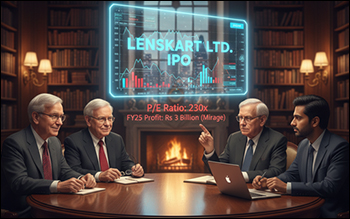 Image source: Google Gemini
This past weekend, I found myself going into a disturbed sleep, my mind swirling with the relentless noise around Lenskart's upcoming IPO-the bullish analyst reports, the dizzying valuation, and the widespread FOMO.
Then suddenly, the chaos made way for stillness and three distinct figures emerged around a shiny, wooden table.
It was the council of investing legends: Peter Lynch, Warren Buffett, and Benjamin Graham. "You seem troubled by the hype," remarked Graham, adjusting his spectacles. "Let us help you filter the signal from the noise."
What followed was a roundtable discussion that could change how we view a flashy IPO.
Moderator: Rahul Shah, Equity Research Analyst
Participants: Peter Lynch, Warren Buffett, Benjamin Graham
Rahul Shah: Gentlemen, thank you for joining me today to analyse the upcoming IPO of Lenskart Ltd., India's largest eyewear retailer. Your collective wisdom is invaluable. Peter, let's start with you. You always preach "Know what you own." What's your take?
Peter Lynch: (Chuckling) Rahul, you know my rule. The best way to research a stock is to try the product. I'd have loved to walk into a Lenskart store, but given the circumstances, I'm relying on you. You've been my eyes and ears on the ground. What's the verdict?
Rahul Shah: It's a mixed bag, Peter. I bought my glasses from Lenskart three years ago. The process was smooth, the product is durable, and I'm still using them. A solid, positive experience. However, my wife had a completely different story. Her glasses didn't meet her expectations, the fit was off, and she's not a fan.
So, the product quality seems inconsistent. It's not a resounding, universal endorsement.
For a company asking for public money, that gives me pause. I'd need to see more data on customer satisfaction and repeat purchases before I get excited.
Peter Lynch: Exactly! That's the heart of it. If you can't define a company's product, you don't own the stock, you own a piece of paper.
A mixed product review tells me this isn't a slam dunk. It's not a ten bagger where every customer is a brand ambassador. I'd wait, watch the quarterly reports post-listing, and see if they can fix these issues and build brand loyalty. This isn't a "buy what you know" story for me yet.
Rahul Shah: A cautious approach. Thank you, Peter. Warren, moving to you. What's your view on IPOs in general and this one in particular?
Warren Buffett: (Calmly, with a slight smile) My view on IPOs is simple, Rahul. I don't buy them. It's not a rule without reason. The dynamics of an IPO are such that it's almost impossible for them to be attractively priced for the investor.
As I've said before, "It's almost a mathematical impossibility to imagine that, out of the thousands of things for sale in a given day, the most attractively priced is the one being sold by a knowledgeable seller to a less-knowledgeable buyer."
The company and its promoters have every incentive to bring the IPO at the peak of market optimism. I'd much rather wait and see how the business performs as a public entity, with a track record we can all scrutinize. Why buy the smoke when you can often wait and see if there's a pot of rice cooking?
Rahul Shah: A timeless principle. So, the very structure of an IPO is a red flag for you.
Warren Buffett: It is. Excitement is the enemy of the rational investor. And IPOs are often dripping with excitement.
Rahul Shah: Understood. Let's bring in the professor. Mr. Graham, you draw a critical distinction between an investment and a speculation. Where does Lenskart fall?
Benjamin Graham: (Adjusting his spectacles, peering at the financials) Rahul, the first disappointment is the limited data. Three years? It's like judging a man's character by his behaviour on a three-day holiday. I want to see a cycle, at least seven years, to understand the true earning power and resilience of an enterprise. This truncated view is inadequate.
Nevertheless, let's work with what we have. The top-line growth is impressive, I'll grant them that.
From Rs 38 billion to Rs 67 billion in three years is commendable. But where is the profit? They lost money in FY23 and FY24. Now, in FY25, they show a modest profit of Rs 3 billion. But this is a mirage.
Rahul Shah: A mirage? How so?
Benjamin Graham: Look closer. This profit is not from their core operations. It's buoyed by 3.6 billion rupees of 'other income'. Strip that away, and the company is still operationally in the red. The primary engine of the business-selling glasses and frames-is not yet generating sustainable profits. This lack of earnings power is a fundamental weakness.
And then we come to the valuation. (He shakes his head in disbelief). At the upper price band, based on this inflated FY25 earnings, the P/E ratio is 230 times. Two hundred and thirty!
In my day, a stock trading at over 20 times earnings was considered highly speculative. This is in another stratosphere entirely. I operated in a different era, yes, but the principles of value are timeless. A price so detached from current earnings is the very definition of speculation, not investment.
Warren Buffett: I have to agree with Ben. This brings me to the concept of a moat. Does Lenskart have one? Is it so difficult for a new competitor to set up shop and sell eyewear? I don't see it.
Contrast this with a company like Apple, which has a deep and wide moat through its ecosystem and brand loyalty. And what did we pay for Apple? We started buying when it was trading at a P/E of around 12 or 13 times.
We were buying a wonderful business at a fair price. Here, with Lenskart, we are being asked to pay an extraordinary price for a business whose 'wonderful' nature is yet to be proven.
Peter Lynch: Warren makes a great point. I've always said that a high P/E ratio can be justified if the growth is phenomenal and sustainable. But Lenskart's growth, while good, is not so extraordinary that it can support a 230x multiple.
In my entire career at Magellan, I rarely, if ever, paid a P/E ratio over 30 or 35.
At that level, you need everything to go perfectly for years to get a decent return. With mixed product reviews and operational losses, the odds are stacked against the investor here.
Rahul Shah: So, the consensus is clear.
Benjamin Graham: Indeed. Based on the available facts, this offering cannot be classified as an investment in the strict, defensive sense of the word. It is a speculation.
And while I have nothing against intelligent speculation, it must be confined to a small portion of one's portfolio and undertaken with full knowledge of the risks.
Warren Buffett: The intelligent investor should be patient. Let the stock list. Let the excitement die down. Let the company prove it can generate consistent profits from its core operations.
Peter Lynch: I'd put it on the watchlist. If they can turn those mixed customer reviews into universally positive ones, scale up profitably, and the stock price comes back to earth in a year or two, then we can have a different conversation.
Rahul Shah: Thank you, gentlemen. To summarise, the committee's view is unanimous.
The Lenskart IPO, given its inconsistent product experience, lack of a clear economic moat, absence of robust operational profitability, and stratospheric valuation, presents an unfavourable risk-reward profile.
It could be in the interest of the average investor to wait and at best, monitor the company's post-listing financial and operational performance for a future opportunity.
Your insights, as always, have been illuminating.
Happy investing.
Warm regards,

Rahul Shah
Editor and Research Analyst, Profit Hunter
Equitymaster Research Private Limited (formerly Equitymaster Agora Research Private Limited) (Research Analyst)

Rahul Shah co-head of research at Equitymaster is the editor of (Research Analyst), Editor, Microcap Millionaires, Exponential Profits, Double Income, Midcap Value Alert and Momentum Profits. Rahul has over 20 years of experience in financial markets as an analyst and editor. Rahul first joined Equitymaster as a Research Analyst, fresh out of university in 2003 but left shortly after to pursue his dream job with a Swiss investment bank. However, he quickly became disillusioned working for the 'financial establishment'. He learned first-hand the greedy stereotype of an investment banker is true and became uncomfortable working for a company that put profit above everything else. In 2006, Rahul re-joined Equitymas ter to serve honest, hardworking Indians like his father, who want to take control of their financial future - and not leave it in the hands of greedy money managers. Following the investment principles of Benjamin Graham (the bestselling author of The Intelligent Investor) and Warren Buffet (considered the world's greatest living investor), Rahul has recommended some of the biggest winners in Equitymaster's history.
Equitymaster requests your view! Post a comment on "How Investing Legends Would Evaluate the Lenskart IPO". Click here!
5 Responses to "How Investing Legends Would Evaluate the Lenskart IPO"
Jagadheesh
Nov 4, 2025Dear Mr.Rahul,
The Lenskart IPO analysed by a roundtable of 3 legends! really amazing and a nice intuitive idea. I have started becoming a fan of your blogs. Keep it up and keep on with the good work.
Regards
Jagadheesh
Virat Trivedi
Nov 3, 2025Though interested in your views only, the presentation was quite refreshing!!
Dr Rajeev Kapur
Nov 3, 2025Thanks Rahul for a very useful article. Brilliant way to analyse an IPO.
ABOUT EQUITYMASTER
Since 1996, Equitymaster has been the source for honest and credible opinions on investing in India. With solid research and in-depth analysis Equitymaster is dedicated towards making its readers- smarter, more confident and richer every day. Here's why hundreds of thousands of readers spread across more than 70 countries Trust Equitymaster.
PREMIUM PRODUCTS
- Hidden Treasure
- Forever Stocks
- Big Wave Profits
- Equitymaster Venture
- Microcap Millionaires
- Momentum Profits
- Double Income
- Midcap Value Alert
- Exponential Profits
- Annual Breakout Alert
- Lazy Millionaire
- Phase One Alert
- Smallcap AlphaQuest
- InsiderPro Stocks
- StockSelect
- Private Briefing
- Active Wealth Multiplier 2030
- FundSelect
- Fund Advantage
QUICK LINKS
POPULAR TOPICS
- Multibagger Penny Stocks
- Basics of Value Investing
- Benjamin Graham
- How to Invest in Gold
- How to Invest in Silver
- Best Stocks to Buy Today
- Best Small-cap Stocks to Buy
- Best Bluechip Stocks to Buy
- Guide to Penny Stocks
- How to Invest in the Share Market
- Warren Buffett - The Value Investor
- Pick the Best Multibagger Stocks
TRENDING TOPICS
- Best Defence Stocks in India
- Upcoming Dividend Stocks
- Best Semiconductor Stocks in India
- Data Center Stocks in India
- Best Railway Stocks in India
- Best Solar Stocks in India
- Fastest Growing Stocks in India
- List of BSE Sensex 30 Stocks
- Adani Group Shares
- Stocks Recently Bought by FIIs in India
- Top Value Stocks in India


LEGAL DISCLAIMER:
Investment in securities market are subject to market risks. Read all the related documents carefully before investing.
Registration granted by SEBI, enlistment with BSE as IA and RA, and certification from NISM in no way guarantee performance of the intermediary or provide any assurance of returns to investors.
All rights reserved. Any act of copying, reproducing or distributing any content from this website whether wholly or in part, for any purpose without the permission of Quantum Information Services Private Limited is strictly prohibited and shall be deemed to be copyright infringement.
Quantum Information Services Private Limited (QIS) is a SEBI registered Research Analyst (bearing registration no INH000021128) and Investment Adviser(Reg. No: INA000000680). Consequent upon the merger of Equitymaster Research Private Limited into QIS, effective October 30, 2025 QIS owns and operates brand 'Equitymaster' and website www.equitymaster.com. This does not constitute or is not intended to constitute an offer to buy or sell, or a solicitation to an offer to buy or sell financial products, units or securities and QIS including its employees, personnel, directors, associates will not be liable for any losses (direct or indirect) incurred or investment(s) made or decisions taken/or not taken based on the information provided herein. All content and information is provided on an 'As Is' basis by QIS. Information herein is believed to be reliable but QIS does not warrant its completeness or accuracy and expressly disclaims all warranties and conditions of any kind, whether express or implied. The services rendered by QIS are on a best effort basis. QIS does not assure or guarantee the user any minimum or fixed returns. The securities quoted, if any are for illustration only and are not recommendatory. Use of this information is at the user's own risk. The user must make his own investment decisions based on his specific investment objective and financial position and using such independent advisors as he believes necessary. This is not directed for access or use by anyone in a country, especially, USA, Canada or the European Union countries, where such use or access is unlawful or which may subject QIS or its affiliates to any registration or licensing requirement.
The performance data quoted represents past performance and does not guarantee future results. As a condition to accessing QIS's content and website, you agree to our Terms and Conditions of Use, available here
Shankar Lal Patel
Nov 7, 2025Hi Rahul, Really like the out of the box thinking to have Legends of the equity investing to have a Round Table discussion to bring out the facts of the Lenskart IPO. Kudos to you and your team.