

Investment in securities market are subject to market risks. Read all the related documents carefully before investing
Equitymaster's 2026 Grand Festive Offer:
Get Rs 20,000 Worth of Research
For Rs 2,950 + GST.
**Important: We hate spam as much as you do. Check out our Privacy Policy and Terms Of Use.
What is NAV in Mutual Funds?
 Image source: Mohamad Faizal Bin Ramli/www.istockphoto.com
A commonly misunderstood aspect of mutual fund investing is the Net Asset Value (NAV).
There is a belief that 'if funds have a lower NAV, it is cheaper.' There are also those who feel hesitant to go into a fund because its NAV 'is a bit too high.' Then there is panic redemption because of sudden downturns in funds' NAV during times of volatile markets.
It's ironic that NAV is of little consequence to your mutual fund investment's success or failure. To truly understand NAV, one must move beyond definitions and look at what NAV represents in practice-and what it does not.
NAV is a Result, Not a Starting Point
NAV reflects the per-unit value of a mutual fund's portfolio after accounting for expenses. It's calculated at the end of every trading day using the closing prices of the securities held by the fund.
The formula is straightforward:
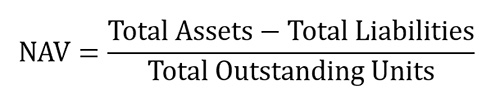
Suppose a mutual fund holds shares and cash worth Rs 1,020 crore. Its expenses and liabilities amount to Rs 20 crore. If the fund has issued 100 crore units, the NAV will be:
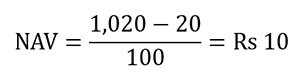
This calculation highlights an important truth: NAV is an accounting outcome, not a price determined by demand and supply like stocks. Investors transact at NAV, but they do not influence it.
Why a High NAV Is Not a Sign of Expensiveness
One of the most persistent myths in mutual fund investing is that funds with lower NAVs offer more upside. This belief largely comes from how stocks are perceived, but the comparison is misplaced.
Consider two equity mutual funds with identical portfolios and performance:
- Fund A was launched in 2004 with an initial NAV of Rs 10
- Fund B was launched in 2019 with an initial NAV of Rs 100
If both funds deliver a 12% annual return, fund A's NAV will naturally be much higher today because it has compounded for a longer period. This does not make fund A "expensive" or fund B "cheap." Both investors earn the same percentage return on their invested capital.
How NAV Moves on a Daily Basis
NAV changes every day, and these movements are often misinterpreted. In reality, NAV fluctuations are driven by three key factors.
- Market Value of Underlying Securities
When the stock or bond prices in the fund's portfolio rise, the fund's total assets increase, pushing NAV higher. Similarly, market corrections reduce NAV. If a fund's equity portfolio rises by 1% in a day and expenses remain unchanged, the NAV will also rise by roughly 1%.
- Expenses and Fees
Mutual fund expenses are not deducted annually in one shot. They are adjusted daily.
For example, if a fund has an expense ratio of 1.5% per year:
![Formula3]()
This small daily deduction quietly reduces NAV over time, which is why expense ratios have a meaningful long-term impact on returns.
- Dividends and Distributions
When a fund pays a dividend, the NAV falls to the extent of the payout.
If a fund with a NAV of Rs 60 declares a dividend of Rs 4 per unit, the NAV will drop to approximately Rs 56 after the payout. This drop is often mistaken as a loss, even though the investor has received Rs 4 in cash.

NAV and SIPs: Where Volatility Helps You
For SIP investors, NAV volatility is not something to fear-it is something to embrace.
The number of units you receive in an SIP depends on the NAV on the investment date:
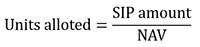
If you invest Rs 10,000 monthly:
- At NAV Rs 50 → 200 units
- At NAV Rs 40 → 250 units
When markets correct and NAVs fall, SIP investors accumulate more units. Over time, this averaging effect improves return potential when markets recover. This is why experienced investors focus more on staying invested than on short-term NAV movements.
NAV During Market Corrections: A Test of Behaviour
Sharp declines in NAV often trigger emotional decisions. Investors see their portfolio value drop and assume something is fundamentally wrong with the fund.
However, NAV reflects current market prices, not long-term intrinsic value. A fall in NAV during a broader market correction does not automatically mean the fund has failed. In many cases, it simply reflects temporary market sentiment.
Investors who redeem based solely on falling NAVs often lock in losses, while those who remain invested benefit from eventual recovery.
When NAV Actually Matters
While NAV should not guide fund selection, it does play a role in certain aspects of investing.
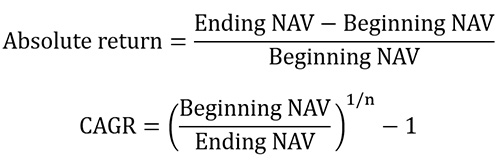
- Calculating Returns
All mutual fund returns-absolute, CAGR, or rolling-are derived from NAV changes.
- Taxation at Redemption
Capital gains tax is calculated using the purchase NAV and redemption NAV. The difference determines your taxable gain.
- Exit Load
Exit loads, if applicable, are charged on the redemption value calculated using NAV.
What Investors Should Focus on Instead of NAV
Rather than asking whether a fund's NAV is high or low, investors are better served by asking:
- How consistent has the fund been across market cycles?
- Does the portfolio align with current economic conditions?
- How has the fund handled downside volatility?
- Are returns justifying the expense ratio?
The Bottom Line
NAV is an essential metric, but it's often given more importance than it deserves. It tells you what a fund is worth today, not whether it's a good or bad investment.
A high NAV does not limit future returns, and a low NAV does not guarantee growth. What truly matters is the quality of the underlying portfolio, the discipline of the fund manager, and the investor's ability to stay invested through market cycles.
In mutual fund investing, NAV is a mirror it reflects value. It's not a compass that guides returns.
Invest wisely.
Happy investing.
Disclaimer: This write up is for information purpose and does not constitute any kind of investment advice or a recommendation to Buy / Hold / Sell a fund. Returns mentioned herein are in no way a guarantee or promise of future returns. As an investor, you need to pick the right fund to meet your financial goals. If you are not sure about your risk appetite, do consult your investment consultant/advisor. Mutual Fund Investments are subject to market risks, read all scheme related documents carefully. Registration granted by SEBI, enlistment as RA and IA with Exchange and certification from NISM no way guarantee performance of the intermediary or provide any assurance of returns to investors.

An MBA in Finance and a Master's degree in Commerce (M.Com), Mitali Dhoke is a Sr. Research Analyst at PersonalFN with close to five years of experience in the financial services industry. At PersonalFN, Mitali primarily focuses on mutual fund research and is recognized as an NFO (New Fund Offer) specialist.
ABOUT EQUITYMASTER
Since 1996, Equitymaster has been the source for honest and credible opinions on investing in India. With solid research and in-depth analysis Equitymaster is dedicated towards making its readers- smarter, more confident and richer every day. Here's why hundreds of thousands of readers spread across more than 70 countries Trust Equitymaster.
PREMIUM PRODUCTS
- Hidden Treasure
- Forever Stocks
- Big Wave Profits
- Equitymaster Venture
- Microcap Millionaires
- Momentum Profits
- Double Income
- Midcap Value Alert
- Exponential Profits
- Annual Breakout Alert
- Lazy Millionaire
- Phase One Alert
- Smallcap AlphaQuest
- InsiderPro Stocks
- StockSelect
- Private Briefing
- Active Wealth Multiplier 2030
- FundSelect
- Fund Advantage
QUICK LINKS
POPULAR TOPICS
- Multibagger Penny Stocks
- Basics of Value Investing
- Benjamin Graham
- How to Invest in Gold
- How to Invest in Silver
- Best Stocks to Buy Today
- Best Small-cap Stocks to Buy
- Best Bluechip Stocks to Buy
- Guide to Penny Stocks
- How to Invest in the Share Market
- Warren Buffett - The Value Investor
- Pick the Best Multibagger Stocks
TRENDING TOPICS
- Best Defence Stocks in India
- Upcoming Dividend Stocks
- Best Semiconductor Stocks in India
- Data Center Stocks in India
- Best Railway Stocks in India
- Best Solar Stocks in India
- Fastest Growing Stocks in India
- List of BSE Sensex 30 Stocks
- Adani Group Shares
- Stocks Recently Bought by FIIs in India
- Top Value Stocks in India


LEGAL DISCLAIMER:
Investment in securities market are subject to market risks. Read all the related documents carefully before investing.
Registration granted by SEBI, enlistment with BSE as IA and RA, and certification from NISM in no way guarantee performance of the intermediary or provide any assurance of returns to investors.
All rights reserved. Any act of copying, reproducing or distributing any content from this website whether wholly or in part, for any purpose without the permission of Quantum Information Services Private Limited is strictly prohibited and shall be deemed to be copyright infringement.
Quantum Information Services Private Limited (QIS) is a SEBI registered Research Analyst (bearing registration no INH000021128) and Investment Adviser(Reg. No: INA000000680). Consequent upon the merger of Equitymaster Research Private Limited into QIS, effective October 30, 2025 QIS owns and operates brand 'Equitymaster' and website www.equitymaster.com. This does not constitute or is not intended to constitute an offer to buy or sell, or a solicitation to an offer to buy or sell financial products, units or securities and QIS including its employees, personnel, directors, associates will not be liable for any losses (direct or indirect) incurred or investment(s) made or decisions taken/or not taken based on the information provided herein. All content and information is provided on an 'As Is' basis by QIS. Information herein is believed to be reliable but QIS does not warrant its completeness or accuracy and expressly disclaims all warranties and conditions of any kind, whether express or implied. The services rendered by QIS are on a best effort basis. QIS does not assure or guarantee the user any minimum or fixed returns. The securities quoted, if any are for illustration only and are not recommendatory. Use of this information is at the user's own risk. The user must make his own investment decisions based on his specific investment objective and financial position and using such independent advisors as he believes necessary. This is not directed for access or use by anyone in a country, especially, USA, Canada or the European Union countries, where such use or access is unlawful or which may subject QIS or its affiliates to any registration or licensing requirement.
The performance data quoted represents past performance and does not guarantee future results. As a condition to accessing QIS's content and website, you agree to our Terms and Conditions of Use, available here
Equitymaster requests your view! Post a comment on "What is NAV in Mutual Funds?". Click here!
Comments are moderated by Equitymaster, in accordance with the Terms of Use, and may not appear
on this article until they have been reviewed and deemed appropriate for posting.
In the meantime, you may want to share this article with your friends!