


Equitymaster's 2026 Grand Festive Offer
Two Research Reports, Six Stocks
3 Small Cap, 3 Large Cap
**Important: We hate spam as much as you do. Check out our Privacy Policy and Terms Of Use.
Is it the Right Time to Invest in Copper and Metal Mutual Funds
 Image source: ChatGPT/www.istockphoto.com
Metals have traditionally been treated as cyclical investments, rising and falling with economic growth, inflation, or global uncertainty.
However, the current cycle suggests something more structural is at play. Copper, silver, and other industrial metals are no longer just inputs for construction or manufacturing. They are becoming essential to the modern economy.
Electrification, renewable energy, artificial intelligence, data centres, and rising defence spending are steadily reshaping metal demand in ways that look durable rather than temporary.
This shift is already reflected in market behaviour. Gold has already delivered over 10% return in 2026 to date, while silver is up over 30%.
For investors, this creates a key question. Is it the right time to invest in copper and metal mutual funds?
Let's start with copper.
The copper industry is currently undergoing a structural shift, moving away from its traditional role as a cyclical economic indicator ("Dr. Copper") towards a strategic component of the modern economy.
Artificial Intelligence (AI), data centers, electrification, and geopolitical insecurity are now the primary drivers of demand. Together, these forces, combined with a persistent supply-demand mismatch, form the central narrative shaping the copper market today.
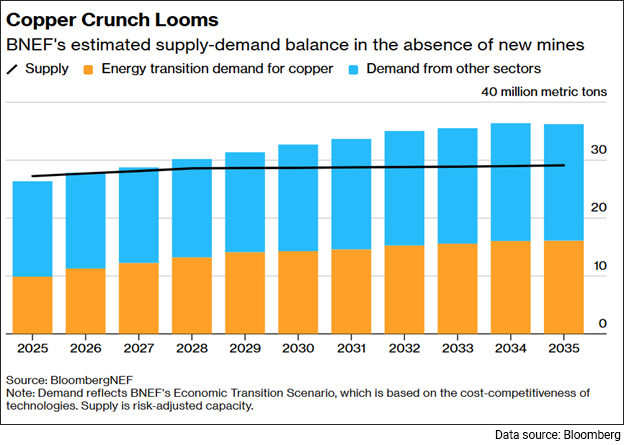
Global copper demand is projected to rise by nearly 50%, increasing from 28 million metric tons (MMt) in 2025 to 42 MMt by 2040.
At the same time, production from existing mines is projected to peak in 2030 in the absence of new investment, then decline to 22 MMt by 2040 as resource depletion accelerates. This implies a potential supply shortfall of 10 MMt by 2040.
Vectors of Demand Growth
Copper demand is being driven by four cumulative vectors, with a fifth potentially emerging.
Core Economic Demand
This remains a big contributor, spanning construction, household appliances, and industrial machinery.
Historically, core demand has been closely linked to economic development. As countries industrialise and urban populations expand, copper consumption rises sharply through wiring, plumbing, and consumer durables.
Construction continues to dominate this segment. An 8-storey building requires about 20 MT of copper, largely for electrical wiring and plumbing, according to S&P Global.
While China's construction boom defined copper demand in the early 21st century, the center of gravity is now shifting. S&P estimates that by 2040, Asia (excluding China) and India together will account for about 60% of construction copper consumption.
Another powerful driver within core demand is the rapid spread of air conditioning and household appliances, supported by rising incomes and global rise in temperatures.
The developing world is projected to add nearly 2 billion (bn) new air conditioners by 2040. Globally, the installed base of AC units is expected to rise from 2.5 bn in 2025 to over 4.5 bn by 2040.
As billions of people enter the middle class, demand for washing machines, refrigerators, and televisions increases. Copper demand for refrigerators alone is forecast to grow at 4.5% annually.
Energy Transition
The clean energy transition is expected to be the fastest-growing driver of copper demand, nearly doubling consumption from 8.5 MMt in 2025 to about 15.6 MMt by 2040.
An electric vehicle (EV) uses 2.9 times as much copper as an internal combustion engine vehicle.
Solar and wind technologies are also copper-intensive. It's estimated that meeting global power demand by 2040 will require roughly 650 one-gigawatt nuclear reactors' worth of capacity.
This further increases copper usage across grids and transmission networks.
A critical nuance in copper demand is the growing shift toward Lithium Iron Phosphate (LFP) batteries.
LFP batteries are about 73% more copper-intensive than nickel-rich alternatives as they require more cells and thus more copper foil current collectors to achieve the same voltage.
The global consumer preference for larger vehicles further drives up copper usage, as heavier vehicles require larger batteries.
Solar energy systems consume approximately 2.2 MT of copper per megawatt of installed capacity. This copper is used in modules, inverters, cables, and transformers.
Data Center and New-Age Demand
AI has emerged as a distinct and fast-growing demand driver.
By 2030, data centres could account for as much as 14% of total US electricity demand, necessitating extensive grid upgrades. Copper consumption from data centres is forecast to grow from 1.1 MMt in 2025 to 2.5 MMt by 2040.
Rising defence spending is another underappreciated source of demand. Global defence expenditure is projected to double to nearly US$ 6 trillion by 2040, with copper playing a critical role in munitions, electrified weapon systems, and military infrastructure.
A potential fifth vector of demand lies in the mass adoption of humanoid robots. If deployment reaches one billion units by 2040, this segment alone could require around 1.6 MMt of copper annually.
Supply Constraints
Meeting this surge in demand is constrained by severe physical, regulatory, and economic barriers.
Developing a new copper mine takes an average of 17 years from discovery to production. This timeline is extended by permitting delays, environmental litigation, and community consultations.
Ore quality is also deteriorating. In South America, average copper head grades have declined by 44% since 2000, from 1.3% to around 0.7%, increasing extraction costs and operational complexity.
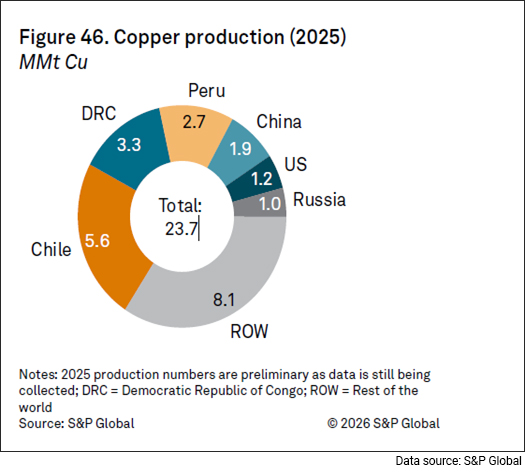
Operational disruptions add another layer of fragility. Supply disruptions in key regions such as Chile, Peru, and Indonesia have left supply gaps. For example, the closure of the Cobre Panama mine left a major global supply source stranded.
Rising capital costs further complicate the picture. At copper prices of around US$ 9,500 per metric ton, nearly 40% of prospective new projects are estimated to be economically unviable.
Processing and Geopolitics
The supply chain is heavily concentrated at the processing stage.
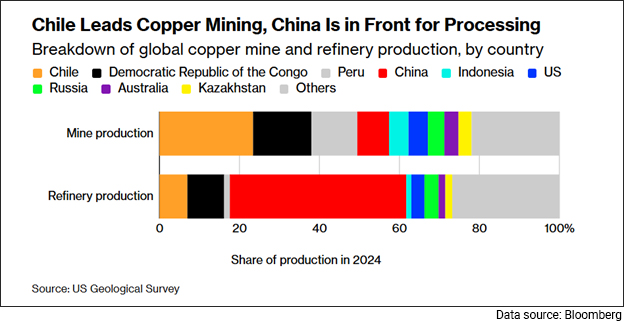
China accounts for about 40% of global smelting capacity and 66% of copper concentrate imports. This dominance gives Chinese smelters significant influence over treatment charges and global trade flows.
The US remains heavily dependent on imports of refined copper and manufactured parts, creating a strategic vulnerability. Tariffs and industrial policies are increasingly being used to localise supply chains, although this often has complex inflationary effects.
Why metal mutual funds fit this cycle
Against this backdrop, investing in metal mutual funds offers a strategic way to participate in long-term economic shifts, including the green transition and the AI boom, while providing portfolio diversification.
Similar to copper, the same forces are reshaping silver demand. Silver is transitioning from a precious metal to an industrial necessity. It's also critical for solar panels (photovoltaics) and 5G infrastructure.
The silver market has also been in a structural deficit for five consecutive years. Similarly, demand for rare earth minerals and other industrial inputs continues to rise.
Steel demand is also expected to strengthen as industrialisation accelerates across emerging economies.
Further, a weakening US dollar and rising expectations of interest rate cuts add another layer of support to metals. A softer dollar makes commodities cheaper for non-US buyers, improving global demand.
At the same time, lower interest rates reduce the opportunity cost of holding non-yielding assets such as gold and silver.
Together, these macro tailwinds reinforce the constructive outlook for metals in the current cycle. Metal mutual funds allow investors to benefit from the surging industrial metal demand as metals evolve from cyclical commodities into core components of modern technology.
Investing through mutual funds or Exchange Traded Funds (ETFs) resolves many of the logistical challenges associated with owning physical metals.
- No Storage/Security Hassles: Unlike physical metals, funds do not require investors to worry about insurance, secure storage, or theft.
- Liquidity and Cost Efficiency: Funds offer high liquidity and generally lower costs than the premiums and fabrication charges associated with physical bars or coins.
- Systematic Investment Plan: Mutual funds enable investors to use SIPs, allowing for staggered investing to average out entry prices, which is difficult with physical metal purchases.
Many metal mutual funds also invest in mining companies, some of which are potentially attractive relative to broader equity markets. Rising metal prices directly boost mining companies' profitability.
Gold miners, in particular, are generating strong free cash flows and are seeing margins improve as gold prices rise while maintaining capital discipline.
Portfolio Diversification
Metal funds serve as a hedge against economic instability and inflation.
Gold and silver are treated as portfolio insurance against geopolitical risks and currency devaluation. Central banks are aggressively buying gold to diversify reserves, supporting the long-term price floor.
Metals and metal-linked funds tend to exhibit low correlation with equities and bonds, helping reduce overall portfolio volatility.
Professional fund management further helps navigate commodity cycles, geopolitical risks, and operational disruptions.
Bottomline
The case for metals today rests less on short-term price cycles and more on long-term structural change.
Copper, silver, and other industrial metals sit at the heart of electrification, AI, and energy transition, even as supply struggles to keep pace.
For investors, metal mutual funds offer a measured way to participate-best used as a disciplined satellite allocation rather than a core bet.
Remember that metals are highly volatile and cyclical. Given the volatility of commodities, metal mutual funds can be considered a satellite allocation to complement core equity and debt holdings rather than a primary holding.
Disclaimer: This article is for information purposes only. It is not a stock recommendation and should not be treated as such. Learn more about our recommendation services here...
ABOUT EQUITYMASTER
Since 1996, Equitymaster has been the source for honest and credible opinions on investing in India. With solid research and in-depth analysis Equitymaster is dedicated towards making its readers- smarter, more confident and richer every day. Here's why hundreds of thousands of readers spread across more than 70 countries Trust Equitymaster.
PREMIUM PRODUCTS
- Hidden Treasure
- Forever Stocks
- Big Wave Profits
- Equitymaster Venture
- Microcap Millionaires
- Momentum Profits
- Double Income
- Midcap Value Alert
- Exponential Profits
- Annual Breakout Alert
- Lazy Millionaire
- Phase One Alert
- Smallcap AlphaQuest
- InsiderPro Stocks
- StockSelect
- Private Briefing
- Active Wealth Multiplier 2030
- FundSelect
- Fund Advantage
QUICK LINKS
POPULAR TOPICS
- Multibagger Penny Stocks
- Basics of Value Investing
- Benjamin Graham
- How to Invest in Gold
- How to Invest in Silver
- Best Stocks to Buy Today
- Best Small-cap Stocks to Buy
- Best Bluechip Stocks to Buy
- Guide to Penny Stocks
- How to Invest in the Share Market
- Warren Buffett - The Value Investor
- Pick the Best Multibagger Stocks
TRENDING TOPICS
- Best Defence Stocks in India
- Upcoming Dividend Stocks
- Best Semiconductor Stocks in India
- Data Center Stocks in India
- Best Railway Stocks in India
- Best Solar Stocks in India
- Fastest Growing Stocks in India
- List of BSE Sensex 30 Stocks
- Adani Group Shares
- Stocks Recently Bought by FIIs in India
- Top Value Stocks in India


LEGAL DISCLAIMER:
Investment in securities market are subject to market risks. Read all the related documents carefully before investing.
Registration granted by SEBI, enlistment with BSE as IA and RA, and certification from NISM in no way guarantee performance of the intermediary or provide any assurance of returns to investors.
All rights reserved. Any act of copying, reproducing or distributing any content from this website whether wholly or in part, for any purpose without the permission of Quantum Information Services Private Limited is strictly prohibited and shall be deemed to be copyright infringement.
Quantum Information Services Private Limited (QIS) is a SEBI registered Research Analyst (bearing registration no INH000021128) and Investment Adviser(Reg. No: INA000000680). Consequent upon the merger of Equitymaster Research Private Limited into QIS, effective October 30, 2025 QIS owns and operates brand 'Equitymaster' and website www.equitymaster.com. This does not constitute or is not intended to constitute an offer to buy or sell, or a solicitation to an offer to buy or sell financial products, units or securities and QIS including its employees, personnel, directors, associates will not be liable for any losses (direct or indirect) incurred or investment(s) made or decisions taken/or not taken based on the information provided herein. All content and information is provided on an 'As Is' basis by QIS. Information herein is believed to be reliable but QIS does not warrant its completeness or accuracy and expressly disclaims all warranties and conditions of any kind, whether express or implied. The services rendered by QIS are on a best effort basis. QIS does not assure or guarantee the user any minimum or fixed returns. The securities quoted, if any are for illustration only and are not recommendatory. Use of this information is at the user's own risk. The user must make his own investment decisions based on his specific investment objective and financial position and using such independent advisors as he believes necessary. This is not directed for access or use by anyone in a country, especially, USA, Canada or the European Union countries, where such use or access is unlawful or which may subject QIS or its affiliates to any registration or licensing requirement.
The performance data quoted represents past performance and does not guarantee future results. As a condition to accessing QIS's content and website, you agree to our Terms and Conditions of Use, available here
Equitymaster requests your view! Post a comment on "Is it the Right Time to Invest in Copper and Metal Mutual Funds". Click here!
Comments are moderated by Equitymaster, in accordance with the Terms of Use, and may not appear
on this article until they have been reviewed and deemed appropriate for posting.
In the meantime, you may want to share this article with your friends!