

Investment in securities market are subject to market risks. Read all the related documents carefully before investing
Two Years of Market Correction
Is This Your Buying Window?
See Where the Opportunities are Emerging for the Next 3-5 Years
**Important: We hate spam as much as you do. Check out our Privacy Policy and Terms Of Use.
Here's How Public Trusts Will Now Be Able to Invest in Mutual Funds
 Image source: Andrii Yalanskyi/www.istockphoto.com
The assets under management (AUM) of the Indian mutual fund are currently Rs 74.41 trillion (tn) as of June 2025.
The increase in AUM over the past several years is not just because of the mark-to-market gains but sizeable inflows into various types of mutual fund schemes by investors.
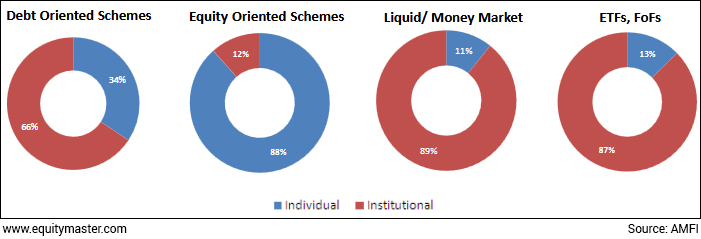
The AMFI data shows that individual investors (who are now holding around 60% of the industry's assets) are predominantly investing in equity-oriented mutual fund schemes.
On the other hand, the institutional investors (who are holding around 40% of the industry's assets) are mainly investing in debt-oriented funds, liquid/money market funds and fund of funds.
Investor Categories Across Types of Schemes
However, there is likely to be a change in the proportion of type schemes held by institutional investors going forward.
Also, their overall share and value of institutional assets held in mutual funds may go up.
Here's why...
Public Trusts Can Now Invest in Mutual Funds
The Charity Commissioner of Maharashtra in circular (no. 619, dated 21 July 2025) has now allowed Trusts to invest up to 50% of their money into mutual funds.
Which type of mutual funds can Trusts invest in?
The circular has stated the following:
- Units of debt mutual fund schemes regulated by the capital market regulator
- Units of infrastructure debt mutual funds
- Units of mutual funds, which have a minimum of 65% of their investment in shares of body corporates listed on a recognised stock exchange (i.e., equity-oriented mutual funds)
- Exchange traded funds (ETFs) and index funds that replicate the BSE Sensex or the NSE Nifty Index, or those constructed specifically for the disinvestment of shareholding of the Government of India in a body corporate.
In case of infrastructure debt mutual funds, the ratings for underlying securities of the fund shall relate to the non-banking financial company and be above investment grade. This is mainly provided to minimise the credit risk involved.
Which Other Securities Can a Public Trust Invest in?
A trust can also invest up to 50% of its money in...
- Shares of listed companies which has a market capitalisation of not less than Rs 50 billion (bn)
- Government Securities (both, centre and state and fully guaranteed by the government)
- Listed (or proposed to be listed on exchange in case of fresh issue) debt securities issued by any corporate entity, including a bank and a public financial institution, with a maturity of at least 3 years from the date of investment
- Basel III Tier-I bonds issued by a scheduled commercial bank, which are either listed or proposed to be listed on the exchange
- Infrastructure debt instruments issued by a body corporate engaged mainly in the business of development or operation and maintenance of infrastructure, or development, construction or finance of low-cost housing
In case of listed debt securities, Basel III Tier-I bonds, and infrastructure debt instruments, the circular states that the securities must be rated AA or equivalent by at least two SEBI-registered rating agencies.
If more than two ratings are available, the two lowest ratings will be considered. This is to ensure that trusts invest their money thoughtfully, recognising the risk involved.
It's important to note that until this circular, which has come into force with immediate effect, trusts could invest mainly in fixed deposits (FDs) with scheduled banks, post office savings bank or in a cooperative bank approved by the state government.
To make other types of investments, an application to the Charity Commissioner was necessary, and only general or special order, other investments were allowed.
Is Permission from the Charity Commissioner Necessary Now?
The new circular has done away with the requirement to obtain permission from the Charity Commissioner of Maharashtra, as long as the investment rules are followed.
It has removed the need for trustees to apply for permission each time, thus simplifying and improving the investment process for trusts.
The Positive Impact
The new circular is expected to benefit several registered public trusts in Maharashtra, including religious and educational. Currently, there are over 59,000 trust registration applications approved in Maharashtra, according to data from the Office of the Charity Commissioner, Maharashtra State.
If the byelaws of the trusts permit, potentially, billions of rupees may consider investing a portion of their corpus in the capital market for better returns than bank FDs. Mutual funds, in particular, may see a large flow of money from trusts.
Index funds, ETFs, some large cap funds, debt funds and liquid funds may witness significant inflows in the coming months from various trusts in Maharashtra.
This will deepen the capital market. When foreign portfolio investors (FPIs) sell, the impact on the market may be limited due to this.
At present, it is encouraging to see retail and domestic institutional investors actively participating in the Indian capital market.
It is a sign of their exuding confidence in the prospects of the Indian economy, which is perceived to be a "bright spot" amid global uncertainty.
That said, it is important for everyone to invest thoughtfully and carefully in their personal journey of wealth creation.
Happy investing.
Disclaimer: This article is for information purposes only. It is not a recommendation and should not be treated as such.

With more than two decades of experience under his belt in investments, the personal finance domain, wealth management, and as an economic commentator, Rounaq Neroy brings forth potentially the best investment ideas and perspectives for investors to make wise decisions. He has been an integral part of Quantum Information Services Pvt. Ltd. since 2009.
ABOUT EQUITYMASTER
Since 1996, Equitymaster has been the source for honest and credible opinions on investing in India. With solid research and in-depth analysis Equitymaster is dedicated towards making its readers- smarter, more confident and richer every day. Here's why hundreds of thousands of readers spread across more than 70 countries Trust Equitymaster.
PREMIUM PRODUCTS
- Hidden Treasure
- Forever Stocks
- Big Wave Profits
- Equitymaster Venture
- Microcap Millionaires
- Momentum Profits
- Double Income
- Midcap Value Alert
- Exponential Profits
- Annual Breakout Alert
- Lazy Millionaire
- Phase One Alert
- Smallcap AlphaQuest
- InsiderPro Stocks
- StockSelect
- Private Briefing
- Active Wealth Multiplier 2030
- FundSelect
- Fund Advantage
QUICK LINKS
POPULAR TOPICS
- Multibagger Penny Stocks
- Basics of Value Investing
- Benjamin Graham
- How to Invest in Gold
- How to Invest in Silver
- Best Stocks to Buy Today
- Best Small-cap Stocks to Buy
- Best Bluechip Stocks to Buy
- Guide to Penny Stocks
- How to Invest in the Share Market
- Warren Buffett - The Value Investor
- Pick the Best Multibagger Stocks
TRENDING TOPICS
- Best Defence Stocks in India
- Upcoming Dividend Stocks
- Best Semiconductor Stocks in India
- Data Center Stocks in India
- Best Railway Stocks in India
- Best Solar Stocks in India
- Fastest Growing Stocks in India
- List of BSE Sensex 30 Stocks
- Adani Group Shares
- Stocks Recently Bought by FIIs in India
- Top Value Stocks in India


LEGAL DISCLAIMER:
Investment in securities market are subject to market risks. Read all the related documents carefully before investing.
Registration granted by SEBI, enlistment with BSE as IA and RA, and certification from NISM in no way guarantee performance of the intermediary or provide any assurance of returns to investors.
All rights reserved. Any act of copying, reproducing or distributing any content from this website whether wholly or in part, for any purpose without the permission of Quantum Information Services Private Limited is strictly prohibited and shall be deemed to be copyright infringement.
Quantum Information Services Private Limited (QIS) is a SEBI registered Research Analyst (bearing registration no INH000021128) and Investment Adviser(Reg. No: INA000000680). Consequent upon the merger of Equitymaster Research Private Limited into QIS, effective October 30, 2025 QIS owns and operates brand 'Equitymaster' and website www.equitymaster.com. This does not constitute or is not intended to constitute an offer to buy or sell, or a solicitation to an offer to buy or sell financial products, units or securities and QIS including its employees, personnel, directors, associates will not be liable for any losses (direct or indirect) incurred or investment(s) made or decisions taken/or not taken based on the information provided herein. All content and information is provided on an 'As Is' basis by QIS. Information herein is believed to be reliable but QIS does not warrant its completeness or accuracy and expressly disclaims all warranties and conditions of any kind, whether express or implied. The services rendered by QIS are on a best effort basis. QIS does not assure or guarantee the user any minimum or fixed returns. The securities quoted, if any are for illustration only and are not recommendatory. Use of this information is at the user's own risk. The user must make his own investment decisions based on his specific investment objective and financial position and using such independent advisors as he believes necessary. This is not directed for access or use by anyone in a country, especially, USA, Canada or the European Union countries, where such use or access is unlawful or which may subject QIS or its affiliates to any registration or licensing requirement.
The performance data quoted represents past performance and does not guarantee future results. As a condition to accessing QIS's content and website, you agree to our Terms and Conditions of Use, available here
Equitymaster requests your view! Post a comment on "Here's How Public Trusts Will Now Be Able to Invest in Mutual Funds". Click here!
Comments are moderated by Equitymaster, in accordance with the Terms of Use, and may not appear
on this article until they have been reviewed and deemed appropriate for posting.
In the meantime, you may want to share this article with your friends!