

Will RBI Cut Rates in December 2025 and How to Approach Debt Markets Now
 Image source: Dilok Klaisataporn/www.istockphoto.com
The Reserve Bank of India (RBI), in the last two bi-monthly monetary policy meetings held in August and October 2025, kept the policy repo rate unchanged at 5.5%.
However, this status quo came after successive rate cuts since February 2025 to support growth, while CPI inflation continued to soften.
Policy Rate Actions by RBI
| Month | Repo Policy Rate | Policy Action (Basis points) |
Monetary Policy Stance |
|---|---|---|---|
| Apr-23 to Aug-24 | 6.50% | Status quo | Focus on the withdrawal of Accommodative stance |
| Oct-24 to Dec-24 | 6.50% | Status quo | Neutral |
| 25-Feb | 6.25% | -25 | Neutral |
| 25-Apr | 6.00% | -25 | Neutral |
| 25-Jun | 5.50% | -50 | Neutral |
| 25-Aug | 5.50% | Status quo | Neutral |
| 25-Oct | 5.50% | Status quo | Neutral |
Source: RBI Monetary Policy Statements
The six-member Monetary Policy Committee (MPC) of the RBI also decided to keep the stance of the monetary has been kept neutral.
However, in the last bi-monthly monetary policy meeting (held in October 2025), two members - Dr Nagesh Kumar and Prof. Ram Singh - opined to change the stance to accommodative from neutral.
The MPC observed that the current macroeconomic conditions and the outlook have opened up policy space for further supporting growth.
That said, it was also noted that the impact of the front-loaded monetary policy actions and the recent fiscal measures is still playing out.
Plus, the fact that trade-related uncertainties are also unfolding (due to the protectionist policies of Trump 2.0 and geopolitical tensions).
Hence, the MPC considered it prudent to wait for the impact of policy actions to play out and greater clarity to emerge before charting the next course of action.
Policy Rate Actions of Central Banks in AEs and EMEs
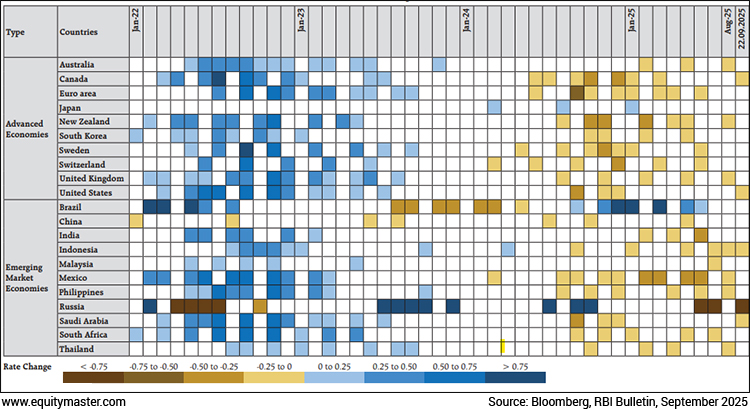
In contrast, in August-September 2025, major central banks opted to reduce their benchmark interest rates, weighing concerns of domestic growth and unemployment over inflation. The RBI preferred to remain watchful of the evolving global macroeconomic and geopolitical situation.
It also raised India's GDP growth projection to 6.8% from 6.5%. The RBI anticipates the streamlining of GST, a favourable monsoon, lower inflation, and monetary policy easing, to offset some of the adverse effects of the external headwinds.
However, it warned that prolonged geopolitical tensions and volatility in international financial markets caused by risk-off sentiments of investors, could pose downside risks to the growth outlook.
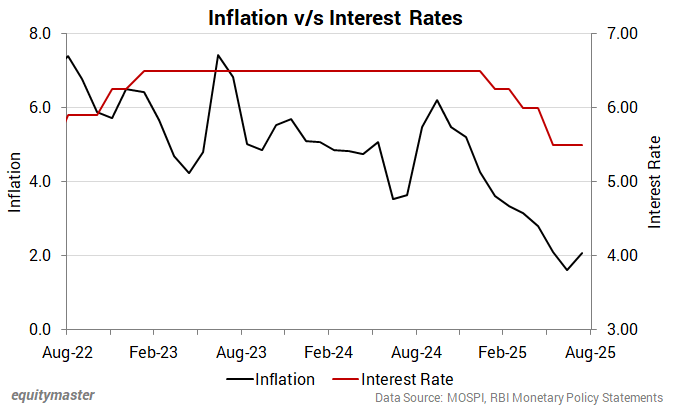
The RBI also kept its eye on headline inflation. While it remained below the RBI's medium-term target of 4% (with a tolerance band of + /- 2%), and expected it to soften more than projected in the August 2025 meeting, it cautioned that a large unfavourable base effect would exert upward pressure on headline CPI inflation, especially in Q4FY26.
Will RBI Cut Policy Rates Further?
The RBI, in its October 2025 bi-monthly policy statement, has said that the current macroeconomic conditions and the outlook have opened policy space to further support growth.
The RBI expects headline inflation and core inflation to remain low after the impact of the new GST rates.
Thus, after having taken a cautious approach against the backdrop of trade-related uncertainties, it is possible that the policy repo rate may be reduced by 25 basis points (bps) in the December 2025 bi-monthly monetary policy meeting.
If that happens, the RBI would have reduced policy rates by 125 bps cumulative in 2025.
The 10-year G-sec yield, as a result, would also soften due to the positive correlation between interest rates and yields.
That said, the demand at the state debt auction would also play a pivotal role in the direction of the benchmark yield.
Indian states are expected to borrow Rs 94.01 trillion (tn) through bond sales in the second half of the current fiscal year. In the October to December quarter, Rs 2.82 tn would be raised through state bond sale, lower than the Rs 3.25 tn anticipated.
Lower than expected supply of bonds is expected to keep yields low and augur well for bond prices. This is due to the inverse relationship between yields and bond prices.
What Should be Your Strategy to Invest in Debt Markets Now?
Overall, we seem to be near the bottom of the current interest rate cycle.
Given this, it may be time to systematically shift to long-duration debt papers (with around 30% G-secs) with a medium-term view of up to 5 years or so. It is best to invest in long-duration debt in a staggered manner.
For an investment horizon of 2 to 3 years, some of the PSU debt papers may be looked at.
If you have a shorter investment horizon, approach shorter maturity debt papers. Prefer the government and quasi-government ones. This may accrue you an interest income. Avoid chasing yields with private debt paper for higher returns, as it could inflict credit risk.
To benefit dynamically from both falling and rising interest rates, a bond laddering strategy may be followed, wherein the focus should be on owning bonds with staggered maturity dates.
Alternatively, dynamic bond funds may be considered.
If you have an investment horizon of up to or less than a year, it would be better to stick to some of the best liquid funds having no exposure to private issuers.
[Read: Top Debt Mutual Funds in India]
When approaching debt as an asset class, ideally, choose safety of principal over returns. This shall ensure capital preservation and earn a decent income.
Alternatively, bank fixed deposits may be considered if you are looking to keep the capital safe, but make sure the bank you are considering has strong financials and is among the systemically important ones or large banks.
Finally, when investing in debt (or any asset class for that matter), always assess your risk appetite and investment time horizon to make a sensible choice.
Be a thoughtful investor.
Happy investing.
Disclaimer: This article is for information purposes only. It is not a recommendation and should not be treated as such.

With more than two decades of experience under his belt in investments, the personal finance domain, wealth management, and as an economic commentator, Rounaq Neroy brings forth potentially the best investment ideas and perspectives for investors to make wise decisions. He has been an integral part of Quantum Information Services Pvt. Ltd. since 2009.
ABOUT EQUITYMASTER
Since 1996, Equitymaster has been the source for honest and credible opinions on investing in India. With solid research and in-depth analysis Equitymaster is dedicated towards making its readers- smarter, more confident and richer every day. Here's why hundreds of thousands of readers spread across more than 70 countries Trust Equitymaster.
PREMIUM PRODUCTS
- Hidden Treasure
- Forever Stocks
- Super Sector Stocks
- Equitymaster Venture
- Microcap Millionaires
- Momentum Profits
- Double Income
- Midcap Value Alert
- Exponential Profits
- Annual Breakout Alert
- Lazy Millionaire
- Phase One Alert
- Smallcap AlphaQuest
- InsiderPro Stocks
- StockSelect
- Private Briefing
- Active Wealth Multiplier 2030
- FundSelect
- Fund Advantage
QUICK LINKS
POPULAR TOPICS
- Multibagger Penny Stocks
- Basics of Value Investing
- Benjamin Graham
- How to Invest in Gold
- How to Invest in Silver
- Best Stocks to Buy Today
- Best Small-cap Stocks to Buy
- Best Bluechip Stocks to Buy
- Guide to Penny Stocks
- How to Invest in the Share Market
- Warren Buffett - The Value Investor
- Pick the Best Multibagger Stocks
TRENDING TOPICS
- Best Defence Stocks in India
- Upcoming Dividend Stocks
- Best Semiconductor Stocks in India
- Data Center Stocks in India
- Best Railway Stocks in India
- Best Solar Stocks in India
- Fastest Growing Stocks in India
- List of BSE Sensex 30 Stocks
- Adani Group Shares
- Stocks Recently Bought by FIIs in India
- Top Value Stocks in India


LEGAL DISCLAIMER:
Investment in securities market are subject to market risks. Read all the related documents carefully before investing.
Registration granted by SEBI, enlistment with BSE as IA and RA, and certification from NISM in no way guarantee performance of the intermediary or provide any assurance of returns to investors.
All rights reserved. Any act of copying, reproducing or distributing any content from this website whether wholly or in part, for any purpose without the permission of Quantum Information Services Private Limited is strictly prohibited and shall be deemed to be copyright infringement.
Quantum Information Services Private Limited (QIS) is a SEBI registered Research Analyst (bearing registration no INH000021128) and Investment Adviser(Reg. No: INA000000680). Consequent upon the merger of Equitymaster Research Private Limited into QIS, effective October 30, 2025 QIS owns and operates brand 'Equitymaster' and website www.equitymaster.com. This does not constitute or is not intended to constitute an offer to buy or sell, or a solicitation to an offer to buy or sell financial products, units or securities and QIS including its employees, personnel, directors, associates will not be liable for any losses (direct or indirect) incurred or investment(s) made or decisions taken/or not taken based on the information provided herein. All content and information is provided on an 'As Is' basis by QIS. Information herein is believed to be reliable but QIS does not warrant its completeness or accuracy and expressly disclaims all warranties and conditions of any kind, whether express or implied. The services rendered by QIS are on a best effort basis. QIS does not assure or guarantee the user any minimum or fixed returns. The securities quoted, if any are for illustration only and are not recommendatory. Use of this information is at the user's own risk. The user must make his own investment decisions based on his specific investment objective and financial position and using such independent advisors as he believes necessary. This is not directed for access or use by anyone in a country, especially, USA, Canada or the European Union countries, where such use or access is unlawful or which may subject QIS or its affiliates to any registration or licensing requirement.
The performance data quoted represents past performance and does not guarantee future results. As a condition to accessing QIS's content and website, you agree to our Terms and Conditions of Use, available here
Equitymaster requests your view! Post a comment on "Will RBI Cut Rates in December 2025 and How to Approach Debt Markets Now". Click here!
Comments are moderated by Equitymaster, in accordance with the Terms of Use, and may not appear
on this article until they have been reviewed and deemed appropriate for posting.
In the meantime, you may want to share this article with your friends!