

MEMBER'S LOGINX
| Invalid Username / Password | ||||||||
| Invalid Captcha | ||||||||
|
||||||||
| Sign Up | Forgot Password? | ||||||||

The Rally of the Past 5 Years Was Just a Preview of...
Peak India
Grab this Opportunity with Our 3 High-potential
Stock Recommendations
- Home
- Views On News
- Jan 2, 2026 - Best Performing Largecap Stocks of 2025
Best Performing Largecap Stocks of 2025
 Image source: Rasi Bhadramani/www.istockphoto.com
The year 2025 was a tough year for equity investors.
High valuations, an earnings downgrade, an economic slowdown, low earnings growth, and consistent selling by foreign investors led the market to consolidate in a range in the latter half of the year.
Foreign investors have sold shares worth over Rs 3 trillion (tn) as they reallocated funds to regions with exposure to Artificial Intelligence.
At the same time, mutual funds, insurance companies, banks, and other domestic institutions purchased shares worth more than Rs 7.8 tn, exceeding last year's high of Rs 5.3 tn.
Most of the selling pressure was concentrated in small-cap stocks, with the Nifty Smallcap 100 index delivering a return of -5.7%. The Nifty Midcap 100 also declined, returning -5.98%.
However, large-cap stocks outperformed, with the Nifty 50 delivering a 10.6% return.
So, which large-cap stocks performed best in 2025?
Let's take a look...
#1 Hindustan Copper
First on the list is Hindustan Copper, which delivered a 115% return as Copper prices surged.
Hindustan Copper stands out as India's only fully integrated copper producer. HCL engages in all stages of copper production, from mining to the final conversion into marketable products.
The company holds nearly two-fifths of the nation's copper ore reserves, with over 755 MT of resources. It has a current mine annual capacity of 4.33 MT.
To address the domestic supply shortfall, it's aggressively expanding the mine and plans to increase its annual capacity from 4.3 MT to 12 MT by 2030-31. The company anticipates producing 80,000-90,000 tons of metal-in-concentrate.

In the near term, a capacity of 0.25 MT is expected to be completed by December 2025. Another capacity of 3 MT is scheduled to commence mining operations by Q4 FY27.
The company is also expanding capacity at the Malanjkhand copper project, the Khetri copper complex, and the Indian Copper Complex (ICC).
The expansion at Khetri Copper Complex aims to increase annual ore capacity from 1 MT to 3 MT. The expansion at Malanjkhand will increase annual capacity from 2.5 MT to 5 MT. The annual mining capacity of the Jharkhand-based ICC is expected to increase from 0.4 MT to 0.9 MT.
The company plans to invest Rs 20 billion (bn) over the next 5-6 years, with an annual allocation of Rs 4.5-5 bn for mine expansion. The majority of this will go towards Malanjkhand (around Rs 9 bn), followed by Khetri and ICC (around Rs 2 bn each).
It's also acquiring new copper deposits in India and exploiting new blocks in Chhattisgarh, Rajasthan, and Jharkhand. The company is also participating in mineral auctions abroad to diversify its geographical base.
Through its joint venture KABIL (Khanij Bidesh India Limited), the company is engaged in non-invasive exploration across five lithium blocks in Argentina to secure strategic minerals.
It has signed agreements to sell its primary product, copper concentrate, to Kutch Copper and Hindalco.
From a financial perspective, revenue rose by 39% year-on-year (YoY) to Rs 7.2 bn in Q2 FY26.
Profit after tax (PAT) grew by 82.3% to Rs 1.8 bn, aided by higher revenue and improved margins. EBITDA surged 86.3% to Rs 2.8 bn, while margins expanded 1000 basis points to 39.3%.
Check out Hindustan Copper's financial factsheet and quarterly results to know more.
#2 AU Small Finance Bank
Second on the list is AU Small Finance Bank, delivering a 78% return.
AU is the first small finance bank to receive in-principal approval to transition into a universal bank. This transition has an 18-month timeline. The bank manages a total asset base of Rs 1.6 tn.
The bank is geographically spread across the South (777 touchpoints), North (682), West (502), Central (394), and East (271). It has 661 branches, 1,144 asset centres across 485 districts.
As of 30 September 2025, the bank manages deposits of Rs 1.3 tn for 12 m customers. Deposit rose by 21% YoY, outpacing banking sector deposit growth of 9.5%. Term deposits accounted for 66.6% of the deposits, followed by savings accounts (23.7%) and current accounts. Low-cost CASA ratio stood at 29.4%.
Gross loan portfolio surged 17% YoY to Rs 1.2 tn but yields on gross advances fell by 50 bps YoY to 13.9% due to the repricing of the 29% variable-rate book and changes in the asset mix.
However, asset quality deteriorated slightly. Gross NPAs increased to 2.4%, while net NPAs rose to 0.9%. This was primarily due to stress in the microfinance portfolio.
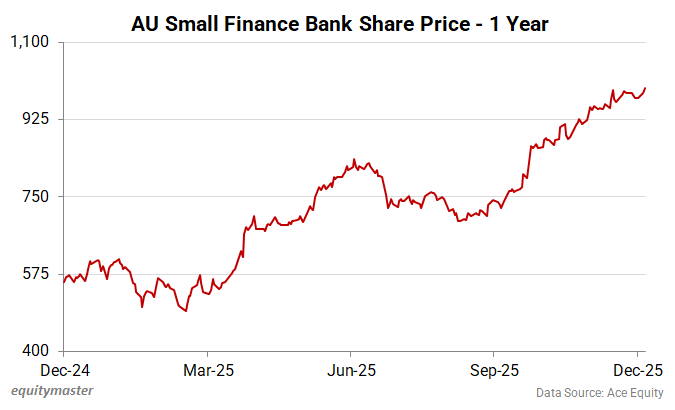
Despite that credit cost (net) declined 10% to Rs 4.8 bn, as fresh slippages fell by 12%. The bank described Q2 as the lowest point in the current credit cycle.
Net interest income (NII) surged 9% YoY to Rs 21.4 bn, driven by growth in advances. However, PAT declined 2% to Rs 5.6 bn, dragged down by 29% growth in provisions and 17% in employee costs.
Looking ahead, the bank maintains its target for full-year loan growth at 2-2.5 times nominal GDP.
Growth is expected to be led by core secured segments, with an endeavor to improve earnings as margins expand and credit costs decline. The bank's unsecured book, accounting for about 8% of the loan portfolio, has driven recent credit costs.
The management noted that credit costs have peaked, and the book is expected to reflect normalised costs by the end of FY26. However, NIM is expected to continue expanding over the next few quarters.
This will be driven by the continued repricing of the deposit book following recent interest rate cuts and the stabilisation of unsecured segments, which will reduce interest income reversals.
Having received in-principle approval in August 2025, the bank has an 18-month timeline to transition to a Universal Bank. The banking license is expected to enhance brand trust, facilitate lower-cost fund acquisition, and provide a level playing field for competing for prime customer segments.
Check out AU Small Finance Bank 5-Year financial factsheet and quarterly results to know more.
#3 Authum Investment & Infrastructure
Third on the list is Authum Investment & Infrastructure, which delivered a 76% return. Authum is a Systemically Important Non-Banking Financial Company (NBFC) registered with the RBI. It offers financial services, including equity investments and structured credit solutions.
Authum operates through two primary, complementary, business verticals designed to balance market-driven returns with predictable cash flows.
The investments business vertical focuses on long-term equity investments in both listed and unlisted companies. It invests in large-cap and mid-cap segments, targeting market leaders with stable revenue streams and robust governance.
As of 31 March 2025, listed equities represented about 90% of the company's total investment value.
The company holds significant stakes in listed entities, including Prataap Snacks (42.33%) and Nitco (49.3%), and focuses on operational turnarounds to drive outsized returns.
The credit and alternative assets business provides structured credit, special-situation funding, and distressed-asset resolution.
Revenue declined 45.5% YoY to Rs 5.9 bn in Q2 FY26, due to a fall in investment income and a drop in recoveries. However, PAT fell just 9.4% to Rs 7.7 bn, as operating margin expanded to 97%.
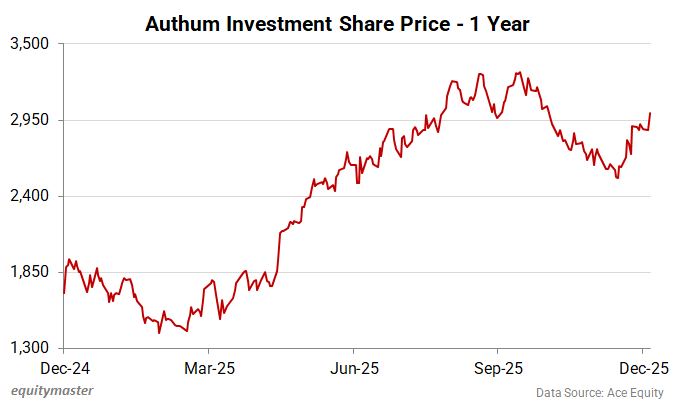
Looking ahead, Autumn aims to advance the platformisation of its credit business, positioning it as a comprehensive and integrated lending platform.
To this end, in June 2025, Authum completed the acquisition of an 88.37% stake in Asset Reconstruction (India SME ARC) for about Rs 3.1 bn. This subsidiary allows Authum to acquire non-performing assets from banks and resolve them using in-house turnaround expertise.
As of 30 September 2025, ISARC had Rs 2.4 bn in free cash reserves targeted for deployment in FY26.
The company is evaluating the feasibility of asset management to launch credit-focused alternative investment funds targeting private credit and special situations.
Authum aims to expand its third-party servicing business, with AUM of Rs 19 bn, to generate consistent fee-based income. It provides collection services for other financial institutions.
Check out Authum's financial factsheet and quarterly results to know more.
#4 Multi-Commodity Exchange of India
Fourth on the list is Multi-Commodity Exchange of India (MCX), which delivered a 75% return.
MCX is India's leading commodity derivatives exchange. It is the world's largest commodity exchange and the sixth largest in terms of the number of contracts traded.
The company offers futures and options across bullion, energy, base metals, and a limited set of agricultural contracts. MCX is the market leader, accounting for 98.1% of total traded value in commodity futures and 97.4% in commodity options.
In Q2 FY26, consolidated revenue rose 31% YoY to Rs 3.7 bn, supported by higher Average Daily Turnover (ADT) and an improving product mix.
Options revenue stood at Rs 2.2 bn, or nearly 60% of total revenue, reflecting their growing dominance in the trading mix. Futures revenue stood at Rs 1.1 bn.
F&O ADT surged by 86% to Rs 4.1 tn as options ADT rose by 91% to 3.7 tn. This was higher than the 55% ADT growth in the growth futures segment. This growth in the options market was driven by bullion, whose ADT increased by about 700% to Rs 2 tn.
The ADT growth was driven by 6.4 lakh unique clients trading options, up from 5.4 lakh in Q2 FY25. Rapid scaling of options, particularly in bullion, boosted premium generation without a proportional increase in costs, leading to operating leverage. Net profit rose 29% to about Rs 2 bn.
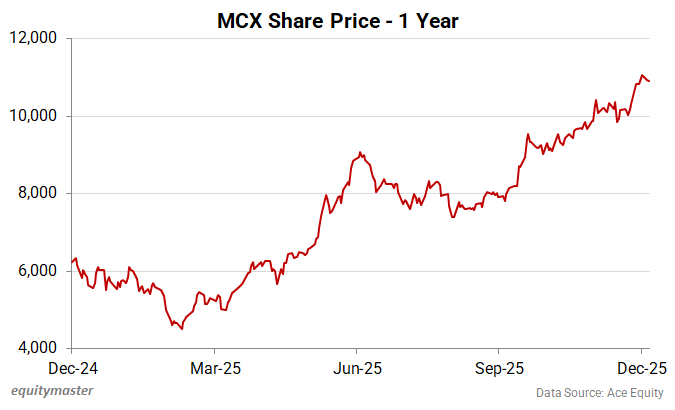
Looking ahead, the management sees an untapped commodity market that MCX plans to capitalise on. To this end, MCX is increasing its distribution network, having already added 17 new members. It maintains a healthy pipeline of brokers transitioning from equity segments.
Rising institutional participation, driven by mutual funds launching multi-asset schemes that include commodities, and increased engagement with portfolio management services, will also benefit MCX. It's also evolving its product suite to meet the scale and volatility requirements of the Indian market.
The recently launched BULLDEX options are expected to grow organically and find a unique niche alongside existing bullion contracts.
New products for electricity derivatives and "sensitive commodities" are being monitored, and weekly options remain "on the radar" for future implementation. It also plans to revive the base metals segment by consolidating delivery centers in phases.
Check out MCX's financial factsheet and quarterly results to know more.
#5 Canara Bank
Fifth on the list is Canara Bank, delivering a 54% return.
Canara Bank is a public sector bank with a vast physical presence, boasting 9,948 domestic branches. Its reach is well distributed across rural (32%), semi-urban (30%), and urban and metro (19% each).
The bank's global deposits rose 13.4% YoY to Rs 15.3 tn in Q2 FY26, while domestic deposits was Rs 13.9 tn. The CASA ratio was 30.7%. CASA increased 10.5%, due to new targeted products and digital initiatives.
On the advanced front, global gross advances surged 13.7% to Rs 11.5 tn, while domestic advances was Rs 10.8 tn up 13.3% YoY. The bank's total income increased 11.2% YoY to Rs 386 bn in Q2 FY26, driven by both interest and non-interest streams. Net profit surged 18.9% to Rs 47.7 bn.
Due to recoveries from written-off accounts and treasury income, net income increased 41.6% to Rs 70.5 bn but NII declined 1.9% YoY to Rs 91.4 bn, with margins at 2.5%, down from 2.9% last year. Margins fell slightly due to the immediate repricing of loans linked to the repo rate.
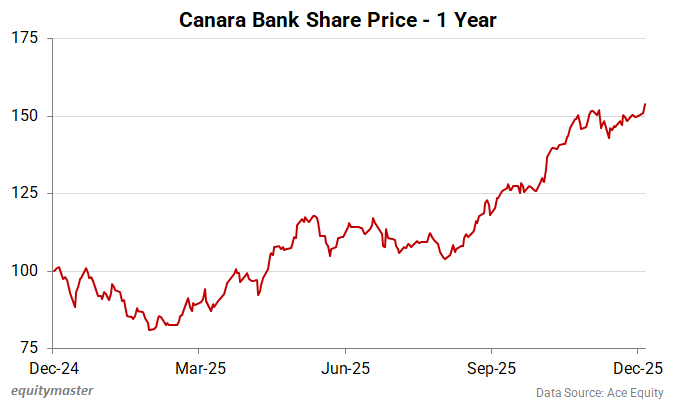
Asset quality also remained strong. Gross NPAs decreased 138 bps to 2.3%, while net NPAs fell to 0.5%. Along with the improvement in asset quality, credit costs also improved.
Looking ahead, the bank targets global business growth of 10.5% and global advances' growth of 10-11%. Current performance (13.7% advance growth) is already exceeding FY26 targets.
The target for global deposit growth is 9-10%, with a domestic CASA ratio target of 32%. The bank expects full-year net profits to cross Rs 200 bn.
An uptick in NIM is expected from the Q4FY26 onwards as deposit costs rationalise. The bank aims to regain NIM levels of 2.9-3%, provided no further rate cuts occur.
The bank targets gross NPA below 2.5% and net NPA below 0.6% by March 2026. Current levels (2.35% GNPA and 0.54% NNPA) are already within these numbers.
Check out Canara Bank's financial factsheet and quarterly results to know more.
Conclusion
Despite a challenging market environment in 2025, large-cap stocks proved resilient.
Strong balance sheets, sectoral tailwinds, improving earnings visibility, and domestic institutional support helped largecaps deliver outsized returns. These performers highlight how scale, execution, and positioning mattered far more than broad market sentiment.
However, instead of relying on hype, investors need to carefully analyse the company's fundamentals, including financial performance, corporate governance practices, and growth strategies.
Happy investing.
Disclaimer: This article is for information purposes only. It is not a stock recommendation and should not be treated as such. Learn more about our recommendation services here...
ABOUT EQUITYMASTER
Since 1996, Equitymaster has been the source for honest and credible opinions on investing in India. With solid research and in-depth analysis Equitymaster is dedicated towards making its readers- smarter, more confident and richer every day. Here's why hundreds of thousands of readers spread across more than 70 countries Trust Equitymaster.
PREMIUM PRODUCTS
QUICK LINKS
POPULAR TOPICS
- Multibagger Penny Stocks
- Basics of Value Investing
- Benjamin Graham
- How to Invest in Gold
- How to Invest in Silver
- Best Stocks to Buy Today
- Best Small-cap Stocks to Buy
- Best Bluechip Stocks to Buy
- Guide to Penny Stocks
- How to Invest in the Share Market
- Warren Buffett - The Value Investor
- Pick the Best Multibagger Stocks
TRENDING TOPICS
- Best Defence Stocks in India
- Upcoming Dividend Stocks
- Best Semiconductor Stocks in India
- Data Center Stocks in India
- Best Railway Stocks in India
- Best Solar Stocks in India
- Fastest Growing Stocks in India
- List of BSE Sensex 30 Stocks
- Adani Group Shares
- Stocks Recently Bought by FIIs in India
- Top Value Stocks in India


LEGAL DISCLAIMER:
Investment in securities market including mutual fund investments are subject to market risks. Read all the related documents carefully before investing.
Registration granted by SEBI, enlistment with BSE as IA and RA, and certification from NISM in no way guarantee performance of the intermediary or provide any assurance of returns to investors.
All rights reserved. Any act of copying, reproducing or distributing any content from this website whether wholly or in part, for any purpose without the permission of Quantum Information Services Private Limited is strictly prohibited and shall be deemed to be copyright infringement.
Quantum Information Services Private Limited (QIS) is a SEBI registered Research Analyst (bearing registration no INH000021128) and Investment Adviser(Reg. No: INA000000680). Consequent upon the merger of Equitymaster Research Private Limited into QIS, effective October 30, 2025 QIS owns and operates brand 'Equitymaster' and website www.equitymaster.com. This does not constitute or is not intended to constitute an offer to buy or sell, or a solicitation to an offer to buy or sell financial products, units or securities and QIS including its employees, personnel, directors, associates will not be liable for any losses (direct or indirect) incurred or investment(s) made or decisions taken/or not taken based on the information provided herein. All content and information is provided on an 'As Is' basis by QIS. Information herein is believed to be reliable but QIS does not warrant its completeness or accuracy and expressly disclaims all warranties and conditions of any kind, whether express or implied. The services rendered by QIS are on a best effort basis. QIS does not assure or guarantee the user any minimum or fixed returns. The securities quoted, if any are for illustration only and are not recommendatory. Use of this information is at the user's own risk. The user must make his own investment decisions based on his specific investment objective and financial position and using such independent advisors as he believes necessary. This is not directed for access or use by anyone in a country, especially, USA, Canada or the European Union countries, where such use or access is unlawful or which may subject QIS or its affiliates to any registration or licensing requirement.
The performance data quoted represents past performance and does not guarantee future results. As a condition to accessing QIS's content and website, you agree to our Terms and Conditions of Use, available here
Equitymaster requests your view! Post a comment on "Best Performing Largecap Stocks of 2025". Click here!
Comments are moderated by Equitymaster, in accordance with the Terms of Use, and may not appear
on this article until they have been reviewed and deemed appropriate for posting.
In the meantime, you may want to share this article with your friends!