

MEMBER'S LOGINX
| Invalid Username / Password | ||||||||
| Invalid Captcha | ||||||||
|
||||||||
| Sign Up | Forgot Password? | ||||||||
- Home
- Outlook Arena
- Aug 2, 2003 - Identifying a banking stock: Do's and Don'ts
Identifying a banking stock: Do's and Don'ts
In continuation to enlighten investor's on how to analyse a sector and identify stocks, here is our analysis on the banking sector this time. To start of with, unlike any other manufacturing or service company, a bank's accounts are presented in a different manner (as per banking regulations). The analysis of a bank account differs significantly from any other company. The key operating and financial ratios, which one would normally evaluate before investing in company, may not hold true for a bank (like say operating margins).
However, before we go into analyzing ratios, we take a look at the way a bank functions. The primary business of a bank is to accept deposits and give out loans. So in case of a bank, capital (read money) is a raw material as well as the final product. Bank accepts deposits and pays the depositor an interest on those deposits. The bank then uses these deposits to give out loans for which it charges interest from the borrower.
Of the cash reserve, a bank is mandated to maintain a certain percentage of deposits with the Reserve Bank of India (RBI) as CRR (cash reserve ratio), on which it earns lower interest. Whenever there is a reduction in CRR announced in the monetary policy, the amount available with a bank, to advance as loans, increases. The second part of regulatory requirement is to invest in G-Secs that is a part of its statutory liquidity ratio (SLR). The bank's revenues are basically derived from the interest it earns from the loans it gives out as well as from the fixed income investments it makes. If credit demand is lower, the bank increases the quantum of investments in G-Sec.
Apart from this, a bank also derives revenues in the form of fees that it charges for the various services it provides (like processing fees for loans and forex transations). In developed economies, banks derive nearly 50% of revenues from this stream. This stream of revenues contributes a relatively lower 15% in the Indian context.
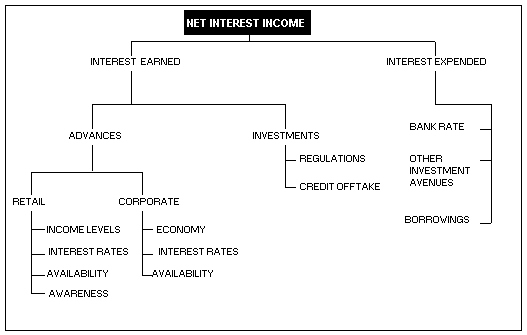
Having looked at the profile of the sector in brief, let us consider some key factors that influence a bank's operations. One of the key parameters used to analyse a bank is the Net Interest Income (NII). NII is essentially the difference between the bank's interest revenues and its interest expenses. This parameter indicates how effectively the bank conducts its lending and borrowing operations (in short, how to generate more from advances and spend less on deposits).
Interest revenues:
Interest revenues = Interest earned on loans + Interest earned on investments + Interest on deposits with RBI.
Interest on loans:
Since banking operations basically deal with 'interest', interest rates (read bank rate) prevailing in the economy have a big role to play. So, in a high interest rate scenario, while banks earn more on loans, it must be noted that it has to pay higher on deposits also. But if interest rates are high, both corporates and retail classes will hesitate to borrow. But when interest rates are low, banks find it difficult to generate revenues from advances. While deposit rates also fall, it has been observed that there is a squeeze on a bank when bank rate is soft. A bank cannot reduce interest rates on deposits significantly, so as to maintain its customer base, because there are other avenues of investments available to them (like mutual funds, equities, public savings scheme).
Since a bank lends to both retail as well as corporate clients, interest revenues on advances also depend upon factors that influence demand for money. Firstly, the business is heavily dependent on the economy. Obviously, government policies (say reforms) cannot be ignored when it comes to economic growth. In times of economic slowdown, corporates tighten their purse strings and curtail spending (especially for new capacities). This means that they will borrow lesser. Companies also become more efficient and so they tend to borrow lesser even for their day-to-day operations (working capital needs). In periods of good economic growth, credit offtake picks up as corporates invest in anticipation of higher demand going forward.
Similarly, growth drivers for the retail segment are more or less similar to the corporate borrowers. However, the elasticity to a fall in interest rate is higher in the retail market as compared to corporates. Income levels and cost of financing also play a vital role. Availability of credit and increased awareness are other key growth stimulants, as demand will not be met if the distribution channel is inadequate.
Interest on Investments and deposits with the RBI
The bank's interest income from investments depends upon some key factors like government policies (CRR and SLR limits) and credit demand. If a bank had invested in G-Secs in a high interest rate scenario, the book value of the investment would have appreciated significantly when interest rates fall from those high levels or vice versa.
Interest expenses
A bank's main expense is in the form of interest outgo on deposits and borrowings. This in turn is dependent on the factors that drive cost of deposits. If a bank has high savings and current deposits, cost of deposits will be lower. The propensity of the public to save also plays a crucial role in this process. If the spending power for the populace increases, the need to save reduces and this in turn reduces the quantum of savings.
Key parameters to keep in mind while analysing a banking stock:
Please click on the link to read our detailed report on parameters for a banking stock
However, we would like to touch upon one key aspect. Why price to book value is important while analysing a banking stock rather than P/E? As we had mentioned earlier, cash is the raw material for a bank. The ability to grow in the long-term therefore, depends upon the capital with a bank (i.e. capital adequacy ratio). Capital comes primarily from net worth. This is the reason why price to book value is important. But deduct the net non-performing asset from net worth to get a true feel of the available capital for growth.
The banking sector plays a very vital role in the working of the economy and it is very important that banks fulfill their roles with utmost integrity. Since banks deal with cash, there have been cases of mismanagement and greed in the global markets. And hence, in the final analysis, investors need to check up on the quality of management. This is the last factor but not the least to be brushed aside.
Equitymaster requests your view! Post a comment on "Identifying a banking stock: Do's and Don'ts". Click here!
1 Responses to "Identifying a banking stock: Do's and Don'ts"
ABOUT EQUITYMASTER
Since 1996, Equitymaster has been the source for honest and credible opinions on investing in India. With solid research and in-depth analysis Equitymaster is dedicated towards making its readers- smarter, more confident and richer every day. Here's why hundreds of thousands of readers spread across more than 70 countries Trust Equitymaster.
PREMIUM PRODUCTS
QUICK LINKS
POPULAR TOPICS
- Multibagger Penny Stocks
- Basics of Value Investing
- Benjamin Graham
- How to Invest in Gold
- How to Invest in Silver
- Best Stocks to Buy Today
- Best Small-cap Stocks to Buy
- Best Bluechip Stocks to Buy
- Guide to Penny Stocks
- How to Invest in the Share Market
- Warren Buffett - The Value Investor
- Pick the Best Multibagger Stocks
TRENDING TOPICS


Copyright © Equitymaster Agora Research Private Limited.
Whitelist | Refer | Terms | Privacy | Contact | About | Sitemap

Equitymaster Agora Research Private Limited (Research Analyst)
SEBI (Research Analysts) Regulations 2014, Registration No. INH000000537.
103, Regent Chambers, Above Status Restaurant, Nariman Point, Mumbai - 400 021. India.
Telephone: +91-22-61434055. Email: info@equitymaster.com. Website: www.equitymaster.com.
CIN:U74999MH2007PTC175407
Name of the Compliance & Grievance Officer: Ms Sonal Ramachandran
Telephone: +91-22-61434003 | Email: compliance@equitymaster.com
LEGAL DISCLAIMER:
Investment in securities market are subject to market risks. Read all the related documents carefully before investing.
Registration granted by SEBI and certification from NISM in no way guarantee performance of the intermediary or provide any assurance of returns to investors.
All rights reserved. Any act of copying, reproducing or distributing this newsletter whether wholly or in part, for any purpose without the permission of Equitymaster is strictly prohibited and shall be deemed to be copyright infringement.
Equitymaster Agora Research Private Limited (Research Analyst) bearing Registration No. INH000000537 (hereinafter referred as 'Equitymaster') is an independent equity research Company. Equitymaster is not an Investment Adviser. Information herein should be regarded as a resource only and should be used at one's own risk. This is not an offer to sell or solicitation to buy any securities and Equitymaster will not be liable for any losses incurred or investment(s) made or decisions taken/or not taken based on the information provided herein. Information contained herein does not constitute investment advice or a personal recommendation or take into account the particular investment objectives, financial situations, or needs of individual subscribers. Before acting on any recommendation, subscribers should consider whether it is suitable for their particular circumstances and, if necessary, seek an independent professional advice. This is not directed for access or use by anyone in a country, especially, USA, Canada or the European Union countries, where such use or access is unlawful or which may subject Equitymaster or its affiliates to any registration or licensing requirement. All content and information is provided on an 'As Is' basis by Equitymaster. Information herein is believed to be reliable but Equitymaster does not warrant its completeness or accuracy and expressly disclaims all warranties and conditions of any kind, whether express or implied. Equitymaster may hold shares in the company/ies discussed herein. As a condition to accessing Equitymaster content and website, you agree to our Terms and Conditions of Use, available here. The performance data quoted represents past performance and does not guarantee future results.
Rajiv Ranjan
Oct 10, 2020I like banking stock like Kotak Mahindra Bank, HDFC Bank. These banks have shown consistent performance over long periods of time. They have processes in place so expected to do well in future also.
Thanks