

Investment in securities market are subject to market risks. Read all the related documents carefully before investing
India's Bull Market
Has The Pause Finally Ended?
Global developments could be setting the stage for a new rally
**Important: We hate spam as much as you do. Check out our Privacy Policy and Terms Of Use.
The One Chart that Opens the Door to Exponential Returns
Michael Moritz is the billionaire head of the VC firm Sequoia Capital.
He was once asked why Sequoia was so successful. Moritz mentioned longevity. He said some VC firms succeed for five or ten years, but Sequoia has prospered for four decades.
On being asked the secret sauce, Moritz replied, "I think we have always been afraid of going out of business".
Only the paranoid survive.
There are 2 ways of surviving in the financial world.
The first is the one that most of investors who swear by investing legends like Warren Buffett and Charlie Munger follow.
Compounding: The eighth wonder of the world
It's a tried and tested investing strategy. But only if you give it years to work its magic.
It's like planting a Chinese bamboo tree. The first couple of years will never show much progress on the outside. But 5 years later, the progress will create something remarkable.
As Buffett puts it, 'Time is the friend of a wonderful company and an enemy of a bad one'.
Buffett didn't panic and sell during 14 recessions he has endured in his investing carrier. I'm sure all of us are aware of the wonders of compounding and have been practising it in some or the other asset class.
But today I'm writing about the other way of investing which appeals only to a limited audience. But if done right, this strategy can make you a fortune.
On a lighter note, whenever I think of VC investing, the speed and magnitude of returns come to mind. I'm always reminded of a line from one of my favourite Hindi movie Hera Pheri 2.
"21 days mein paise double".
Just look at all the tech IPOs which listed in the last 1 year. The maximum returns were made by VCs and private equity players.
The poor retail investor was left holding overpriced, overhyped stocks in their portfolios.
Venture capital funds have a peculiar way of operating. Actually, it's not peculiar. It just looks peculiar to stock market investors because our focus is on minimising risk.
But VCs work on the premise of 'more is better'.
The more darts you throw at the board, the higher the statistical probability that you will hit the bulls-eye. Thus, more is better.
The common rule of thumb is that of 10 start-ups, three or four fail completely. Another three or four return the original investment. Only one or two will produce substantial returns.
For a VC fund to beat public equity markets, the one or two successful companies, give them a 50x returns over a 5-7 year period.
Only way to get a 50-100x return in such a short span of time is to invest during the growth phase of the company.
Here are some examples...
- Tiger Global made a 340 times return on its investment in Freshworks.
- Info Edge clocked 1,000 times return on Zomato when it went public.
- Despite Paytm's disastrous listing, Chinese investors Ant Financial and Alibaba made over US$1 bn.
That precisely is the inherit advantage which venture capitalists have. This road is fraught with risks. But investing in an early-stage start-up can prove to be the jewel in your portfolio.
Look at this chart...
A Picture Speaks a Thousand Words
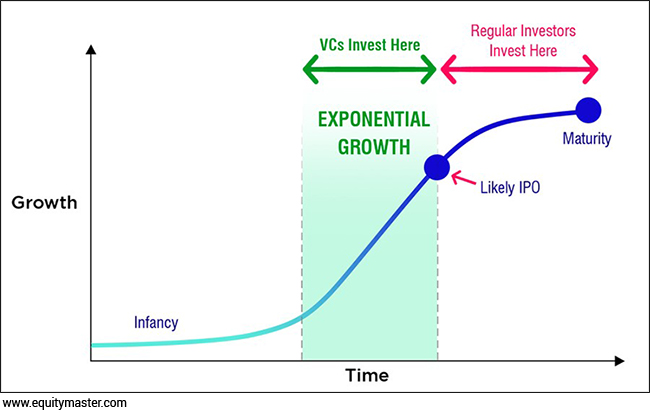
The explosive growth of a young company is often captured by VCs. The growth leads to re-rating in the valuation of the company every time it raises funds.
Have you ever seen a VC fund raiser for a fast growing start-up happen at lower valuation?
I haven't.
When a when a company is growing and its losses are rising, the focus of investors and promoters is to grow revenues as fast as possible. This way the losses can be overlooked in the short term.
This is exactly how VCs make their exponential returns.
Unfortunately, when the stock lists, the explosive growth period of the company is behind it. It will likely grow at or marginally above its industry's growth rate.
In that case how can investors make exponential gains like VCs?
The full market size of these industries hasn't been discovered yet. And this is where the opportunity is. It's like finding sun rise sectors and strong companies in them before the market.
That is the space from where your next 50-100 bagger will come from.
Warm regards,
Aditya Vora
Research Analyst, Hidden Treasure

Aditya Vora (Research Analyst) Hidden Treasure has 7 years of experience in the markets as an equity research analyst. He is a Chartered Accountant by qualification and worked with some of the big names on Dalal Street like Motilal Oswal, CRISIL, and IDFC securities. He follows a rigorous process of financially screening stocks. At the same time, Aditya believes an investor's edge lies in capturing qualitative factors. His forte is bottom up stock picking. However, he is also a firm believer in the importance of market cycles. Especially identifying emerging themes at an early stage.
ABOUT EQUITYMASTER
Since 1996, Equitymaster has been the source for honest and credible opinions on investing in India. With solid research and in-depth analysis Equitymaster is dedicated towards making its readers- smarter, more confident and richer every day. Here's why hundreds of thousands of readers spread across more than 70 countries Trust Equitymaster.
PREMIUM PRODUCTS
- Hidden Treasure
- Forever Stocks
- Big Wave Profits
- Equitymaster Venture
- Microcap Millionaires
- Momentum Profits
- Double Income
- Midcap Value Alert
- Exponential Profits
- Annual Breakout Alert
- Lazy Millionaire
- Phase One Alert
- Smallcap AlphaQuest
- InsiderPro Stocks
- StockSelect
- Private Briefing
- Active Wealth Multiplier 2030
- FundSelect
- Fund Advantage
QUICK LINKS
POPULAR TOPICS
- Multibagger Penny Stocks
- Basics of Value Investing
- Benjamin Graham
- How to Invest in Gold
- How to Invest in Silver
- Best Stocks to Buy Today
- Best Small-cap Stocks to Buy
- Best Bluechip Stocks to Buy
- Guide to Penny Stocks
- How to Invest in the Share Market
- Warren Buffett - The Value Investor
- Pick the Best Multibagger Stocks
TRENDING TOPICS
- Best Defence Stocks in India
- Upcoming Dividend Stocks
- Best Semiconductor Stocks in India
- Data Center Stocks in India
- Best Railway Stocks in India
- Best Solar Stocks in India
- Fastest Growing Stocks in India
- List of BSE Sensex 30 Stocks
- Adani Group Shares
- Stocks Recently Bought by FIIs in India
- Top Value Stocks in India


LEGAL DISCLAIMER:
Investment in securities market are subject to market risks. Read all the related documents carefully before investing.
Registration granted by SEBI, enlistment with BSE as IA and RA, and certification from NISM in no way guarantee performance of the intermediary or provide any assurance of returns to investors.
All rights reserved. Any act of copying, reproducing or distributing any content from this website whether wholly or in part, for any purpose without the permission of Quantum Information Services Private Limited is strictly prohibited and shall be deemed to be copyright infringement.
Quantum Information Services Private Limited (QIS) is a SEBI registered Research Analyst (bearing registration no INH000021128) and Investment Adviser(Reg. No: INA000000680). Consequent upon the merger of Equitymaster Research Private Limited into QIS, effective October 30, 2025 QIS owns and operates brand 'Equitymaster' and website www.equitymaster.com. This does not constitute or is not intended to constitute an offer to buy or sell, or a solicitation to an offer to buy or sell financial products, units or securities and QIS including its employees, personnel, directors, associates will not be liable for any losses (direct or indirect) incurred or investment(s) made or decisions taken/or not taken based on the information provided herein. All content and information is provided on an 'As Is' basis by QIS. Information herein is believed to be reliable but QIS does not warrant its completeness or accuracy and expressly disclaims all warranties and conditions of any kind, whether express or implied. The services rendered by QIS are on a best effort basis. QIS does not assure or guarantee the user any minimum or fixed returns. The securities quoted, if any are for illustration only and are not recommendatory. Use of this information is at the user's own risk. The user must make his own investment decisions based on his specific investment objective and financial position and using such independent advisors as he believes necessary. This is not directed for access or use by anyone in a country, especially, USA, Canada or the European Union countries, where such use or access is unlawful or which may subject QIS or its affiliates to any registration or licensing requirement.
The performance data quoted represents past performance and does not guarantee future results. As a condition to accessing QIS's content and website, you agree to our Terms and Conditions of Use, available here
Equitymaster requests your view! Post a comment on "The One Chart that Opens the Door to Exponential Returns". Click here!
Comments are moderated by Equitymaster, in accordance with the Terms of Use, and may not appear
on this article until they have been reviewed and deemed appropriate for posting.
In the meantime, you may want to share this article with your friends!