

MEMBER'S LOGINX
| Invalid Username / Password | ||||||||
| Invalid Captcha | ||||||||
|
||||||||
| Sign Up | Forgot Password? | ||||||||
Investment in securities market are subject to market risks. Read all the related documents carefully before investing
LIVE NOW
The Small Cap Proxy Players Briefing
- Home
- Views On News
- Jan 30, 2025 - Why Tata Motors Share Price is Falling
Why Tata Motors Share Price is Falling
 Image source: wassam siddique/www.istockphoto.com
Editor's Note: Tata group's flagship automobile firm Tata Motors is having a tough time on Dalal Street these days.
On 30 January 2025, the company's stock price declined up to 9% in a single trading session following release of the company's quarterly earnings.
From Rs 180 in January 2020, Tata Motors share price faced setbacks due to weak demand and challenges at JLR, plunging to Rs 65 in March 2020 amid the pandemic.
However, by late 2021, the stock rebounded to Rs 500, driven by JLR's recovery, strong domestic demand and excitement around EVs.
In 2025, it reached Rs 764.95, delivering a 325% return over five years, a 32% CAGR.
Since then, the stock price has come down, trading at Rs 700 at present.
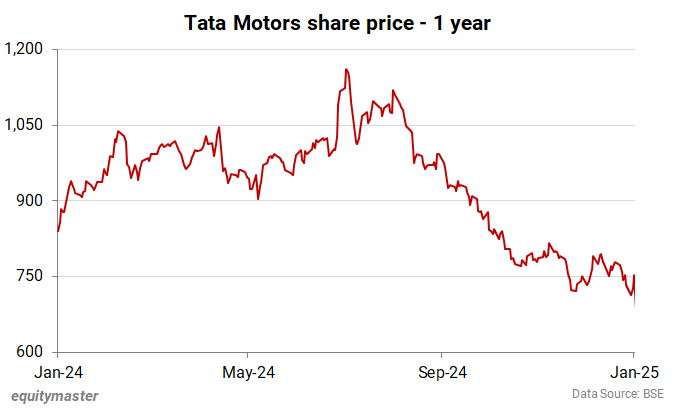
While the current decline in its stock price is attributed to dampened quarterly earnings, the stock price has remained under pressure since early January 2025.
Continue reading...
Why Tata Motors Share Price is Falling
The automobile sector in India plays a crucial role in the country's economy. It contributes significantly to manufacturing output and employment. Over the years, the sector has seen steady growth, supported by rising demand and technological advancements.
However, challenges like fluctuating raw material costs and economic cycles affect the industry periodically. Amid these dynamics, leading companies drive innovation and market trends.
Tata Motors is one of the key names in India's automobile sector. It is part of the renowned Tata Group and operates globally. The company manufactures a wide range of vehicles, including passenger cars, commercial vehicles, and electric vehicles.
Tata Motors has earned a reputation for its innovation and robust product portfolio. Its subsidiary, Jaguar Land Rover (JLR), also contributes significantly to its global presence.
In the last month, Tata Motors share price has remained under pressure. This decline has put investors under pressure too, raising concerns about the company's performance and future outlook.
Let's examine the key factors driving down Tata Motors share price.
Profit Falls
For the quarter ended December 2024, Tata Motors reported a 22% year-on-year (YoY) decline in its consolidated net profit at Rs 54.5 billion (bn), missing street estimates. The automaker's performance was weighed down by weaker margins and subdued Jaguar Land Rover (JLR) volumes, despite a sequential improvement.
Jaguar Land Rover (JLR) faced weak demand in China and Europe, along with rising customer acquisition costs and higher warranty expenses.
Tata Motors said that it expects demand to improve gradually, supported by infrastructure investments, upcoming product launches, and stable interest rates. JLR's wholesale volumes are projected to improve further in the fourth quarter, though the company remains cautious about overall demand trends, particularly in China.
Note that Tata Motors' leadership in EVs, improving financials and strategic focus on high-growth areas provide a compelling case for sustained growth. However, challenges persist. JLR faces margin pressures amid weak global demand, rising costs and a normalising product mix.
In India, softer demand for CVs and PVs adds to more uncertainties. It remains to be seen how the company performs in the coming quarter.
Price Hike
Tata Motors, India's largest commercial vehicle manufacturer, has announced a price increase of up to 2% on its trucks and buses. This revision will take effect from today, i.e. 1 January 2025. The hike is attributed to rising input costs and will apply across all models and variants.
The decision follows a previous announcement of up to a 3% price hike on passenger cars, including electric vehicles, starting in January.
The rise in vehicle prices is part of an industry-wide trend. Automakers are grappling with higher raw material and operational costs, pushing them to adjust prices. Prices of vehicles, ranging from small cars to luxury offerings, are set to increase.
While cost pressures are the primary driver, experts suggest this timing is also strategic. Many companies revise prices in December to boost year-end sales as customers delay purchases for new-year-manufactured vehicles.
Industry experts note that annual price increases are common in the automobile industry. The price hike also reflects broader challenges faced by the sector.
Rising raw material costs, shifting consumer preferences for advanced features, and dealers' inventory costs have strained automakers' margins.
Following the price hike, Tata Motors share price has faced downward pressure. The announcement of price hikes, although necessary, has heightened investor concerns.
Higher vehicle costs could dampen demand, particularly in a price-sensitive market like India.
Investors are wary of potential impacts on sales volumes and profitability, contributing to the stock's decline.
What Next?
Tata Motors is working on strategies to address its challenges and secure long-term growth. The company plans to expand its electric vehicle (EV) portfolio, with new launches like the Harrier EV and Sierra EV expected soon.
These initiatives align with Tata Motors' goal to have an EV variant for every model by 2030. By improving localisation efforts, the company aims to stabilise costs and maintain competitive pricing. This will be crucial in sustaining market leadership in the EV segment.
Cost optimisation is another critical focus. The company is intensifying efforts to streamline production costs and improve operating efficiency. For commercial vehicles, Tata Motors is enhancing its value proposition through improved payload capacity, new variants, and better financing solutions.
These steps are intended to address margin pressures and stabilise profitability across segments.
Globally, Jaguar Land Rover (JLR) remains a key contributor to growth. Tata Motors plans to overcome recent supply chain challenges to boost production and sales volumes.
With JLR transitioning to a fully electric lineup by 2036 and focusing on high-value luxury models, Tata Motors expects to maximise profitability in international markets.
Tata Motors is also investing in digital transformation and connected vehicle technologies to enhance customer satisfaction and operational efficiency.
Platforms like Fleetedge and Mileage Sarathi, along with digital storefronts such as E-Dukaan and Fleetverse, are helping the company deepen service and sales penetration.
Its goals include achieving carbon neutrality by 2039 and becoming net cash-positive by the end of the year.
Investors should evaluate the company's fundamentals, corporate governance, and valuations of the stock as key factors when conducting due diligence before making investment decisions.
How Tata Motors Share Price has Performed Recently
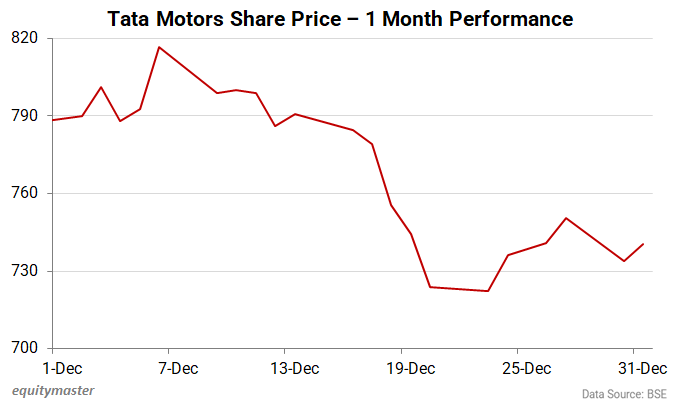
In the past five days, Tata Motors share price has gone up marginally. In the last month, it has slipped 6.4%.
In the last six months its share price has tumbled 26%.
The stock touched its 52-week high of Rs 1,179.1 on 30 July 2024 and a 52-week low of Rs 718 on 23 December 2024.
About Tata Motors
Tata Motors Limited is a leading global automobile manufacturer with a portfolio that covers a wide range of cars, SUVs, buses, trucks, pickups, and defence vehicles.
It's a US$ 34 bn organisation and a leading global automobile manufacturing company.
Tata Motors offers an extensive range of integrated, smart, and e-mobility solutions.
The company has a strong presence in India, but it also exports its vehicles to over 100 countries around the world. It has several joint ventures with other automotive manufacturers, including Fiat, Jaguar Land Rover, and Daimler.
To know more about the company, check out Tata Motors financial factsheet and its latest quarterly results.
You can also compare Tata Motors with its peers:
To know what's moving the Indian stock markets today, check out the most recent share market updates here.
Disclaimer: This article is for information purposes only. It is not a stock recommendation and should not be treated as such. Learn more about our recommendation services here...
ABOUT EQUITYMASTER
Since 1996, Equitymaster has been the source for honest and credible opinions on investing in India. With solid research and in-depth analysis Equitymaster is dedicated towards making its readers- smarter, more confident and richer every day. Here's why hundreds of thousands of readers spread across more than 70 countries Trust Equitymaster.
PREMIUM PRODUCTS
- Hidden Treasure
- Forever Stocks
- Big Wave Profits
- Equitymaster Venture
- Microcap Millionaires
- Momentum Profits
- Double Income
- Midcap Value Alert
- Exponential Profits
- Annual Breakout Alert
- Lazy Millionaire
- Phase One Alert
- InsiderPro Stocks
- StockSelect
- Private Briefing
- Active Wealth Multiplier 2030
- FundSelect
QUICK LINKS
POPULAR TOPICS
- Multibagger Penny Stocks
- Basics of Value Investing
- Benjamin Graham
- How to Invest in Gold
- How to Invest in Silver
- Best Stocks to Buy Today
- Best Small-cap Stocks to Buy
- Best Bluechip Stocks to Buy
- Guide to Penny Stocks
- How to Invest in the Share Market
- Warren Buffett - The Value Investor
- Pick the Best Multibagger Stocks
TRENDING TOPICS
- Best Defence Stocks in India
- Upcoming Dividend Stocks
- Best Semiconductor Stocks in India
- Data Center Stocks in India
- Best Railway Stocks in India
- Best Solar Stocks in India
- Fastest Growing Stocks in India
- List of BSE Sensex 30 Stocks
- Adani Group Shares
- Stocks Recently Bought by FIIs in India
- Top Value Stocks in India


LEGAL DISCLAIMER:
Investment in securities market are subject to market risks. Read all the related documents carefully before investing.
Registration granted by SEBI, enlistment with BSE as IA and RA, and certification from NISM in no way guarantee performance of the intermediary or provide any assurance of returns to investors.
All rights reserved. Any act of copying, reproducing or distributing any content from this website whether wholly or in part, for any purpose without the permission of Quantum Information Services Private Limited is strictly prohibited and shall be deemed to be copyright infringement.
Quantum Information Services Private Limited (QIS) is a SEBI registered Research Analyst (bearing registration no INH000021128) and Investment Adviser(Reg. No: INA000000680). Consequent upon the merger of Equitymaster Research Private Limited into QIS, effective October 30, 2025 QIS owns and operates brand 'Equitymaster' and website www.equitymaster.com. This does not constitute or is not intended to constitute an offer to buy or sell, or a solicitation to an offer to buy or sell financial products, units or securities and QIS including its employees, personnel, directors, associates will not be liable for any losses (direct or indirect) incurred or investment(s) made or decisions taken/or not taken based on the information provided herein. All content and information is provided on an 'As Is' basis by QIS. Information herein is believed to be reliable but QIS does not warrant its completeness or accuracy and expressly disclaims all warranties and conditions of any kind, whether express or implied. The services rendered by QIS are on a best effort basis. QIS does not assure or guarantee the user any minimum or fixed returns. The securities quoted, if any are for illustration only and are not recommendatory. Use of this information is at the user's own risk. The user must make his own investment decisions based on his specific investment objective and financial position and using such independent advisors as he believes necessary. This is not directed for access or use by anyone in a country, especially, USA, Canada or the European Union countries, where such use or access is unlawful or which may subject QIS or its affiliates to any registration or licensing requirement.
The performance data quoted represents past performance and does not guarantee future results. As a condition to accessing QIS's content and website, you agree to our Terms and Conditions of Use, available here
Equitymaster requests your view! Post a comment on "Why Tata Motors Share Price is Falling". Click here!
Comments are moderated by Equitymaster, in accordance with the Terms of Use, and may not appear
on this article until they have been reviewed and deemed appropriate for posting.
In the meantime, you may want to share this article with your friends!