

MEMBER'S LOGINX
| Invalid Username / Password | ||||||||
| Invalid Captcha | ||||||||
|
||||||||
| Sign Up | Forgot Password? | ||||||||
Investment in securities market are subject to market risks. Read all the related documents carefully before investing
We're Going On-Air Today:

- Home
- Views On News
- Jan 1, 2026 - Pros and Cons of Investing in JSW Steel
Pros and Cons of Investing in JSW Steel
 JSW Steel logo source: https://www.jswsteel.in/
The stock of JSW Steel along with other steel stocks are in the news.
The big reason for the jump in the stock today (+4.9%) was the government's decision to impose tariffs on steel products.
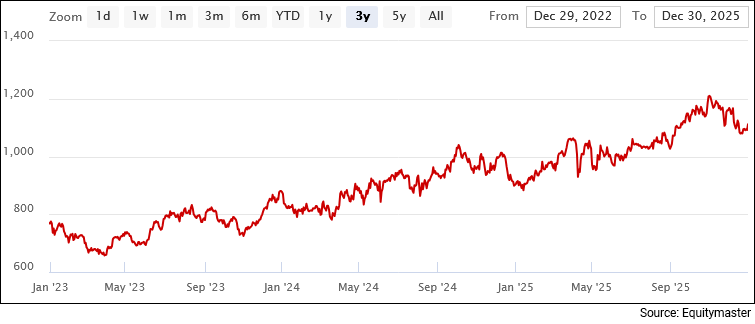
And before the recent correction, the stock has been trending up for more than two years.
JSW Steel Share Price - 3 Years
But what does the future hold for the stock?
In this editorial, we will discuss the pros and cons of investing in the stock of JSW Steel.
But first...
Latest Development: Import Tariffs on Steel Products
Steel stocks rose today after the Indian government announced a 3-year import tariff on steel products. These tariffs will be safeguard duties amounting to 12% in the first year, 11.5% in the second year, and 11% in the third year.
The products covered are non-alloy and alloy flat steel. Speciality steels have not been included in the tariff. The countries on which the tariff has been imposed are Vietnam, China, and Nepal.
Import tariffs help protect pricing of domestic steel producers by preventing cheaper imports.
Pros
Well Established Position and Good Growth Prospects
The company has a well-established position in the Indian steel industry.
It manufactures and sells a wide range of steel products, including flat and long steel products at it facilities across India. The company sells its products under different brand names and caters to various industries.
Its diversified portfolio categories are hot-rolled, cold-rolled, galvanneal, galvanised/galvalume, pre-painted, tinplate, electrical steel, TMT bar, wire rod, special steel bar, and round & bloom.
It has grown steadily over the years and is now in an expansion phase for the next leg of growth. JSW Steel aims to almost double its production capacity to 50 MTPA by 2030.
The company is planning a major investment of Rs 500-600 bn to set up a 10 million tonnes per annum green steel plant in Salav village, Raigad district, Maharashtra.
This plant is specifically designed to serve the European market, which is preparing to implement the Carbon Border Adjustment Mechanism (CBAM).
The project is part of JSW's brownfield expansion, expected to be completed over 3-4 years.
Cons
Recent Performance
The company has struggled to deliver on growth over the last two years. The topline and bottomline have both been essentially flat since FY23.
Although the company's cash flows have been strong, the lack of growth has not impressed the stock market. The company's return ratios have also been negatively impacted with the ROE and ROCE both in single digits in FY23 and FY25. A small recovery in FY24 did not sustain.
To add to this, the company is in investment mode which has resulted in debt levels going up. The company's debt to equity ratio has been historically high and stood at 1 in FY25, up from 0.9 in FY24.
Should You Consider the Stock of JSW Steel?
Founded in 1982, it has expanded through mergers and acquisitions, including Ispat Steel and Bhushan Power & Steel. It operates in India, the US, and Italy.
There's been a rise in demand for specialty steel across industries like renewable power, automobiles, and white goods. India's reliance on steel imports has prompted JSW Steel to scale up its value-added product capacities to drive import substitution and achieve self-reliance.
JSW plans to increase the share of high-margin, value-added products in its product mix to protect margins during steel price volatility.
The company consistently invests in the latest technologies to enhance its production processes and ensure superior quality products.
However, a big concern is the company's vulnerability to global commodity prices. Prices of finished steel and the raw materials to produce it, are closely linked to global economic conditions.
A slowdown in infrastructure spending, construction, or manufacturing can lead to sharp drop in earnings and stock prices.
Investors should evaluate the company's fundamentals, corporate governance, and valuations of the stocks when conducting due diligence before making any investment decision.
For more details, you can have a look at the JSW Steel fact sheet and quarterly results.
For a sector overview, read our steel sector report.
To know what's moving the Indian stock markets today, check out the most recent share market updates here.
Happy investing.

Sarit Panackal, is Managing Editor at Equitymaster. Sarit found his calling at the age of 19 while in engineering college. Fascinated with the stock market, he spent more time studying finance than engineering. He joined Equitymaster as an analyst in 2013. He has worked closely with all our editors, including co-heads of research, Rahul Shah and Tanushree Banerjee. As Managing Editor, he oversees Equitymaster's publications and ensures the highest quality of content reaches you, the reader.
ABOUT EQUITYMASTER
Since 1996, Equitymaster has been the source for honest and credible opinions on investing in India. With solid research and in-depth analysis Equitymaster is dedicated towards making its readers- smarter, more confident and richer every day. Here's why hundreds of thousands of readers spread across more than 70 countries Trust Equitymaster.
PREMIUM PRODUCTS
- Hidden Treasure
- Forever Stocks
- Big Wave Profits
- Equitymaster Venture
- Microcap Millionaires
- Momentum Profits
- Double Income
- Midcap Value Alert
- Exponential Profits
- Annual Breakout Alert
- Lazy Millionaire
- Phase One Alert
- InsiderPro Stocks
- StockSelect
- Private Briefing
- Active Wealth Multiplier 2030
- FundSelect
QUICK LINKS
POPULAR TOPICS
- Multibagger Penny Stocks
- Basics of Value Investing
- Benjamin Graham
- How to Invest in Gold
- How to Invest in Silver
- Best Stocks to Buy Today
- Best Small-cap Stocks to Buy
- Best Bluechip Stocks to Buy
- Guide to Penny Stocks
- How to Invest in the Share Market
- Warren Buffett - The Value Investor
- Pick the Best Multibagger Stocks
TRENDING TOPICS
- Best Defence Stocks in India
- Upcoming Dividend Stocks
- Best Semiconductor Stocks in India
- Data Center Stocks in India
- Best Railway Stocks in India
- Best Solar Stocks in India
- Fastest Growing Stocks in India
- List of BSE Sensex 30 Stocks
- Adani Group Shares
- Stocks Recently Bought by FIIs in India
- Top Value Stocks in India


LEGAL DISCLAIMER:
Investment in securities market are subject to market risks. Read all the related documents carefully before investing.
Registration granted by SEBI, enlistment with BSE as IA and RA, and certification from NISM in no way guarantee performance of the intermediary or provide any assurance of returns to investors.
All rights reserved. Any act of copying, reproducing or distributing any content from this website whether wholly or in part, for any purpose without the permission of Quantum Information Services Private Limited is strictly prohibited and shall be deemed to be copyright infringement.
Quantum Information Services Private Limited (QIS) is a SEBI registered Research Analyst (bearing registration no INH000021128) and Investment Adviser(Reg. No: INA000000680). Consequent upon the merger of Equitymaster Research Private Limited into QIS, effective October 30, 2025 QIS owns and operates brand 'Equitymaster' and website www.equitymaster.com. This does not constitute or is not intended to constitute an offer to buy or sell, or a solicitation to an offer to buy or sell financial products, units or securities and QIS including its employees, personnel, directors, associates will not be liable for any losses (direct or indirect) incurred or investment(s) made or decisions taken/or not taken based on the information provided herein. All content and information is provided on an 'As Is' basis by QIS. Information herein is believed to be reliable but QIS does not warrant its completeness or accuracy and expressly disclaims all warranties and conditions of any kind, whether express or implied. The services rendered by QIS are on a best effort basis. QIS does not assure or guarantee the user any minimum or fixed returns. The securities quoted, if any are for illustration only and are not recommendatory. Use of this information is at the user's own risk. The user must make his own investment decisions based on his specific investment objective and financial position and using such independent advisors as he believes necessary. This is not directed for access or use by anyone in a country, especially, USA, Canada or the European Union countries, where such use or access is unlawful or which may subject QIS or its affiliates to any registration or licensing requirement.
The performance data quoted represents past performance and does not guarantee future results. As a condition to accessing QIS's content and website, you agree to our Terms and Conditions of Use, available here
Equitymaster requests your view! Post a comment on "Pros and Cons of Investing in JSW Steel". Click here!
Comments are moderated by Equitymaster, in accordance with the Terms of Use, and may not appear
on this article until they have been reviewed and deemed appropriate for posting.
In the meantime, you may want to share this article with your friends!