

MEMBER'S LOGINX
| Invalid Username / Password | ||||||||
| Invalid Captcha | ||||||||
|
||||||||
| Sign Up | Forgot Password? | ||||||||
Investment in securities market are subject to market risks. Read all the related documents carefully before investing
LIVE NOW
The Small Cap Proxy Players Briefing
- Home
- Views On News
- Feb 15, 2026 - 3 Microcap Stocks with strong growth plans
3 Microcap Stocks with strong growth plans
 Image source: Cristina Gaidau/www.istockphoto.com
Microcaps are volatile. That's a part of investing.
But when a microcap starts showing steady, sustainable growth, something interesting happens. The volatility gradually settles, confidence builds, and the market begins to rerate the stock.
Over the past year, smallcaps have fallen sharply. Microcaps even more so. Prices have come down across the board, in many cases faster than the underlying businesses.
Corrections like these create fertile ground for investors who are willing to dig deeper to find companies that may be mispriced despite clear growth visibility.
In this editorial, we look at 3 microcap stocks with strong growth plans.
These businesses aren't just promising scale but actively investing to achieve it.
#1 Ddev Plastiks
First on the list is Ddev Plastiks, India's largest listed manufacturer of polymer compounds, producing the essential raw materials that manufacturers turn into high-voltage power cables, footwear, packaging, and automotive parts.
Their core business revolves around creating a variety of specialised compounds, including PVC, XLPE, and Halogen-Free Flame Retardant materials, which are the lifeblood of the wire and cable industry. This generates about 81% of the revenue.
It has 5 factories split between India's east and west coasts, to efficiently manage logistics for both domestic and foreign clients in over 50 countries.
The company achieved a 5% compounded annual growth rate (CAGR) in revenue growth over three years, along with a net profit CAGR of 50%.
The last 3-year average return on equity (ROE) was 27%.
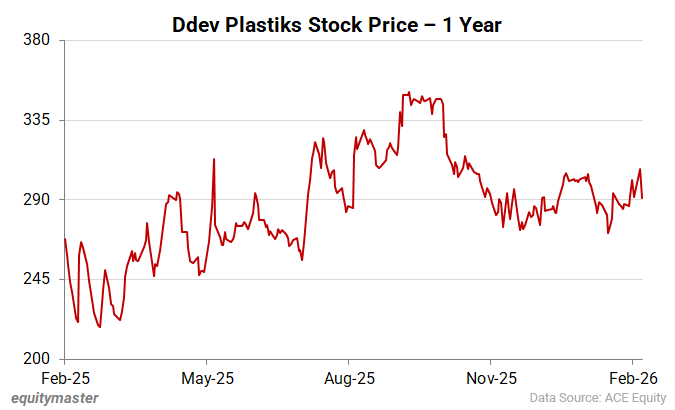
Looking ahead, the management is guiding for an aggressive target of Rs 50 bn in revenue by FY30, a CAGR of 12-15%. For FY26, the guidance is for revenues between Rs 28.5 bn and Rs 29.5 bn and a volume target of 210,000 to 220,000 metric tons.
The leadership is confident in maintaining earnings before interest, taxes, depreciation, and amortisation (EBITDA) margins in the 10-12% range.
A major pivot is their entry into the Battery Energy Storage Systems (BESS) sector, where the plan is to invest Rs 1.5-2 bn to build a 5 GWh assembly plant.
This venture is expected to start contributing revenue from the second half of FY27, with the first gigawatt projected to generate Rs 8-9 bn annually once fully operational.
The company is also seeing a revival in export demand, particularly from the US markets, following trade tariff resolutions, which should further bolster volumes.
For more details, check out Ddev Plastiks' financial factsheet.
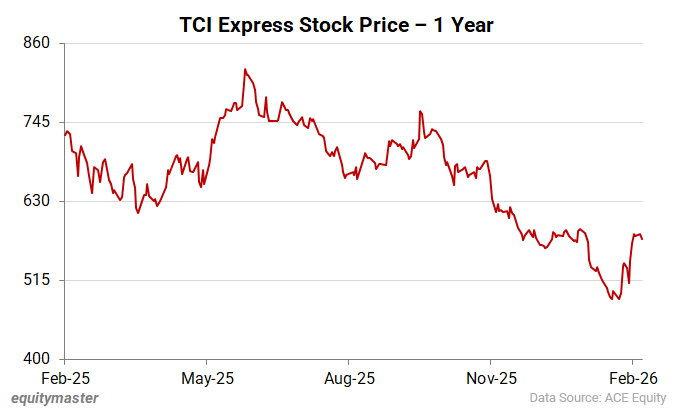
#2 TCI Express

Want To Read The Full Article?
Enter your email to continue reading on Equitymaster.
Important: We hate spam as much as you do. Check out our Privacy Policy and Terms Of Use.
By submitting your email address, you also sign up for Profit Hunter, a daily newsletter from Equitymaster covering exciting investing ideas and opportunities in India.
ABOUT EQUITYMASTER
Since 1996, Equitymaster has been the source for honest and credible opinions on investing in India. With solid research and in-depth analysis Equitymaster is dedicated towards making its readers- smarter, more confident and richer every day. Here's why hundreds of thousands of readers spread across more than 70 countries Trust Equitymaster.
PREMIUM PRODUCTS
- Hidden Treasure
- Forever Stocks
- Big Wave Profits
- Equitymaster Venture
- Microcap Millionaires
- Momentum Profits
- Double Income
- Midcap Value Alert
- Exponential Profits
- Annual Breakout Alert
- Lazy Millionaire
- Phase One Alert
- InsiderPro Stocks
- StockSelect
- Private Briefing
- Active Wealth Multiplier 2030
- FundSelect
QUICK LINKS
POPULAR TOPICS
- Multibagger Penny Stocks
- Basics of Value Investing
- Benjamin Graham
- How to Invest in Gold
- How to Invest in Silver
- Best Stocks to Buy Today
- Best Small-cap Stocks to Buy
- Best Bluechip Stocks to Buy
- Guide to Penny Stocks
- How to Invest in the Share Market
- Warren Buffett - The Value Investor
- Pick the Best Multibagger Stocks
TRENDING TOPICS
- Best Defence Stocks in India
- Upcoming Dividend Stocks
- Best Semiconductor Stocks in India
- Data Center Stocks in India
- Best Railway Stocks in India
- Best Solar Stocks in India
- Fastest Growing Stocks in India
- List of BSE Sensex 30 Stocks
- Adani Group Shares
- Stocks Recently Bought by FIIs in India
- Top Value Stocks in India


LEGAL DISCLAIMER:
Investment in securities market are subject to market risks. Read all the related documents carefully before investing.
Registration granted by SEBI, enlistment with BSE as IA and RA, and certification from NISM in no way guarantee performance of the intermediary or provide any assurance of returns to investors.
All rights reserved. Any act of copying, reproducing or distributing any content from this website whether wholly or in part, for any purpose without the permission of Quantum Information Services Private Limited is strictly prohibited and shall be deemed to be copyright infringement.
Quantum Information Services Private Limited (QIS) is a SEBI registered Research Analyst (bearing registration no INH000021128) and Investment Adviser(Reg. No: INA000000680). Consequent upon the merger of Equitymaster Research Private Limited into QIS, effective October 30, 2025 QIS owns and operates brand 'Equitymaster' and website www.equitymaster.com. This does not constitute or is not intended to constitute an offer to buy or sell, or a solicitation to an offer to buy or sell financial products, units or securities and QIS including its employees, personnel, directors, associates will not be liable for any losses (direct or indirect) incurred or investment(s) made or decisions taken/or not taken based on the information provided herein. All content and information is provided on an 'As Is' basis by QIS. Information herein is believed to be reliable but QIS does not warrant its completeness or accuracy and expressly disclaims all warranties and conditions of any kind, whether express or implied. The services rendered by QIS are on a best effort basis. QIS does not assure or guarantee the user any minimum or fixed returns. The securities quoted, if any are for illustration only and are not recommendatory. Use of this information is at the user's own risk. The user must make his own investment decisions based on his specific investment objective and financial position and using such independent advisors as he believes necessary. This is not directed for access or use by anyone in a country, especially, USA, Canada or the European Union countries, where such use or access is unlawful or which may subject QIS or its affiliates to any registration or licensing requirement.
The performance data quoted represents past performance and does not guarantee future results. As a condition to accessing QIS's content and website, you agree to our Terms and Conditions of Use, available here
Equitymaster requests your view! Post a comment on "3 Microcap Stocks with strong growth plans". Click here!
Comments are moderated by Equitymaster, in accordance with the Terms of Use, and may not appear
on this article until they have been reviewed and deemed appropriate for posting.
In the meantime, you may want to share this article with your friends!