

MEMBER'S LOGINX
| Invalid Username / Password | ||||||||
| Invalid Captcha | ||||||||
|
||||||||
| Sign Up | Forgot Password? | ||||||||
Investment in securities market are subject to market risks. Read all the related documents carefully before investing
We're Going On-Air Today:

- Home
- Views On News
- Mar 13, 2025 - 5 Undervalued Auto Stocks Set for a Comeback
5 Undervalued Auto Stocks Set for a Comeback
 Image source: ChatGPT
Recently, the Nifty has experienced a significant correction of nearly 13% from its peak in September 2024.
This has led to sell off in many sectors, including automobile. The Nifty Auto Index has corrected by more than 20% from its peak, dragged down by a broader market sell-off and a bloodbath in small-cap stocks.
Contrarian investors should be scanning the horizon for hidden value. Beneath the surface gloom, tectonic shifts are reshaping the sector: electric vehicle adoption is rising, and premiumisation trends are defying economic headwinds.
For investors with a multi-year lens, this is a rare alignment of value and vision.
With this in mind, let's look at the 5 undervalued automobile stocks.
We have filtered these stocks using the Equitymaster's top undervalued automobiles stocks screener.
Take a look...
#1 Popular Vehicles and Services
Popular Vehicles and Services is a diversified automobile dealership covering the entire lifecycle of vehicle ownership.
The company offers new vehicle sales from various original equipment manufacturers (OEMs), including Maruti Suzuki, Honda, Jaguar Land Rover, Tata Motors, and BharatBenz, featuring passenger, commercial, and electric vehicles.
It also engages in pre-owned vehicle sales with trade-in options and certified vehicles. Additionally, it provides maintenance services at authorised centers and operates the 'Maruti Driving School' in Kerala.
Coming to its financial performance, the company has delivered a solid top-line growth of 25% compounded annual growth rate (CAGR) over a 3-year period and a net profit CAGR of 35%. The last 3-year return on equity (ROE) has been 16%.
The company has a not-so-strong balance sheet. It has a total debt of 5,068 million (m) against a cash and bank balance of 465 m.
The stock is currently trading at a price-to-book ratio (PB) of 1.2 against an industry average of 2.7.
The stock has a limited trading history. It was trading at a PB around 3 after listing on the exchanges but has been in a downtrend since.
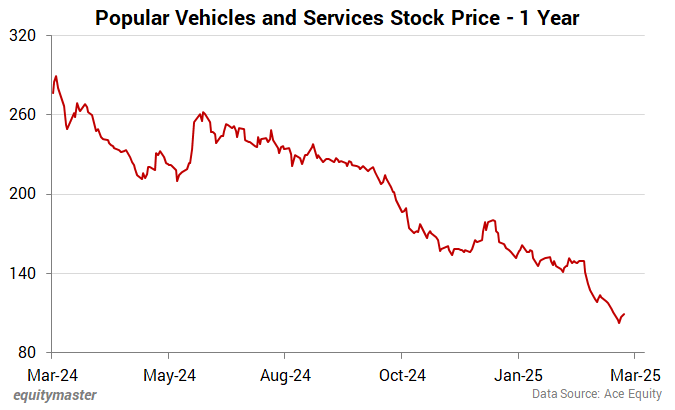
Looking ahead, the management of Popular Vehicles & Services is expecting a significant revenue growth of about 20-25% in for FY26 over FY25.
The long-term revenue growth target remains 15-20%. They anticipate Q4 FY25 will be far better than Q2 FY25 and expect a bounce back from Q4 onwards.
The company is focused on growing the service business, targeting a growth of about 20-25% for the year. This could drive profitability and the return on capital employed.
For more details, check out Popular Vehicles and Services' financial factsheet.
#2 Tata Motors
Coming second on the list is Tata Motors, a global automobile manufacturer with a strong presence in India, encompassing commercial vehicles (CV), passenger vehicles (PV), including electric vehicles (EV), and the modern luxury brands of Jaguar Land Rover (JLR).
Tata Motors is undergoing a strategic realignment, with the Tata Motors standalone business expected to comprise 60% CV and 40% residual PV in a separation.
Coming to its financial performance, the stock has delivered a topline growth of 21% CAGR over the 3-year period and a net profit CAGR of 128% over the same period. The last 3-year return on equity (ROE) has been 15%.
This stark difference in sales and profit growth is due to several factors such as higher volumes and better product mix.
Tata Motors implemented strategies focusing on profitable growth, which included better management of costs. The commercial vehicles business achieved its highest-ever profits due to a focus on profitable growth and a demand-pull strategy.
A decrease in commodity prices during the period, particularly in FY24, helped to reduce input costs, thereby improving profit margins.
After the recent correction, the stock is trading at a PB of 2.2 against an industry average of 2.7.
Recently, specific business segments have started facing challenges, with stress in the small commercial vehicle and pickups.
External factors such as a tense global geo-political scenario causing supply chain disruptions also pose a concern.
These negative factors have resulted in the recent derating of the stock.
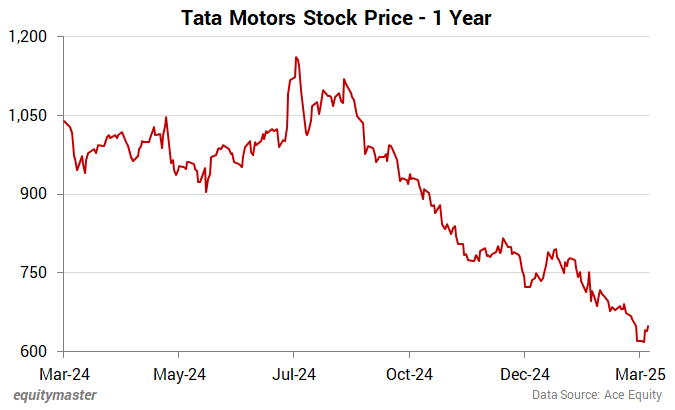
Looking ahead, JLR is targeting double-digit operating margins by 2026 and to be net cash positive by FY25.
The company is focused on elevating brand profitability through top-end offerings and personalisation, optimising investments, reducing costs, and enhancing after-sales profitability. A new Jaguar brand re-launch is underway.
The EV business aims to drive up penetration through multiple product launches, enhancing the charging network, and introducing aspirational product features while improving profitability.
For more details, check out Tata Motors' financial factsheet.
#3 VST Tillers Tractors
At number three comes VST Tillers Tractors, a prominent player in the Indian agricultural machinery sector, primarily involved in the manufacturing and trading of agricultural machinery and their spare parts. It's the largest power tiller manufacturer in India.
VST is entering the EV space, supplying drive trains for electric tractors to a US-based company and unveiling its own FIELDTRAC EV series.
Coming to its financial performance, the company has delivered a moderate top-line growth of 8% CAGR over the 3-year period and a net profit CAGR of 9%.
Its balance sheet is very lean and clean, with net zero debt for more than a decade. The last 3-year return on equity (ROE) has been 13%.
The stock, after the recent correction, is trading at a PB of 2.8 against an industry average of 3.1.
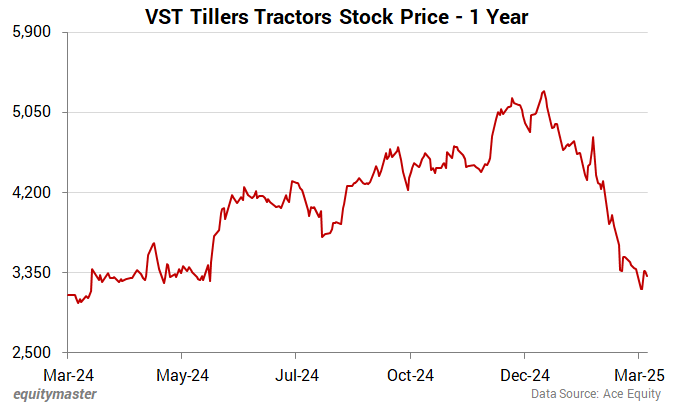
The stock took a hit despite the company reporting a solid 29% revenue growth year-on-year (YoY) and even doubling its operating profit.
So, what went wrong?
First, the actual profit after taxes (PAT) plummeted to Rs 170 m from nearly Rs 1,700 m a year ago, and that's largely because of "paper losses."
The company holds equity investments, and their value dropped temporarily this quarter, leading to a notional loss of Rs 110 m.
Last year, they'd gained Rs 150 m from the same investments, so this swing spooked investors-even though no real cash was lost, it made the bottom line look shaky.
Then there's the slow start to the next quarter (Q4). Sales for both tractors and tillers dipped in January, which management blamed on customers delaying purchases due to cash flow issues.
They're confident February and March will bounce back, but investors tend to panic at the first sign of a slowdown.
Adding to the jitters is the unpredictable US market. The company had big plans there, but potential tariffs on steel and aluminium threw a wrench in those plans.
Meanwhile, growth in Europe has stalled. Economic turbulence there means exports are likely to stay flat or inch up just a tiny bit this year.
Looking ahead, the company has jumped into the big tractor game with their new VST Zetor range, targeting heavy-duty 40-50 HP machines. It sold over 100 units last quarter and are aiming for 1,500 in FY26.
Meanwhile, it's also pushing deeper into northern India - states like UP, MP, and Punjab - where it has set up dealer networks.
Two years ago, only 4% of sales used retail finance; now it's 8%. The target is 15-20%.
The company is also eyeing acquisitions or partnerships, both in India and abroad, to fast-track growth. The management has promised at least one deal within two years, which could be a game-changer.
For more information, check out VST Tillers Tractors' financial factsheet.
#4 Atul Auto
Fourth on the list is Atul Auto, engaged in the 3-wheeler business. The company offers a comprehensive range of 3-wheeler products that cater to both passenger and cargo transportation needs.
Atul Auto is notable for being India's only pure-play auto-rickshaw company and stands among the top five three-wheeler manufacturers in India. It's also distinguished as the only player with a complete range of 3-wheeler products across all fuel types: diesel, petrol, CNG, LPG, and electric.
The company is increasingly focusing on green mobility and has a subsidiary, Atul Greentech, dedicated to the development and production of lithium-ion battery-based electric vehicles for both passenger and cargo applications. It also develops related components like battery packs.
Coming to its financial performance, company has delivered a good top-line growth of 21% CAGR over the 3-year period and a net profit CAGR of 40% over the same period. The last 3-year return on equity (ROE) has been -2%.
The stock, after the recent correction, is trading at a PB of 2.8 against an industry average of 6.2.
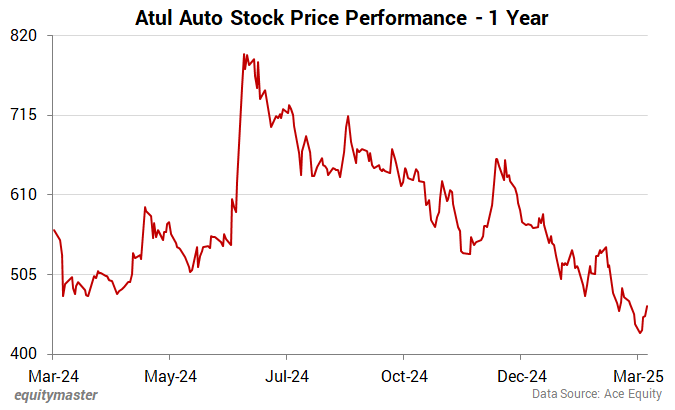
Looking ahead, the company looks well-positioned for a rebound.
EV-L5 sales are growing nicely, proving Atul's ability to tap into India's EV boom. Plus, using a subsidiary model shields the parent company from excessive upfront risks.
With reasonable debt and a debt-to-equity ratio of 0.3, Atul can fund growth without taking on unnecessary financial risk.
For more information, check out Atul Auto's financial factsheet.
#5 Landmark Cars
Fifth on the list is Landmark Cars, a leading Indian multi-brand automotive retailer. It specialises in the sales and service of premium and luxury vehicles.
The company represents an impressive portfolio of global and Indian automotive brands, including Honda, Mercedes-Benz, Renault, Jeep, Volkswagen, Ashok Leyland, BYD, MG Motors, Mahindra & Mahindra (M&M), and Kia.
Coming to its financial performance, the stock has delivered top-line growth of 19% CAGR over the 3-year period and a net profit CAGR of 65% over the same period. The last 3-year return on equity (ROE) has been 20%.
The stock is trading at a PB of 3.3 which is slightly higher than the industry average of 2.7 but it is lower than its 3-year median PB of 5.9.
In the latest quarter, its revenue grew 24% YoY, the company achieved its highest-ever quarterly earnings before interest, taxes, depreciation, and amortization (EBITDA) of Rs 695 m at a 5.8% margin on reported revenue.
However, gross margins contracted both on YoY basis and quarter-on-quarter basis. This contraction is primarily attributed to the new store addition, where the service revenue is still ramping up and is currently at around 1%.
This has led to the continuation of the decline in the stock price.
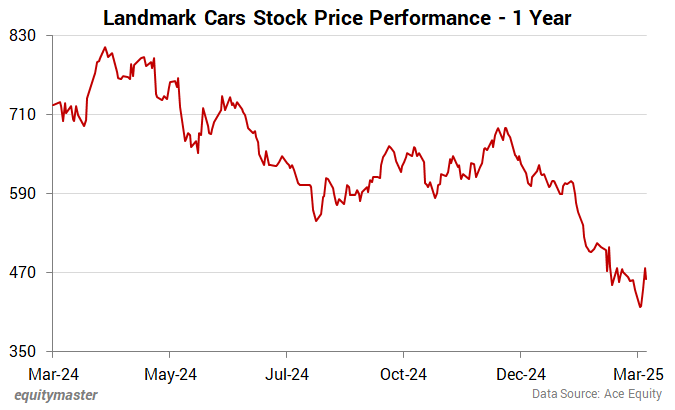
The gross margins in the existing outlets remain intact, and the management expects overall gross margins to improve once the new outlets reach their full potential.
Looking ahead, Landmark aims to grow its top line and profitability to be equal to or higher than industry benchmarks as it continues to invest in new brands and territories.
The majority of planned expansions are now completed, with the focus shifting to ramping up business volumes.
It anticipates that the penetration of EVs in the overall market will increase to around 7% or 8% initially and then stabilize.
Landmark continues to be the largest partner for BYD in India and expects further launches from BYD this year, including the Sealion 7 SUV and the eMAX 7.
It's after-sales business is expected to regain its historic growth trajectory as new workshops scale up.
For more information, check out Landmark Cars' financial factsheet.
Conclusion
The Indian auto sector's recent slump isn't a dead end-it's a detour. The five stocks above offer glimpses of value in a sector undergoing seismic shifts: EV adoption, premiumization, and rural revival.
But let's be clear-this isn't a green light to hit the gas blindly.
Before jumping in, ask:
Does the debt tell a growth story or a warning tale?
Are EVs a tailwind or a hype cycle for this company?
Is the management's vision backed by a track record?
It's always a good idea for investors to evaluate the company's fundamentals, corporate governance, and valuations of the stock as key factors when conducting due diligence before making investment decisions.
Investing isn't about shortcuts; it's about homework. Dive into annual reports, stress-test assumptions, and weigh risks against your financial goals.
Happy investing.
Disclaimer: This article is for education purposes only. It is not a recommendation and should not be treated as such. Learn more about our recommendation services here...
ABOUT EQUITYMASTER
Since 1996, Equitymaster has been the source for honest and credible opinions on investing in India. With solid research and in-depth analysis Equitymaster is dedicated towards making its readers- smarter, more confident and richer every day. Here's why hundreds of thousands of readers spread across more than 70 countries Trust Equitymaster.
PREMIUM PRODUCTS
- Hidden Treasure
- Forever Stocks
- Big Wave Profits
- Equitymaster Venture
- Microcap Millionaires
- Momentum Profits
- Double Income
- Midcap Value Alert
- Exponential Profits
- Annual Breakout Alert
- Lazy Millionaire
- Phase One Alert
- InsiderPro Stocks
- StockSelect
- Private Briefing
- Active Wealth Multiplier 2030
- FundSelect
QUICK LINKS
POPULAR TOPICS
- Multibagger Penny Stocks
- Basics of Value Investing
- Benjamin Graham
- How to Invest in Gold
- How to Invest in Silver
- Best Stocks to Buy Today
- Best Small-cap Stocks to Buy
- Best Bluechip Stocks to Buy
- Guide to Penny Stocks
- How to Invest in the Share Market
- Warren Buffett - The Value Investor
- Pick the Best Multibagger Stocks
TRENDING TOPICS
- Best Defence Stocks in India
- Upcoming Dividend Stocks
- Best Semiconductor Stocks in India
- Data Center Stocks in India
- Best Railway Stocks in India
- Best Solar Stocks in India
- Fastest Growing Stocks in India
- List of BSE Sensex 30 Stocks
- Adani Group Shares
- Stocks Recently Bought by FIIs in India
- Top Value Stocks in India


LEGAL DISCLAIMER:
Investment in securities market are subject to market risks. Read all the related documents carefully before investing.
Registration granted by SEBI, enlistment with BSE as IA and RA, and certification from NISM in no way guarantee performance of the intermediary or provide any assurance of returns to investors.
All rights reserved. Any act of copying, reproducing or distributing any content from this website whether wholly or in part, for any purpose without the permission of Quantum Information Services Private Limited is strictly prohibited and shall be deemed to be copyright infringement.
Quantum Information Services Private Limited (QIS) is a SEBI registered Research Analyst (bearing registration no INH000021128) and Investment Adviser(Reg. No: INA000000680). Consequent upon the merger of Equitymaster Research Private Limited into QIS, effective October 30, 2025 QIS owns and operates brand 'Equitymaster' and website www.equitymaster.com. This does not constitute or is not intended to constitute an offer to buy or sell, or a solicitation to an offer to buy or sell financial products, units or securities and QIS including its employees, personnel, directors, associates will not be liable for any losses (direct or indirect) incurred or investment(s) made or decisions taken/or not taken based on the information provided herein. All content and information is provided on an 'As Is' basis by QIS. Information herein is believed to be reliable but QIS does not warrant its completeness or accuracy and expressly disclaims all warranties and conditions of any kind, whether express or implied. The services rendered by QIS are on a best effort basis. QIS does not assure or guarantee the user any minimum or fixed returns. The securities quoted, if any are for illustration only and are not recommendatory. Use of this information is at the user's own risk. The user must make his own investment decisions based on his specific investment objective and financial position and using such independent advisors as he believes necessary. This is not directed for access or use by anyone in a country, especially, USA, Canada or the European Union countries, where such use or access is unlawful or which may subject QIS or its affiliates to any registration or licensing requirement.
The performance data quoted represents past performance and does not guarantee future results. As a condition to accessing QIS's content and website, you agree to our Terms and Conditions of Use, available here
Equitymaster requests your view! Post a comment on "5 Undervalued Auto Stocks Set for a Comeback". Click here!
Comments are moderated by Equitymaster, in accordance with the Terms of Use, and may not appear
on this article until they have been reviewed and deemed appropriate for posting.
In the meantime, you may want to share this article with your friends!