

MEMBER'S LOGINX
| Invalid Username / Password | ||||||||
| Invalid Captcha | ||||||||
|
||||||||
| Sign Up | Forgot Password? | ||||||||
Investment in securities market are subject to market risks. Read all the related documents carefully before investing
LIVE NOW
The Small Cap Proxy Players Briefing
- Home
- Views On News
- Jul 28, 2025 - What Happened to IEX Shares?
What Happened to IEX Shares?
 Image source: MadamLead/www.istockphoto.com
The year 2025 has been brutal for certain stocks, with some collapsing over 90%-wiping out years of gains in weeks. One such dramatic fall unfolded in May 2025, as Gensol Engineering went from a green energy darling to a cautionary tale.
Amid corporate governance issues and regulatory scrutiny, its shares have plummeted a staggering 94% in 2025 so far.
But while Gensol's downfall grabbed headlines earlier this year, a new concern is brewing-this time with Indian Energy Exchange (IEX).
In just 5 days, IEX shares have plunged over 29%, catching many investors off guard. This has got investors asking: Why are IEX shares falling?
In this article, we'll look at what's behind the steep correction in IEX and whether it's a short-term panic or a deeper concern.
Before getting into the reasons behind the drop, let's first understand what IEX does.
About IEX
Indian Energy Exchange (IEX) is India's first and largest power exchange, providing an electronic platform for trading electricity.
It built a first-of-its-kind electronic platform that brought together state electricity boards, power producers, traders, and large consumers under one roof.
To diversify and meet renewable energy targets, the company has extensively included renewable energy in its portfolio by introducing green energy trading and issuing renewable energy certificates (REC) to renewable energy providers.
The company reported 84.2% market share in FY25.
Despite the entry of rivals like PXIL (Power Exchange India Limited) and the newer Hindustan Power Exchange (HPX), IEX's lead remained unshaken.
Competitive pricing or lower transaction fees didn't sway the market-what truly mattered was liquidity. With the highest number of buyers and sellers, IEX consistently offered the most efficient prices, often helping participants save lakhs or even crores.
However, over the past five days, shares of this near-monopoly have tumbled over 29%.
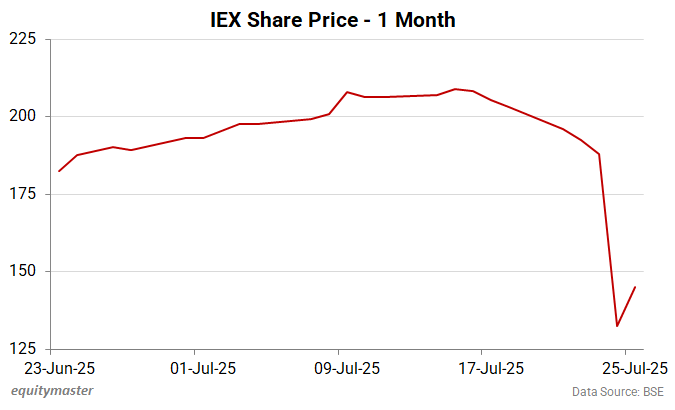
The sharp decline comes after India's power regulator proposed a major reform of introducing market coupling to restructure the electricity pricing mechanism.
What is market Coupling?
Market coupling is an economic model used in energy markets to create a single, uniform price for electricity across different trading platforms.
Under this mechanism, bids and offers collected from all power exchanges are aggregated and cleared together, resulting in one market-clearing price for the day-ahead or real-time markets.
Currently, IEX acts as India's leading platform for spot electricity price discovery.
In its order, the Central Electricity Regulatory Commission (CERC) said this reform is meant to improve how electricity prices are discovered and to make the market more efficient.
According to CERC, the objectives of market coupling are: discovery of a uniform market clearing price for day-ahead or real-time markets; optimal use of transmission infrastructure; and maximisation of economic surplus across buyers and sellers.
The rollout will happen in phases. By January 2026, the day-ahead market will shift to a round-robin system, where each exchange gets a turn to act as the market coupling operator. Grid-India will serve as the backup and keep an eye on the system as the audit operator.
Eventually, this model will expand to the term-ahead and real-time markets as well, once pilot tests and consultations are completed.
Until then, all exchanges have been instructed to share their market data with Grid-India and the CERC to help build the system and to facilitate its implementation.
Why Now?
The move towards market coupling isn't sudden. It comes after a four-month shadow pilot run by Grid-India between December 2024 and March 2025. The idea was to test how this system would work in real-world conditions-without actually disrupting live markets.
So, what did the pilot show?
When the day-ahead market was coupled, it led to a modest welfare gain of Rs 380 million (m) or 0.3%. The price impact was pretty much negligible due to skewed liquidity, while in the real-time market, the benefits were even smaller - just Rs 720 m, or 0.01%.
But the real breakthrough came when real-time markets were coupled with something called SCED (Security Constrained Economic Dispatch).
That alone generated savings of Rs 14 m every day, even though the average power cost per megawatt-hour ticked up slightly. On the plus side, it helped reduce price volatility-a win for both buyers and sellers.
However, the pilot also flagged a few major roadblocks-like the need to align bidding formats and pricing algorithms across all exchanges. Without ironing this out, a smooth rollout will be difficult.
Now, based on those findings, CERC has asked Grid-India to build dedicated software to simulate market coupling for the term-ahead segment.
Power exchanges have also been directed to share data and feedback to aid implementation, while consultations for drafting the required regulatory changes are underway.
What Does This Mean for IEX?
For IEX, the proposed market coupling reform could be a game-changer-and not in a good way.
The market thinks that once coupling kicks in, IEX's near-monopoly in price discovery could be history. Right now, it sets the benchmark price in India's spot power market.
But after coupling, all platforms will feed into a common price engine. IEX would then become just one of several bidding windows-stripped of the power to determine prices.
And that's a serious blow. Without the pricing edge, its biggest moat vanishes.
The fear is that users could shift to rival exchanges that offer better user experience, lower fees, or more flexibility-especially when price becomes the same across platforms.
This hits directly at IEX's financial muscle.
In FY25, IEX handled over 121 billion units (BU) of electricity transactions and clocked revenue of Rs 6.57 billion (bn).
According to its investor presentation for Q4 FY25 and FY25, about 79% of this revenue for FY25 came from transaction fees. While the per-unit fee isn't explicitly disclosed, even a small charge-say a few paise-across billions of units adds up significantly.
IEX runs a tech-heavy, asset-light model, with profit margins above 65% and ROE around 40%. It's also virtually debt-free.
But if coupling flattens the pricing advantage, users might no longer feel compelled to stick with IEX. And that could directly hit its topline and margins going forward.
Could Market Coupling be a Hidden Opportunity for IEX?
Now let's flip the script and ask...
Could this actually turn out to be a win for IEX instead of something to lose sleep over?
If you look at the bigger picture, there's still a lot going in IEX's favour. It's a capital-light, profitable platform operating in a sector with massive headroom for growth.
Only about 7% of India's total electricity is currently traded on exchanges. The rest still flows through long-term Power Purchase Agreements (PPAs). But the government wants to boost exchange-traded electricity to 25% over the next five years.
In other words, the market is still young. If the overall pie grows, IEX could still be a major beneficiary-even if its share shrinks slightly.
The bigger idea?
As India leans more into green and flexible energy, long-term PPAs may no longer fit the bill. Short-term, exchange-based trading is likely to become the norm. And with its massive existing base and trusted platform, IEX could still emerge stronger even in a coupled market.
Recent Development
# Robust Quarterly Numbers
IEX delivered a strong numbers in the latest quarter, reflecting solid growth across key segments. Revenue grew 19% YoY to Rs 1,842 m, supported by higher trading volumes.
Electricity volumes on the exchange rose by 14.9% YoY to 32.4 bn units, while trading in Renewable Energy Certificates (RECs) saw a sharp spike of 149.3% YoY, reaching 52.7 lakh units.
On the profitability front, the company posted a 25% YoY jump in consolidated net profit at Rs 1.2 bn, up from Rs 960 m in the same quarter last year.
Meanwhile, total expenses increased by 53% to Rs 320 m, compared to Rs 294 m in the year-ago period, largely due to higher operational and platform-related costs.
What Next for IEX?
Looking ahead, IEX seems well-placed to ride several positive trends.
As more power buyers turn to market-based procurement and volumes grow in real-time and green energy segments, the company stands to gain.
The government's push for a unified power market also works in IEX's favour. On its part, the company is introducing new products like long-term contracts and cross-border trade, which could open up fresh growth avenues.
One big opportunity lies in the natural diversity across regions. North India sees peak demand in summers, Telangana has its own seasonal farm-related needs, and different regions generate power through various sources like wind, solar, hydro, and thermal.
This mismatch in supply and demand creates more need for flexible, exchange-based trading.
On top of that, the rise in solar usage and new time-based tariffs could drive more trading activity during off-peak hours, helping IEX grow even further.
Conclusion
The market coupling news have sparked concerns about potential impacts on exchange dynamics. While this has led to some near-term weakness in sentiment, it remains to be seen whether the shift will pose a long-term challenge or lead to improved market efficiency.
India is projected to witness strong growth in electricity demand, driven by industrialisation, EV adoption, last-mile connectivity, and rising AC usage.
As per CEA estimates, all-India power demand is expected to grow at a CAGR of 5.3%, while traded volumes on exchanges like IEX are projected to rise at a faster pace of 6% CAGR, reaching approximately 2,300 BU by FY30.
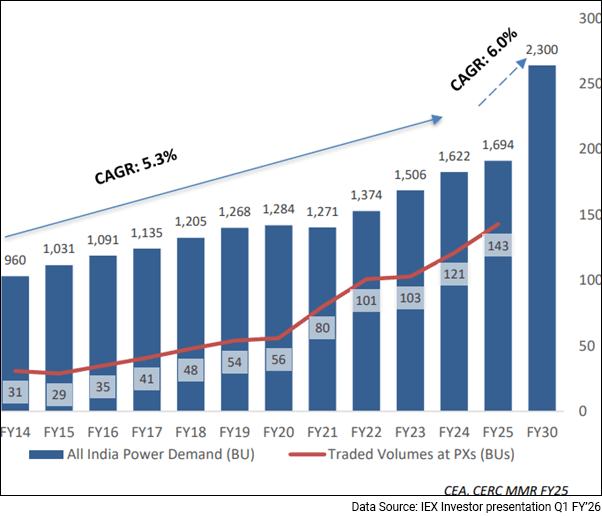
Against this backdrop, IEX continues to benefit from a structurally supportive environment.
Its tech-led, scalable platform and consistent push for product innovation keep it well aligned with the evolving landscape of power market reforms and rising competition.
Investors should evaluate the company's fundamentals, corporate governance, and valuations of the stock as key factors when conducting due diligence before making investment decisions.
Disclaimer: This article is for information purposes only. It is not a stock recommendation and should not be treated as such. Learn more about our recommendation services here...
ABOUT EQUITYMASTER
Since 1996, Equitymaster has been the source for honest and credible opinions on investing in India. With solid research and in-depth analysis Equitymaster is dedicated towards making its readers- smarter, more confident and richer every day. Here's why hundreds of thousands of readers spread across more than 70 countries Trust Equitymaster.
PREMIUM PRODUCTS
- Hidden Treasure
- Forever Stocks
- Big Wave Profits
- Equitymaster Venture
- Microcap Millionaires
- Momentum Profits
- Double Income
- Midcap Value Alert
- Exponential Profits
- Annual Breakout Alert
- Lazy Millionaire
- Phase One Alert
- InsiderPro Stocks
- StockSelect
- Private Briefing
- Active Wealth Multiplier 2030
- FundSelect
QUICK LINKS
POPULAR TOPICS
- Multibagger Penny Stocks
- Basics of Value Investing
- Benjamin Graham
- How to Invest in Gold
- How to Invest in Silver
- Best Stocks to Buy Today
- Best Small-cap Stocks to Buy
- Best Bluechip Stocks to Buy
- Guide to Penny Stocks
- How to Invest in the Share Market
- Warren Buffett - The Value Investor
- Pick the Best Multibagger Stocks
TRENDING TOPICS
- Best Defence Stocks in India
- Upcoming Dividend Stocks
- Best Semiconductor Stocks in India
- Data Center Stocks in India
- Best Railway Stocks in India
- Best Solar Stocks in India
- Fastest Growing Stocks in India
- List of BSE Sensex 30 Stocks
- Adani Group Shares
- Stocks Recently Bought by FIIs in India
- Top Value Stocks in India


LEGAL DISCLAIMER:
Investment in securities market are subject to market risks. Read all the related documents carefully before investing.
Registration granted by SEBI, enlistment with BSE as IA and RA, and certification from NISM in no way guarantee performance of the intermediary or provide any assurance of returns to investors.
All rights reserved. Any act of copying, reproducing or distributing any content from this website whether wholly or in part, for any purpose without the permission of Quantum Information Services Private Limited is strictly prohibited and shall be deemed to be copyright infringement.
Quantum Information Services Private Limited (QIS) is a SEBI registered Research Analyst (bearing registration no INH000021128) and Investment Adviser(Reg. No: INA000000680). Consequent upon the merger of Equitymaster Research Private Limited into QIS, effective October 30, 2025 QIS owns and operates brand 'Equitymaster' and website www.equitymaster.com. This does not constitute or is not intended to constitute an offer to buy or sell, or a solicitation to an offer to buy or sell financial products, units or securities and QIS including its employees, personnel, directors, associates will not be liable for any losses (direct or indirect) incurred or investment(s) made or decisions taken/or not taken based on the information provided herein. All content and information is provided on an 'As Is' basis by QIS. Information herein is believed to be reliable but QIS does not warrant its completeness or accuracy and expressly disclaims all warranties and conditions of any kind, whether express or implied. The services rendered by QIS are on a best effort basis. QIS does not assure or guarantee the user any minimum or fixed returns. The securities quoted, if any are for illustration only and are not recommendatory. Use of this information is at the user's own risk. The user must make his own investment decisions based on his specific investment objective and financial position and using such independent advisors as he believes necessary. This is not directed for access or use by anyone in a country, especially, USA, Canada or the European Union countries, where such use or access is unlawful or which may subject QIS or its affiliates to any registration or licensing requirement.
The performance data quoted represents past performance and does not guarantee future results. As a condition to accessing QIS's content and website, you agree to our Terms and Conditions of Use, available here
Equitymaster requests your view! Post a comment on "What Happened to IEX Shares?". Click here!
Comments are moderated by Equitymaster, in accordance with the Terms of Use, and may not appear
on this article until they have been reviewed and deemed appropriate for posting.
In the meantime, you may want to share this article with your friends!