

MEMBER'S LOGINX
| Invalid Username / Password | ||||||||
| Invalid Captcha | ||||||||
|
||||||||
| Sign Up | Forgot Password? | ||||||||
Investment in securities market are subject to market risks. Read all the related documents carefully before investing
We're Going On-Air Today:

- Home
- Views On News
- Oct 2, 2025 - 3 Consistent Compounding Midcap Stocks
3 Consistent Compounding Midcap Stocks
 Image source: iQoncept/www.istockphoto.com
Most investors get carried away chasing the next big story. But the real wealth is built by companies that compound steadily, year after year, with little noise and plenty of discipline.
Midcaps are the sweet spot. They're no longer fragile small-caps, yet not so large that growth slows down.
This is where some of the market's best wealth creators quietly operate.
The three mid-cap stocks discussed here have a track record of strong earnings growth, robust balance sheets, and management teams that know how to execute effectively.
They've cracked the code of consistent compounding...and if history is any guide, their journey is far from over.
#1 Varun Beverages
First on the list is Varun Beverages, the second largest franchisee of PepsiCo in the world (outside the US).
It's PepsiCo's strategic partner, responsible for the "demand delivery" side of the business.
This includes the manufacturing, bottling, selling, and robust distribution of PepsiCo's extensive range of products, which encompasses popular carbonated soft drinks (CSDs) like Pepsi, Mountain Dew, etc.
Varun Beverages focuses on having a solid infrastructure and robust supply chain, while PepsiCo handles brand development, trademarks, and concentrate formulation ("demand creation").
The company's geographic footprint spans 14 countries, including franchise rights across India, Nepal, Sri Lanka, Morocco, Zambia, Zimbabwe, South Africa, Lesotho, Eswatini, and the DRC, along with distribution rights in Namibia, Botswana, Mozambique, and Madagascar.
India is the largest contributor, accounting for 72% of revenues in 2024 and over 90% of PepsiCo India's volume.
The company is also expanding into the snacks category, notably with exclusive rights to manufacture and package Cheetos in Morocco and the manufacture, distribution, and sale of Simba Munchiez in Zimbabwe and Zambia.
A dedicated snacks facility in Zimbabwe is expected to start production in soon.
The company has demonstrated financial performance characteristic of a consistent compounding machine, marked by aggressive volume growth, expanding margins, and prudent capital management.
Over the five years from 2019 to 2024, the company recorded impressive compounded annual growth rates (CAGR).
Its sales volume CAGR stood at 18%, revenue CAGR was 22.9%, and net profit CAGR soared to 41%.
Its 5-year average return on equity (ROE) stands at 25%.
This robust performance has been supported by operational efficiencies, including backward integration, which typically contributes 3-4% higher margins compared to standard bottlers, and cost management.
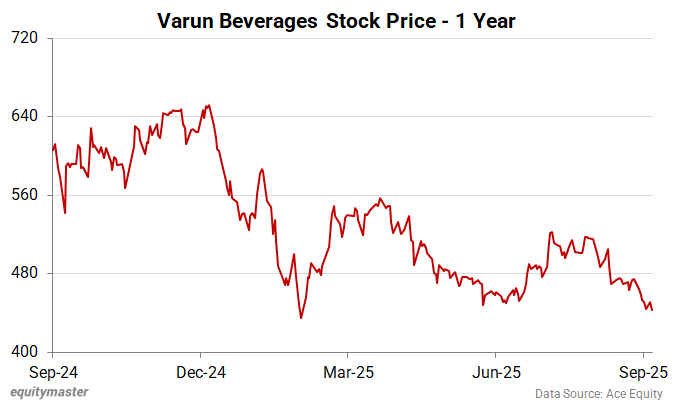
Looking ahead, the management is focused on leveraging enhanced capacities and an expanded distribution network to drive sustainable, long-term value creation.
It has committed substantial capital expenditure, capitalising net assets of Rs 25 bn in 2025, including setting up four new greenfield production facilities in India.
The commissioning of these new, efficient plants closer to distributors will drive growth in under-penetrated regions and improve operational and logistics efficiency.
It currently caters to over 4 m retail outlets but recognises a huge potential scope of growth, aiming to reach up to 12 m retail outlets across the country.
Regarding profitability, management has historically guided consolidated margins at 21% and, while demonstrating better performance, asserts that margins are sustainable due to the company's debt-free position, efficient new plants, and continuous cost-cutting efforts.
For more details, check out Varun Beverages' financial factsheet.
#2 ICICI Lombard General Insurance Company
Coming second on the list is ICICI Lombard General Insurance Company, a leading private general insurance company in India.
The company makes money by providing financial protection against a comprehensive and diversified range of non-life risks, such as those related to motor vehicles, health, personal accidents, fire, marine transport, engineering, and liability.
The core function of the business involves gathering premiums (Gross Direct Premium Income or GDPI) from policyholders and then generating value through two primary engines: profitable risk underwriting and robust investment of the substantial funds accumulated from premiums (known as "float").
ICICI Lombard has consistently demonstrated market-leading performance, reinforcing its position as a consistent compounding midcap stock through reliable growth, high capital adequacy, and prudent financial management.
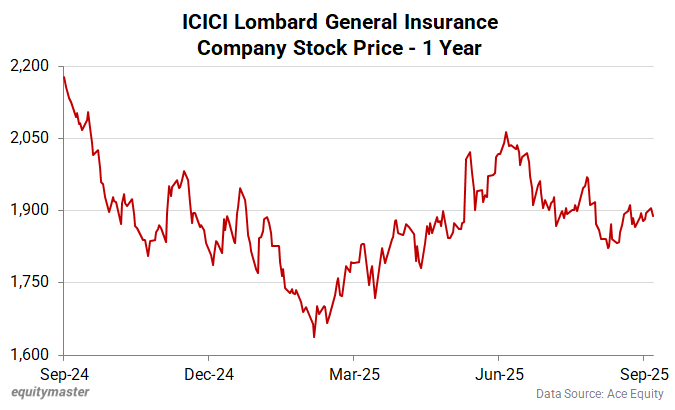
Coming to its financial performance, the company has delivered a top-line growth of 16% CAGR over a 5-year period and a net profit CAGR of 16%.
The last 5-years average ROE has been 18%.
A hallmark of the company's compounding nature is its conservative and successful investment strategy.
This discipline is evidenced by zero instances of default on the debt portfolio since inception, with 86.1% of the debt portfolio invested in sovereign or AAA-rated securities as of 31 March 2025.
Looking ahead, the management is optimistic about the growth of the Indian general insurance sector, citing the favourable regulatory environment and positive economic policy stimuli.
The management targets a consistent ROE between 16-20% over the long term.
For more details, check out ICICI Lombard General Insurance Company's financial factsheet.
#3 BSE
At number three comes BSE Ltd, established in 1875. It's Asia's oldest stock exchange.
As a premier Market Infrastructure Institution (MII), BSE makes money by providing a platform for capital-raising and facilitating trading across diverse financial products.
BSE generates revenue from the following:
Securities Services: Earning transaction charges from various trading segments, including equity derivatives (like the SENSEX derivatives), equity cash, and the massive BSE STAR Mutual Fund platform, along with associated clearing and settlement income.
Corporate Services: Collecting listing fees and book-building charges from Indian companies utilising BSE's platforms to raise capital through IPOs, bonds, commercial papers, and other debt instruments.
Investment & Treasury Income: Generating income from its own investments and earning treasury income derived from funds held for clearing and settlement purposes.
Data & Index Services: Licensing market data products and intellectual property from its index business, which manages flagship indices like the SENSEX.
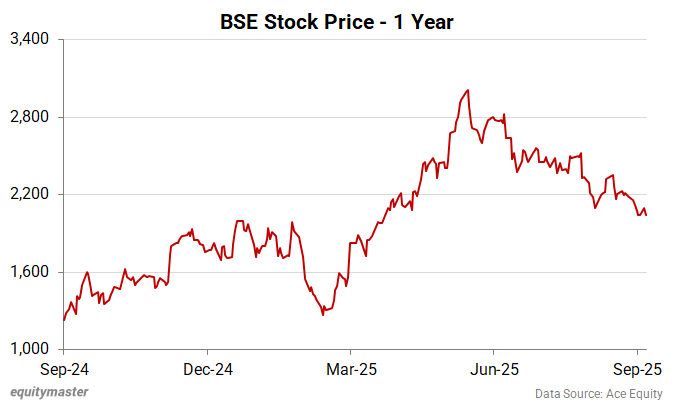
Coming to its financial performance, the company has delivered a top-line growth of 40% CAGR over a 5-year period and a net profit CAGR of 65%.
The last 5-years average ROE has been 18%.
Looking ahead, the management is optimistic about the medium-term outlook despite potential near-term moderation.
BSE plans to continue leveraging the strength of its unique SENSEX brand and expanding its connectivity suite with market participants.
The recent strong volume growth was already led by the Sensex derivatives product, driven by an expanded client base and higher non-expiry day activities.
Further growth is anticipated with the launch of Bankex Futures and Options contracts.
The highly successful BSE STAR MF platform achieved a 30% year-on-year revenue growth in 1QFY26.
The company will expand its services from current electronic platforms, including book-building for IPOs, offer to buy, offer for sale, and the new bond platform.
The management sees encouraging signs of revival in the IPO market, supported by a very healthy pipeline.
For more information, check out BSE's financial factsheet.
Conclusion
Consistent compounding doesn't come from hype but from execution, resilience, and smart capital allocation.
These companies operate in a structurally growing industries, enjoy strong financial metrics, and have managements focused on long-term value creation.
For investors willing to think long term, these midcaps demonstrate a timeless lesson: wealth isn't built in a year, it's built over decades of steady compounding. The earlier you identify such businesses and hold on through cycles, the greater the rewards.
Of course, no stock is risk-free. It's essential to dig deeper into the financials, management quality, and corporate governance before making any decisions and only invest in line with your goals and risk tolerance.
Happy investing.
Disclaimer: This article is for education purposes only. It is not a recommendation and should not be treated as such. Learn more about our recommendation services here...

Manish Kumawat is a Research Analyst with the StockSelect team at Equitymaster. An engineer turned finance professional, he blends analytical rigour with a passion for markets to spot undervalued opportunities. When not dissecting balance sheets, he enjoys exploring investment frameworks and reading about business strategy.
ABOUT EQUITYMASTER
Since 1996, Equitymaster has been the source for honest and credible opinions on investing in India. With solid research and in-depth analysis Equitymaster is dedicated towards making its readers- smarter, more confident and richer every day. Here's why hundreds of thousands of readers spread across more than 70 countries Trust Equitymaster.
PREMIUM PRODUCTS
- Hidden Treasure
- Forever Stocks
- Big Wave Profits
- Equitymaster Venture
- Microcap Millionaires
- Momentum Profits
- Double Income
- Midcap Value Alert
- Exponential Profits
- Annual Breakout Alert
- Lazy Millionaire
- Phase One Alert
- InsiderPro Stocks
- StockSelect
- Private Briefing
- Active Wealth Multiplier 2030
- FundSelect
QUICK LINKS
POPULAR TOPICS
- Multibagger Penny Stocks
- Basics of Value Investing
- Benjamin Graham
- How to Invest in Gold
- How to Invest in Silver
- Best Stocks to Buy Today
- Best Small-cap Stocks to Buy
- Best Bluechip Stocks to Buy
- Guide to Penny Stocks
- How to Invest in the Share Market
- Warren Buffett - The Value Investor
- Pick the Best Multibagger Stocks
TRENDING TOPICS
- Best Defence Stocks in India
- Upcoming Dividend Stocks
- Best Semiconductor Stocks in India
- Data Center Stocks in India
- Best Railway Stocks in India
- Best Solar Stocks in India
- Fastest Growing Stocks in India
- List of BSE Sensex 30 Stocks
- Adani Group Shares
- Stocks Recently Bought by FIIs in India
- Top Value Stocks in India


LEGAL DISCLAIMER:
Investment in securities market are subject to market risks. Read all the related documents carefully before investing.
Registration granted by SEBI, enlistment with BSE as IA and RA, and certification from NISM in no way guarantee performance of the intermediary or provide any assurance of returns to investors.
All rights reserved. Any act of copying, reproducing or distributing any content from this website whether wholly or in part, for any purpose without the permission of Quantum Information Services Private Limited is strictly prohibited and shall be deemed to be copyright infringement.
Quantum Information Services Private Limited (QIS) is a SEBI registered Research Analyst (bearing registration no INH000021128) and Investment Adviser(Reg. No: INA000000680). Consequent upon the merger of Equitymaster Research Private Limited into QIS, effective October 30, 2025 QIS owns and operates brand 'Equitymaster' and website www.equitymaster.com. This does not constitute or is not intended to constitute an offer to buy or sell, or a solicitation to an offer to buy or sell financial products, units or securities and QIS including its employees, personnel, directors, associates will not be liable for any losses (direct or indirect) incurred or investment(s) made or decisions taken/or not taken based on the information provided herein. All content and information is provided on an 'As Is' basis by QIS. Information herein is believed to be reliable but QIS does not warrant its completeness or accuracy and expressly disclaims all warranties and conditions of any kind, whether express or implied. The services rendered by QIS are on a best effort basis. QIS does not assure or guarantee the user any minimum or fixed returns. The securities quoted, if any are for illustration only and are not recommendatory. Use of this information is at the user's own risk. The user must make his own investment decisions based on his specific investment objective and financial position and using such independent advisors as he believes necessary. This is not directed for access or use by anyone in a country, especially, USA, Canada or the European Union countries, where such use or access is unlawful or which may subject QIS or its affiliates to any registration or licensing requirement.
The performance data quoted represents past performance and does not guarantee future results. As a condition to accessing QIS's content and website, you agree to our Terms and Conditions of Use, available here
Equitymaster requests your view! Post a comment on "3 Consistent Compounding Midcap Stocks". Click here!
Comments are moderated by Equitymaster, in accordance with the Terms of Use, and may not appear
on this article until they have been reviewed and deemed appropriate for posting.
In the meantime, you may want to share this article with your friends!