

MEMBER'S LOGINX
| Invalid Username / Password | ||||||||
| Invalid Captcha | ||||||||
|
||||||||
| Sign Up | Forgot Password? | ||||||||
Investment in securities market are subject to market risks. Read all the related documents carefully before investing
We're Going On-Air Today:

- Home
- Views On News
- Oct 23, 2025 - Why Textile Stocks are Rising
Why Textile Stocks are Rising
 Image source: gyn9038/www.istockphoto.com
Indian stock markets, including Sensex and Nifty 50, were reporting strong gains at the time of writing. The Sensex was higher by 575 points, trading just above the 85,000 points mark.
One set of stocks seeing strong momentum is textile stocks. Major players like Welspun Living, Indo Count, and Kitex Garments are experiencing impressive gains of 6.4%, 5.6%, and 15.3%, respectively.
This coordinated surge suggests a broader trend at play within the textile sector, not just individual company performance.
So, what's behind this sudden surge in textile stocks? Let's explore the key reason driving this exciting momentum.
Positive Trade Deal Signals
Top textile stocks in India have rallied significantly following a conversation between Prime Minister Narendra Modi and US President Trump, discussing the positive development in ongoing trade negotiations. This news instantly lifted investors confidence and gave fresh momentum to India's export-driven textile sector.
Recently, things were quite challenging. The US imposed a 50% tariff on several Indian imports, which impacted Indian companies since a substantial portion of revenue is derived from the American markets.
This move handed a competitive edge to textile manufacturers in Bangladesh and Vietnam, as they continued to export to the US with significantly lower duties. Indian companies faced thinner margins, decreased orders, and growing concerns about losing international market share.
The latest conversation between India's Prime Minister and US President has renewed expectations that a new phase of trade talks could ease these restrictions. Over the past few weeks, the textile industry and the government have taken steps to stabilise the sector and rebuild investors trust.
In response to the challenge posed by US tariffs, many Indian textile exporters are strategically expanding their presence in European markets and even offering discounts to long-term US buyers to retain their partnerships. This diversification is helping offset losses related to tariffs and reshaping India's export map.
On the policy front, the government has stepped in with several supportive measures. It has extended the duty-free import of cotton until the end of December 2025, giving manufacturers relief from rising input costs and the RoDTEP export incentives scheme until March 2026. These measures help reduce costs and support exporters, boosting investor confidence in the textile sector's stability.
All these factors are combining to create strong hope. What once looked like a struggling industry weighed down by tariffs is now showing clear signs of recovery. Stronger trade talks, government cost relief, more export markets, and rising domestic demand are driving growth.
What's Next for Textile Stocks?
The textile industry is shifting towards sustainability by making clothes from natural materials like cotton, silk, and wool. They are also innovating by recycling plastic waste into fabric, promoting eco-friendly fashion.
According to media reports, India aims to expand its textiles and apparel industry to Rs 29,400 billion (bn) by 2030, with exports targeted at Rs 8,400 bn. This growth strategy focuses on decarbonisation, digital transformation, and waste reduction in manufacturing processes.
The industry is adopting multifaceted approaches, including circular fashion practices and the integration of renewable energy, to foster sustainability and operational excellence.
In the future, digital textile printing is expected to help small businesses fulfill small orders efficiently by printing designs directly onto fabric, reducing costs, driving innovation, and competitiveness in the market.
Textile dyeing in plants often faces power outage due to high electricity usage. To solve this problem, many are switching to thermal energy solutions, like boilers, which generate heat to power machines, increasing efficiency and reducing reliance on electricity.
The textile industry is moving towards a circular economy where clothes can be easily recycled or biodegraded. An example is a special yarn that breaks down quickly in landfills, allowing bacteria to digest it faster and reducing environmental harm.
With a strong manufacturing base and growing momentum, India offers a great investment opportunity. Government initiatives are streamlining business expansion and fostering industry growth.
By embracing sustainability and innovation alongside robust government support, India's textile sector is creating a new height of growth and opportunities.
How Indian Textile Stocks Have Performed Recently
Here are the latest stock price details of India's top Textiles stocks. For more detailed updates, read our Textiles sector report and check the latest Textiles sector results.
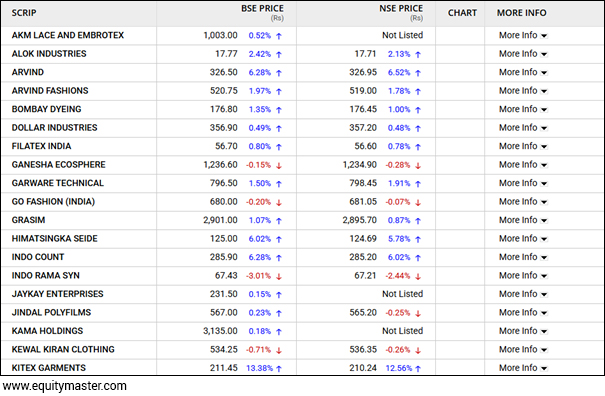
To know what's moving the Indian stock markets today, check out the most recent share market updates here.
Investors should evaluate the company's fundamentals, corporate governance, and valuations of the stock as key factors when conducting due diligence before making investment decisions.
Disclaimer: This article is for information purposes only. It is not a stock recommendation and should not be treated as such. Learn more about our recommendation services here...
ABOUT EQUITYMASTER
Since 1996, Equitymaster has been the source for honest and credible opinions on investing in India. With solid research and in-depth analysis Equitymaster is dedicated towards making its readers- smarter, more confident and richer every day. Here's why hundreds of thousands of readers spread across more than 70 countries Trust Equitymaster.
PREMIUM PRODUCTS
- Hidden Treasure
- Forever Stocks
- Big Wave Profits
- Equitymaster Venture
- Microcap Millionaires
- Momentum Profits
- Double Income
- Midcap Value Alert
- Exponential Profits
- Annual Breakout Alert
- Lazy Millionaire
- Phase One Alert
- InsiderPro Stocks
- StockSelect
- Private Briefing
- Active Wealth Multiplier 2030
- FundSelect
QUICK LINKS
POPULAR TOPICS
- Multibagger Penny Stocks
- Basics of Value Investing
- Benjamin Graham
- How to Invest in Gold
- How to Invest in Silver
- Best Stocks to Buy Today
- Best Small-cap Stocks to Buy
- Best Bluechip Stocks to Buy
- Guide to Penny Stocks
- How to Invest in the Share Market
- Warren Buffett - The Value Investor
- Pick the Best Multibagger Stocks
TRENDING TOPICS
- Best Defence Stocks in India
- Upcoming Dividend Stocks
- Best Semiconductor Stocks in India
- Data Center Stocks in India
- Best Railway Stocks in India
- Best Solar Stocks in India
- Fastest Growing Stocks in India
- List of BSE Sensex 30 Stocks
- Adani Group Shares
- Stocks Recently Bought by FIIs in India
- Top Value Stocks in India


LEGAL DISCLAIMER:
Investment in securities market are subject to market risks. Read all the related documents carefully before investing.
Registration granted by SEBI, enlistment with BSE as IA and RA, and certification from NISM in no way guarantee performance of the intermediary or provide any assurance of returns to investors.
All rights reserved. Any act of copying, reproducing or distributing any content from this website whether wholly or in part, for any purpose without the permission of Quantum Information Services Private Limited is strictly prohibited and shall be deemed to be copyright infringement.
Quantum Information Services Private Limited (QIS) is a SEBI registered Research Analyst (bearing registration no INH000021128) and Investment Adviser(Reg. No: INA000000680). Consequent upon the merger of Equitymaster Research Private Limited into QIS, effective October 30, 2025 QIS owns and operates brand 'Equitymaster' and website www.equitymaster.com. This does not constitute or is not intended to constitute an offer to buy or sell, or a solicitation to an offer to buy or sell financial products, units or securities and QIS including its employees, personnel, directors, associates will not be liable for any losses (direct or indirect) incurred or investment(s) made or decisions taken/or not taken based on the information provided herein. All content and information is provided on an 'As Is' basis by QIS. Information herein is believed to be reliable but QIS does not warrant its completeness or accuracy and expressly disclaims all warranties and conditions of any kind, whether express or implied. The services rendered by QIS are on a best effort basis. QIS does not assure or guarantee the user any minimum or fixed returns. The securities quoted, if any are for illustration only and are not recommendatory. Use of this information is at the user's own risk. The user must make his own investment decisions based on his specific investment objective and financial position and using such independent advisors as he believes necessary. This is not directed for access or use by anyone in a country, especially, USA, Canada or the European Union countries, where such use or access is unlawful or which may subject QIS or its affiliates to any registration or licensing requirement.
The performance data quoted represents past performance and does not guarantee future results. As a condition to accessing QIS's content and website, you agree to our Terms and Conditions of Use, available here
Equitymaster requests your view! Post a comment on "Why Textile Stocks are Rising". Click here!
Comments are moderated by Equitymaster, in accordance with the Terms of Use, and may not appear
on this article until they have been reviewed and deemed appropriate for posting.
In the meantime, you may want to share this article with your friends!